One of the wonderful pleasures of spring bird-watching is the possibilities of catching sight of the new chicks. The birds of course go to great lengths to keep their children hidden from predators, but once in awhile one gets lucky and gets a peek at some of the young ones. Today I stopped by the covered bridge a few miles up the Tuolumne River and found that the Great Horned Owls (Bubo virginianus) had hatched and there were at least two chicks in the nest. No matter what stage of life they are in, I find the stare of an owl unsettling.
I haven't been allowed back to work at my campus, but there are no rules against walking around the grounds, so I stopped there last week to see if the Red-tailed Hawks had laid eggs or not. The pair have been around for weeks, but I didn't see them on the nest they used last year, but as I looked carefully I saw something move up there.
Zooming in, one can see there is at least one baby present. I couldn't tell if there were others. They fledged two young ones last year.
Spring rolls on! I'll be watching for the Ospry babies next. There are at least four active nests up the river.
Well, maybe or maybe not. Irruption is not a terrible geologist misspelling of what volcanoes do, but is instead the rapid migration of a group of birds into an area where they are not commonly seen. They can be caused by many factors, most notably a seed or cone failure in areas where the birds normally range. Several birders in our county (Stanislaus) have noted a relative increase in sightings of Red-breasted Nuthatches (Sitta canadensis), which I can confirm because I actually saw one for myself this week on the campus at Modesto Junior College. Looking at the eBird map of Red-breasted Nuthatch sights this year does show a cluster of sightings in the town of Modesto.
The Red-breasted Nuthatches are pretty little birds, and I am thrilled every time I'm privileged to see one. They are found all over the United States and Canada, but they tend to prefer conifer forests of the north, and large-scale irruptions may involve many thousands of the birds invading the southern states. Ours probably are originating in the Sierra Nevada, and I suspect that when they invade our valley habitat, they are expressing a preference for the conifers that are often used for landscaping in our city environments.
In any case, this is the second time I've seen this individual in a week, high up in a pine tree next to the sheep enclosure on our west campus. Today was the first time I was able to catch a clear shot.
Sometimes the unexpected happens. I was a little frustrated with daylight savings cutting into my evening walking time between classes, but I went walking anyway and was treated to a fascinating sight: a Starling murmuration. Several thousand birds were doing an acrobatic flyover near the Briggsmore Ave/Highway 99 overpass, and it was hypnotizing (which was probably the intended effect, but in regards to predators wanting to pick off an isolated bird). Despite the very poor light conditions, I was able to get two minutes of video (below).
It's amazing how the birds can fly in such coordination, creating strange patterns in the sky, looking almost like a single organism. At times I imagined single cells separating and coming together again, and a bird tornado. Studies suggest the birds maintain their coordination by concentrating on the activity of the nearest seven birds around them.
European Starlings are an anathema to many birders and ecologists. They are native to Europe (hence the name), but a few were introduced to Central Park in New York City more than a century ago as an effort to establish all the birds mentioned in the works of Shakespeare. The idea went awry and the birds spread across the continent by the tens of millions. They are often the most numerous birds I record on my birding explorations, and they have displaced native species in many habitats. All bad, but forgotten in a moment of pure natural art.
The college campus where I work is not the best environment to watch birds, but it's certainly not the worst. There is a sheep pasture with a heavily vegetated drainage pond, some open fields grazed by cows and horses, and lots and lots of diverse species of mature trees, both native and non-native. Overall the number of species I've seen there is about half what I've seen along the Tuolumne River Parkway Trail where I do most of my searches.
But there are still some neat species to be seen. One of the pretty little birds I occasionally run across on campus are Say's Phoebes (Sayornis saya). Say's Phoebes are members of the flycatcher family, and their behavior fits their name. They'll perch on a branch, sally forth when they see a bug, and return to their perch. I saw this one while walking between classes yesterday.
Some birds are very rare, and I'll never see them at all, and there are some birds that are around, but I just never catch them. The Red-breasted Nuthatch (Sitta canadensis) is one of those birds. Prior to this year I had only seen one, a chance sighting in 2018 at Modesto Junior College. Ever since, I've been trying to see another, hoping to get better pictures than the fuzzy ones I got last year. My interest was piqued when local birders starting using the term 'irruption' in discussing the nuthatches. It seems that when major food sources fail in the normal home range of the bird, they will spread into new areas, and some suspected that we were in the midst of one based on a fairly high number of local sightings. So my 'spidey-sense' was on high alert.
I finally spotted one two weeks ago on campus, but I was victimized by a failing zoom lens on my camera (since replaced), and I only got two very poor pictures that served only to prove the identity of the bird. But this morning I was following the movements of some Cedar Waxwings when my eye caught movement in the deodar tree at my side. My new camera was working, and I finally got some reasonably sharp pictures of the beautiful little bird.
The nuthatches gained their name from their habit of jamming nuts into the bark of trees, and breaking loose the edible parts ("hatching" the seed). They also spend their time walking up and down the trucks of trees searching out bugs and spiders. They are found all over the United States and Canada, except by me; I don't find them very often. But on this day I got lucky!
It's an omen of sorts, or maybe a blessing by nature.
The Killdeer (Charadrius vociferous) is the mascot or icon of the Great Valley Museum, as can be seen on our various logos. There is a good reason for this: the bird survives quite well in the valley environment, both on the dry prairies and in the river/delta wetlands.
We had a major moment take place this week: after 35 years of proposals and dashed hopes, and after a year of fenced-off construction zones, the fences came down and yesterday people could walk freely along the paths of our new Outdoor Nature Lab. It is a marvelous microcosm of the environment of the Great Valley, with native vegetation and native rock exposures from the prairies at the confluence of the Great Valley and the Sierra Nevada foothills. Interpretive signs will soon be posted, and activities will soon be available for our local children to learn about their local natural environment.
Our local species are already responding to the newly completed environment, and in particular, the Killdeer, our icon. We noticed almost right away that a pair was moving around the grounds, and we suspected there might be a nest. Someone soon found it, but I don't know how they ever saw it.
How good are you at nest-finding? It's in this picture...can you find it?
The eggs will be incubated for 22-28 days, and when they hatch, the chicks will be able to walk as soon as their feathers dry off. Given such a vulnerable location, just sitting out on the ground, one has to wonder how they can survive out there in the open prairie.
It involves deception, of course. If the danger is from a browsing cow or deer, the parents will make a big display to cause the animals to graze in another direction. But if the danger is a predator that might eat the eggs and/or the parents, the birds will do a fascinating "broken-wing" dance that will catch the attention of the fox or raccoon and the birds will lead the animal away from the nest. We were subjected to the dance while we took a short look at the nest. Check out the video of the display below.
What a wonderful welcome to the next stage of our service to nature education in our community!
I admit it. Sometimes when I'm out there looking for birds, I'm watching for the rare and unusual species. I have a tendency to ignore the birds that are always there, and yet are real beauties. I am, for instance, on the lookout for the first Blue Grosbeak and the first Lazuli Bunting of the spring, primarily because blue is pretty much my favorite color, especially with birds.
And so it is with the California Scrub Jay (Aphelocoma californica). I see them commonly on walks throughout the region, and I rarely lift the camera for a picture, and I dutifully count them on the bird list and walk on. But once in a great while, I stop and think about living in a place where one could never see one of these birds (and that actually includes everywhere except the Pacific Coast states). I'm then reminded how extraordinary this bird actually is. You would be missing out, never being able to see these birds.
They can certainly be obnoxious at times, carrying on continuous fights with the local Mockingbirds, and arguing among themselves. But they are extremely intelligent birds as well, and worthy of being enjoyed. And photographed too, when I finally think of it.
I was walking the perimeter of my workplace, the West Campus of Modesto Junior College, when I spotted the fourth hawk species of the new year, a Cooper's Hawk (Accipiter cooperii). It joins a list that includes the Red-tailed, the Red-shouldered, and the Swainson's. The campus is a good environment for hawks, as there are a lot of open fields full of ground squirrels, snakes, and other food sources.
I saw this Cooper's Hawk a few times last year in the grove of trees on the east end of the campus near Carpenter Road, but I usually wasn't able to get many good shots. I took twelve shots today, but ten of them focused on the branches in the foreground (yes, I know there is a manual focus on my camera, but I didn't have time). I liked how this one turned out, though. Cooper's Hawks are very similar to Sharp-shinned Hawks, but I don't think I've seen one of them yet (although I wouldn't be the least bit surprised if I've photographed a few and misidentified them).
I sometimes have to remind myself that I'm privileged here in California to see a rare bird on a regular basis. There are hundreds of thousands of birders across North America and the world who never get to see a Yellow-billed Magpie (Pica nuttalli). I sometimes see dozens of them on a given day, since there is a good-sized flock on my campus of Modesto Junior College. The reason of course is that they are found in only one small part of the world, the Great Valley and Coast Ranges of California. They are one of the very few truly endemic birds in California. There are probably not much more than 100,000 of them in existence due to a devastating population crash brought about by the West Nile Virus a decade ago.
I can't say that I ignore them. They have a raucous manner and one usually knows they are near by, due to their constant chattering and arguing. But they are pretty skittish around humans so they keep their distance. For that reason I was kind of surprised the other day when I walked past a Magpie on the baseball field fence. It just watched me until I was just a few feet away, so I pulled out the camera and snapped a few shots.
Familiarity can breed complacence (I could never hold these beautiful birds in contempt), so it was a nice reminder of what a treasure we have in these birds and what a pleasure it is to be able to observe them.
You just never know. It's been a heck of a weather day with heavy squalls and wind lashing at our campus while I've been teaching. I really wanted to go out and get some exercise and look for a few birds but it didn't seem to be in the cards. But somehow the students finished their lab a bit early, and...the sun came out for a few precious minutes. I wandered over to the "mini-wilderness", the drainage pond and sheep pasture that is the nearest thing to a wild area on our campus. I noticed an oddly colored bird on a fence, and when I focused in I realized I was up closer than ever before to our resident rarity: a Cassin's Kingbird (Tyrannus vociferans). I posted pictures of the Cassin's Kingbird only a month ago, but I was thrilled to get such clear close-ups today.
It is a real surprise to see this bird here. Western Kingbirds flood into the region in the spring and are a common sight during the summer months, but it is a tropical species that migrates south to Mexico for the winter. The Cassin's Kingbird is a related species, but it rarely gets this far north, so this individual is a real outlier, especially since it's been staying here through the winter (I've been observing it off and on since the summer of 2016). I do wonder if we can expect to see more of them as the climate warms up and conditions here become more to their liking.
There's something I've learned with fossil and mineral hunting. If you haven't seen the thing you are looking for, you won't recognize it when you see it. But if you've seen an example of the fossil or mineral, you'll pick it out right away. I'm still a newbie at bird identification, but a few weeks ago I saw a Red-breasted Sapsucker (Sphyrapicus ruber) in Yosemite Valley. I got all excited and got pictures and posted on my discovery that night.
Then, only nine days later, I was wandering the campus of CSU Stanislaus and much to my surprise I saw another Red-breasted Sapsucker! So I posted on the species again. Having seen it once, I guess I was primed to recognize it right away when I saw it again.
So here we are eight days later. I was taking a break between classes and wandered out to the sheep compound, my MJC "mini-wilderness", and saw another woodpecker deep among the branches of a dead tree. I focused in with the camera, and wouldn't you know it, there was another Red-breasted Sapsucker! I've never encountered one here before. So once again, I am posting. It the pattern holds, we should be hearing of the Tuolumne River Parkway Trail Sapsucker discovery any day now...
You just never know. One of the joys of my new hobby (well, four years now) is the possibility that any day there can be something new and unexpected. I was roaming the west campus on my lunch break and it seemed like the birds had all left to have a siesta somewhere other than where I was at. But then I saw movement in the dead cottonwood tree in the sheep pasture and discovered a Say's Phoebe. It's not an overly rare bird, but it is the first time I've seen one on campus. But that's not what I'm talking about today!
While I was trying to catch a shot of the Phoebe, another bird fluttered into the branches above. I saw yellow and thought "warbler" but I zeroed in and discovered that it was actually a Kingbird. And it wasn't a Western Kingbird that floods into our region in the spring and summer. They're all gone now, having migrated south back into Central America. I could see the white tips on the tail feathers, the white "moustache", and the gray head and realized it was a Cassin's Kingbird (Tyrannus vociferans). This is remarkable because not only are we at the extreme northern edge of its range, but it should have migrated south by now along with the Western Kingbirds.
This may very well be the same bird that I discovered on campus last year. I haven't seen it in almost a year so it is kind of a mystery about why it is here.
Red-tailed Hawks (Buteo jamaicensis) have a rather strained and tenuous relationship with the other birds on the West Campus of Modesto Junior College. As often as not I see them being mobbed by crows or magpies, and I'm sure they are guilty of consuming the occasional unsuspecting or careless bird. But tonight it was rather clear that they enjoy reptiles in their diet as well. I was standing by the sheep pond on the northwest corner of the campus, which is pretty much the most wilderness-like part of our campus. I sensed a large bird soar over me and the hawk landed in the tree in front of me with dinner hanging out of its mouth. It was a strange sight, to say the least. It gave me a few quizzical looks and took off for a tree a little farther away to finish dinner without the paparazzi snapping pictures...
We have a particularly beautiful bird inhabiting our campus, but unless you live here in California, you don't get to see it except in pictures. It's one of the few true California endemic bird species, the Yellow-billed Magpie (Pica nuttalli). It is related to the Black-billed Magpie that is common across the country, but the two populations are isolated from one another by the Sierra Nevada and they've been separated since the Ice Ages. In general, the Yellow-billed Magpie is better adapted to hot temperatures like those in the Great Valley. Besides the yellow bill, the California birds have yellow around their eyes.
The Yellow-billed Magpies are gregarious, historically gathering in huge flocks and around 2008-2009 it was almost their undoing. The West Nile Virus reached the Great Valley and the magpies were particularly susceptible to infection, which was deadly much more than 90% of the time. Their populations crashed, from more than 200,000 to around 90,000. Even though I was not watching birds carefully at that time, the sudden quiet was disconcerting. It was a real tragedy. Instead of flocks of dozens or hundreds, one would see half a dozen birds at a time.
Luckily, the bird seems to be making something of a comeback. Some of the birds may have developed some immunity to the infection, and my impression is that there are more of them on our West Campus. The flock seems to be about 25 strong. I've been having problems getting close enough to them for photography, but today one landed just outside my classroom and I just happened to have my camera at that moment. I'm hopeful for their future; the world would be a dismal world without them.
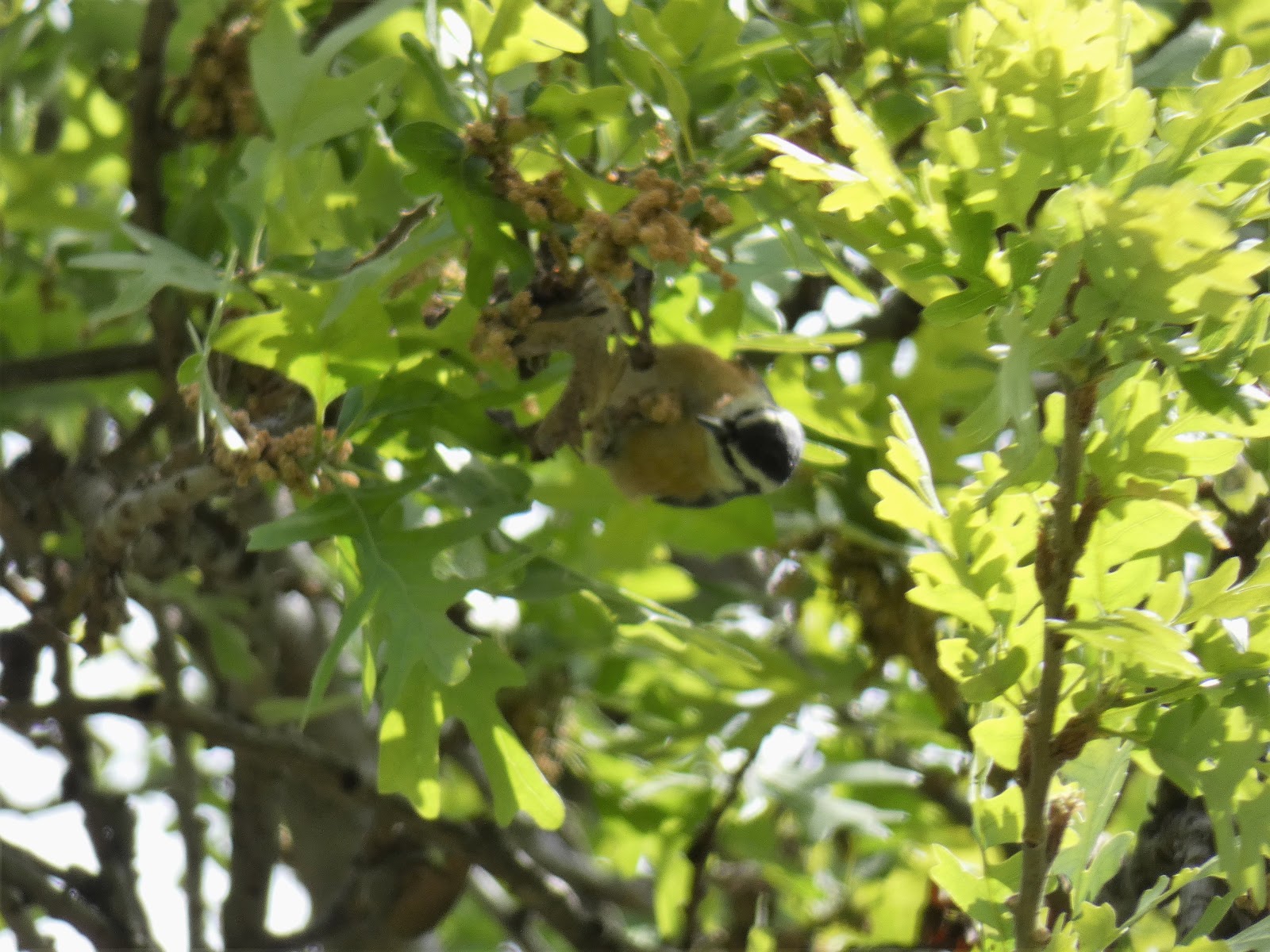
I'm a little behind on bird updates, as these pictures are from April 17. I'm not happy with the them, but then again I was lucky to see this bird at all. It's a Red-breasted Nuthatch (Sitta canadensis), and it was deep in the foliage of a tree on the West Campus of my college. It was the last week of classes, and I was stretching my legs during a break from grading. It's the first time I've seen one so I'm looking forward to getting better shots some day.
The Red-breasted Nuthatchers usually search for insects in the summer and later in the year they may switch to nuts (kind of like their name). They are more of a conifer forest species and are typically found at higher elevations outside the Great Valley. They range across North America from the Mexican border to Alaska.
School has not yet begun at MJC (that's coming on Monday), so the West Campus quad has been particularly deserted throughout the holiday break. The campus has an attractive array of different kinds of trees, and when the students aren't milling about, the birds move in.
I was walking from one end of the quad to the other, delivering a print job to the duplicating office, and I saw seven species of bird in the 300 foot stroll. The others will show up as posts one of these times, along with all the birds from my visit at the Sacramento NWR a few days ago (yes, I've gotten behind).
It's probably clear that my favorite sighting was the flock of Cedar Waxwings (Bombycilla cedrorum). The birds have such beautiful (and slightly comical) plumage, and their presence seems to be limited to just a few weeks in the spring and fall. Their name comes from the bright orange wax deposits that sometime appear on their wingtips. The function is unknown, but maybe related to attracting mates.
The birds were eating what I think were toyon berries, which are ripe right now, and which were probably the reason I saw so many birds in the quad. I was able to get some of these shots because they were perched in a tree next to the second floor of the building I was running errands in.
I don't see rare birds all that often. Call it a combination of inexperience and impatience, and maybe lack of persistence, but I've only had one legitimate discovery of a bird that was unexpected or rare for our region. It was a Cassin's Kingbird (Tyrannus vociferans) that was hanging around the pond area on west campus last January. I didn't even recognize it as a Cassin's. I thought it was the more common Western Kingbird, but even at that, the Kingbirds in general are tropical species and they don't spend winters this far north. Members of the local Audubon Society pointed out the correct identification.
So...I was out for my normal lunchtime stroll, and was looking for a small raptor that I've seen hanging out in a dead ash tree at the north end of Parking Lot 209. I noticed another bird in the upper branches and turned on the camera to get a closer look. It had the characteristic yellow underside and the charcoal colored head with the white neck stripe of a Cassin's. I got these pictures, did a quick check with the local Audubon folks and confirmed that my identification was correct. So now I've seen two rare birds, even though they could be the same individual. There have been four reports of Cassin's Kingbirds in our immediate region over the years.
The distribution map below gives an idea of how unusual sightings actually are this far north (and keep in mind that most sightings are in spring and summer). In other words, our campus Cassin's is quite a bit out of place, and out of time.