For me, anyway. But we had to travel to see them...
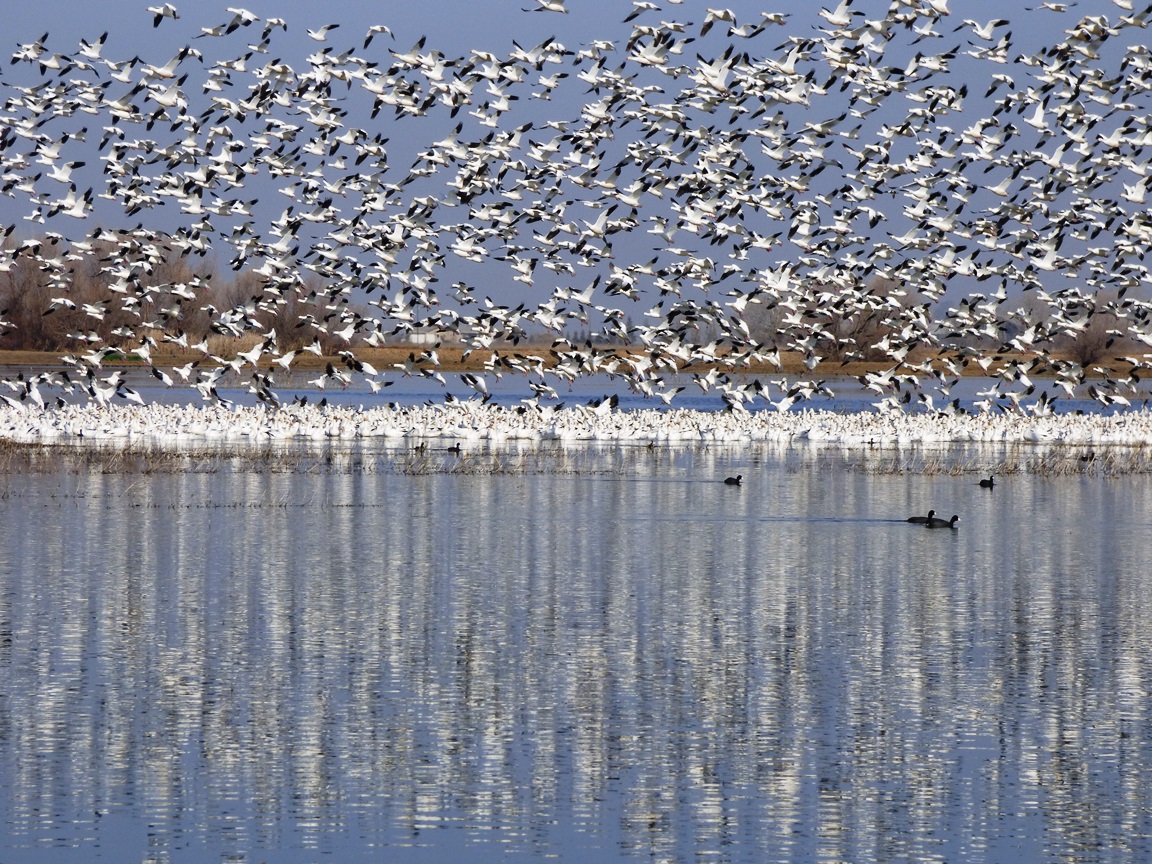
Tundra swans visit our home region occasionally, and we'll typically see a couple of them if we travel south to the Merced National Wildlife Refuge during the winter season. But there are never all that many. It was a bit different during our Christmas traveling. We were headed north in the Great Valley past Sacramento and the tiny town of Williams. We then turned west towards Clear Lake and started looking for Snow or Ross's Geese, as we have seen them often in the flooded rice fields in that vicinity. Indeed, we soon saw geese filling the sky by the thousands, and more white birds in the rice ponds.
The white birds were interspersed with Greater White-fronted Geese, and I realized with a start that these birds were huge. They weren't geese at all, they were Tundra Swans, and there were more than a hundred of them!
There were apparently families, as juveniles were dispersed among the adult birds. Tundra Swans are notable in that they mate for life. They breed in the far north Arctic and migrate south for the winter as do so many others. They find winter shelter in the relatively warm climate of the Great Valley. Flooded rice fields provide much of their food needs.
Seeing these majestic birds was a nice beginning to our journey. We saw a number of other beautiful birds along the way, but there have been few posts these last few weeks because we also, ahem, spent a great deal of time with treasured family members for the holidays. I'll try to get caught up before the new semester starts!
This was a rare event for Mrs. Geotripper and I. The Tundra Swan (Cygnus columbianus) is not a rare bird, but we've only seen them once before, and only for a few moments. Yesterday we saw dozens of them at the San Luis National Wildlife Refuge.
We were following the Waterfowl Auto-Tour at the main part of the refuge north of Los Banos, and while we got a couple of nice photos of birds here and there, overall there wasn't much going on until we approached the end of the loop.
There's a short detour at that point that leads to a trailhead for the Souza Marsh Trail. There were a couple of serious birders stopped on the road with tripods and telescopes deployed. I looked north and saw a large number of white birds in the distance and immediately suspected swans, since Snow Geese and the like wouldn't have captured their interest to that extent. We stopped too and a quick look with the zoom lens revealed dozens of Tundra Swans as well as hundreds of other birds representing at least nine or ten species, including Snow Geese, Greater White-fronted Geese, Northern Shovelers, Northern Pintails, American Coots, Pied-Billed Grebes, Great Egrets, and Mallards.
Tundra Swans, as their name suggests, breed in the far north Arctic lands and migrate south during the winter months. California's Great Valley provides an ideal winter refuge with moderate temperatures and plentiful food supplies.
Although the Tundra Swans are smaller than our other native swan, the Trumpeter (which is never seen in our area), they are huge in comparison to the geese and ducks. I took several videos of the swans, but I like this one because of the Greater White-fronted Geese who came floating by in formation on either side of the swan. It shows the size differential well.
The San Luis National Wildlife Refuge is one of a string of refuges along the river floodplains of the Great Valley that provides a winter home for migrants like the swans and geese, but also a natural habitat for our year-round species. I'm amazed at how little known they are even in our local area. We only saw two other vehicles on the loop when we were there on Saturday. It is a serene place to visit.
The refuge includes a beautiful new visitor center (along with the resident cat named Lucky) that is a good starting point for a visit. There are three auto-tours in the immediate vicinity and several hiking trails.
I was trying to think which birds are appropriate for Christmas day wishes, and I couldn't get much farther than "The Twelve Days of Christmas", with partridges, turtle doves, french hens, calling birds (colly birds), and of course, the six geese a-laying and seven swans a-swimming. There are some who think that all twelve gifts are birds out of Celtic legends. I'm in no position to analyze the veracity of the claim, though.
Out of the long list I was able to pick out the geese and swans, since they've arrived in our area for their winter sojourn in our local wildlife refuges. The first two pictures are Ross's Geese (Chen rossii), the smaller of the two white geese. All of them were hanging out at the Merced National Wildlife Refuge a week ago.
The larger Snow Goose (Chen caerulescens) has a longer beak with a black lip. The geese often flock together in huge numbers. There is nothing quite like seeing tens of thousands take flight all at once.
We will sometimes see Tundra Swans (Cygnus columbianus) at the local refuges as well.
Merry Christmas and a wonderful holiday season all around. May you find blessings as numerous as the birds who fill the skies! And here's hoping for a wonderful new year as well! Thanks for reading!