Several million years ago, a small finch species, either pregnant or part of a small flock, got blown off course and somehow survived a tortuous passage over two thousand miles of ocean to land on the newly emergent Hawaiian Islands. The circumstance seems unlikely, but it only had to happen once. The birds discovered some kind of food that kept them alive, but over time, the populations became isolated as they searched for different food sources. Some were scattered on other islands. Over time they evolved, eventually diverging into four dozen or more species. These so-called Honeycreepers were more diverse than Charles Darwin's celebrated Galapagos finches. Time (and human intervention) was not kind to most of the species, and many went extinct. Today there are only a dozen or so left, and some of them are exceedingly rare (as in less than a dozen birds remaining). The reasons are many, but the biggest cause in recent time has been the spread of avian malaria, caused by introduced species of mosquitos. Today, most of the Honeycreepers survive in high-altitude forests where it is too cold for the mosquitos.

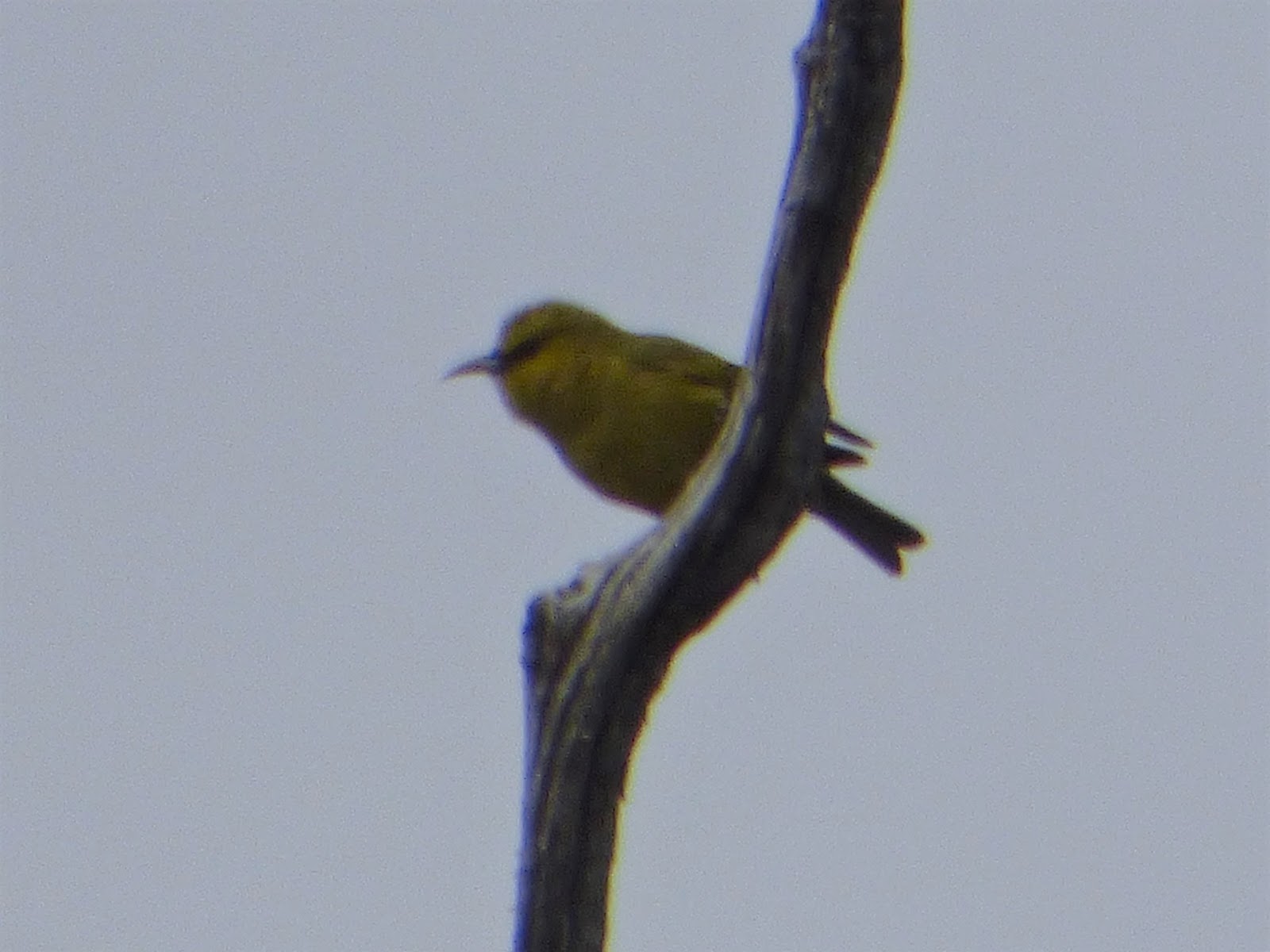
I've only seen a few of the Honeycreepers, perhaps just three species, and I've captured decent shots of none, which explains their absences from these pages so far. I'm on the Big Island this week, however, and I spent the last two days in Hawai'i Volcanoes National Park. We were exploring the edge of an intriguing pit crater called the Devils Throat when I saw a bird soaring on the far side. It landed for a few moments and I was able to confirm: it was a Honeycreeper called the 'Apanane (
Himatione sanguinea). These are the pictures I got, at extreme zoom from about 150-200 meters away.
The bright red plumage of the 'apanane
found its way into many robes of royal Hawaiians, but the birds were prolific enough to escape extinction when the islands were colonized. They are considered secure for the time being as long as an "island" of cooler air remains above the 4,000 foot level where mosquitos can't thrive (some of the birds may be developing resistance to malaria as well). Their current population on the islands is estimated to be just over a million individuals. And I finally photographed one of them!
 |
| The Devils Throat lava pit. I love my camera; the pictures above were on a bird in the shrubs on the opposite rim several hundred feet away. |