If you have trouble distinguishing between heron species, you are not alone! It helps though, if two of the species happen to be foraging next to each other. That happened today at Willow Lake on the campus of CSU Stanislaus. The Snowy Egret (Egretta thula) and Great Egret (Ardea alba) are similar in shape and coloration, but the details are definitely different. The Great Egret is larger, has a yellow bill, and black legs and feet. The Snowy Egret is smaller, has a black bill, has green legs and yellow feet. Cattle Egrets (the picture below is from Honolulu in Hawaii) are also white, but combine a yellow bill with yellow legs, and in breeding season, they have some buff-colored feathers on their head and back. The Great and Snowy Egrets are native to North America. The Cattle Egret (Bubulcus ibis) arrived in the Americas in the late 1800s and spread to North America in the late 1940s. They are common now all the way north into Canada.
Also, as can be seen below, Great Egrets get the joke quicker than a Snowy Egret!
Showing posts with label Great Egret (Ardea alba). Show all posts
Wednesday, September 19, 2018
Sunday, December 31, 2017
Just How Close Can You Get to a Wild Bird? Great Egret at the Sacramento National Wildlife Refuge
Some of you no doubt saw my Facebook and Instagram post of a Great Egret (Ardea alba) at the Sacramento National Wildlife Refuge from last week. It's a phone picture, which is sort of unusual because as good as those phone cameras are these days, it's not often I can catch pictures of birds because I'm just never close enough, and I don't have enough zoom.
That wasn't the case on Saturday. We were following the auto-tour road at the Sacramento National Wildlife Refuge near Willows, and as we crept along, I saw this Great Egret alongside the road ahead and fully expected that it would be spooked by our passing and fly away. It didn't. I crept up to within three feet of the driver's side window, and still the bird stood there not caring whether I was there or not. I started fumbling for my camera fully expecting it to fly away, and still it didn't. I started snapping.
The detail is pretty amazing when you are only three or four feet away, and have a 60x zoom at your disposal. It's almost microscopic...for once I could look into the eye of an avian dinosaur and sense the creature within. Well maybe, anyway. I feel more affinity for mammals as a rule. These birds are pretty alien for the most part.
I took a bunch of pictures and the bird finally moved. It walked right around the car so Mrs. Geotripper could have her turn too! This was a defiant creature if I've ever seen one...
That wasn't the case on Saturday. We were following the auto-tour road at the Sacramento National Wildlife Refuge near Willows, and as we crept along, I saw this Great Egret alongside the road ahead and fully expected that it would be spooked by our passing and fly away. It didn't. I crept up to within three feet of the driver's side window, and still the bird stood there not caring whether I was there or not. I started fumbling for my camera fully expecting it to fly away, and still it didn't. I started snapping.
The detail is pretty amazing when you are only three or four feet away, and have a 60x zoom at your disposal. It's almost microscopic...for once I could look into the eye of an avian dinosaur and sense the creature within. Well maybe, anyway. I feel more affinity for mammals as a rule. These birds are pretty alien for the most part.
I took a bunch of pictures and the bird finally moved. It walked right around the car so Mrs. Geotripper could have her turn too! This was a defiant creature if I've ever seen one...
Thursday, December 14, 2017
Great Egret on the Tuolumne River Bluffs
Great Egrets (Ardea alba) are relatively common sights in our region on the floor of California's Great Valley. The pastures and riparian woodlands are ideal habitat for them, but for whatever reason I don't see a great many of them on my Tuolumne River walks. There is occasionally one hanging out on the river just downstream of the west end stairway up the bluffs, and sometimes I see one near the highway bridge. The last few times I've been down to the river, there has been one perched on the telephone pole at Reinway Park. I love their graceful posing, so I snapped shots on two different days, one of them at sunset. I'm presuming it is the same bird.
Wednesday, November 22, 2017
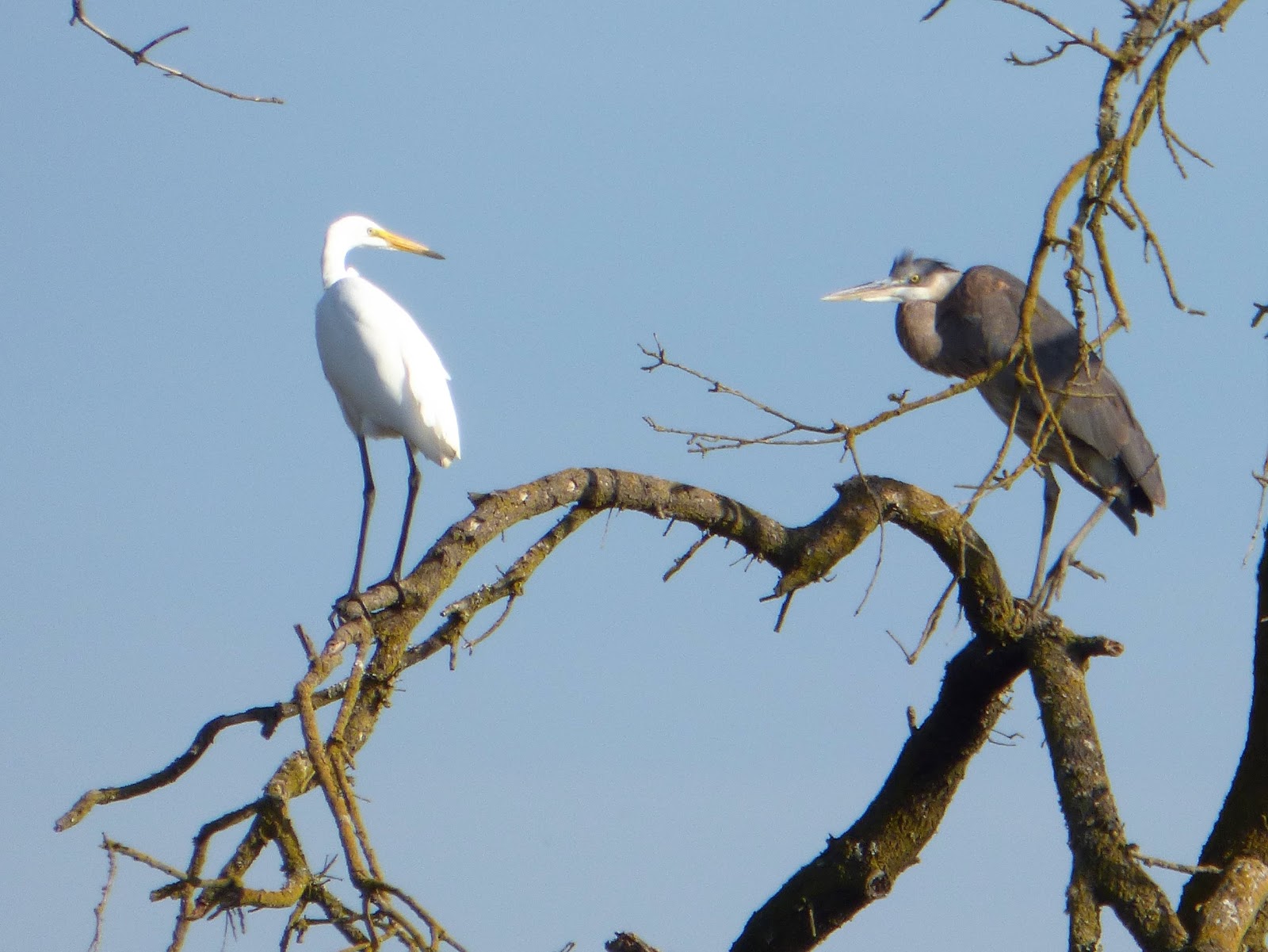
Showing the Way to a Peaceful Thanksgiving Feast: Great Egret and a Great Blue Heron Share a Space
I don't why this made me think of Thanksgiving, but I was walking out at the San Joaquin River National Wildlife Refuge this afternoon when I saw a Great Egret (Ardea alba) and a Great Blue Heron (Ardea herodias) sharing a branch on a tree by the slough. I saw two different, yet related species occupying close quarters, and doing so quite peaceably.
| Doesn't the heron in flight remind you of a dragon? |
In any case, I saw these two enjoying the afternoon sunshine together, and thought about how nice it can be when folks get along with others. I'm going to be doing a lot of driving in the next few days, so if I don't get the chance later, I hope that you have many things to be thankful for, and that your time in these next few days is precious and memorable, wherever and however you spend it.
Saturday, September 16, 2017
Some "Great" Birds at the San Luis National Wildlife Refuge: A Great Blue Heron, and a Great Egret
There's some anticipation in the air these days. The summer's heat is still lingering, although not so bad as before. Birds have been kind of scarce on my recent explorations, but I've been seeing a few
V-shaped formations high in the sky. The season is changing, and the winter migrants will be arriving soon. For no particular reason, we wandered down to the San Luis National Wildlife Refuge during the afternoon. No one promises much in the way of birdwatching at this time of year when the swamps and marshes are all dried up. But when we arrived, the feeling of anticipation was palpable. The water managers were just starting to flood some of the long-dry marshes. Few birds had yet discovered the water, but there were some.
I saw the Great Blue Heron (Ardea herodias) first, perched openly on the dead snag. It actually took me a moment to notice that one of the roots below was not a root, but was instead a Great Egret (Ardea alba) standing in the reeds.
The San Luis National Wildlife Refuge is one of our treasures, tens of thousands of wetland acres managed in such a way as to mimic the wilderness prairie that existed for thousands of years before the arrival of humans. Millions of birds flock to the Great Valley for the winter, and these refuges, representing a mere five percent of the original landscape, allow them to survive and even thrive. The refuges are understaffed and starved of funds, and they deserve better. If you are ever in the Great Valley during the late fall, winter, or spring, the San Luis Refuge is an incredible place to visit. There are three auto-tours, and a number of hiking trails are available. The visitor center is new, and is a great place to start your exploration.
V-shaped formations high in the sky. The season is changing, and the winter migrants will be arriving soon. For no particular reason, we wandered down to the San Luis National Wildlife Refuge during the afternoon. No one promises much in the way of birdwatching at this time of year when the swamps and marshes are all dried up. But when we arrived, the feeling of anticipation was palpable. The water managers were just starting to flood some of the long-dry marshes. Few birds had yet discovered the water, but there were some.
I saw the Great Blue Heron (Ardea herodias) first, perched openly on the dead snag. It actually took me a moment to notice that one of the roots below was not a root, but was instead a Great Egret (Ardea alba) standing in the reeds.
The San Luis National Wildlife Refuge is one of our treasures, tens of thousands of wetland acres managed in such a way as to mimic the wilderness prairie that existed for thousands of years before the arrival of humans. Millions of birds flock to the Great Valley for the winter, and these refuges, representing a mere five percent of the original landscape, allow them to survive and even thrive. The refuges are understaffed and starved of funds, and they deserve better. If you are ever in the Great Valley during the late fall, winter, or spring, the San Luis Refuge is an incredible place to visit. There are three auto-tours, and a number of hiking trails are available. The visitor center is new, and is a great place to start your exploration.
Tuesday, November 1, 2016
Great Egret in the Campus Wetland
The campus wetland, my "mini-wilderness" has been undergoing some changes. The campus is "improving" the road system to give our students better access to the various parking lots, which is a good thing, but part of the process has been to shore up old fencing, and provide new secure fencing on the west boundary of the school property. As a result, I can only walk around three-quarters of the wetland before running into fences. I'm not sure what that will mean for our campus foxes or the other creatures that use the wetland. History generally shows that foxes and the others are pretty resourceful, so they'll probably be okay.
On the other hand, the pond has been dry for months. It serves as the drainage and groundwater recharge basin for the entire west campus, and it has been very dry, to say the least, for the last six months, and for much of the last five years. Consequently, without water there have been few birds hanging around. The last two storms brought some record rainfall totals, though, so I was pleased to see water in the pond, and even a few Mallards in attendance. There was also a Great Egret (Ardea alba), which I haven't seen on campus in months. It was a bit skittish, taking off before I even arrived at the fencing, but it perched in the old cottonwood tree while I walked by, and allowed me a few pictures.
If the pond persists for a few weeks, look for a few more members of the bird community in these posts!.
On the other hand, the pond has been dry for months. It serves as the drainage and groundwater recharge basin for the entire west campus, and it has been very dry, to say the least, for the last six months, and for much of the last five years. Consequently, without water there have been few birds hanging around. The last two storms brought some record rainfall totals, though, so I was pleased to see water in the pond, and even a few Mallards in attendance. There was also a Great Egret (Ardea alba), which I haven't seen on campus in months. It was a bit skittish, taking off before I even arrived at the fencing, but it perched in the old cottonwood tree while I walked by, and allowed me a few pictures.
If the pond persists for a few weeks, look for a few more members of the bird community in these posts!.
Subscribe to:
Posts (Atom)