Showing posts with label Chen caerulescens. Show all posts

Wednesday, October 9, 2019

Two First Fall Arrivals on the Same Day: Snow Goose and Greater White-fronted Goose

One thing about the fall migration of Arctic geese into our region: when they are here, the geese tend to lose their individuality. There are tens of thousands of them, all looking alike. It's a spectacular sight to see tens of thousands of geese taking off all at once with the beating wings sounding like a jet plane. But the individuals don't ever stand out in the massive crowds.
But for a few days in the early fall, there is a moment when the first vanguards of the vast flocks begin to arrive, and for those few short moments, the individual birds, the first pioneers stand out. That was the happy circumstance this morning when I started my walk on the Tuolumne Parkway Trail. There is a big cornfield adjacent to the parking area of the west trailhead, and a week or two ago they harvested the corn and chopped up the stalks. That's goose paradise. The Canada Geese have been hanging out in large numbers and so I wasn't surprised to see nearly a hundred of them this morning. But one of them was white, and that wasn't normal.

I got the camera out and had a closer look. It took only a moment to see the red legs and pink beak that proved the bird was a Snow Goose (Chen caerulescens). I noticed it was holding its wing at an odd angle, making me wonder if it was injured in some way. If that was the case, it's possible this individual isn't a returning migrant, but instead was forced to stay behind last spring. I did notice that when I came by again 90 minutes later, all the birds were gone, so maybe it was able to fly after all.
But while I was scanning the flock I noticed a pair of other birds that didn't fit. They looked like Greater White-fronted Geese (Anser albifrons) at first glance, but they seemed to lack the distinctive coloration on their breasts. I got pictures and checked the books and realized I had found a pair of juvenile Greater White-fronted Geese, who lack the distinctive streaking.
You can come looking for them if you want to see them, but be reassured that in a few short weeks there will be tens of thousands of them arriving as winter approaches. Our local bird refuges will be spectacular!

Wednesday, January 10, 2018

Snow Geese at the Sacramento National Wildlife Refuge (and a bonus volcano!)

The Sacramento National Wildlife Refuge preserves wetlands and prairie environments in the northern part of the Great Valley between Williams and Willows. It's one of our favorite sites for birdwatching in the entire state, in part for the variety and number of birds, but as can be seen in these photographs, for the setting as well.

To the northeast the volcanic center of Lassen Peak looms over the valley floor. The volcano erupted only a century ago. To the west, the northern Coast Ranges form the background to pictures of flying geese.
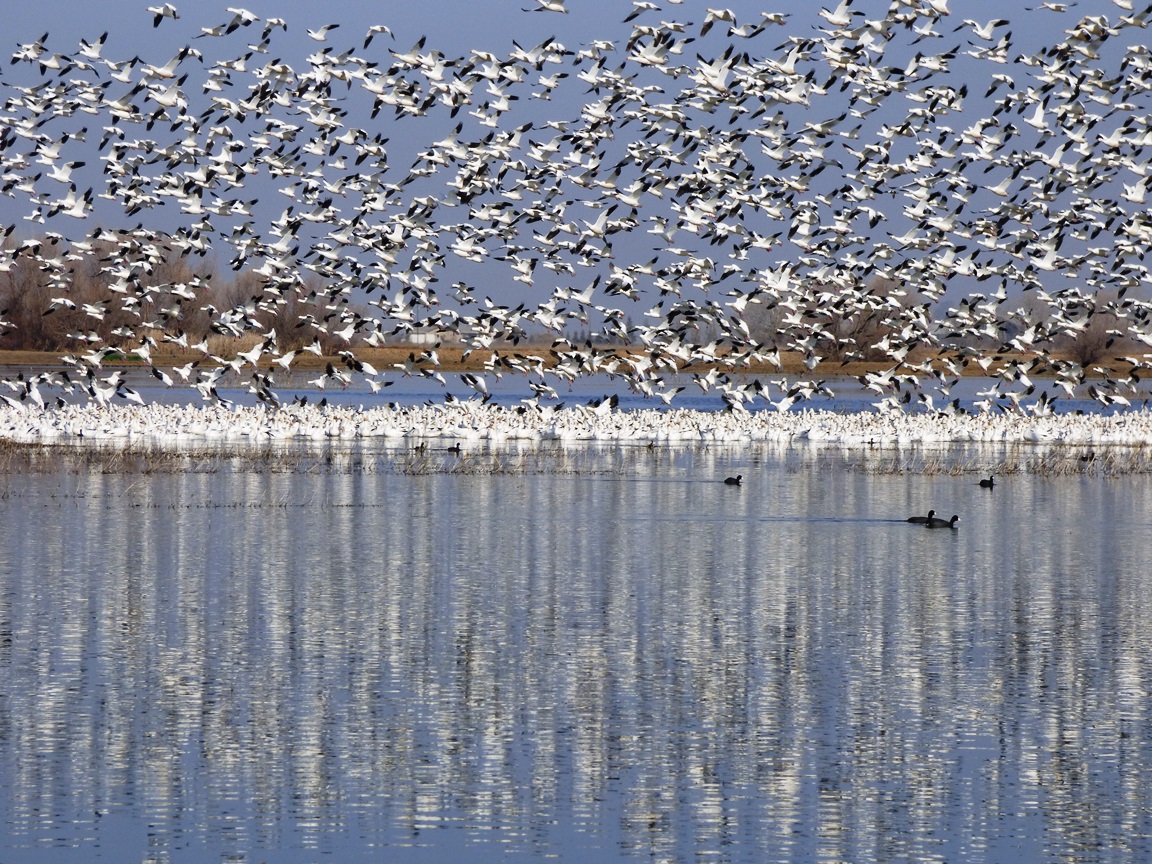
The Snow Geese (Chen caeruescens) are present in the ponds by the tens of thousands. Much of the time they simply placidly float across the ponds grazing for food, but something (a raptor, tourists, coyote?) will cause thousands of them to take flight all at once, and it is a truly dramatic sight. It's also loud (check out the video below).

Like many other birds in the Great Valley, the Snow Geese are migrants. They breed in the far northern reaches of the Arctic in Canada and Alaska and spend their winters in warmer climates like the valley, and other refuges in the southern United States and Mexico.

The birds are monogamous for life and often travel in large family groups. Their numbers have increased greatly over the years and so they are hunted on other parts of the refuge system. There are reports that they are putting considerable environmental pressure on their breeding grounds as well. They do have a great many predators, both of the eggs and young, and also adults. No wonder they flock into the air so much...
This wasn't the biggest flock taking flight that day, but it was the only video I caught of them taking off. Enjoy...

Tuesday, December 12, 2017

10,000+ Geese Taking Flight at the San Joaquin River National Wildlife Refuge

Three Sandhill Cranes soar against a backdrop of hundreds of geese
I lived here for a quarter century absolutely ignorant of the dramatic scenes taking place just west and south of my home. Each winter tens of thousands of Snow Geese, Ross's Geese, Cackling Geese, and White-fronted Geese as well as Sandhill Cranes take the long journey out of the Arctic Circle and head for California's Great Valley. They converge on a series of wildlife refuges that wind up and down the valley like a string of pearls. They bide their time through the winter and then when spring comes they head north again to breed.
They once ranged across the entire valley, but agricultural development has stolen away 95% of their habitat, leaving precious little living space. Refuge managers will often grow fields of corn to provide food for the hungry birds.
They spend their days foraging around the region but as the sun sets low on the horizon they start to settle into a large field where they can bunch together. This evening the flock was pretty close to the viewing platform on Beckwith Road about 10 miles west of Modesto. When I first arrived about 25 minutes before sunset, there were just a few hundred birds in the field, but more were arriving by the minute. Soon there was a thousand, and then ten thousand. The noise was deafening (the amount of gossiping going on was appalling!).
Occasionally something would startle the birds and many of them would take flight all at once, circling like a bird tornado over the field until whatever got them going resolved itself. Who knows what it might have been. I've seen coyotes lurking in the area, as well as Bald Eagles.
Soon an entire sector of the pastureland was covered with thousands of birds settling in for the night, but as I was turning to go, there was one more disturbance. There was a sound like a jet plane throttling upwards to take off and thousands of birds were once again in the air.
I caught a short video of the moment. Sorry for the shaky cinematography. I've been watching too many crime procedurals lately. Or else I was just kind of excited...


Tuesday, February 14, 2017

Snow Geese at the San Joaquin National Wildlife Refuge

It's been quite some time since I've been out to the San Joaquin National Wildlife Refuge, so when I got a few extra hours in my day, I hurried out to have a look. Few birds were actually at the viewing platform, but there were a few Sandhill Cranes at the end of the road a mile farther west. The best sight was about a mile to the east. There were several hundred Snow Geese (Chen caerulescens), and White-fronted Geese, and they were grazing in close proximity to the road. The birds are getting ready to begin their journey north to the Aleutian Islands for summer breeding. In the meantime, they were building up their fat stores of the northern journey. It's a privilege to have them so close to town!

Sunday, February 28, 2016

A Different Kind of California Snow: Geese Getting Ready to Fly at the Merced National Wildlife Refuge

A juvenile Snow Goose

Snow Geese (Chen caerulescens) are a big part of winter here in California. They shelter in the string of national wildlife refuges up and down the valley, and in those refuges they can cover the ground like snow.
I was at the San Joaquin NWR a week earlier, and saw few Snow Geese (two, to be exact), so I could be forgiven for thinking they had already started north on their migration, but yesterday at the Merced National Wildlife Refuge, I realized they are still here, by the thousands.
They won't be here much longer, of course. They've been storing up energy for the long flight ahead to their Arctic breeding grounds. It's going to be a lot quieter on the refuge.
The gray birds in the foreground are Sandhill Cranes
There is nothing quite like seeing thousands of Snow Geese taking to the air all at once. One can't always see what causes the mass flights, a marauding hawk, a coyote, or an idiot tourist, but if you are nearby, it sounds like a jet plane. Somehow they invade the sky without knocking each other down.

I didn't catch the moment of liftoff, but here is a short video of Snow Geese filling the skies at Merced yesterday.

Thursday, December 24, 2015

Some Geese and Swans for Christmas Day

I was trying to think which birds are appropriate for Christmas day wishes, and I couldn't get much farther than "The Twelve Days of Christmas", with partridges, turtle doves, french hens, calling birds (colly birds), and of course, the six geese a-laying and seven swans a-swimming. There are some who think that all twelve gifts are birds out of Celtic legends. I'm in no position to analyze the veracity of the claim, though.
Out of the long list I was able to pick out the geese and swans, since they've arrived in our area for their winter sojourn in our local wildlife refuges. The first two pictures are Ross's Geese (Chen rossii), the smaller of the two white geese. All of them were hanging out at the Merced National Wildlife Refuge a week ago.
The larger Snow Goose (Chen caerulescens) has a longer beak with a black lip. The geese often flock together in huge numbers. There is nothing quite like seeing tens of thousands take flight all at once.
We will sometimes see Tundra Swans (Cygnus columbianus) at the local refuges as well.
Merry Christmas and a wonderful holiday season all around. May you find blessings as numerous as the birds who fill the skies! And here's hoping for a wonderful new year as well! Thanks for reading!

Tuesday, November 3, 2015

Some Early Arriving Snow Geese at Merced National Wildlife Refuge

Winter can be a tough time for birds. Some can tolerate severe snows and survive at high altitudes or far northern latitudes. Many Arctic species have to migrate to more temperate latitudes, but over the course of history they have found their wintering grounds have been taken over by agricultural development.
The humans who took over the wetlands and lakes of the Great Valley have made some effort to encourage the survival of the birds, establishing a series of wildlife refuges that provide some haven for the birds (although in a trade-off, the chance to hunt them as well). There are half a dozen refuges in my immediate vicinity including the Merced National Wildlife Refuge, which is one of my favorite sites for bird watching.
At the height of the season, there will be tens of thousands of Sandhill Cranes, Snow Geese, Ross's Geese, White-fronted Geese in residence, along with Pelicans, Swans, and many others. It can get quite crowded by the time January comes around, and food sources can run short, especially in drought years when the fields cannot be adequately watered or flooded. But the effort is made, and many of the birds survive (some succumb to avian cholera and other diseases of overcrowding).
We visit the refuge as often as we can as the year progresses. There are a number of interesting birds present all year, but yesterday we were watching for the arrival of the winter migrants. Thousands of Lesser Sandhill Cranes have already arrived, but it doesn't feel crowded yet. The geese are not yet present in large numbers, but a few early migrants were hanging about. There were White-fronted Geese (above), whom we saw in large numbers farther to the north a few weeks ago at the Sacramento National Wildlife Refuge.
There were also a few dozen Snow Geese (Chen caerulescens). They generally arrive in large numbers in December when they'll fill the skies by the thousands.
Many of the Snow Greese seemed to be in family groups, with three or four juveniles hanging out with a mature goose. I don't know if they maintain such groupings, but it sure looked like it.
It was dry at the refuge, and many of the lakebeds are still totally empty of water. We've finally had a vigorous storm this week, and I am greatly hoping the storm is a harbinger of things to come. The wildlife needs a break, and a better chance for survival. Life is hard enough as it is.

Monday, February 2, 2015

Bird of the Day: Snow Geese at the Merced National Wildlife Refuge

I have to admit I haven't been following football much this year. I think there was some kind of big game today, seeing as how I detected a sense of despair and sadness emanating from the spirits of my Seattle region relatives. I took advantage of the afternoon by heading out to the Merced National Wildife Refuge to visit the overwintering birds.
There were birds of all kinds (look for lots of them in coming posts!), but the Snow Geese (Chen caerulescens) were just stunning. There are tens of thousands of them spending the winter months at the refuge.
The geese will be leaving to their breeding grounds in the far north in just a few weeks. In the meantime, they are foraging on the refuge wetlands and in surrounding agricultural fields to fatten up for the flight.
They roost in huge flocks, and there is nothing quite like the sound when they all take flight at once. They didn't do it while we were there today (and it's not really good for them if it is a false alarm; it uses unnecessary energy). To get an idea, check out these videos I posted earlier: https://www.youtube.com/watch?v=0fHPoNMnCJw or https://www.youtube.com/watch?v=PTPMSrxHtvU.
It was a beautiful day on the refuge after a month of fog and gloom. We hope to be back soon!