Showing posts with label Sierra Nevada foothills. Show all posts

Friday, January 29, 2021

One Rock Wasn't Like the Others...


It was the biggest weather event of our year, in which we received about a third of our yearly precipitation in just two days. In the aftermath, it was a sunny afternoon and it seemed a nice time to check out Willm's Road in the prairies just east of our town. I've been a geologist for far longer than I've been a birder, so I also enjoy looking at the rocks. Passing an outcrop of metamorphic rock, I saw one that was a bit rounder than expected. I stopped the car and backed up and pulled out the binoculars. That was no rock!

The camouflage was almost perfect. It was a Burrowing Owl (Athene cunicularia) watching over the roadway. It is always a thrill to see one of these inscrutable birds, and I rarely see them more often than two or three times a year if I am lucky.


Wednesday, March 6, 2019

Mountain Bluebirds on the California Prairie

I've had some pleasant finds of late on our birding journeys of late. We ventured out on Monday to the prairies that lie east of our town in the Great Valley. We ended up on Willm's Road near Knight's Ferry on the Stanislaus. There were quite a few birds out, but have I ever mentioned that blue is my favorite color? I saw a flash of blue on the fenceposts in the distance and realized I was seeing a Mountain Bluebird (Sialia currucoides) for the first time in my county. I've seen them only twice before, once in Tuolumne Meadows in Yosemite National Park, and last summer in Mesa Verde National Park.
These are some of the most beautiful birds there are, but their habitat is locally under siege. They prefer woodlands at the edge of the prairie, the trees providing nesting sites, and the prairie providing the insects that they eat. But the prairies out here are being converted to almond orchards at a furious rate. There are lots of difficult issues involved here, but it seems a shame to be losing so much of one of California's unique and rare environments and the animals that live there.
Mrs. Geotripper caught this shot of the Mountain Bluebird giving us "the look".

Thursday, February 1, 2018

Juvenile Red-tailed Hawk on the California Prairie

We saw quite a few species on our short excursions through the California prairie last weekend. As we drove south from the Willms Ranch stock pond, we passed a juvenile Red-tailed Hawk (Buteo jamaicensis) on Crabtree Road. It didn't worry about us enough to fly off, but it certainly kept an eye on us.
I'm slowly getting better with my identifying of hawk species, but Red-tails can be especially challenging because their coloration is highly variable (in other words, I could be wrong and welcome corrections, as always). The hawk is one of the most visible raptors in North America with a range that extends from Panama and the Caribbean Sea to Alaska and the Arctic Circle.

Thursday, October 26, 2017

Western Meadowlark in the Volcanic Barrens of the Sierra Nevada Foothills

The western foothills of the Sierra Nevada are one of the least-known parts of the range. Every year, millions of tourists drive quickly through the grasslands on their way to Yosemite Valley or the recreational lakes towards Sonora Pass. They pay little heed to the barren landscape, but in so doing they are missing out on one of the most dramatic parts of the geological story of the Sierra Nevada.

Nine or ten million years ago, the Sierra Nevada was a different place. The range was lower, and Cascades-style volcanoes were active in the summit regions around Sonora and Ebbets Passes. There may not have been large-scale glaciers, but the volcanoes may have been covered with snow at times, and erupting ash would have produced volcanic mudflows (lahars) that traveled dozens of miles down the western slopes. The mudflows came to rest in the foothills where today the deposits are called the Mehrten Formation.

In some circumstances, the volcanic muds could produce rich soils, but yearly rainfall is only enough for prairie grasses to grow. It's not a desert, but it's not a woodland either. The grasslands do provide excellent habitat for the Western Meadowlark (Sturnella neglecta), and it's a rare trip when I don't see one in the area. These pictures are from a short excursion a week or two ago on Willms Road near Knights Ferry on the Stanislaus River. One can just make out the bird on the rocks in the foreground of the first picture, but zooming in I got a better view. I love the colors of the lichens on the rocks.

Saturday, April 2, 2016

One of the Prettiest of Songs: A Western Meadowlark on Willms Road


Meadowlarks have one of the prettiest bird songs around. I grew up hearing them on my Grandparent's ranch when I was a child, so whenever I hear them these days, I briefly turn eight years old again, when an acre was a trackless wilderness in which all manner of adventures could be had.
We were on Willms Road, which travels south from Knights Ferry on the Stanislaus River in the foothills of the Sierra Nevada. Being spring, the Western Meadowlarks (Sturnella neglecta) are singing their hearts out, and one stayed on the fencepost long enough to be videoed, but my photos came out a bit fuzzy, so enjoy the two shots below from an earlier trip in the southern Mother Lode.
Besides their beautiful songs, the Meadowlarks are quite striking in their plumage as well.

Sunday, January 31, 2016

Mute Swans and Clearing Storm at Dawson Lake, Sierra Foothills

Another storm came through this morning, one of half a dozen this month that have dropped five inches of rain on the valley floor. That's not a complaint, not in the least. The drought remains, and every drop counts. We are actually ahead of normal rainfall and snowpack for the first time in five years.
The sun came out in the late afternoon, so we ran up the road to Dawson Lake near La Grange in the Sierra Nevada foothills. It was windy and cold as the last of the storm clouds drifted away, so not many birds were out and about. There were two Mute Swans (Cygnus olor, which translates to "swan - swan") on the lake.
Mute Swans are the birds of legend and myth in Europe and Asia, but they are not native to North America. They were brought here in the 1880s for the "enhancement" of ponds and gardens. Many escaped, and they have spread to various localities across the country. Because of their voracious appetites and aggressive nature, they have displaced native birds, including some rare and endangered species.
Just the same, there are just two of them at Dawson Lake, and they are graceful beautiful birds. They were a very nice complement to the rippling lake waters and setting sun. The storms are clearing out, for now.

Monday, October 5, 2015

Acorn Woodpecker Contemplating a Sunset near Yosemite National Park

I realize the explanation is a bit more prosaic, but I couldn't help but think that this Acorn Woodpecker (Melanerpes formicivorus) was quietly contemplating a beautiful sunset yesterday in the Sierra Nevada foothills just a few miles south of the Wawona entrance of Yosemite National Park. We were exploring the Nelder Grove of Sequoia trees, and saw the bird in a dead Ponderosa tree.
Some birds are incredibly intelligent, but we don't generally give them credit for enjoying things beyond their sphere of perception, mainly where their food and shelter is, and where the predators are. A fiery sky in the distance mainly provides a bit more light as far as they are concerned. Given the many holes drilled into the trunk of the snag, it's a granary tree. I have no doubt the bird was guarding its supply of acorns that have been secreted into the holes. 
The sunset was beautiful, though.

Saturday, May 2, 2015

A Doomed Romance in One Act, and Red-winged Blackbirds at the Willms Road Pond

Well, the romance was over quickly. One display of those bright red shoulder epaulets from the Red-winged Black Bird (Agelaius phoeniceus), and the Western Kingbird (Tyrannus verticalis) was completely unimpressed. Off to greener pastures for both of them.
We were on our short excursion on Willms Road near Knights Ferry in the Sierra Nevada foothills when we stopped at our favorite little stock pond out on the California prairie. There are usually some interesting birds hanging out, including the Kingbird in the above drama. We almost always see a crowd of Red-winged Blackbirds in the tules and rushes.
The Red-winged Blackbirds are hard to photograph. It's not so difficult to get the bright flash of the red shoulder epaulettes, but unless the light is just right the black body is featureless. I got lucky with a couple of shots this time, with the sunlight reflecting off the feathers of the breast and head of this individual.

The Blackbirds have a melodic song that is sometimes a high-pitched whistle. The males seem to always be busy trying to catch the attention of the ladies. I guess it is the equivalent of catcalls from construction workers in New York...
The stock pond on Willms Road (two or three miles south of Knights Ferry on Highway 108/120) is our local barometer for the severity of the drought. Most years in late April or May, the hills here are still green, but not so much this year. Compare how it looked in March. The pond has water, but perhaps not as much as it should (it's sometimes hard to judge, as the outlet has suffered some erosion damage so it may not be possible to completely fill the pond anymore). It's one of our favorite spots for a few minutes of serenity that's not all that far from home.

Sunday, April 19, 2015

A Violet-Green Swallow near Table Mountain in the Sierra Nevada

I took a hike to the top of Table Mountain in the Sierra Nevada Mother Lode today. It wasn't a birding trip, but there were a few of them about, including some swallows that were moving very fast over the grassy meadows. One of them finally sat still long enough for a couple of pictures, and I was able to see the green coloring of the Violet-green Swallow (Tachycineta thalassina). I've seen them before in the Mono Lake area, but this was the first I've identified on this side of the mountain (due more to my lack of attention than any kind of rarity on their part). These birds, like their cousins the Tree Swallows, are residents of western North America, ranging from Central America and Mexico to northern Alaska, depending on the time of year. They prefer open woodlands, which is just where I found them.

Table Mountain is a unique geologic and biologic environment. You can read more about this strange place over at Geotripper (click here).

Monday, March 2, 2015

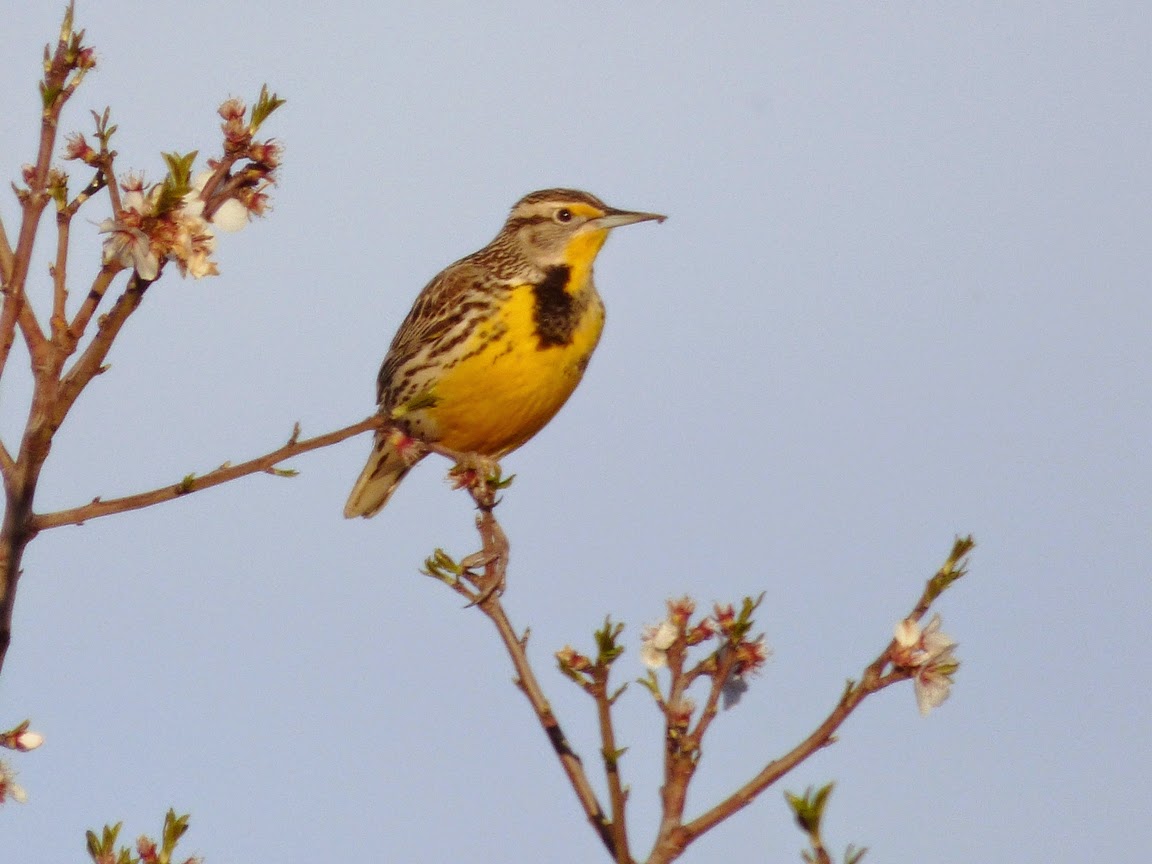
Western Meadowlark on the California Prairielands


One of the most beautiful of bird songs is that of the Western Meadowlark (Sturnella neglecta). I have seen few of them during the winter months, when they spend a lot of time on the ground looking for bugs. They'll sing, but they won't show themselves all that much.

As the spring season arrives they become more visible as the males perch on fence posts and treetops to advertise for love and companionship. We took a drive out into what I call the California prairielands, an increasingly precious region that is losing ground to rapidly expanding (but unsustainable) almond orchards. One might notice the irony that our singing individual is perched on a young almond tree. We were on Warnerville and Willms Road east of Oakdale, are part of the prairie that is particularly beautiful right now (look for some views in a soon to be posted Geotripper blog post).

The Meadowlarks are beautiful birds (aren't most of them?) that range all across the west and midwest of North American continent. There is an Eastern Meadowlark that is barely distinguishable in appearance, but differs in song and feeding style. It is the state bird of six different states: Kansas, Montana, Nebraska, North Dakota, Oregon, and Wyoming.

The Meadowlarks have powerful jaws and sometimes feed by using a method called "gaping" where they stick their long bills in the soil and open their beaks to access seeds and bugs. The Cornell Lab of Ornithology offers additional information about these fascinating birds.

Our bird stayed still long enough to catch a few seconds of singing. Enjoy!