Showing posts with label San Joaquin National Wildlife Refuge. Show all posts

Sunday, April 28, 2024

My Rare Bird Jinx and the Roseate Spoonbill

Let's understand first how rare this bird actually is. In California north of Bakersfield, it's been seen just once, near Moss Landing way back in 1978. This year there has been in the entire American West a single bird found near Bakersfield. It's a Roseate Spoonbill (Platalea ajaja), a bird more familiar to the tropics and the Gulf of Mexico coastline. So there was a flurry of excitement when Jody Smith, a local birder, saw one at the San Joaquin River National Wildlife Refuge here in Stanislaus County yesterday afternoon. Word spread quickly and perhaps a dozen birders got a look before sunset last night.
It was sunset before I saw the flurry of emails and online reports, so I was going to have to pin my hopes that it might hang around a little the next day. So I got up bright and early, arrived at the refuge at 6:45 AM, and of course...nothing. That's my kind of luck, my rare bird jinx. I scanned the area for some time, but then gave up. And besides, the San Joaquin River National Wildlife Refuge is a special place for many reasons, so I spent the next hour recording nearly three dozen species. But in the end I returned to the spot where the bird had been sighted again, and....nothing.

I shifted strategy, and drove up the road to an adjacent floodplain where the Spoonbill could have gone. And nothing once again. I was being stubborn, so I decided to give it one last chance and go back to the original discovery sight, and found a couple of other birders hoping to catch a look. And...nothing.

I joked with the other birders that my jinx was such that the only way they could see the Spoonbill would be if I left, because, well, that's the way Murphy's Law works. I told them I would make the sacrifice for them and left.

But...I walked a bit slowly, and just as I was about to disappear from their sight they started yelling and waving their arms. The Spoonbill had arrived! And for once the jinx was broken, and I got to see a very rare bird. And it was pretty impressive even if the picture are a little grainy. It was pretty far away.
 

It's always a thrill to see a new and rare bird.


Wednesday, February 7, 2018

Strange Looking "Geese" at Goose Day on the San Joaquin River National Wildlife Refuge

Um...those don't look like geese to me...
The San Joaquin River National Wildlife Refuge is a marvelous bit of the (almost) original landscape of the Great Valley of California, combining prairie and riparian habitats in support of hundreds of thousands of migratory waterfowl. There is a four mile long hiking trail in one sector of the refuge, but only a viewing platform at the other, at the end of Beckwith Road a few miles of west of the town of Modesto. I have seen incredible sights from the platform and from along the road, but it's always been sort of a mystery as to what lies in distance, the places where the public is not usually allowed to go.
Last month, we were given the chance to find out. The refuge sponsored their first ever Goose Day celebration on January 13, and the festivities included an auto-tour into the interior of the preserve. The managers expected two or three dozen people, but got 100-200 people instead. The group worked out caravanning and dozens of cars motored their way into the refuge.
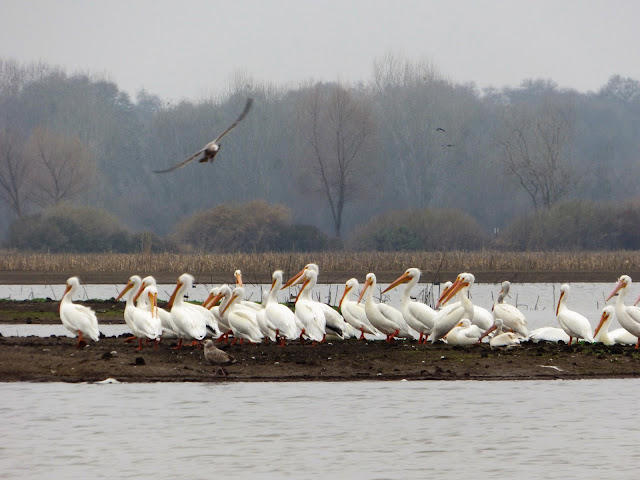
The ironic part of course is that few geese were in attendance (who could have foreseen that?). I don't think anyone who was there was disappointed. Their interest was in all of the birds who call the refuge home, and the chance to see the interior up close. Aside from a few comments about how cold it was, I heard no complaints. The most visible of the "charismatic" birds were several dozen American White Pelicans (Pelecanus erythrorhynchos) on an island in Page Lake.
The pelicans famously scoop up fish in their bill, although they do not store them there (they swallow them right away). They don't dive like Brown Pelicans, but instead will hunt cooperatively, swimming along in a group herding the fish ahead to where they can scoop them up.
The Pelicans are doing well. Their population crashed in the middle 1900s due to pressure from hunters and fishermen who feared the birds were consuming the valuable fish species (they weren't). DDT had an effect on populations as well, as did wetlands habitat loss. Their numbers are rebounding today.

The auto-tour spent around an hour on the shoreline of the pond in the midst of the refuge. We did see geese flying overhead, and we also saw a Great Horned Owl, Sandhill Cranes, Black-necked Stilts, Yellowlegs, and numerous other shorebirds. The tour continued on the other side of Beckwith Road, following the dike along the Stanislaus River across from Caswell State Park.
One can see why they don't want to have unrestrained public visitation. The road maintenance costs would be prohibitive.

After the tour I did in fact find a couple of geese, some Snow Geese along Beckwith Road a bit west of the viewing platform. There are in fact tens of thousands of geese in residence, but during the day they range across the region looking for food. They gather at dusk in huge flocks.
A few days later, things were back to normal, and I headed out the platform during an afternoon break. There were hundreds of Pelicans on the island, and perhaps several thousand Sandhill Cranes visible from the road.

Wednesday, March 15, 2017

Preparing for the Incredible Journey North: Greater White-fronted Geese at the San Joaquin River National Wildlife Refuge

In early October the birds numbered in the dozens or hundreds. By late November they were in the thousands and tens of thousands. And then, after a long winter, they are beginning to leave again, headed north to their breeding grounds in the Arctic. They include the Snow and Ross's Geese, the Cackling Geese, and the ones I saw yesterday, the Greater White-fronted Geese (Anser albifrons).
The Beckwith Road viewing platform will be closing soon as more and more birds abandon the refuge and fly north, so I made a last trip out yesterday to see who was still hanging around. There were perhaps a hundred or so of the Greater White-fronted Geese near the road.
Several thousand Snow Geese were visible as well, but they were down by the lake and not easy to photograph. All in all, in the warm sunny weather of the past week they felt like the last few hangers-on, reluctant to start the several thousand mile long journey to their summer home. Given the big storm scheduled for next week, maybe delaying a bit was a good idea...

Tuesday, February 14, 2017

Snow Geese at the San Joaquin National Wildlife Refuge

It's been quite some time since I've been out to the San Joaquin National Wildlife Refuge, so when I got a few extra hours in my day, I hurried out to have a look. Few birds were actually at the viewing platform, but there were a few Sandhill Cranes at the end of the road a mile farther west. The best sight was about a mile to the east. There were several hundred Snow Geese (Chen caerulescens), and White-fronted Geese, and they were grazing in close proximity to the road. The birds are getting ready to begin their journey north to the Aleutian Islands for summer breeding. In the meantime, they were building up their fat stores of the northern journey. It's a privilege to have them so close to town!

Saturday, December 3, 2016

Snow Geese, Cackling Geese, and Ross's Geese at the San Joaquin National Wildlife Refuge, Pt. 1

I fell for the ruse. I was duped into Christmas shopping on a Saturday, because it included a quick trip out to the Beckwith Road viewing platform at the San Joaquin National Wildlife Refuge west of Modesto in the Great Valley. It was a decent trade-off. When we pulled up, it looked like we would be disappointed, as the fields were almost empty of birds. But then the magic started...the sky filled with geese coming from all directions, all spiraling towards the field west of the viewing platform. There were dozens, then hundreds, and then thousands of them.
The Cackling Geese arrived first, and the few Ross's Geese looked a bit confused and lost, but the tornado of white birds expanded, and more and more of them arrived. It was an astounding sight. I took a few videos. The first is below. I'll post the second in a few moments.

Wednesday, November 16, 2016

American Kestrel at the San Joaquin National Wildlife Refuge

There were rumors "flying" about in birding circles this week about a Brant that made an appearance at the Beckwith Road viewing platform. Well, not rumors, it was actually there. It's only the fourth appearance by this goose species ever in our county. I'm not quite to the place where I drop everything in an effort to see a single rare bird, but I was in town on errands, so I went on out to the San Joaquin NWR to see what was happening. It was early in the afternoon which is not the best time to see the birds, and my low expectations were fulfilled. The geese flock was nearly a mile away. There was not much else going on, but as I was leaving, I saw an American Kestrel (Falco sparverius) perched on the telephone wires.
It was not as skittish as they often are, and didn't fly off, so I got a couple of shots. They are colorful little falcons.

It looks like some Snow Geese and Ross's Geese have begun arriving in the valley. I could see a flock at the pond in the great distance, along with the Cackling Geese.

Wednesday, November 2, 2016

Greater White-fronted Geese the Next to Arrive at the San Joaquin National Wildlife Refuge

The next members of the goose parade have arrived at the San Joaquin National Wildlife Refuge. I have no idea if they were here last week or not, but I'm only out there for an hour once a week, and can only report on what I see. There were thousands of Cackling Geese in the cornfields, and hundreds of Sandhill Cranes last week, but I didn't notice any Greater White-fronted Geese (Anser albifrons). This week I could tell the flock of Cackling Geese had grown considerably (look for a video soon), and the cranes were investigating a plowed field across Beckwith Road towards the Stanislaus River at Caswell. I finished my observations and took off for school. There is a pond close to the highway about half a mile west of the viewing platform, and the previous week it had been occupied by Cackling Geese. I slowed for a look and realized that many of the birds didn't have the white necks, so I stopped for pictures.
We are still awaiting the arrival of the Snow Geese and the Ross's Geese, and maybe some swans. I'll keep you posted!

Friday, October 28, 2016

Cackling Geese and Sandhill Cranes Arrive at the San Joaquin National Wildlife Refuge

One of the pleasures of the fall semester is that short break I have between the afternoon lab and the evening class. That's just enough time to drive over to the Beckwith Road viewing platform for the San Joaquin National Wildlife Refuge (about ten miles west of Modesto). Tens of thousands of winter migrants shelter here, including Snow Goose, Ross's Goose, Greater White-fronted Goose, and today's visitors, Aleutian Cackling Goose (Branta hutchinsii), and Sandhill Cranes (Grus canadensis).
The Cackling Geese were once thought to be a small subspecies of the Canada Goose, but DNA analysis indicates they are a separate species. They breed in Arctic environments, then migrate to the United States for the winter. They have a wide range in the American Midwest, but tend to be concentrated into just a few refuges in California's Central Valley. The San Joaquin National Wildlife Refuge is one of them. During the summer, the refuge managers grow crops of corn, and selectively cut the stalks during the winter so the birds can have a secure food source throughout the winter months. The birds were rather agitated when I was there Tuesday because tractors were mowing part of the pasture. I'm guessing there were around a thousand near the viewing platform.
There were hundreds of Sandhill Cranes at the refuge as well, but they were far away from the viewing platform. We saw them at the Merced National Wildlife Refuge during our visit a couple of weeks ago. They were far away, but their calls carried a great distance. They are gorgeous elegant birds. In a few months, as the corn starts to run a bit short, they'll be hanging out much closer to the road.
Look for occasional reports in coming months. I try to get out there at least once a week.

Thursday, February 4, 2016

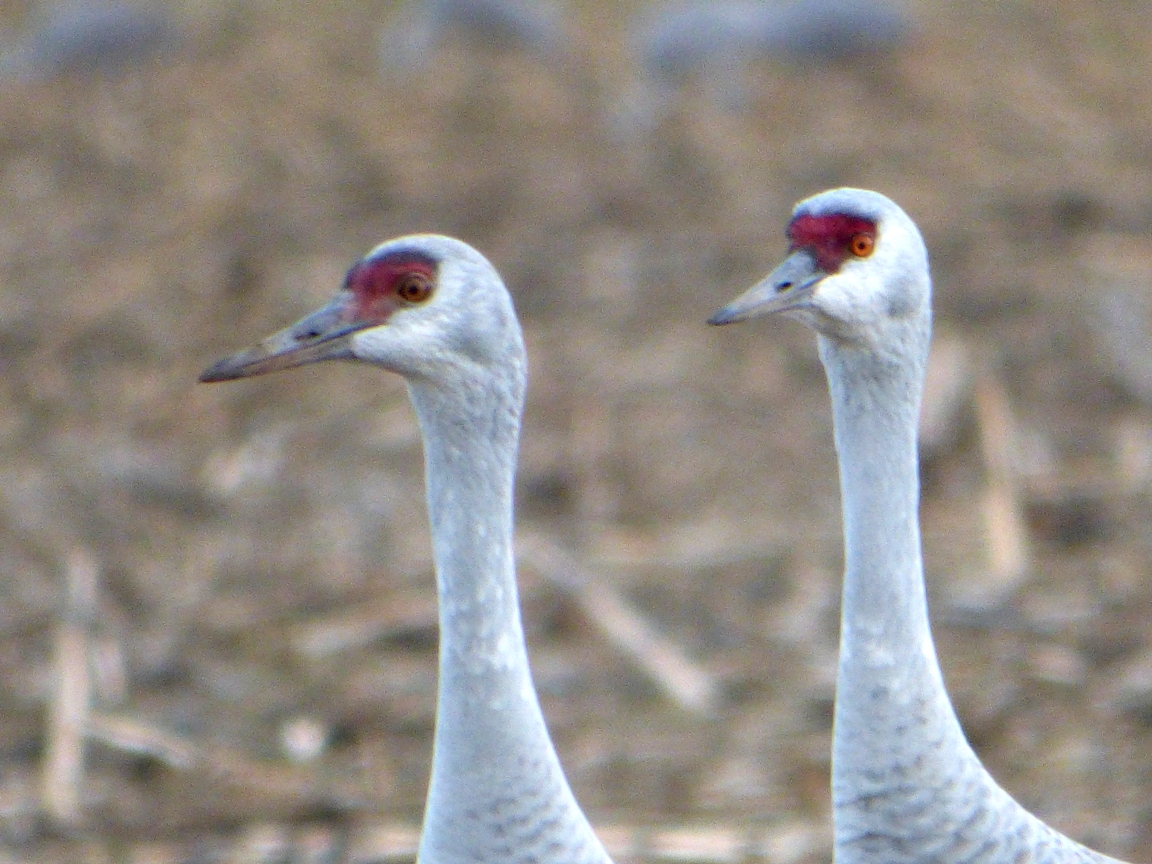
Sandhill Crane Heads at the San Joaquin National Wildlife Refuge

Does it seem like there have been a lot of Sandhill Cranes (Grus canadensis) in my blogs of late? There's a reason for that. They're going to be gone pretty soon.
Oh, not from extinction so far as I know. But gone from this area. It's February and spring is coming soon. They will be moving north back to their breeding grounds in Canada and Alaska. I'm going to miss them.
I'm still getting cloudy afternoons on Tuesdays when I can get out to the Beckwith Road platform overlooking the San Joaquin National Wildlife Refuge so the zoomed shots are still a bit unfocused. But the birds have been roaming closer and closer to the road. The reason is, of course, food.
The cornfields have long since been mowed down, and the voracious cranes and geese have eaten a lot of the food in the refuge. They've avoided the cobs remaining near the road, but now that area is one of the "good" spots for foraging, so they have been close enough for some detailed shots of their faces and heads. And thus today's post.
Since taking up birding, the cranes have been one of my favorite local "discoveries". I had no idea that they spent winters here in the Central Vally, just a short drive from my workplace. By the tens of thousands!
I wish them well on their arduous journey. In the meantime, I'll keep shooting and posting until they're gone!
Arduous journey? Say what?

Wednesday, January 27, 2016

Sandhill Cranes at the San Joaquin National Wildlife Refuge (and an unwelcome visitor)

One of the finest moments of my day comes on Tuesdays when I have a spare hour between the end of a lab and evening office hours. The Beckwith Road viewing platform on the San Joaquin National Wildlife Refuge is only about ten miles away.
In those few moments, I can drive out to the refuge just as the sun is reaching the horizon, and see what the migratory birds are up to. In the late fall, it began with the Aleutian Cackling Geese. They were there by the tens of thousands. In those first weeks, their honking was deafening.
Then the Snow Geese and Ross's Geese began arriving in large numbers. Few sights are more astounding than to see thousands of them taking off as one. During this time, the Sandhill Cranes were ever present, sometimes closer, sometimes farther away. The Department of Fish and Wildlife plants the fields with corn, and as the winter progresses, they will mow different parts of the crop, keeping up a constant supply of food for the hungry birds.
As the winter starts to drag on, the corn has been all mown, and the food starts to run a bit short. That's when observations become fun, because the birds start searching for corn at the edge of the field near the road. They became a great deal more tolerant of passing vehicles, and drivers using their cars as photography blinds. That's the way it was yesterday, when I was able to get quite a few shots of the Sandhill Cranes (Grus canadensis).  The are grand, elegant birds. Their strange call at a great distance almost reminds me of purring cats. It feels like the sound carries for miles (you can hear some here: https://www.allaboutbirds.org/guide/Sandhill_Crane/id).
As I was leaving in the twilight, I saw something moving between the refuge and the Stanislaus River off to the north. It is clear that the birds sometimes have good reason to be vigilant and cautious!

Friday, January 22, 2016

Greater White-fronted Geese and Friends at the San Joaquin National Wildlife Refuge

Greater White-fronted Geese at the San Joaquin NWR
Between storms this week, I made the drive out to the viewing platform on Beckwith Road west of Modesto, on the San Joaquin National Wildlife Refuge. It wasn't easy! The roads were flooded in places, and mud covered parts of the access road. But the birds were certainly there.
Greater White-fronted Geese and Aleutian Cackling Geese
There were thousands of them, but unlike earlier visits, they were spread out and were intermingling with each other. There weren't the flocks of tens of thousands of a single species. It might have been the time of day, but I think there was an element of resources. Most of the maize fields have been cut down now, and they seem to have eaten most of the food. That may have caused them to spread out and graze much closer to the road, where the corn hadn't yet been completely consumed.
Greater White-fronted Geese. The name comes from the white patch behind the beak.
The birds I noticed the most were the Great White-fronted Geese (Anser albifrons). They are winter migrants, breeding far to the north in the Arctic. They were mingling with Snow Geese (Chen caerulescens), Cackling Geese (Branta hutchinsii), and Sandhill Cranes (Grus canadensis).
Greater White-fronted Goose and a Snow Goose

Conditions weren't the best for photography, given the overcast and late afternoon, so the pictures are a bit more fuzzy than I would like. But who cares, really? I was away from the hustle and bustle on campus for a few precious minutes, seeing beautiful creatures.
Sandhill Cranes at the San Joaquin NWR

It's still January, but I'm already feeling like they'll be gone soon, headed back north for the summer. I'll be hanging on to the precious moments while I can.