Showing posts with label Mallard (Anas platyrhynchos). Show all posts

Wednesday, April 3, 2019

Life Sucks Sometimes. Let's Look at Some Baby Ducks.

Spring is breaking out all over. At CSU Stanislaus, the Mallards (Anas platyrhynchos) have had their ducklings and eight or so were exploring the lawns near Warrior Lake today.
Momma was doing her stellar job of keeping all her ducks in a row, so to speak. There was one oddity today, and I wonder if other folks have ever seen this happen. A Canada Goose was assisting in the protection of the ducklings! It was following the family and when I approached on the sidewalk, it placed itself between me and the ducklings and made threatening noises.
All I could think of while watching the cute little babies trundling across the lawn was "life sucks", but this made things better for a moment. I made a short video for your enjoyment...

The

Wednesday, May 2, 2018

Some More Spring Arrivals, But These Aren't Migrants: The Babies of CSU Stanislaus


The babies are everywhere! I took the occasion to wander the campus of CSU Stanislaus in Turlock this afternoon. The landscape includes some rather large ponds, and an artificial stream that is meant to reflect the vegetation from the Sierra Nevada to the floor of the Great Valley. Reeds have become established in some of the ponds, and as such, the campus has recreated some of the wetland environments that used to exist in valley. The birds have responded, and a number of species are reproducing and raising their young on the campus. And that means for a few weeks of the year, there are adorable young chicks running around everywhere.

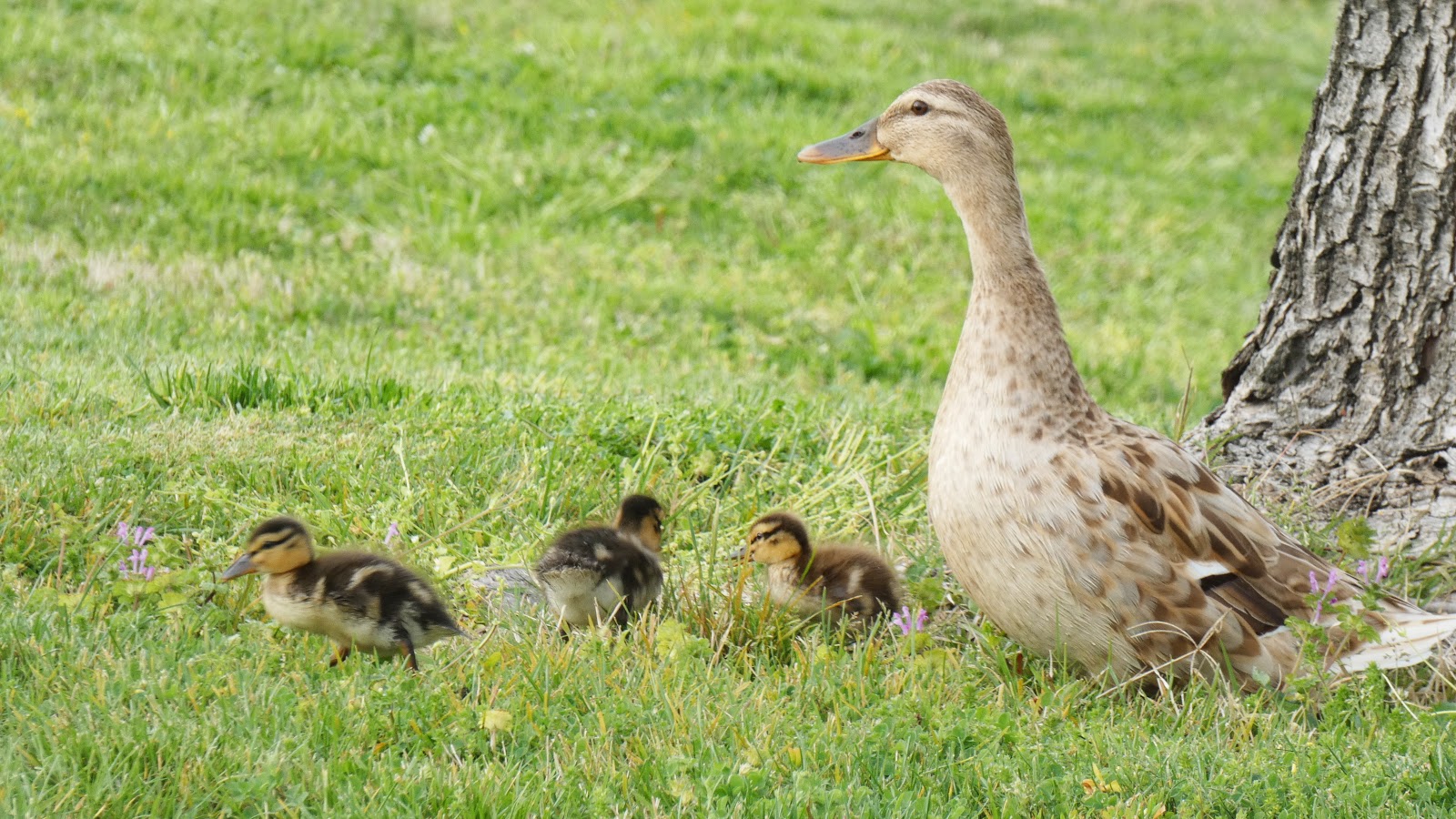
First we have the Mallard babies (Anas platyrhynchos). Five of them were huddled just a few inches from the pathway along the artificial stream. Apparently the humans here treat them well because Momma Mallard let me carefully step by without scattering as long as I had my back to them and pretended to be looking at something else.
Then there were the Canada Geese babies (Branta candensis). There are a lot of geese on the campus, and at times they have become a bit of a nuisance. They sometimes get chased off by specially trained dogs, but there were around thirty of them scattered across the campus today. There were two broods of goslings that I ran across, and the parents were on the verge of being aggressive when I walked by, but they kept their distance. The babies of course were cute.
The biggest surprise was one that I didn't recognize right away because it seemed like there were no parents around. I got two clues a short time later, as an American Coot (Fulica Americana) was nearby chasing off some Mallards from the baby. And then there were the feet, visible when it climbed out of the water for a moment. Those giant odd-shaped feet are unmistakeably coot-like.


Wednesday, April 11, 2018

Mallard Duck Family at CSU Stanislaus

It turned into "Duck Week" here at Geotripper, and as I got to the end of the list of the more rarely seen species, I realized that in four years I had never posted on the most common duck of all. We have a truism in geology that you could spend a field season in a place collecting all the rare and unusual rocks and minerals, and somehow never pick up the single most common rock in the area. Apparently I do that with birds, too.
In any case, I wondered how to do something original with a duck that is seen at virtually every park and pond in North America, the Mallard (Anas platyrhynchos) I was going through the small handful of pictures that I've ever taken of them, finding little to work with. Then the answer became as obvious as the nose on my face, in the sense that I looked up and beyond the end of my nose, there was a Mallard family walking right outside my office at CSU Stanislaus. I got up and snapped a few shots of the insufferably cute chicks, and that was that.