Showing posts with label California prairielands. Show all posts

Friday, January 29, 2021

One Rock Wasn't Like the Others...


It was the biggest weather event of our year, in which we received about a third of our yearly precipitation in just two days. In the aftermath, it was a sunny afternoon and it seemed a nice time to check out Willm's Road in the prairies just east of our town. I've been a geologist for far longer than I've been a birder, so I also enjoy looking at the rocks. Passing an outcrop of metamorphic rock, I saw one that was a bit rounder than expected. I stopped the car and backed up and pulled out the binoculars. That was no rock!

The camouflage was almost perfect. It was a Burrowing Owl (Athene cunicularia) watching over the roadway. It is always a thrill to see one of these inscrutable birds, and I rarely see them more often than two or three times a year if I am lucky.


Friday, December 4, 2020

The Burrowing Owls Finally Make an Appearance!

As we get towards the end of the year, I start to review the lists and try and figure out which birds I love, but have not yet seen. Two weeks ago, the Phainopeplas arrived on the Tuolumne River Trail and I was finally able to check them off the list, and the next most favorite bird moved to #1: the Burrowing Owl (Athene cunicularia).
I was distressed about not seeing a single Burrowing Owl all year. I've been concerned about their welfare in our area because they are denizens of the prairie, and the prairies in our region are being dug up and planted with almond orchards, some 40,000 acres in our county in the last decade or so. We've made a number of trips through the seasons on Crabtree and Willms Roads in the Mother Lode foothills between the Tuolumne and Stanislaus Rivers. We've seen lots of interesting birds, but not a single owl was to be found anywhere.

The little owls sometimes dig their own burrows, but most of the time they take over the abandoned burrows of other creatures like badgers or ground squirrels. They hunt and consume a huge variety of small mammals, reptiles, and large insects, and hunt day and night. Almond orchards don't really provide that kind of habitat or food resource, so the birds get pushed east into the foothills.

So here it is, early December, and no Burrowing Owls anywhere. I had a few extra minutes this afternoon (it's been a loooong semester), so I drove out Crabtree Road, and finally saw two of them! They were several hundred yards away, and I don't know how I ever spied them. I was pleased, but there were no possibilities for pictures. I headed back home, and saw a bird ahead on the fence by the road, but it flew into a depression and disappeared. I slowed a bit and I saw it land on the fence behind me.. I rolled to a slow stop and very slowly opened the car door to get out and try for some pictures. Much to my surprise, the owl cooperated! Enjoy!


Saturday, April 8, 2017

Sometimes I Miss the Little Ones: Savannah Sparrow on the California Prairie

It was a rich weekend for finding birds on the California Prairie. I think I'm finally starting to run short of species from my trip last Saturday, but it is rare that I post four new species in just one week. Today's featured species is the kind of bird that I constantly overlook because they are always sort of there in the foreground while I'm staring off in the distance looking for those larger "charismatic" types. They are the sparrows of course, and I'm only just beginning to learn to tell them apart. The bird above is a Savannah Sparrow (Passerculus sandwichensis; the species name is almost longer than the bird is). These are one of the common sparrows all across North America, with an estimated population of 180 million. They thrive in grassland prairies, although their name is based on the city in Georgia. The little yellow patch over the eye is one of their distinguishing characteristics.

I clearly need to learn my sparrow species. About thirty different kinds have been sighted in my region, although just twelve of them are abundant. Still, size really doesn't count in this business. The little ones are sometimes the prettiest. Just ask any hummingbird...

Thursday, April 6, 2017

Lesser Yellowlegs in the California Prairielands near Willms Road

We had a rather productive trip to the prairielands east of our little village at the foot of the Sierra Nevada Mother Lode. In addition to the Tricolored Blackbirds, the Burrowing Owl, the Western Meadowlark, the Horned Larks, Pied-billed Grebes, and a variety of Hawks were out and about. As we explored some of the vernal pools we saw a lone bird on one of the ephemeral creeks, and realized we could add a Yellowlegs to our tally for the day.
I'm the first to admit that I'm not very good at shorebird identification. There are two species of Yellowlegs, the Greater and Lesser. Part of the difference is the size, but a single bird gives no scale. The Greater is supposed to have a longer beak that is very slightly upturned, but I don't see that in these pictures, so I'm calling it a Lesser Yellowlegs (Tringa flavipes). As always I am open to gentle correction!
It is the most beautiful time of the year out on our prairie. The flowers are starting to show in some of the vernal pools, and there is greenery everywhere. All of the creeks are flowing, and it's a good time for the animals and plants after five years of drought. I'm looking forward to a few more weeks of color on the hillsides!

Wednesday, April 5, 2017

Tricolored Blackbird at Willms Pond in the Prairielands

One has to start somewhere. I've noticed that the first chance I ever have to shoot a new species, it is usually under less than ideal conditions, and the pictures are not to my own "stringent" standards (really, I have pretty low standards for pictures). We were out on the prairielands last week, and I had some pretty nice results, between seeing a Burrowing Owl for the first time in years, getting close-ups of a Western Meadowlark, some Horned Larks, and some nesting Tree Swallows. I was on the lookout, however, for a new species.

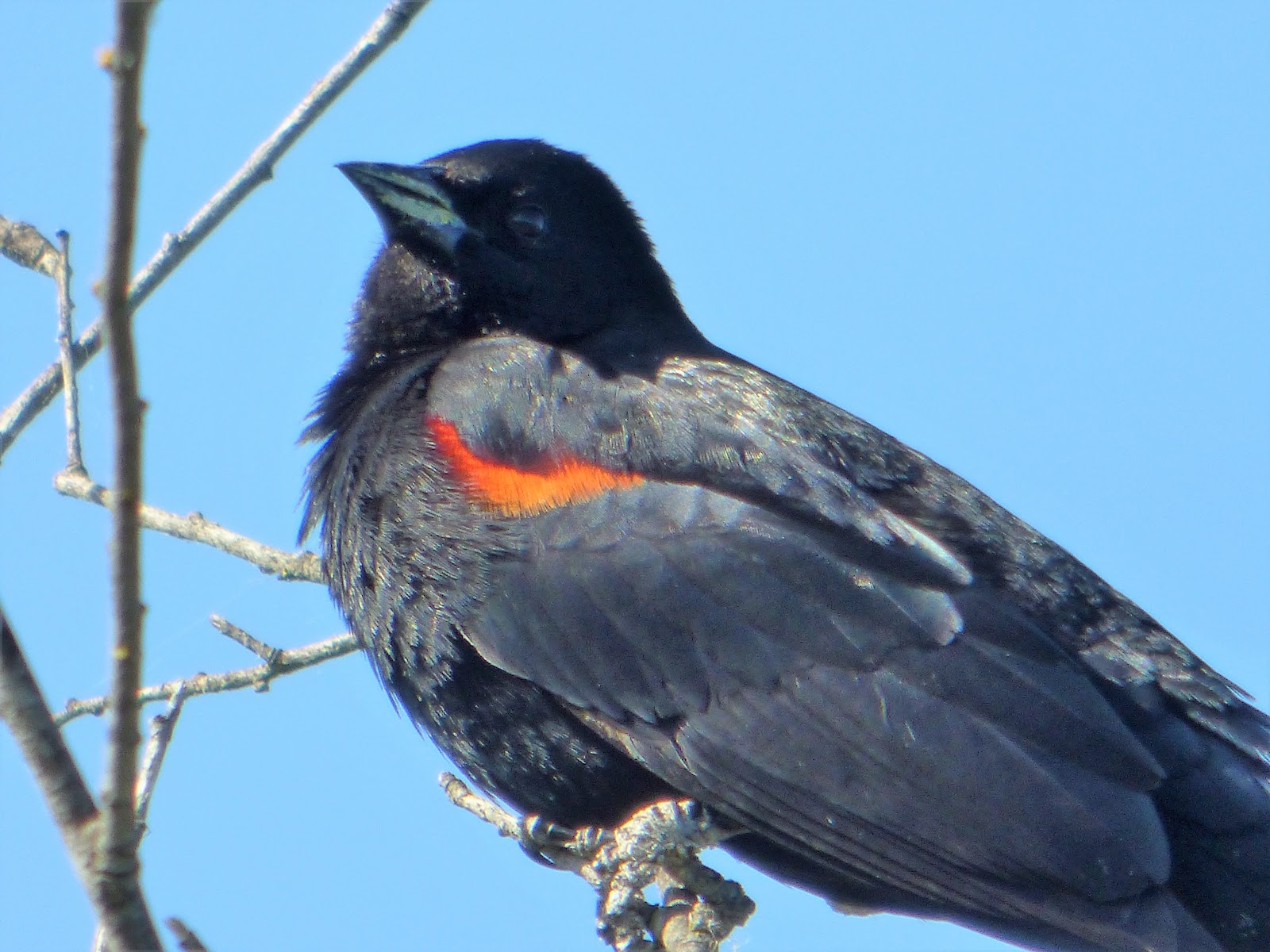
Tricolored Blackbirds are very similar to the Redwinged Blackbirds, which range across North America, numbering in the tens of millions. The Tricolors are almost a California endemic, found outside the state only in northern Baja, and at some widely scattered nesting sights in eastern Oregon and Washington. Their population is estimated at a few hundred thousand at most and falling, in part because of an unfortunate nesting habit. They prefer to nest in large colonies in open grassy fields, with nests only a few feet apart from each other. In a number of unfortunate cases, those nests were in wheat or alfalfa fields, and the fields were mechanically harvested before the nestlings could escape destruction. The population dropped so precipitously that they were declared an endangered species in California just a few years ago.

Efforts to protect the birds included payments to farmers with large colonies in their pastures to delay the harvest a few weeks. Cooperation has helped to stabilize the population, but they are still in trouble.
Birders had reported that dozens of Tricolored Blackbirds had take up residence at the small stockpond on Willms Road where Mrs. Geotripper and I like to watch for wildlife, so we stopped and waited to see who was out and about. The blackbirds were making a lot of noise in the reeds across the pond, but they only occasionally popped out. It took the highest zoom and a bit of luck to get the pair of shots of unmistakable Tricolors. The white band under the red is the distinguishing feature.
The Redwinged Blackbirds (Agelaius phoeniceus) were out in force as well, and they weren't nearly as bashful as the Tricolors. So, to make up for fuzzy and distant shots of my target species, I've thrown in a couple of close-ups of their close cousins.
The Willms Road pond is especially pretty this time of year, overflowing with water, and surrounded by grassy hills. The owners are kind enough to provide access for fishing and birdwatching, so if you check it out, please be courteous and pick up any garbage that you come across.

Tuesday, April 4, 2017

Western Meadowlark in the Prairielands above Knight's Ferry

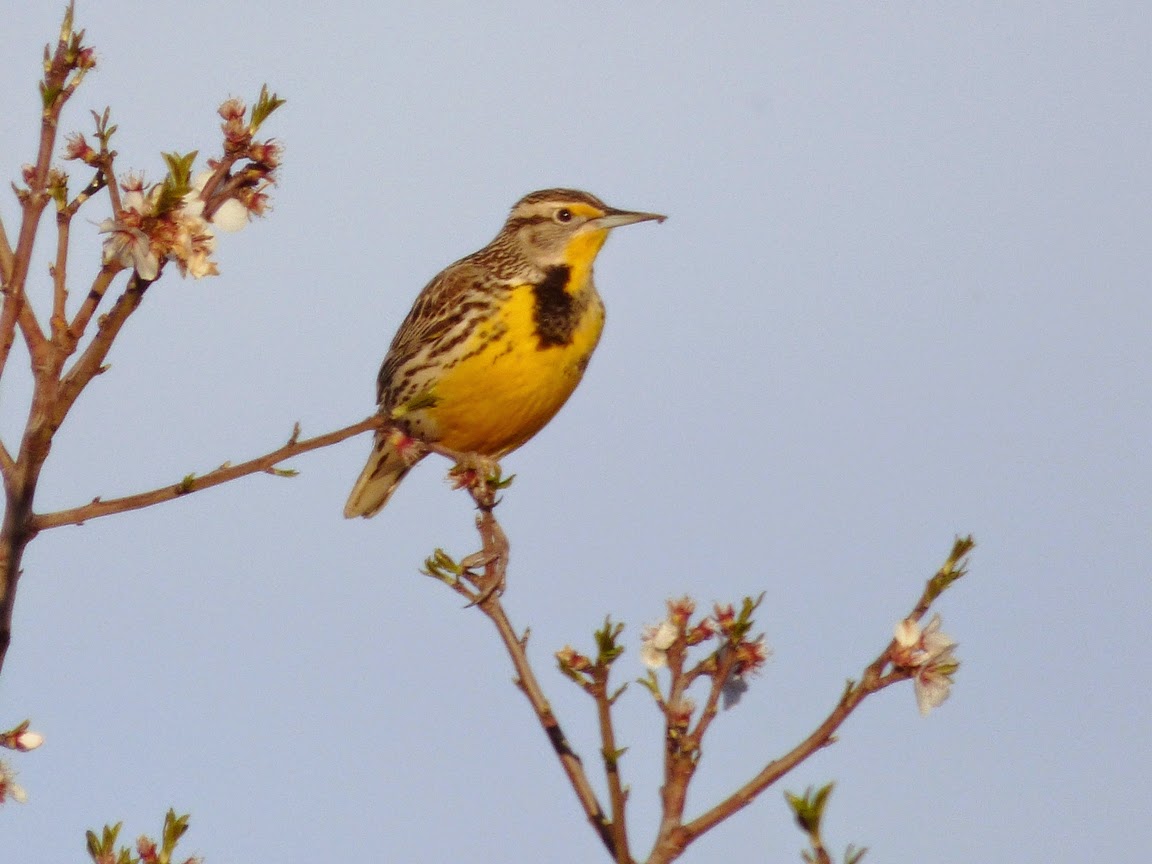
After torturing you with fuzzy indistinct photos of the Burrowing Owl I saw on Sunday in the prairielands, I thought it only fair to share with you one of the sharpest shots I've gotten lately, that of a Western Meadowlark (Sturnella neglecta) that was perched on a fencepost only a few hundred yards from where I saw the owl. It was hardly bothered at all that we stopped the car just a few yards away, as it was far more interested in catching the attention of the ladies
We were driving Willms Road south from Knights Ferry to take in the vernal pools, the birds, and hopefully some wildflowers. We had the windows down, and the song of the meadowlark could be heard along the entire distance. They are out in force this time of the year.

Sunday, April 2, 2017

Burrowing Owl on the California Prairielands at Willms Road

The California prairielands used to extend in an unbroken band across the lower reaches of the Sierra Mother Lode and the four-hundred mile long Great Valley. Today 95% of the prairie has been plowed or paved over, and much of the rest has been preserved intact only because ranchers use the land for grazing. Such is the case for the Willms Ranch area south of Knights Ferry on the Stanislaus River, and east of Oakdale. It's privately owned, but the grasslands stretch for miles, and a handful of country roads provide access. It's a favorite spot for Mrs. Geotripper and me to go birding.
The funny thing about today's trip is an ongoing joke (but not really a joke) where I insist that this is the day that I'm finally going to see a burrowing owl and get pictures. I saw a Burrowing owl out there perhaps a decade or two ago, and we can't pass the spot without looking for another. But we never saw one again, despite birder reports of their presence in the area. Until today, that is.
I stopped as I always do at one of the ephemeral creeks that crosses the road, and I inadvertently flushed out a bird that I didn't immediately recognize. It was larger than any of the sparrows or meadowlarks we had been seeing, but was too small to be a hawk. I kept an eye on the bird and saw it land in the distance under an alcove. It was a hundred yards or more away, so the chances of seeing anything weren't great, but I upped the zoom and scanned the alcoves, and there it was: a Burrowing Owl!
The pictures aren't of my preferred quality, but they were enough to confirm the bird's identity. The Burrowing Owls (Athene cunicularia) range the length of the western United States all the way into South America. They prefer open grasslands, and their population has suffered as the grasslands have given way to development, either of the orchard kind, or the urban kind. Their name comes from their preference for burrows, either excavated by themselves, or the various other denizens of the prairie.
So next time, I'm going to be more careful about scaring birds! Maybe there will be some clear shots...

Monday, March 2, 2015

Western Meadowlark on the California Prairielands


One of the most beautiful of bird songs is that of the Western Meadowlark (Sturnella neglecta). I have seen few of them during the winter months, when they spend a lot of time on the ground looking for bugs. They'll sing, but they won't show themselves all that much.

As the spring season arrives they become more visible as the males perch on fence posts and treetops to advertise for love and companionship. We took a drive out into what I call the California prairielands, an increasingly precious region that is losing ground to rapidly expanding (but unsustainable) almond orchards. One might notice the irony that our singing individual is perched on a young almond tree. We were on Warnerville and Willms Road east of Oakdale, are part of the prairie that is particularly beautiful right now (look for some views in a soon to be posted Geotripper blog post).

The Meadowlarks are beautiful birds (aren't most of them?) that range all across the west and midwest of North American continent. There is an Eastern Meadowlark that is barely distinguishable in appearance, but differs in song and feeding style. It is the state bird of six different states: Kansas, Montana, Nebraska, North Dakota, Oregon, and Wyoming.

The Meadowlarks have powerful jaws and sometimes feed by using a method called "gaping" where they stick their long bills in the soil and open their beaks to access seeds and bugs. The Cornell Lab of Ornithology offers additional information about these fascinating birds.

Our bird stayed still long enough to catch a few seconds of singing. Enjoy!