Showing posts with label Northern Harrier. Show all posts

Monday, January 13, 2020

The Birds of Del Puerto Canyon - A Place That Could Soon Be Damned

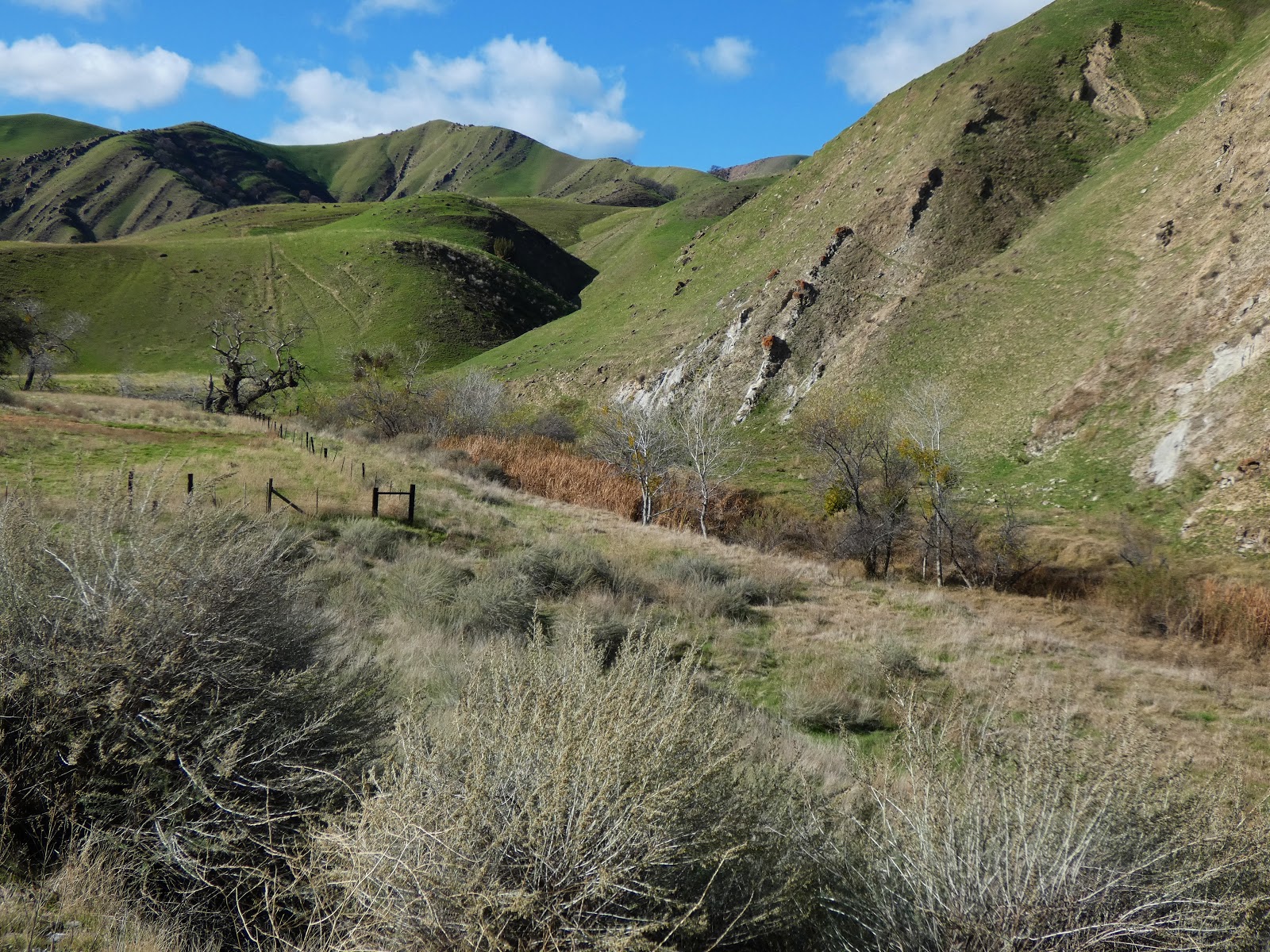
This portion of the canyon would be inundated by the proposed reservoir.

The Diablo Range is one of the principle "sub-ranges" of the California's Coast Ranges, running more than 100 miles from Highway 46 at Polonio Pass to the Sacramento-San Joaquin Delta. There are only a few major highways that cross the range, principally the Altamont Corridor and Pacheco Pass at San Luis Reservoir. There are a handful of state parks that preserve a portion of the range, mainly Henry Coe and Mt. Diablo, but for the most part the lands are privately owned and are given over mainly to grazing and ranching. Only one paved road provides access to the interior of the range north of Pacheco, and that is the winding route of Del Puerto Canyon.
Loggerhead Shrike


Del Puerto is the only public access to the mountain range in Stanislaus County, and as such is one of very few places where anyone can study the unique bird life (and many other animals) in this intriguing place. But now there are plans afoot to eliminate much of that access, and indeed to severely impact the natural environment. There are plans to build a large dam that will inundate five miles of the extraordinarily scenic canyon.
Savannah Sparrow

The canyon is one of the most important bird habitats in Stanislaus County, offering a significant variety of ecosystems, including riparian wetlands, grassland prairies, oak woodland, and a unique serpentine soil-based gray pine habitat. The eBird archives record more than 160 species of birds in the canyon
Killdeer
These pictures, some better, some worse, record two trips in the last year up into the canyon, when I didn't actually have a lot of time for actual birding. They serve to show the wonderful opportunities the canyon has for learning about the fascinating natural history of our region. The proposed dam would have a profound impact on the environment of the lower canyon.
Bullock's Oriole, a summer migrant in the canyon


Black-headed Grosbeak, another summer migrant


Western Tanager


Say's Phoebe in the lower canyon
Northern Harrier in the proposed dam site

Western Kingbird in the lower canyon


There will be many reasons offered as to why this reservoir is SO necessary, and how there will be SO many benefits. But the question needs to be asked, what is this taking away from all of us?

If you are on Facebook, check out https://www.facebook.com/groups/463664377903706/

Read the Environmental Impact Report at this link. If Del Puerto Canyon has significance to you, please respond and be active in the opposition! If you have expertise in any of the areas that will affected, you need to be heard from.

There are several important meetings and deadlines coming up very soon:

1/15 3:30pm Protest. Corner of Ward and Sperry
1/15 4:00pm Public Meeting. Hammon Senior Center 1033 West Las Palmas, Patterson
1/21 6:30pm City Council Meeting. 1 Plaza Circle. - request they take a stand, voice concerns
1/27 5:00pm Public Comments DUE. ahansen@delpuertowd.org OR Anthea Hansen PO Box 1596 Patterson CA 95363
1/28 9:00am Board of Supervisors Meeting 1010 10th St Modesto CA - voice concerns, they have final decision

Monday, November 18, 2019

Wild Day With a Northern Harrier at the Merced National Wildlife Refuge

The Northern Harrier (Circus hudsonius) is quite a challenge to photograph. They search for prey in marshes and wetlands by flying low over the vegetation listening for small mammals or birds. Their hearing is enhanced by their owl-like faces that direct sound to their ears. The problem is that they only seem to stop when they are pouncing on something down in the brush. We don't get many chances to see them up close. That's what made today so fun. Today the Harrier came to us.
We were following the auto-tour at the Merced National Wildlife Refuge when we noticed a bird in the water that was most un-ducklike. It was a half submerged Harrier! I've never seen one in the water like that before, but a little research revealed that they sometimes subdue their prey by drowning them. I don't know if that was what was happening, but it was a thrill to have it so close by (only 30-40 yards away). Then it surprised us even more by taking off and landing on a post even closer to the road. It pretty much didn't care that three cars were parked only a few yards away.

I never saw it carrying anything, but after a few moments it flew into some rushes and appeared to be eating something.

It's the closest I've ever been to one of these beautiful birds.

Thursday, March 16, 2017

It's a Bird! It's a Plane! It's an Owl! No, Wait, It's a Northern Harrier at the San Luis National Wildlife Refuge

We were at the San Luis National Wildlife Refuge south of Turlock on Sunday, and saw a number of interesting birds, though not the migratory birds like the geese or cranes. Instead, we were seeing more of the year-round inhabitants of the refuge. The most interesting sights on that particular day were the half dozen Northern Harriers (Circus cyaneus) who were patrolling the grasslands. It's looking to be a pretty good year for the predators. The plentiful rains have produced a bonanza of grass growth and expansion of the wetlands, which in turn leads to rapid population growth of the small rodents who are prey for the Harriers.

At first the Harriers were a challenge to photograph. They were flying in large circles and were moving too fast to capture easily. We finally saw a gray male circling a thicket and his movements were predictable enough that I caught some fairly sharp pictures by letting him fly into the frame. The Harriers are remarkably similar to owls with their flat round faces. The shape gives them a better ability to hear the small rodents in the grass ahead of them.

As we approached the end of the auto-tour, one of the Harriers finally landed in the grass. It stayed still long enough to get a few more shots. The females are brown instead of gray.

The Harriers range from Central America to Canada and the Arctic, depending on the season, and are also found in Europe. They are year-round residents in the Great Valley. They are fairly easy to identify in flight because of the owl-like head, and a distinctive white band at the base of their tail.

POSTSCRIPT 7/6/17: The Latin name of the Northern Harrier has been changed to Circus hudsonius

Wednesday, December 21, 2016

Northern Harrier at Oregon Dunes National Recreation Area

I haven't had many chances to catch pictures of Northern Harriers (Circus cyaneus). It's not that we haven't seen any, it's just that when we do, they are flying and swooping some distance away. It looked like it was going to be another of that kind of day today as well.

We were headed out towards the South Jetty of Oregon Dunes National Recreation Area to have a look at the pounding surf, and we saw a pair of birds flying low over the prairie grasses inland from the coast. I took them to be gulls out the corner of my eye but then realized they were flying differently.

In war movies, there's the occasional reference to flying beneath the radar, with planes skimming the surface and all, and that's what these birds were doing. They hardly ever went more than 10 feet off the ground as they soared across the landscape, appearing and disappearing around the high shrubs. I finally saw the flash of white at the base of their tails, and I knew they were Northern Harriers.
Still, it wasn't easy getting any pictures. One of them was actually paralleling the road, so we were able to follow it for more than a mile before losing it in the distant brush. We argued about whether to back down the road to see if it had circled back behind us but then I looked across the road through the window, and there was a Harrier perched on a log just a few yards away from us.
A bit fuzzy, but this was my best shot showing the owl-like face of the Harrier Hawk.
They have a short round face that strongly resembles an owl. In an evolutionary sense, this is an adaptation that enables the owls to hear sounds better, and the Harrier Hawks also depend a great deal on hearing for their hunting as they soar close to the ground. This sort of thing is called convergent evolution, when totally different organisms evolve similar features. Sharks and dolphins are examples of the same sort of convergence.

POSTSCRIPT (7/6/17): The scientific name of the Northern Harrier has been changed to Circus hudsonius

Sunday, April 24, 2016

Northern Harrier at the San Luis National Wildlife Refuge

It's been a long drought of birding trips. It's the very end of the semester when things are the most hectic, so things like exercise and meditative breaks at bird refuges have become rare. I got most of my grading for the weekend done, so as an afternoon reward, we headed down to the San Luis National Wildlife Refuge (Bear Creek Unit) to see what's going on now that the arctic birds have headed north. We spent several relaxed hours on the auto tours, and much to my delight, we got pictures of three new bird species to debut here on the blog. The first pictures are the least artistic, but they're the first I've taken of the Northern Harrier (Circus cyaneus) that are at all identifiable. The birds (there were several of them) were flying low and slow over the grasslands.
The Harriers are a little bit strange for a hawk, having a foreshortened owl-like face that allows them to hear their prey better in vegetation. They also have a distinctive white band on their backside that is a distinctive mark in identifying them at a distance, which is good because that is just about the only place I see them: at a distance.
I did a bit of searching, and it turns out that I did catch a few photos of a Harrier last fall at the Merced Unit of the San Luis National Wildlife Refuge. A little closer each time...maybe a nice sharp picture next time around.

POSTSCRIPT (7/6/17): The scientific name of the Northern Harrier has been changed to Circus hudsonius.