I love the moment when I realize the Cedar Waxwings are back. They are pretty much the most colorful bird that ever visits my home neighborhood. Based on my extensive observations (of one year duration), they come through our village, eat up as many berries and fruits as they can find, spend a few nights in my flowering pear tree, and then move on.
The Cedar Waxwings (Bombycilla cedrorum) breed in Canada and otherwise spend summers north of my Great Valley town. They will winter as far south as Central America, according to the Cornell range maps. The name "waxwing" derives from the bright red waxy deposit on their wingtips (best seen in the photograph above).
In a way, the Cedar Waxwings paved the way to my starting this blog. I've been blogging over at Geotripper for something like six years, and birds were beginning to make more and more appearances on a blog that I mostly devoted to geological subjects. I actually apologized in this blog post post about Cedar Waxwings for putting in too many bird posts (no one was complaining, mind you). As my catalog of avian photographs grew, I realized I wanted to start a separate blog for my new-found hobby. The nice thing about blogging is that you don't have to be an expert, so here you have it, an amateur bird journey.
The Waxwings can pretty much survive solely on fruits and berries, which has two profound effects on their well-being. Cowbirds will sometimes lay eggs in Waxwing nests. Like many other birds, the Waxwings won't recognize that the big chick isn't one of their own, and will feed them. Unfortunately, the Cowbird chick can't thrive on fruit alone, and often dies. On the other hand, some fruits will start to rot and ferment. Cedar Waxwings have been known to get drunk, much to their detriment (just like human drunks!).
The Waxwings are gregarious and gather in fairly large flocks. There were at least sixty or seventy of them in the two trees I was standing under this morning. A similar number of them roosted in my flowering pear tree last January. I have to admit that they creeped me out just a little back then. I had pulled up in the driveway after a late evening at the lab when something made me glance up. They weren't making a single sound, or moving, but sixty or seventy birds were staring at me. I had a brief moment of Hitchcockian angst. All was forgiven the following morning when they gamely let me photograph them from a close angle.
I hope they'll hang out a bit longer and find their way two blocks to my front-yard tree. They are such gorgeous birds!
Showing posts with label the pasture. Show all posts
Saturday, December 6, 2014
Monday, November 17, 2014
Bird of the Day: Budgerigars in the Pastures!
This morning's walk had a big surprise. For a year I've been walking around the pasture a few blocks from my house looking for native species to photograph. I've seen 35-40 species so far, but today there was such a bright flash of fluorescent green and blue that I knew I as seeing something new.
It was immediately evident that I was not looking at a native species, because the only native parrots in the United States were extirpated nearly a century ago (the Carolina Parrot and the Thick-billed Parrot). There is a chance we may one day see the Thick-billed Parrot in the wild again, but the Carolina Parrot is gone forever. The birds in the pasture today are obviously Budgerigars (Melopsittacus undulatus), or the Common Parakeet. They are clearly escaped or released pets, because they are native to Australia.
I have no idea if this pair is naturalized or feral. It seems to me I would have noticed if they'd been around over the last year. Normally I'd be concerned about feral non-natives, but as many birders point out, these are birds that are occupying habitats made by human intervention. The native birds are already gone for the most part in the urban environment, and the parrots would disappear if we did.
In any case, the two birds I saw today provided a bright splash of color on an overcast gloomy day. I was cheered because the two were together. They are social birds, and I have a lot of empathy for any creature that is alone and separated from others of its kind.
Wednesday, November 5, 2014
Bird of the Day: Another Foreigner, the Eurasian Collared Dove
In the mid 1970s, the Eurasian Collared Dove (Streptopelia decaocto) was only present in the western hemisphere as a pet. In Bermuda, the burglary of a bird shop led to the release of several doves, and for some reason the owner let the other 50 go. In the 1980s, the first Eurasian Collared Doves arrived in Florida, and now have spread across the continent, except for the Great Lakes and New England. They were in California by 2001.
I've only been at this for about a year, so I thought the doves in my neighborhood were all of the mourning kind, but I've come to realize that most of them are the Eurasian species. It's not clear if they have displaced other birds the way the European Starlings have, though. The doves are mostly taking advantage of food sources related to urban and suburban development, including feeders.
I remember the most stunning fact of birding on the Hawaiian Islands is how hard it is to actually see the native species there. The escaped pets and accidental/purposeful introductions of invasive species have simply overwhelmed the natives in the urban parts of the islands. The rapid spread of the Starlings and Collared Doves in the continental United State is concerning.
In any case the doves, if not exactly tame, are tolerant of walkers with cameras and are usually easy to photograph. I caught the first image this morning while walking in the pasture near my house. The second picture was taken in December around the same field. The birds are apparently permanent fixtures around here, despite their fairly recent arrival. And they are pretty to look at.
I've only been at this for about a year, so I thought the doves in my neighborhood were all of the mourning kind, but I've come to realize that most of them are the Eurasian species. It's not clear if they have displaced other birds the way the European Starlings have, though. The doves are mostly taking advantage of food sources related to urban and suburban development, including feeders.
I remember the most stunning fact of birding on the Hawaiian Islands is how hard it is to actually see the native species there. The escaped pets and accidental/purposeful introductions of invasive species have simply overwhelmed the natives in the urban parts of the islands. The rapid spread of the Starlings and Collared Doves in the continental United State is concerning.
In any case the doves, if not exactly tame, are tolerant of walkers with cameras and are usually easy to photograph. I caught the first image this morning while walking in the pasture near my house. The second picture was taken in December around the same field. The birds are apparently permanent fixtures around here, despite their fairly recent arrival. And they are pretty to look at.
Thursday, October 30, 2014
Bird of the Day: California's Endemic, the Yellow-billed Magpie
Today's bird is one of my favorites. The Yellow-billed Magpie (Pica nuttalli) is found only in California, mostly in the Great Valley, making it one of the few truly endemic bird species in the state. Some of the others include the Nuttall's Woodpecker (whose range includes a bit of Baja), and the Island Scrub Jay which lives only on Santa Cruz Island in Channel Islands National Park.
The Yellow-billed Magpie closely resembles the Black-billed Magpie that is widely distributed across western North America, except that it has...a yellow bill (and yellow eye-rings). The birds are genetically close, but were isolated from each other by the Sierra Nevada Mountains during the ice ages, perhaps a few hundred thousand years ago.
The birds survived a near-miss a decade ago when the West Nile Virus arrived in California. Nearly half the population was killed off in just two or three years, dropping from an estimated 180,000 individuals to only 90,000 or so. The survivors had some resistance to the virus, so the population has rebounded in recent years. It would have been a real shame to lose these beautiful and unique birds. I've enjoyed watching the flocks in my neighborhood pasture and on the west campus as well.
The last picture is not a great one (I'm working on getting a better one), but the birds in flight remind me of one of the most ancient of bird species, the Archaeopteryx. There is no close relationship, but the long tail feathers make me think of the long boney tail of the Jurassic creature that resembled the transitional species that led from dinosaur to bird (the Archaeopteryx also had teeth, a trait that only appears in bird embryos these days). I guess I'm not the only one to notice, because when I referred to the Wikipedia article on the ancient birds, they also noted the resemblance.
The Magpies on campus and in the pasture are usually pretty suspicious of me (a good trait), so I was pleased when they hung around during my walk earlier this week in the pasture near my house, and again on Tuesday when I walked the West Campus perimeter. There are several dozen individuals in each flock, which is an improvement over the last few years. It had got way too quiet when the virus was destroying the flocks. I'm glad they're back. Look to see them again soon on these pages.
The Yellow-billed Magpie closely resembles the Black-billed Magpie that is widely distributed across western North America, except that it has...a yellow bill (and yellow eye-rings). The birds are genetically close, but were isolated from each other by the Sierra Nevada Mountains during the ice ages, perhaps a few hundred thousand years ago.
The birds survived a near-miss a decade ago when the West Nile Virus arrived in California. Nearly half the population was killed off in just two or three years, dropping from an estimated 180,000 individuals to only 90,000 or so. The survivors had some resistance to the virus, so the population has rebounded in recent years. It would have been a real shame to lose these beautiful and unique birds. I've enjoyed watching the flocks in my neighborhood pasture and on the west campus as well.
The last picture is not a great one (I'm working on getting a better one), but the birds in flight remind me of one of the most ancient of bird species, the Archaeopteryx. There is no close relationship, but the long tail feathers make me think of the long boney tail of the Jurassic creature that resembled the transitional species that led from dinosaur to bird (the Archaeopteryx also had teeth, a trait that only appears in bird embryos these days). I guess I'm not the only one to notice, because when I referred to the Wikipedia article on the ancient birds, they also noted the resemblance.
The Magpies on campus and in the pasture are usually pretty suspicious of me (a good trait), so I was pleased when they hung around during my walk earlier this week in the pasture near my house, and again on Tuesday when I walked the West Campus perimeter. There are several dozen individuals in each flock, which is an improvement over the last few years. It had got way too quiet when the virus was destroying the flocks. I'm glad they're back. Look to see them again soon on these pages.
Thursday, October 23, 2014
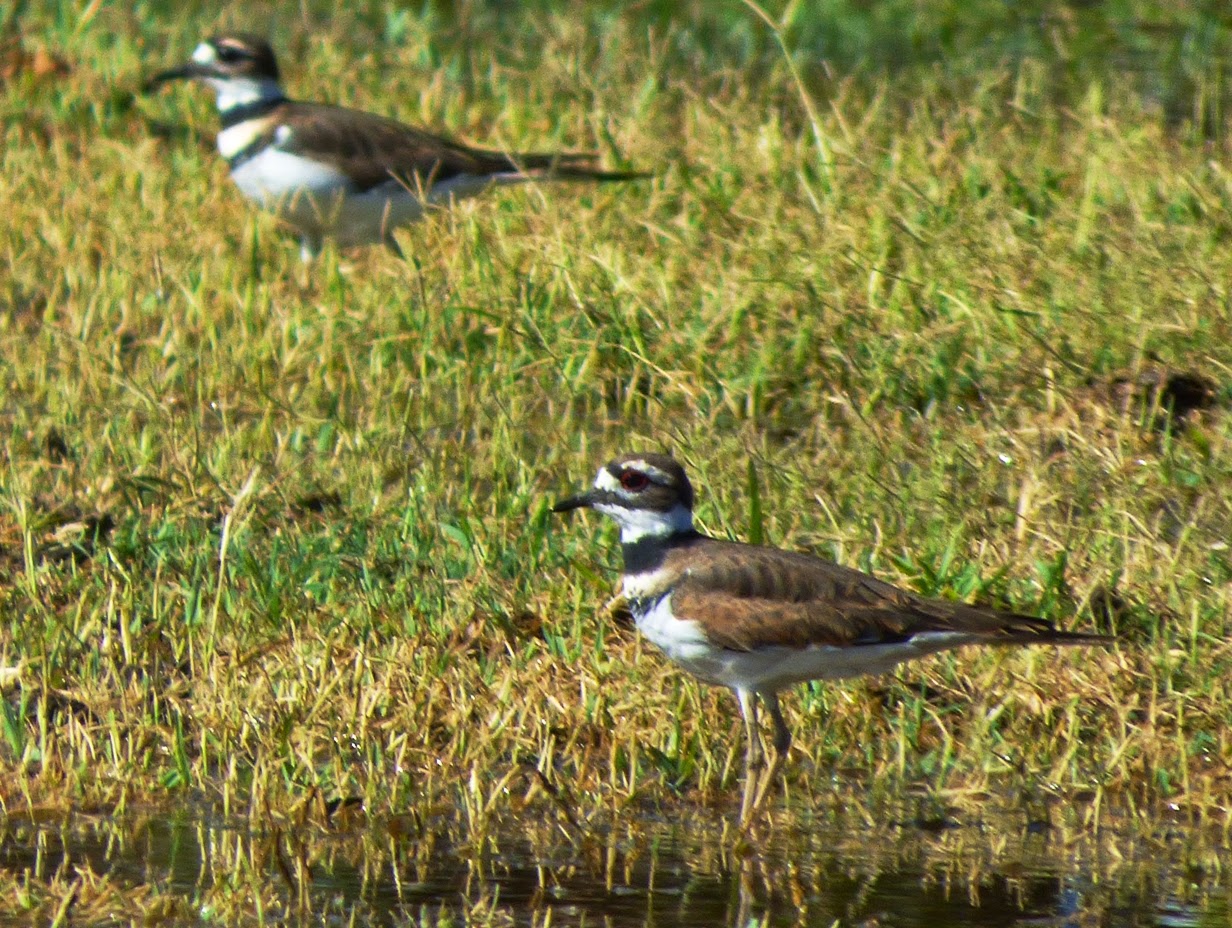
Bird of the Day: Killdeer in the Pasture and the West Campus
The Killdeer (Charadrius vociferus) is one of the most distinctive and common birds I see out in the pastures near my house, along the irrigation canals, and on the West Campus of my school. They are a member of the Plover family, but given the arid nature of our valley, they are often a long way away from water.
I just love their huge orange-rimmed eyes!
They build nests on the ground, which seems kind of precarious, but the birds are masters of distraction when predators come around. They do the "broken-wing" ploy better than just about any other bird.
The birds are abundant across the country, and do well in areas preempted by humans, so they are not considered endangered in any particular way, though their populations have declined by 30% or so in the last forty years.
Their distinctive call (a "kill-deer" sound) and their erratic movements make them among the most watchable birds I see when I am out walking. I think of them as one of the clowns of the avian world, but that's just me anthropomorphizing. Mostly, they are just beautiful birds.
Wednesday, October 22, 2014
Bird of the Day: Nuttall's Woodpecker in the Pasture II
I was walking around the pasture this morning and the Western Bluebirds were out, hanging around on the fence that surrounds the pasture near my house. One of them didn't fit the color pattern and I realized it was a Nuttall's Woodpecker (Picoides nuttallii) searching the fenceposts for goodies. As I mentioned in the previous post on woodpeckers, Nuttall's Woodpeckers are pretty much an Alta California endemic, with a
bit of their range slipping south of the border into Baja California.
They hang out almost exclusively in oak woodlands but don't eat acorns.
They are after insects and other arthropods and occasionally some fruit.
This might be the same individual I photographed at the beginning of the month, but I was unhappy with those shots. Some of these are still just a bit fuzzy, but I liked catching these poses of the bird exploring and checking out the stuff on the fence.
I had sat down on the curb across the street to take the pictures, and he only acknowledged me once, staring from around the post.
He went along exploring and eventually flew up into the old Walnut tree and out of sight. My walk continued. It's been a good couple of days for birdwatching!
I had sat down on the curb across the street to take the pictures, and he only acknowledged me once, staring from around the post.
He went along exploring and eventually flew up into the old Walnut tree and out of sight. My walk continued. It's been a good couple of days for birdwatching!
Tuesday, October 14, 2014
Bird of the Day: Return of the Western Bluebirds to the Campus and the Pasture!
One of my favorites seems to have returned to the region, presumably coming down from the foothills of the Sierra Nevada. I haven't seen the Western Bluebirds (Sialia mexicana) in a couple of months, but yesterday I saw the one in the picture above down the street from my house, and this afternoon I saw a bunch in the agriculture area of our west campus. It's a delight to have them back! As they get used to the student traffic on campus I expect to get less fuzzy shots in coming weeks.
Monday, September 15, 2014
Bird Watching in (Semi) Urban Settings, Part One: The Pasture
I don't live in a very interesting place, especially for a geologist. It's a flat valley floor (a corner of California's Great Valley) given over to agriculture and urban development. It might have once been an open prairie, but today it consists of a small farming town east of Modesto surrounded mostly by almond orchards and corn fields. On the whole, it isn't much of a place for finding birds.
When I started my new hobby of photographing bird species, I wasn't expecting much in my own backyard. When I was walking around the neighborhood for exercise I started to realize that a surprising number of birds were living within a few blocks of my house, especially in the pasture between my house and the local elementary school. It was once slated to become a housing development, but the recession put an end to those plans, so a small herd of cows continues to graze there.
Orchards, with row after row of the same kind of tree, don't make for particularly good habitat, and neither do houses. But the pasture offers grasses and insects, and a variety of trees around the edges (walnut, oak, sycamore, and a few ornamental sequoias) provide shelter. An irrigation canal runs through the middle of the pasture, providing water through the summer (rainfall leaves puddles in the canal during the winter).
The number and variety of birds varies with the seasons. The migratory species pass through occasionally, and I saw the greatest variety in the spring. The fewest birds were in the driest dustiest part of summer. I'm looking forward to seeing the changes coming up this fall (and hoping for some early rainstorms to break up the horrific drought).
I've seen six bird species at the feeders in my yard: House Finch, Lesser Goldfinch, Western Scrub Jay, Western Mockingbird, and Anna's Hummingbird. Within a week or two of walking through the pasture and along the irrigation canal the species count for my neighborhood was up to more than twenty.
What's the take from this? No one could ever mistake my little suburban pasture as an exciting place (notice how I picked sunset shots to dress it up). But it is a wonderful thing to know that an adventure of sorts lies just beyond my neighborhood block, and such a principle is probably true for most people wherever they may be living. Urban jungles still have some green space, and some hint of the original diversity of birds species may be found there. I have two or three other sites that have revealed some interesting bird sightings. I'll review them shortly in another post.
I'm intending to follow up with what I've been doing to my poor friends on Facebook and make a nearly daily posting of the latest bird sightings, which will include oftentimes the same birds (I'm actually starting to recognize some of them). So here are two of yesterday's birds, common visitors in the pasture: Killdeer (Charadrius vociferus). There were a dozen or more searching for bugs in the flooded corner of the pasture. Their call has become a familiar sound on my walks.
Subscribe to:
Posts (Atom)


%2Bin%2Bthe%2Bpasture.jpg)