Showing posts with label Lava Beds National Monument. Show all posts

Wednesday, October 3, 2018

Because the Ice Machine Broke, Here's a Townsend's Solitaire...

I guess that title requires a little bit of explanation. Townsend's Solitaires (Myadestes townsendi) are birds of the conifer forests of the montane west of the United States and Canada. I don't get to see them very often since I live near sea level on the floor of the Central Valley. Last weekend I was at Lava Beds National Monument in the far north of California near the border with Oregon (south of Klamath Falls), which is one of the few places I've seen them regularly.

The problem with Lava Beds is that the monument and the lava flows it protects has no surface water. Rain and snowmelt drain into fractures and fissures in the basalt, so with the exception of some ice pools in the bottom of a couple of lava tubes, birds have no water unless they fly several miles to the Tulelake basin. I've therefore had some great birding experiences in the park campground near the water spigots because the birds gather there in the morning for a drink. This time, though, I was at the visitor center and I didn't expect to see many birds out and about.
But there were. There were at least a half dozen Townsend's Solitaires flitting about, and I soon realized why. The ice machine outside the building was broken, so the park staff had taken the bags and blocks of ice and scattered them into the sagebrush next to the building to melt. And the birds loved it. I was standing there waiting to speak with a ranger about something, and the birds were landing all around me getting drinks, barely heeding the fact that I was only 6-7 feet away.

Monday, July 31, 2017

Common Nighthawk at Lava Beds National Monument


A little over 140 years ago, a bitter war was fought between the U.S. military and a small band of Modoc warriors over their desire to return to their ancestral homeland on the shores of Tule Lake in northeastern California. The Modoc people, around 50 warriors and another 100 elders, women, and children, faced off for six months against at least 600 heavily armed troops. They lost in the end, and much of their culture was lost in the ensuing forced migration to Oklahoma. It was a sad affair, and not nearly as well-known as it should be (I've written about the wars here and here).
The Modoc people spent months resisting the troops in a corner of what is now Lava Beds National Monument. The site is called Captain Jack's Stronghold, and it is a haunted place. We were there last June, looking at how geology influenced the nature of the battles that took place here. A fire burned through a couple of years ago, leaving behind only a few junipers in a copse at the trailhead parking area. I had a feeling there might be a few interesting birds hiding among the branches, and a bit of looking proved me right. There were at least two Common Nighthawks (Chordeiles minor) roosting in the trees.
One can tell from their appearance that they are not actually hawks. They have neither the talons or the beak of a raptor. I've seen a fair number of nighthawks over the years, but usually in flight at dusk or dawn when they are hard to photograph. They are real acrobats in the air, swooping and soaring after insects. They are graceful in the air, and relatively clumsy on the ground. When they are not flying, they hide out in heavy foliage where they blend in (and they were indeed hard to pick out among the shadows in the junipers. The nighthawks are summer visitors to North America. They winter all the way down in South America during the winter, which means they have one of the longest migrations of any American bird.


If you live in North America, you've probably seen the Common Nighthawk. They can fly in an erratic manner much like bats, but they are larger, and have prominent white bars on their wings.

Tuesday, October 20, 2015

Yellow-rumped Warblers at Lava Beds National Monument

It was almost surreal watching the parade of different species visiting the water spigots in the campground at Lava Beds National Monument. As has been mentioned before, there are few open sources of water in the park, so the birds congregate at the campground in the mornings. There was some sort of pecking order, as one species would be drinking, they would leave, and then another would appear. We've already seen the Pinyon Jays, the Townsend's Solitaires, the Red Crossbills, and the Robins. In today's post we see the Yellow-rumped Warblers (Setophaga coronata). Their activity that morning highlighted an unfortunate problem at the campground.
I can't find any clear record of whether they like to eat mistletoe berries, but the warblers I saw in the campground certainly seemed to be foraging in the mistletoe clinging to the Juniper trees in the campsite. The mistletoe was the problem.

A bunch of American Conservation Corps (or YCC, I can't remember) workers were planting trees in the campground. When I asked, they pointed out that mistletoe was killing off most of the Junipers that provided shade in the camp, and so they were planting native Ponderosa Pines that will someday replace the dead Junipers.
The mistletoe berries provide a nutritious food source for the birds, but the birds also spread the sticky seeds from tree to tree. I imagine that a balance is usually maintained, but during the drought, the trees may not be able to fight off the parasites. That's my speculation, anyway.  In the meantime, it was delightful following the brightly colored birds throughout the morning in the camp.

Sunday, October 18, 2015

Townsend's Solitaire (but not so solitary) at Lava Beds National Monument

Water, or more accurately, lack of water makes for strange bedfellows. Lava Beds National Monument in Northern California is really a semi-arid climate, supporting a forest of Pinyon, Juniper and Ponderosa. But surface water is practically non-existent because precipitation sinks into the fissures and cracks that are characteristic of basalt lava flows.
As we've been finding over the last three posts, there is a secure source of water in the monument, at the campground faucets. We were awakened each morning of our recent visit at Lava Beds with the chattering of different kinds of birds waiting for a chance at the water. We've already seen the Robins, the Red Crossbills, and the Pinyon Jays. Today's bird is the Townsend's Solitaire (Myadestes townsendi), which I've only seen once before.
Sibley's guide had this to say about the Solitaire: "Usually solitary, perching inconspicuously in trees". The lack of water seems to have changed that metric. I counted at least half a dozen Solitaires perched conspicuously in the top branches of the Junipers in the campground waiting for their turn at the water.
The bird is also described as "uncommon", but they certainly seemed common enough that morning in the campground. They no doubt spread out widely during the day, looking for looking for juniper berries or mistletoe. 
There were lots of birds at Lava Beds and Tulelake National Wildlife Refuge. After a slow summer for birding, I've now got a serious backlog of bird sightings to share. More to come!

Friday, October 16, 2015

Pinyon Jays at Lava Beds National Monument

It was such an intriguing morning. There are few sources of water in Lava Beds National Monument, as what little water there is sinks into the fissures and cracks of the lava flows. One secure source is the collection pit beneath the water faucets in the park campground. When the sun came up, we were greeted with the cacophony of birds waiting their turn at the water. They seemed to follow a pecking order as the species seemed to change every few minutes. We've already seen the Robins and Red Crossbills. Soon after they took off, a large flock of boisterous Pinyon Jays (Gymnorhinus cyanocephalus) arrived and took their turn at the water.
Pinyon Jays are creatures of the Pinyon-Juniper woodlands. They've been seen in our county, but not by me. This was my first encounter with them since I began birding. They're smart and social birds, often traveling in large flocks. They mostly eat pine seeds and spend a lot of time hiding them. They are a threatened species because their favored habitat is threatened. Hundreds of thousands of acres of Pinyon-Juniper woodland has been stripped and burned across the western United States in an effort to increase grazing acreage for ranchers.
The Pinyon Jays have some evolutionary adaptations that help them utilize their favored food supply. They have a long strong bill for probing cones for seeds, and lack feathers over their nostrils, allowing them to deal with sap in a more efficient manner.
They are beautiful birds. There were a few others that morning in the bird parade. Watch for future posts!

Thursday, October 15, 2015

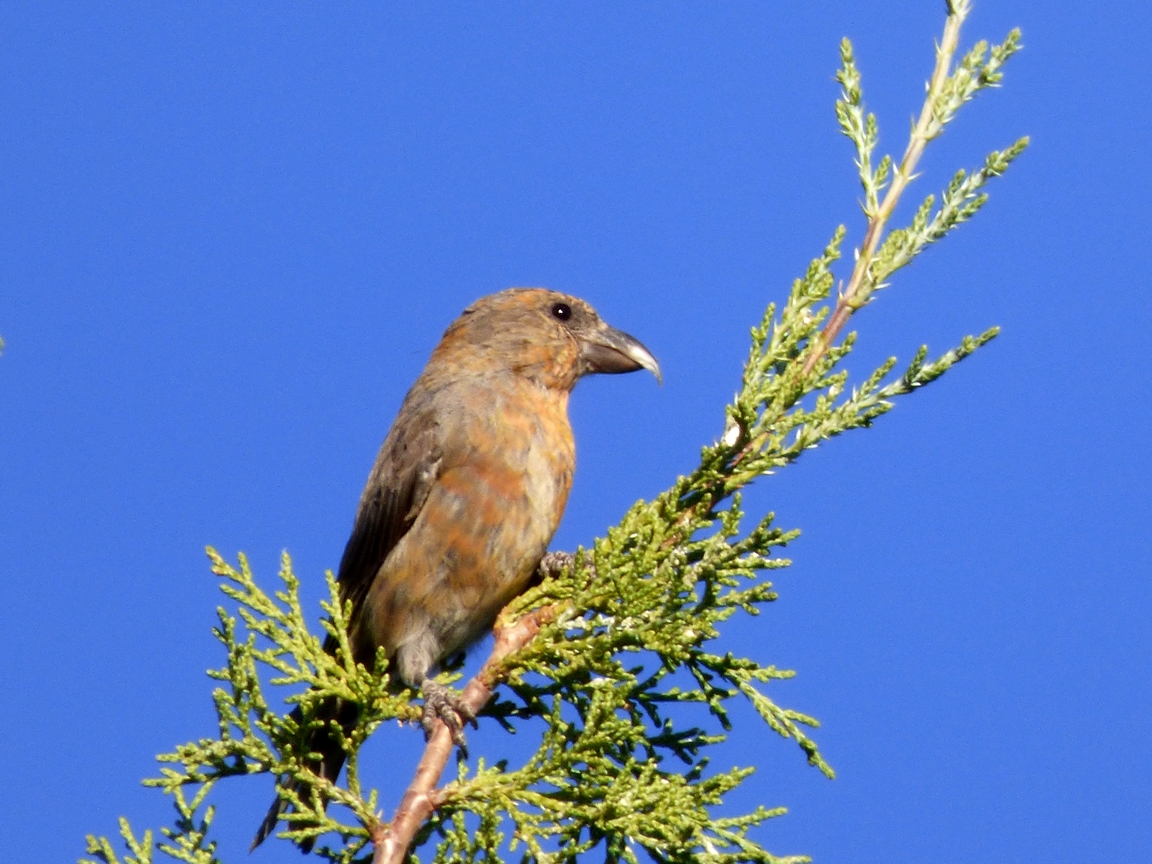
A (Not So Very) Red Crossbill at Lava Beds National Monument

Continuing a short series around the campground water faucet, we are showing off the Red Crossbill (Loxia curvirostra). These are the birds who were making use of the only secure source of water in Lava Beds National Monument (there are no surface streams because precipitation sinks into the joints and fissures of the lava flows). The first post of the series featured an American Robin.
I've only seen the Red Crossbill once before, in the White Mountains of eastern California. I didn't recognize these birds at Lava Beds because they were far up the trees and they weren't red (these are juveniles and lack the bright red color), and I couldn't make out the crossed bills. I thought they were some kind of finch (they are actually in the finch family), but a birder in the campground mentioned their identity as he walked by.
The crossbills take their name from their uniquely evolved beak. It looks broken or offset, but it actually allows them to pry open conifer cones, allowing them to reach the seeds inside. They are completely dependent on cones for their survival, so they migrate to places where cones are ripening, and can breed at any time of the year if food is available.

Monday, October 12, 2015

American Robins at Lava Beds National Monument

Lava Beds National Monument in the far northern reaches of California is a unique park for many reasons, biologically and geologically. And sometimes both. The park is "nothing more" than a vast field of geologically recent lava flows (I say "nothing more", because to a geologist like me, that's all the justification one needs to make a park out of it). The lava flows are honeycombed with lava tubes and craters, cinder cones and pressure ridges, and historical sites dating from the Modoc Indian Wars.
There's one thing the park doesn't have: water. Although the region is semiarid, it gets enough snow and rain to support growths of Ponderosa and Pinyon pines. But the water that falls on the surface quickly sinks into the joints and fractures that are pervasive in the basalt flows. There are no rivers, streams or lakes. That can make life difficult for the various animals that would normally inhabit these environments. One of those species are human beings. The Modoc people were able to utilize the waters of Tulelake at the north end of the monument. The lake is gone now, converted to agricultural fields, but park visitors can find water at faucets in the campground. It's pumped from a thousand-foot well. The water spills to the ground, and the local birds know all about it. They gather in the morning at the monument campground and take turns getting a drink. I didn't know this until I heard the caterwauling early in the morning while I was trying to sleep.
I got my camera and took a seat near the water faucets and saw a parade of birds, some of which were new to me. But not this one. The American Robin (Turdus migratorius) is one of the most familiar birds in North America. But that doesn't take away from their attractive appearance.
These birds were high up in the Cascades in September when I took these pictures, but they might be part of a migratory group that will arrive in the Great Valley in the next few weeks. Hundreds of them wintered in the mini-wilderness on our campus last year.

There were three more species waiting for water those mornings at Lava Beds. Look for the others in future posts.

Thursday, October 1, 2015

A Hermit Thrush on California's Largest Volcano

We had a marvelous trip over the weekend through the volcano country of Northern California. Part of the fun was exploring some new places and seeing all kinds of birds, including this Hermit Thrush (Catharus guttatus) near the summit of Medicine Lake Highland, the largest volcano in California. It was a quick shot off the side of the road, and it was gone.
Medicine Lake Highland (or the Medicine Lake Volcano) is barely half the height of Mt. Shasta, but it is much wider, and contains around 130 cubic miles of lava flows, compared to Shasta's 108. It is a shield style volcano, similar in outline to the gigantic basalt mountains that make up the Big Island of Hawai'i, but it is composed of a variety of lavas, including rhyolite and andesite. The mountain is covered by deep forests and barren lava flows, providing a variety of environments for birds.
Medicine Lake Highland is the broad dome in the distance on the center-left. Shasta can be seen in the distance on the right.