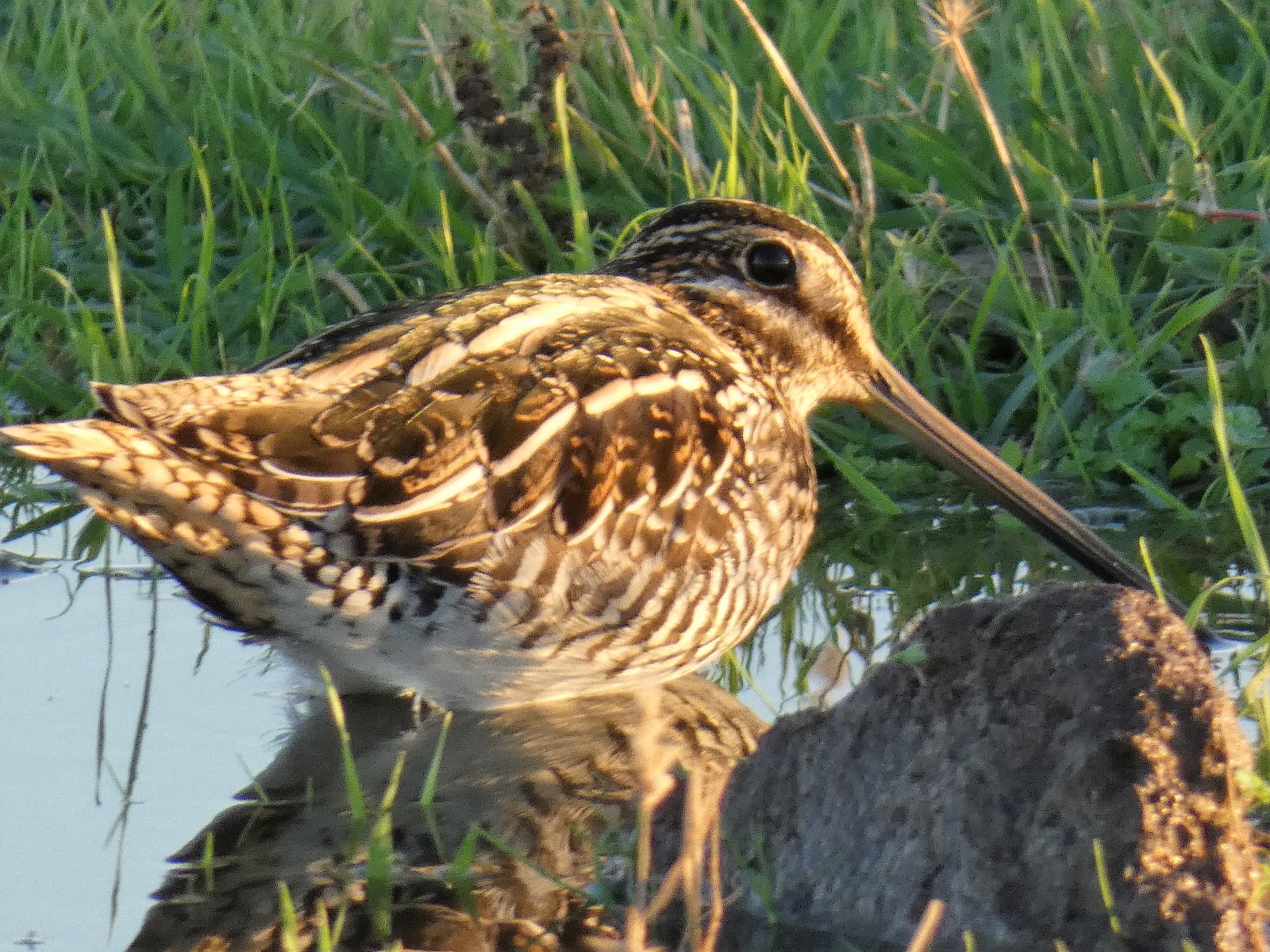
One of the more enduring pranks throughout the history of scouts and summer camps was the Snipe Hunt. The gullible victims were convinced that they could capture the elusive snipes in paper bags, and the snipe was described as all manner of strange birds, squirrels, rabbits and so on. We victims of the prank are sometimes surprised to find out that snipes actually do exist, although we are not likely to capture them in the dark in a paper bag on the night of a full moon. The birds are called the Wilson's Snipe (Gallinago delicata). The Wilson's Snipe is a shorebird with an incredibly long beak that gives them the ability to probe deep into the mud seeking worms and larvae.
My own personal snipe hunt last weekend at the Merced National Wildlife Refuge came to a memorable end as the quarry was hiding in plain sight not four feet from my car window. I was paying attention to the Sandhill Cranes and ducks off in the distance, and I happened to look down as I was turning the camera off only to see the bird relaxing in the grass at the edge of the pond. It never felt the need to move around at all while I took pictures.
Showing posts with label Wilson's Snipe. Show all posts
Tuesday, October 22, 2019
Wednesday, October 31, 2018
It's a Snipe Hunt! I Found Mine at the San Joaquin River National Wildlife Refuge
When I was a scout back in another era we often introduced the new guys to our trip by conducting a snipe hunt, chasing imaginary birds with paper sacks in the dark. For some reason we never caught any. I had no idea at the time that snipes actually existed, but they do.
I was out at the San Joaquin River National Wildlife Refuge the other day looking for migrant geese. I certainly found some at the viewing platform on Beckwith Road, several thousand Aleutian Cackling Geese, Sandhill Cranes, and even a handful of Snow Geese.
There is no open water at the Beckwith Viewing Platform except in the great distance, so it isn't the best place to be searching for shorebirds. But on the way east along the access road there are a few seasonal ponds that are good for birdwatching. This time around my search for a Wilson's Snipe (Gallinago delicate) was successful, although to be honest I didn't know I was searching for it. Six of them were feeding in the mud along the shoreline of the pond.
One of the more noticeable features of the snipe is the location of their eyes in the middle of their skull. This arrangement allows them to see behind as well as ahead. They can see a predator coming from far off, which goes a long way towards explaining why our snipe hunts were never successful all those years ago.
| Two Wilson's Snipes with a Greater Yellowlegs |
Wednesday, March 18, 2015
Wilson's Snipe at the San Joaquin National Wildlife Refuge
I've actually seen or identified several birds this week for the first time. One or two of them resulted from a first time trip over the Diablo Range on the "short cut" that leads from San Jose to Patterson in the Central Valley (note: it is, and never was, a short cut). The other was my quick trip out to the San Joaquin National Wildlife Refuge on Beckwith Road. There was little going on at the parking lot (they were plowing the fields, so no birds were hanging around). But there is a pond along Beckwith Road a half east of the viewing platform, and there were some unfamiliar birds hanging about.
I may have a picture or two in the archives of a Wilson's Snipe (Gallinago delicata), but I haven't gotten as far as identifying one yet, so this is a first. The Snipes are a mythical legend from my Boy Scout days of long ago. Our hazings were far less violent than any fraternities, and mostly consisted of "snipe hunts", going out in the darkness with a paper sack trying to convince the Tenderfoots that they could catch a snipe in their bags. I never suspected that the bird actually existed!
The Snipes are not uncommon, but they are shy and well-camouflaged, so are not seen all that often. With their incredibly long bill, they are obviously well-adapted for searching for tidbits in deep mud pools. Their eyes are set farther back in their heads, so they can in effect see threats coming from behind. Like your third-grade teachers, they have eyes on the back of their heads!
I may have a picture or two in the archives of a Wilson's Snipe (Gallinago delicata), but I haven't gotten as far as identifying one yet, so this is a first. The Snipes are a mythical legend from my Boy Scout days of long ago. Our hazings were far less violent than any fraternities, and mostly consisted of "snipe hunts", going out in the darkness with a paper sack trying to convince the Tenderfoots that they could catch a snipe in their bags. I never suspected that the bird actually existed!
The Snipes are not uncommon, but they are shy and well-camouflaged, so are not seen all that often. With their incredibly long bill, they are obviously well-adapted for searching for tidbits in deep mud pools. Their eyes are set farther back in their heads, so they can in effect see threats coming from behind. Like your third-grade teachers, they have eyes on the back of their heads!
Subscribe to:
Posts (Atom)