Showing posts with label Black-chinned Hummingbird (Archilochus alexandri). Show all posts

Monday, August 27, 2018

The Flying Jewels of the Tuolumne River, the Hummingbirds


Our local environment hosts around five species of hummingbirds, although the Calliope or Costa's Hummingbirds have rarely been sighted (especially not by me). But hummingbirds are common in the area, as the moderate climate provides at least some food during the winter, and plentiful food during other parts of the year.
The Black-chinned Hummingbird (Archilochus alexandri) is a summertime visitor, and they've been regulars at our backyard feeders. I was sitting on the porch last evening and had this one checking me out. They are characterized by...a black chin! But it is the purple iridescence of their head and neck feathers that makes them look like flying amethyst crystals in the right light. I've only caught the color a few times in images.
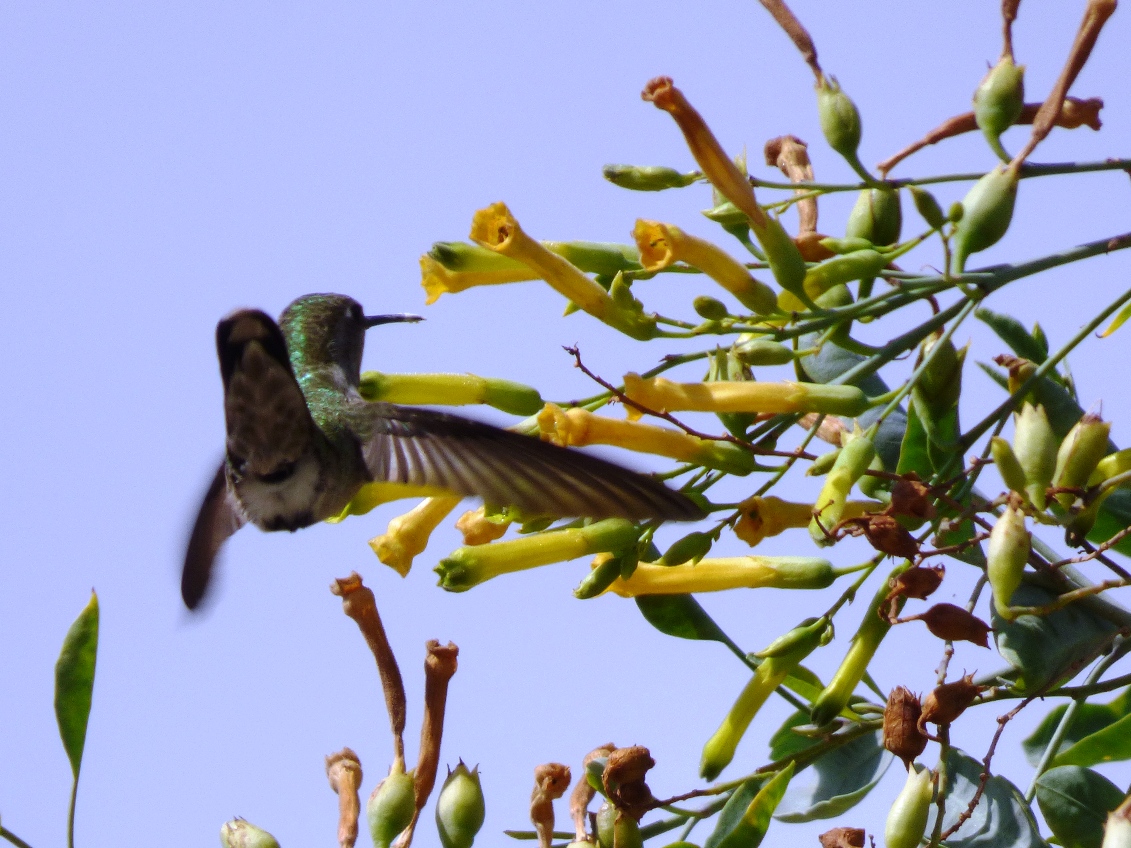
The Rufous Hummingbird (Selasphorus rufus) is a fall and spring migrant in our region. The rich golden color is distinctive. They've been reported at only four other locations in our county so far this fall, but I've been following a small crowd of them in the wild tobacco shrubs near the Waterford water treatment plant, and a little ways downstream. I saw the first ones on August 7, and they are continuing to argue with each other right up through this afternoon. These flying gold nuggets will be missed when they move on south soon.
The Rufous Hummingbirds have a long migration, traveling from Alaska to Mexico with the seasons. When considering their size, their migration is the longest of any bird. Some birds go farther, but the Rufous travels 78 million body lengths; for a human, that would be just over three trips around the world!
The resident hummingbird in our region is the Anna's Hummingbird (Calpte anna). That makes hummingbird identification during the winter rather simple. They have a magenta iridescence when it is visible.

Wednesday, May 31, 2017

Black-chinned Hummingbird in the Backyard

I'm not done with my posts on Hawaiian birds; I finished with the natives, but there are lots of other birds to see there. But in the meantime, in the immortal words of Dorothy of Oz, "There's no place like home". I was told in no uncertain terms by the birds in the backyard to refill the birdfeeders. There was noise all day, but the most insistent individual was a little female Black-chinned Hummingbird (Archilochus alexandri). It quite literally flew by my face, landed on the mostly empty feeder, then perched in the nearby Crepe Myrtle tree and stared at me. The message was clear...

The Black-chinned Hummingbird is a western species with a range extending from Washington to southern Mexico and eastward as far as Texas. They do well in urban settings (they love feeders) so their population has been increasing. I've seen quite a few of them along the Tuolumne River.

Saturday, August 20, 2016

Female Black-chinned Hummingbird on the Tuolumne River

Female hummingbirds can be hard to tell apart. I'm going with the white eye spot and slightly curved beak to call this one a Black-chinned Hummingbird (Archilochus alexandri). I've also seen males on these same shrubs. The hummingbirds in general have been one of the most common birds I've seen along the Tuolumne Parkway Trail over the last few days. Some of the shrubs are flowering despite the dry conditions, providing a food source. There have been quite a few bugs flying in the air, and hummingbirds aren't at all averse to consuming bugs. They need the protein. They need the sugar too, given that their metabolism is such that they could starve in the space of a few hours or a day.

Wednesday, February 24, 2016

Anna's Hummingbird on the Tuolumne River

Spring is springing on the Tuolumne River! I saw quite a few birds on my recent stroll down the Parkway Trail where the Tuolumne flows into the Great Valley. There was a blooming fruit tree along the trail, and I thought I could see something up in the top, and the zoom lens caught the small hummingbird sitting in the luxurious growth of flower petals. It must be a relief to have flowers blooming after the hard times of winter.

I think it's an Anna's Hummingbird (Calypte anna), based on the shape of the dark feathers across the breast, but I couldn't make out any other identifying marks. I'm open to correction if I am wrong!

Friday, November 20, 2015

Black-chinned Hummingbird on the Tuolumne River Parkway Trail

I've hesitated putting these pictures up, because I'm not fully confident in my identification of these birds as Black-chinned Hummingbirds (Archilochus alexandri). We are only seeing them from the back, and Anna's Hummingbirds or others also have green backs. It's just that the only times I have seen them from the front, they were Black-chinned.
The picture above is one of the most unique angles I've ever caught of a hummingbird! The first two pictures are from one month ago, but I caught the picture below just this morning. I'm glad to see the birds survived through what we hope is the end of the drought. These birds are a true western species, and are not found east of the Rocky Mountains.
As always, please let me know if I've missed the species identification! I'm still new at this.