I've been sidelined by the worst cold ever, and haven't been able to see my beloved river trail for several days. Spring has arrived and I have been looking hard for the spring migrants that have been arriving in the region, and really felt like I was missing out.
But wouldn't you know that backyards with feeders can actually attract some of those migrants? We've had them before in previous years, but it still takes your breath away when you actually see one of them. This morning it was a beautiful male Black-headed Grosbeak (Pheucticus melanocephalus).
We also saw some intensely colored American Goldfinches (Spinus tristis). We've had them in the yard on rare occasions in the past, but never got good enough photos to post on the blog.
It was nice of the birds to come to me, since I couldn't get out to them!
Showing posts with label Pheucticus melanocephalus. Show all posts
Thursday, April 21, 2022
Monday, January 11, 2021
Someone Missed the Text about Migration: Black-headed Grosbeak on the Tuolumne River
You never, ever know what you'll see when you set out on an adventure, however modest. Today I was taking my normal birdwatching/exercise stroll on the Tuolumne River Parkway Trail, and many of the normal birds were present. But I was about halfway through when a very unfamiliar sight appeared, one that made my jaw drop: a Black-headed Grosbeak (Pheucticus melanocephalus). These birds are found along the river, and I've seen them a few dozen times...but never, ever in winter. These are tropical birds who spend their winters in Mexico and Central America. According to eBird there are a grand total of six of them in all of California at the moment.
I don't know why this bird is still hanging around. They have a diverse diet of bugs, fruits, nuts, and seeds, and maybe this bird has a secure food source, perhaps some neighborhood bird feeders. Maybe it was injured in some way and wasn't able to make the journey with the others. There have been other winter stragglers in this area...last year it was a Hooded Oriole pair that spent the winter along the trail.
Tuesday, May 7, 2019
Sometimes They Come to You: Black-headed Grosbeak...in my backyard.
I've been documenting the arrival of some incredibly beautiful tropical migrant birds in our region, species like Hooded Orioles, Bullock's Orioles, Blue Grosbeaks, and Lazuli Buntings. I've had to do a lot of walking along the Tuolumne River in order to see some of them. But one of the last of the special birds on my "list" (the species I really wanted to see again) surprised me but good; it came to me.
Two days ago I made a cursory glance towards the sunflower seed feeder on the back porch. It's usually populated by House Sparrows and House Finches, and occasionally by a California Scrub Jay. But that morning I did a double-take. It was a female Black-headed Grosbeak (Pheucticus melanocephalus) grabbing a morning snack.
The Black-headed Grosbeak migrates out of Mexico and spreads throughout the western United States, and just over the border into British Columbia. I've seen them a fair number of times on the Tuolumne River over the last few years, and I saw one last week up in Yosemite Valley, but they've been scarce so far this year. It was nice to have one come to me for once
The picture below is a male Grosbeak that I saw in Yosemite Valley last weekend.
Wednesday, May 2, 2018
Black-headed Grosbeaks in Yosemite Valley
The invasion of the brightly colored tropical migrants continues! I had occasion to be in Yosemite Valley yesterday in the midst of some spectacular thunderstorms (the occasion was "I wanted to go spend the afternoon in Yosemite with Mrs. Geotripper"). We stopped for a moment to take pictures of some big rocks (specifically the Three Brothers) and we realized that there were bright orange-colored birds flitting about in the trees overhead. As always I thought "orioles" first, but a look at the stocky beak quickly told me that we were seeing Black-headed Grosbeaks (Pheucticus melanocephalus) instead. I had seen the male of the species only once before (last Thursday to be precise), so this episode provides support for the idea that one sees what one is looking for, and doesn't see what one is not looking for. They haven't been in Yosemite Valley for very long. They've been reported by only six observers on eBird, the first report having come in on April 21st.
We moved up the valley and ended up at Mirror Lake. While enjoying the spectacular view of Mt. Watkins over the reflecting waters of the "lake" (really a wide spot in the stream), I heard an insistent, but pretty bird song in the trees above. After a few moments I located another Black-headed Grosbeak trying to draw the attention of the ladies. The video appears below.
The watch for the spring migrants shall continue!
We moved up the valley and ended up at Mirror Lake. While enjoying the spectacular view of Mt. Watkins over the reflecting waters of the "lake" (really a wide spot in the stream), I heard an insistent, but pretty bird song in the trees above. After a few moments I located another Black-headed Grosbeak trying to draw the attention of the ladies. The video appears below.
The watch for the spring migrants shall continue!
Thursday, April 26, 2018
A Minor Explosion of Yellow and Orange: Black-headed Grosbeak on the Tuolumne River
The tropical migrants have been arriving in our region this month. There has been a major uptick in the numbers of brightly colored yellow and orange birds along my daily walk on the Tuolumne River Parkway Trail. They are some of my favorite of all birds. So here's the thing: I had a confusing couple of moments this morning because of a minor explosion of orange and yellow.
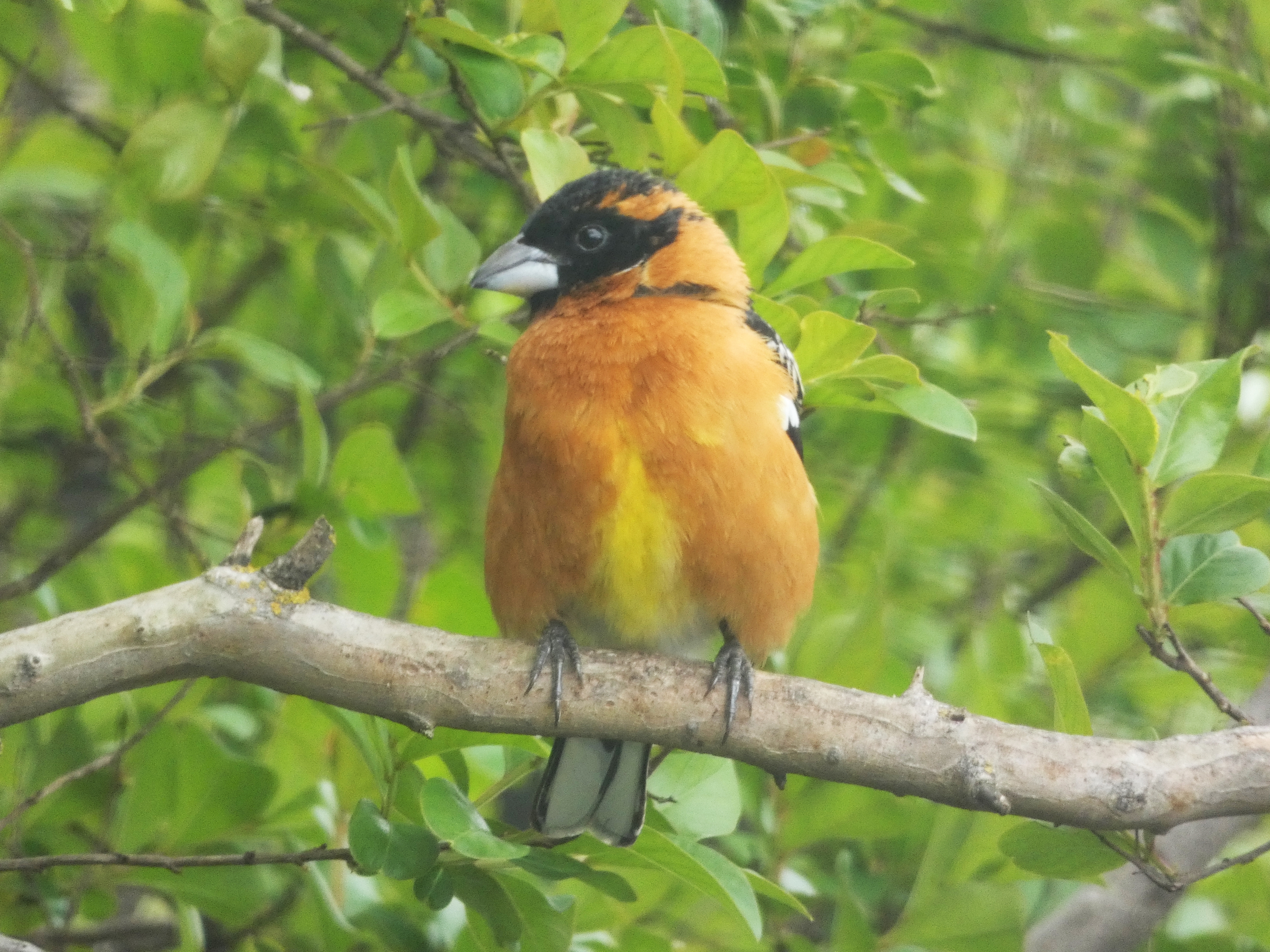
Other birders along the trail have reported two birds I would really like to see: a Hooded Oriole, and a Varied Thrush. So I was watching carefully for any signs of yellow or orange birds up in the oak trees that line the Parkway Trail. And I saw those colors. The first bird was way up on the bluff, so I snapped a pair of pictures for identification purposes, thinking it was a Bullock's Oriole that I saw up close a few days ago (see the earlier pictures here). Upon inspection later, I found I had taken a picture of a Western Tanager! They have only been seen in the region a few times thus far (I may post the picture in another post). Then, I saw another yellow bird in the Wild Tobacco Plants along the road to the water treatment plant, and it proved to be an actual Bullock's Oriole (also a possible future post). And then, I saw ANOTHER yellow and orange bird only a few feet from the orioles, and I assumed it was yet another. But as I started snapping pictures, I realized it was something entirely different...It was a Black-headed Grosbeak (Pheucticus melanocephalus) which I've seen twice before along the river trail, but the individuals that I saw were females, and far more drab, and my pictures were a bit fuzzy (see them here). The Grosbeaks spend winters in Mexico and travel north into the western United States to breed.
So the explosion of yellow and orange birds continues. I'm still looking for that first sighting of a Hooded Oriole for this year, the first sighting of a Varied Thrush ever (for me) on the trail, and better pictures of the Western Tanager. There's always a goal!
Sunday, August 6, 2017
Black-headed Grosbeak on the Tuolumne Parkway Trail
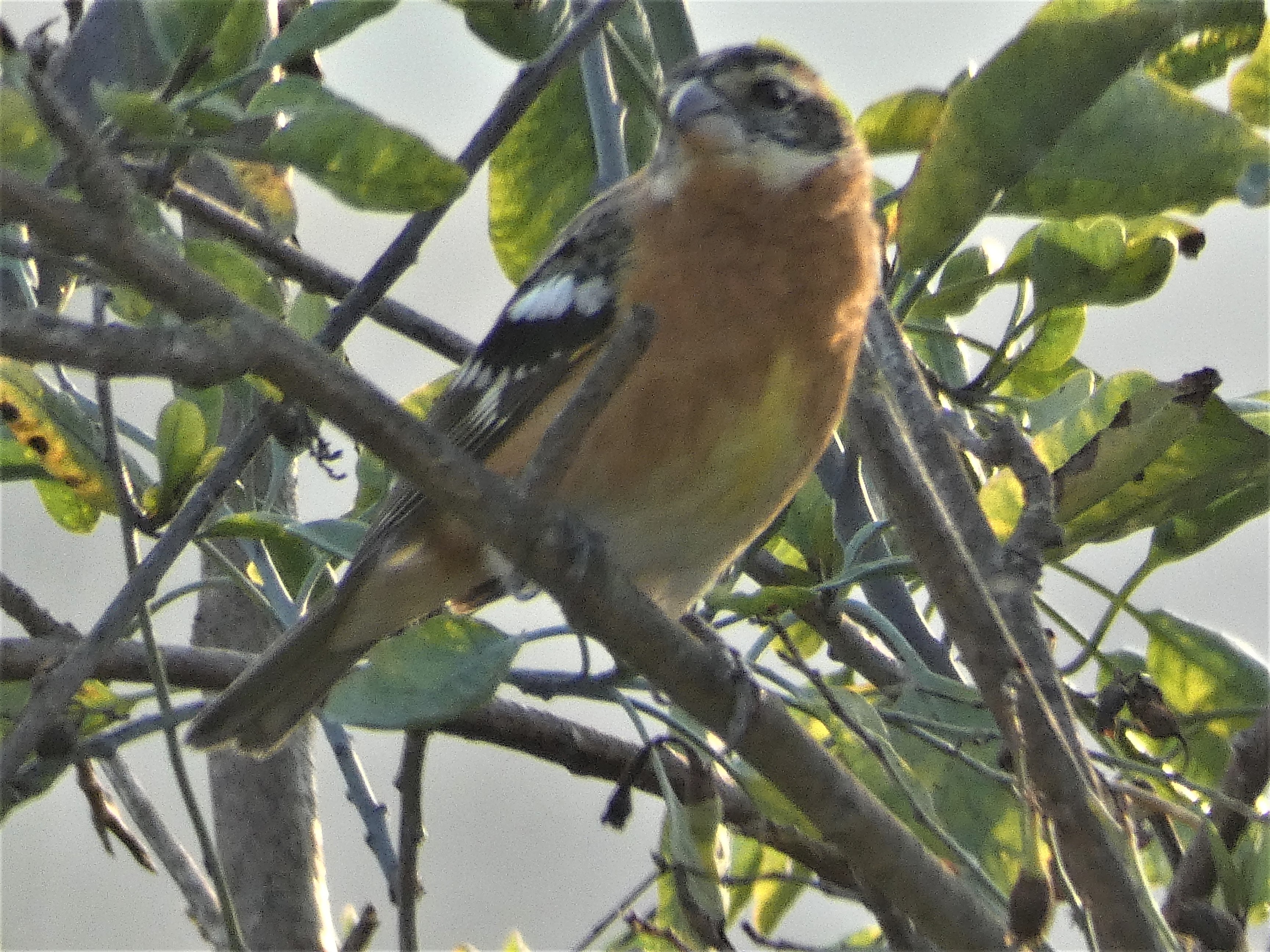
It's a real hit and miss proposition. As the summer wanes, I've been walking the Tuolumne River Parkway Trail almost every morning. On many of those days, the exercise is great, but the birds will be in hiding. On other days it will seem like every bush has an interesting bird perched in it. Three days ago I took nearly a hundred pictures. Yesterday I took none. Today was kind of a middle ground, with fifty pictures, of which about five are useful. But I was pretty thrilled with these. Apparently, the Black-headed Grosbeak (Pheucticus melanocephalus) is not a particularly rare bird, but I've only seen it twice on previous walks, and these pictures show that I didn't get very good shots. Today I did a little bit better.
I was actually tracking some Belted Kingfishers across the Tuolumne when I noticed the female Grosbeak in the bushes of to my right only about thirty yards away. I got these pictures before it got bored with me and flew off. The grosbeaks will only be with us for a few more weeks; they are summer visitors who winter down in Mexico.
Friday, August 19, 2016
Black-headed Grosbeak on the Tuolumne River
It's another case of a bird species being relatively common, but not for me. I saw a Black-headed Grosbeak (Pheucticus melanocephalus) a few days ago while I was strolling on the Tuolumne Parkway Trail where the Tuolumne River flows into the Great Valley. The Grosbeaks spend the summer in the United States and southernmost Canada, and migrate to Mexico and Central America for the winter. The males and females have kind of an egalitarian relationship, as they both will tend to the nest, sit on the eggs and feed the young.
I wasn't close, so the sharp focused pictures will have to come at a different time! I'll keep trying...
Subscribe to:
Posts (Atom)