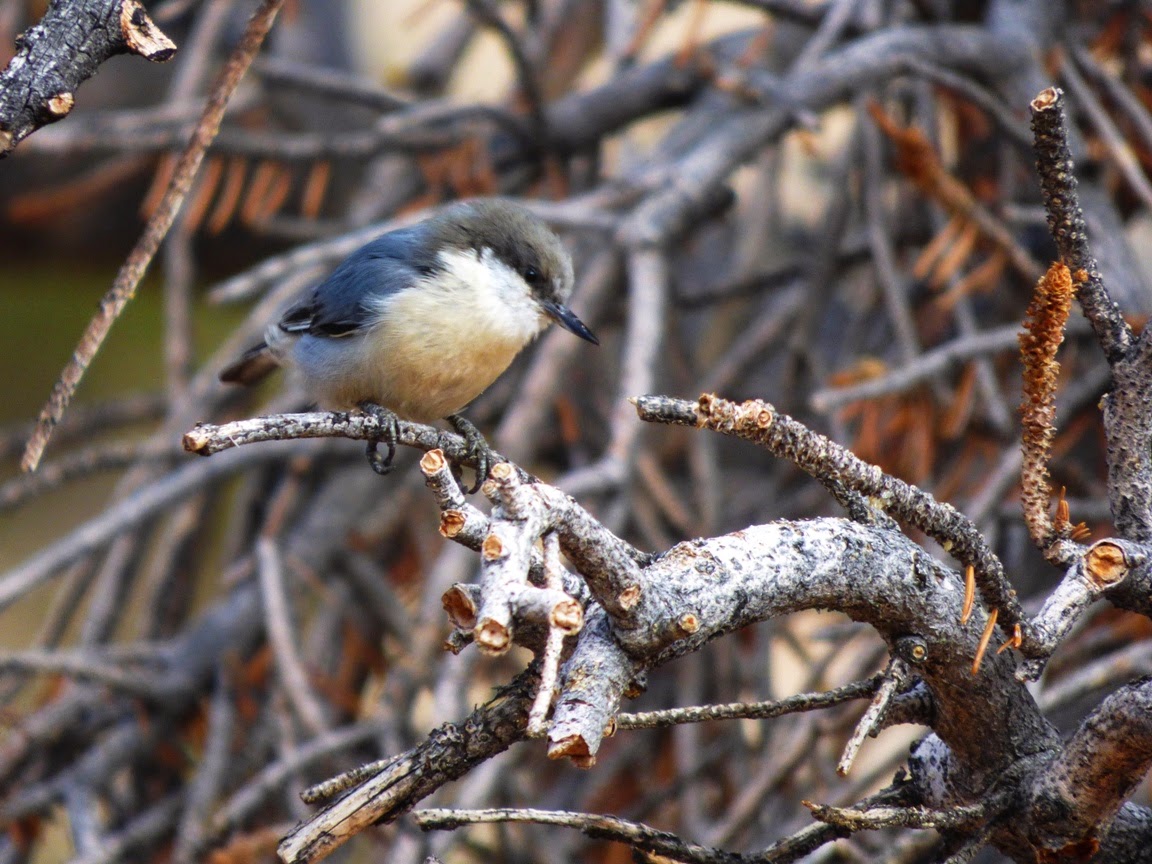
I don't see Pygmy Nuthatches (Sitta pygmaea) all that often. This is only the second post about them, and they are both from the same place: the Bristlecone Forest in the White Mountains east of the Sierra Nevada and Owens Valley. It's almost a cheat to see them here for one particular reason: water. Specifically, there isn't very much of it.
The White Mountains are a huge mountain range, as high as the adjacent Sierra Nevada, but just as they are overshadowed in public perception by the Sierra, they are "rain-shadowed" too. The Sierra Nevada gets several times the precipitation from Pacific storms, and the only forest trees in the White Mountains are the drought resistant Pinon Pine, the Utah Juniper, the Limber Pine, and the ancient Bristlecone Pines, the oldest living trees on the planet. There are few sources of water in the high ridges where the Bristlecones survive, but there is a visitor center at the end of the paved road. The staff usually has a bowl of water set out, and that is enough to bring out a number of birds and small mammals.
If you are ever visiting the Owens Valley, find a half day to visit the Bristlecone Pine forest. It's incredible just to see the birds and the trees, but at 10,000 feet, the views are beyond belief.
Showing posts with label Pygmy Nuthatch (Sitta pygmaea). Show all posts
Friday, October 27, 2017
Monday, January 26, 2015
Bird of the Day: Pygmy Nuthatch in the Bristlecone Forest of the White Mountains
At Geotripper, I've been starting a series on the parts of the Sierra Nevada that aren't Yosemite, I've been going through the fall field trip files looking for pictures and remembered there were some birds that didn't make it onto this blog at the time. They included a fast-moving group of small birds at the Schulman Grove of Bristlecone Pines in the White Mountains across the Owens Valley from the Sierra Nevada.
I got the one semi-clear shot in the trees of the Pygmy Nuthatch (Sitta carolinensis), and thought that was going to be it, so I went hiking for awhile. When I got back to the visitor center, I was surprised to see a small flock of them swarming the picnic tables. They weren't after crumbs. It had rained overnight, and they were drinking from the water droplets on the tables.
The Pygmy Nuthatch tends to live in deciduous and ponderosa forests at somewhat lower elevations, for instance on the western slope of the Sierra Nevada. The Cornell site suggests they sometimes range up to 10,000 feet, which means these birds were behaving, as it was 9,846 feet at the visitor center.
I thought I had captured an adorable picture of two of them, but in the fine tradition of all attempts at portraits, they both blinked. I'll leave it as two friends laughing at a funny joke...
The last shot is one of them drinking.
I got the one semi-clear shot in the trees of the Pygmy Nuthatch (Sitta carolinensis), and thought that was going to be it, so I went hiking for awhile. When I got back to the visitor center, I was surprised to see a small flock of them swarming the picnic tables. They weren't after crumbs. It had rained overnight, and they were drinking from the water droplets on the tables.
The Pygmy Nuthatch tends to live in deciduous and ponderosa forests at somewhat lower elevations, for instance on the western slope of the Sierra Nevada. The Cornell site suggests they sometimes range up to 10,000 feet, which means these birds were behaving, as it was 9,846 feet at the visitor center.
I thought I had captured an adorable picture of two of them, but in the fine tradition of all attempts at portraits, they both blinked. I'll leave it as two friends laughing at a funny joke...
The last shot is one of them drinking.
Subscribe to:
Posts (Atom)