Showing posts with label Knights Ferry. Show all posts

Wednesday, March 6, 2019

Mountain Bluebirds on the California Prairie

I've had some pleasant finds of late on our birding journeys of late. We ventured out on Monday to the prairies that lie east of our town in the Great Valley. We ended up on Willm's Road near Knight's Ferry on the Stanislaus. There were quite a few birds out, but have I ever mentioned that blue is my favorite color? I saw a flash of blue on the fenceposts in the distance and realized I was seeing a Mountain Bluebird (Sialia currucoides) for the first time in my county. I've seen them only twice before, once in Tuolumne Meadows in Yosemite National Park, and last summer in Mesa Verde National Park.
These are some of the most beautiful birds there are, but their habitat is locally under siege. They prefer woodlands at the edge of the prairie, the trees providing nesting sites, and the prairie providing the insects that they eat. But the prairies out here are being converted to almond orchards at a furious rate. There are lots of difficult issues involved here, but it seems a shame to be losing so much of one of California's unique and rare environments and the animals that live there.
Mrs. Geotripper caught this shot of the Mountain Bluebird giving us "the look".

Tuesday, November 13, 2018

Getting Very Close to our National Bird


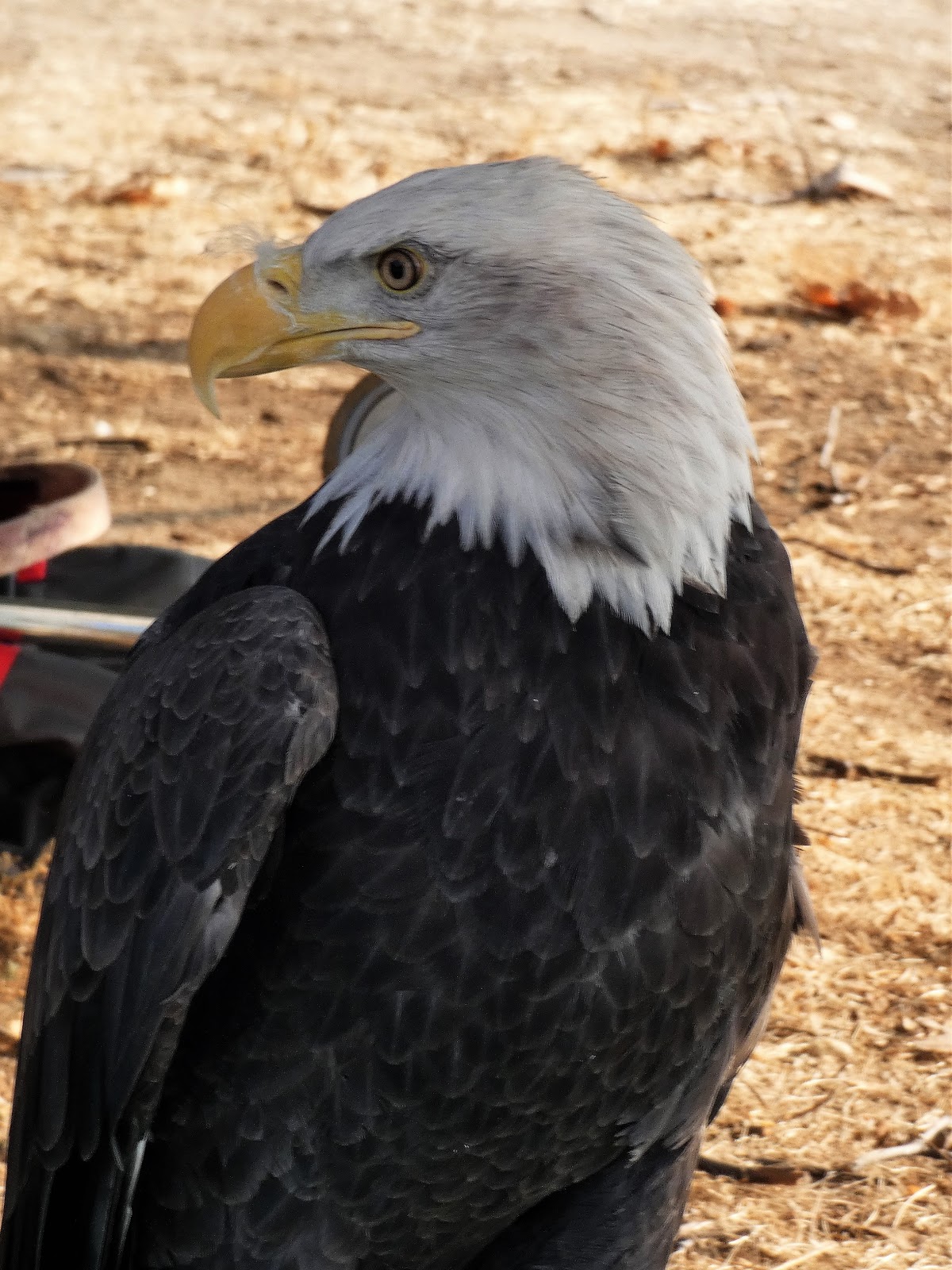
This might not be the right distance to meet a Bald Eagle (Haliaeetus leucocephalus). I grant you that. But my camera does have a pretty good zoom, but this is really close.
It's probably clear that we're not looking at a wild bird. Well, it's wild, but not in the wild. Unfortunately someone apparently shot its wing and the bird has been somewhat tamed and serves as a wildlife ambassador. We were at the Salmon Festival on Saturday at Knight's Ferry on the Stanislaus River.
Bald Eagles aren't at all common in our area but a few of them live here. I've seen them at Turlock Lake and near the Beckwith Platform in the San Joaquin River National Wildlife Refuge.
But never this close!
Here's a more normal distance for a shot of an eagle...

Wednesday, January 31, 2018

A Secretive Sora at the Willms Ranch Pond on California's Prairie


California has some special landscapes that are not part of the usual tourist routes. One of those unheralded ecosystems is the prairie lands that form the edge of the Great Valley. The lowest part of the Sierra Nevada foothills have not yet been completely covered by almond orchards, and aside from the grazing of cows, the grasslands look much as they did hundreds of years ago. Much of the land is private, but parts can be seen from public roads, and a generous ranch owner provides some public access at a stock pond that is a local hot spot for birding. It's on Willms Road a couple of miles south of Knights Ferry on the Stanislaus River. I stopped by on the weekend while looking for Burrowing Owls (note the last two posts).
We saw the usual assortment of American Coots, Egrets, Pied-billed Grebes, Common Gallinule and Kestrels, but as we were preparing to leave, we got a little treat. I was looking back at the reeds and was surprised to see another bird lurking around the shadows. It turned out to be a Sora (Porzana Carolina). The birds, a type of rail, are said to be common but secretive, being heard more often than seen. The pictures show just how hard they were to photograph. This was only third time I've seen one (previous sightings were at Stone Lakes and the Merced National Wildlife Refuge).

The picture above provides an idea of the setting of the pond where we were exploring. We saw the Sora in the reeds to the left of Mrs. Geotripper.

Thursday, October 26, 2017

Western Meadowlark in the Volcanic Barrens of the Sierra Nevada Foothills

The western foothills of the Sierra Nevada are one of the least-known parts of the range. Every year, millions of tourists drive quickly through the grasslands on their way to Yosemite Valley or the recreational lakes towards Sonora Pass. They pay little heed to the barren landscape, but in so doing they are missing out on one of the most dramatic parts of the geological story of the Sierra Nevada.

Nine or ten million years ago, the Sierra Nevada was a different place. The range was lower, and Cascades-style volcanoes were active in the summit regions around Sonora and Ebbets Passes. There may not have been large-scale glaciers, but the volcanoes may have been covered with snow at times, and erupting ash would have produced volcanic mudflows (lahars) that traveled dozens of miles down the western slopes. The mudflows came to rest in the foothills where today the deposits are called the Mehrten Formation.

In some circumstances, the volcanic muds could produce rich soils, but yearly rainfall is only enough for prairie grasses to grow. It's not a desert, but it's not a woodland either. The grasslands do provide excellent habitat for the Western Meadowlark (Sturnella neglecta), and it's a rare trip when I don't see one in the area. These pictures are from a short excursion a week or two ago on Willms Road near Knights Ferry on the Stanislaus River. One can just make out the bird on the rocks in the foreground of the first picture, but zooming in I got a better view. I love the colors of the lichens on the rocks.

Wednesday, October 25, 2017

Horned Lark on the California Prairie (what's left of it, anyway)

Although I no doubt had seen them, I didn't recognize Horned Larks (Eremophila alpestris) until early last year during my travels through the remaining prairies of Central California. At a distance I mistook them for Meadowlarks. I was on a work errand in the Sierra Nevada foothills a few days ago, helping to select rocks (well, really giant boulders) that will become part of our Outdoor Education Laboratory next to our Science Center. I was near Knights Ferry and Willms Road, so I took ten minutes to check out the prairie off to the south. It didn't take long to find a few of the Horned Larks (and some Meadowlarks too).
The birds have declined in the last few decades, to only about 30% of their former population. There are probably plenty of factors, but humans are behind most of them. The biggest factor is probably loss of habitat as more and more prairie is plowed under in service to nut orchards (in our area at least), and the essentially unrestrained use of pesticides that has caused the insect population on our planet to plummet drastically (recent reports suggest that 70-80% of bugs have disappeared in recent decades). There's the cliché of the canary in the coal mine to describe the harbinger of things to come, but a new version would be the disappearing Larks of the prairie.

I've been kind of depressed lately that we really have arrived at the Silent Spring that Rachel Carson wrote about half a century ago.
In case you were wondering why they are called "horned" larks...

Wednesday, April 5, 2017

Tricolored Blackbird at Willms Pond in the Prairielands

One has to start somewhere. I've noticed that the first chance I ever have to shoot a new species, it is usually under less than ideal conditions, and the pictures are not to my own "stringent" standards (really, I have pretty low standards for pictures). We were out on the prairielands last week, and I had some pretty nice results, between seeing a Burrowing Owl for the first time in years, getting close-ups of a Western Meadowlark, some Horned Larks, and some nesting Tree Swallows. I was on the lookout, however, for a new species.

Tricolored Blackbirds are very similar to the Redwinged Blackbirds, which range across North America, numbering in the tens of millions. The Tricolors are almost a California endemic, found outside the state only in northern Baja, and at some widely scattered nesting sights in eastern Oregon and Washington. Their population is estimated at a few hundred thousand at most and falling, in part because of an unfortunate nesting habit. They prefer to nest in large colonies in open grassy fields, with nests only a few feet apart from each other. In a number of unfortunate cases, those nests were in wheat or alfalfa fields, and the fields were mechanically harvested before the nestlings could escape destruction. The population dropped so precipitously that they were declared an endangered species in California just a few years ago.

Efforts to protect the birds included payments to farmers with large colonies in their pastures to delay the harvest a few weeks. Cooperation has helped to stabilize the population, but they are still in trouble.
Birders had reported that dozens of Tricolored Blackbirds had take up residence at the small stockpond on Willms Road where Mrs. Geotripper and I like to watch for wildlife, so we stopped and waited to see who was out and about. The blackbirds were making a lot of noise in the reeds across the pond, but they only occasionally popped out. It took the highest zoom and a bit of luck to get the pair of shots of unmistakable Tricolors. The white band under the red is the distinguishing feature.
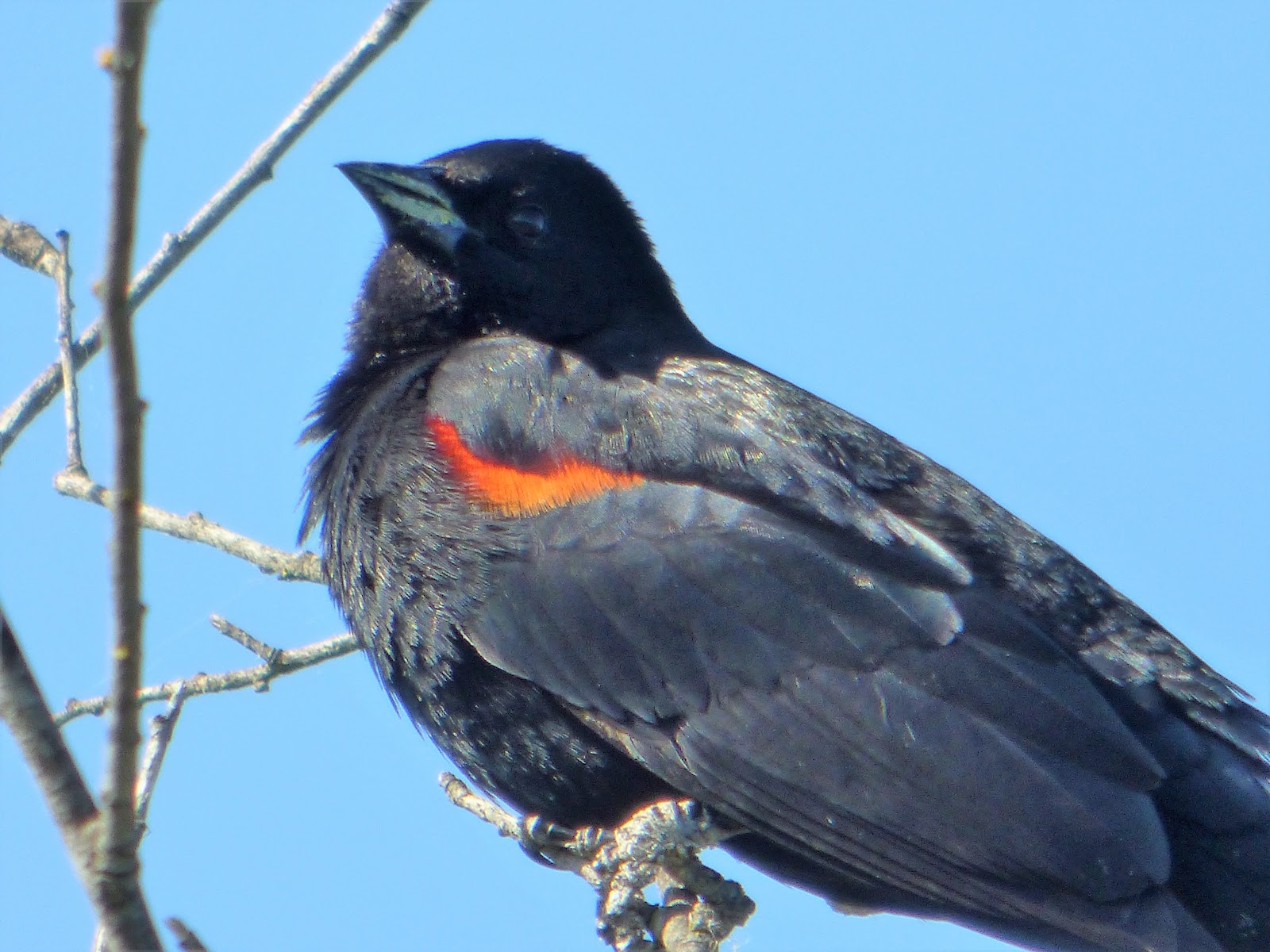
The Redwinged Blackbirds (Agelaius phoeniceus) were out in force as well, and they weren't nearly as bashful as the Tricolors. So, to make up for fuzzy and distant shots of my target species, I've thrown in a couple of close-ups of their close cousins.
The Willms Road pond is especially pretty this time of year, overflowing with water, and surrounded by grassy hills. The owners are kind enough to provide access for fishing and birdwatching, so if you check it out, please be courteous and pick up any garbage that you come across.

Tuesday, April 4, 2017

Western Meadowlark in the Prairielands above Knight's Ferry

After torturing you with fuzzy indistinct photos of the Burrowing Owl I saw on Sunday in the prairielands, I thought it only fair to share with you one of the sharpest shots I've gotten lately, that of a Western Meadowlark (Sturnella neglecta) that was perched on a fencepost only a few hundred yards from where I saw the owl. It was hardly bothered at all that we stopped the car just a few yards away, as it was far more interested in catching the attention of the ladies
We were driving Willms Road south from Knights Ferry to take in the vernal pools, the birds, and hopefully some wildflowers. We had the windows down, and the song of the meadowlark could be heard along the entire distance. They are out in force this time of the year.

Sunday, March 26, 2017

Horned Lark in the California Prairielands near Knights Ferry

With the first days of spring, we are starting to explore the Sierra Nevada foothills and what's left of the California prairie in the eastern part of the Great Valley. On Saturday we were in the Red Hills, seeing many flowers but few birds, but then we headed down to Willms Road out of Knight's Ferry, a backroad providing access to the many ranches in the foothills. There's a stock pond that we like to check out every so often, and along the way we ran across several Horned Larks (Eremophila alpestris) sitting on fenceposts and searching in the grass for tidbits of food.
In case there's any doubt about why they are called "horned" larks, the post-sitting bird turned his head and showed us the upturned feathers that give him his name. The Horned Larks are common birds, but fewer in number than they used to be (perhaps only 30% of their numbers fifty years ago). A likely suspect could be loss of habitat, either to development or to reforestation efforts.
It was a beautiful day on the prairie, perhaps the prettiest kind of day we get all year out here. It's been a wet year, finally, the grass is thick and green and the usually dry waterways are flowing. The foothill rock layers are composed of volcanic mudflows and ash deposits bespeaking a violent origin, but today all was serene.

Saturday, April 2, 2016

One of the Prettiest of Songs: A Western Meadowlark on Willms Road


Meadowlarks have one of the prettiest bird songs around. I grew up hearing them on my Grandparent's ranch when I was a child, so whenever I hear them these days, I briefly turn eight years old again, when an acre was a trackless wilderness in which all manner of adventures could be had.
We were on Willms Road, which travels south from Knights Ferry on the Stanislaus River in the foothills of the Sierra Nevada. Being spring, the Western Meadowlarks (Sturnella neglecta) are singing their hearts out, and one stayed on the fencepost long enough to be videoed, but my photos came out a bit fuzzy, so enjoy the two shots below from an earlier trip in the southern Mother Lode.
Besides their beautiful songs, the Meadowlarks are quite striking in their plumage as well.

Saturday, May 2, 2015

A Doomed Romance in One Act, and Red-winged Blackbirds at the Willms Road Pond

Well, the romance was over quickly. One display of those bright red shoulder epaulets from the Red-winged Black Bird (Agelaius phoeniceus), and the Western Kingbird (Tyrannus verticalis) was completely unimpressed. Off to greener pastures for both of them.
We were on our short excursion on Willms Road near Knights Ferry in the Sierra Nevada foothills when we stopped at our favorite little stock pond out on the California prairie. There are usually some interesting birds hanging out, including the Kingbird in the above drama. We almost always see a crowd of Red-winged Blackbirds in the tules and rushes.
The Red-winged Blackbirds are hard to photograph. It's not so difficult to get the bright flash of the red shoulder epaulettes, but unless the light is just right the black body is featureless. I got lucky with a couple of shots this time, with the sunlight reflecting off the feathers of the breast and head of this individual.

The Blackbirds have a melodic song that is sometimes a high-pitched whistle. The males seem to always be busy trying to catch the attention of the ladies. I guess it is the equivalent of catcalls from construction workers in New York...
The stock pond on Willms Road (two or three miles south of Knights Ferry on Highway 108/120) is our local barometer for the severity of the drought. Most years in late April or May, the hills here are still green, but not so much this year. Compare how it looked in March. The pond has water, but perhaps not as much as it should (it's sometimes hard to judge, as the outlet has suffered some erosion damage so it may not be possible to completely fill the pond anymore). It's one of our favorite spots for a few minutes of serenity that's not all that far from home.

Friday, May 1, 2015

Close Encounter with an American Kestrel near Knights Ferry

We took one of our short excursions yesterday, into the low Sierra Nevada foothills near Knights Ferry on the Stanislaus River. The region is part of the fast-diminishing prairies and grasslands (almonds are the new gold in agriculture around here). We saw several birds here and there, but eventually we started home. We must have passed 200 Meadowlarks, Goldfinches, and Western Kingbirds perched on the fences, but as we approached Highway 108 I saw an unfamiliar shape and stopped down the road. I took a distant shot and realized it was an American Kestrel (Falco sparverius).
I wondered what it would do if turned around and came back up the road (slowly). To my surprise, it didn't seem to care that we were there and I was able to snap a series of extraordinarily close pictures. I've taken a few shots of Kestrels in the past, but never this clear. They are strikingly colorful birds.
The Kestrel is common across North and South America, but their numbers have declined by almost half during the last fifty years, due in part ot habitat loss, and from pesticides that kill some of their principle prey species such as grasshoppers. They are the smallest of the falcons, and sometimes fall prey to the larger raptors.