Showing posts with label Warnerville Road. Show all posts

Sunday, January 28, 2018

Burrowing Owl on What Remains of the California Prairie

I don't know why this is...Burrowing Owls (Athene cunicularia) live all over North and South America, especially on grasslands of the western United States, but for all my searching I've only seen them three times, and those three times were within a hundred yards of the same spot. Go figure.
Can you see the owl in this picture?

It was a beautiful spring-like afternoon, despite being late January. We've had a little bit of rain, enough to bring on some grass growth, although it may fade early, as we are below 50% of normal precipitation and no storms are on the horizon. I decided to see what was happening at the Willm's Ranch stock pond, a prairie water hole that has provided some nice birding for us in the past.
I was on the road a mile or two south of the pond, where an ephemeral creek crosses the road. I first saw a Burrowing Owl there more than a decade ago. My pictures were limited by a 3x zoom on my primitive digital camera. The second sighting was much more recently, on April 2 of last year. My car startled the owl, which took off and landed a few hundred yards away in an alcove. I got a few less than perfect pictures, and put up a post anyway.

Today I spied the owl just a few dozen yards from the road, and it didn't move, much to my delight. I snapped lots of pictures this time around. Now to see if I can't locate a few elsewhere!


Friday, March 11, 2016

Long-billed Curlews along Warnerville Road on the California Prairie

Sometimes you just see odd sights. We were visiting the California prairie a few miles south from where we saw and photographed the Horned Larks. We saw a flock of gray birds in the meadow, and from a distance I thought were maybe some doves, but as we drew closer we could see they had ridiculously long bills.
They were Long-billed Curlews (Numenius americanus)! I'm sure I've seen them before, but I can't find a single picture of one in my archives. It was a surprise to see so many of them out here, as I thought they were shorebirds. It turns out that they are, but they breed in grasslands, and will use their long bills to search for earthworms in the grass, as well as picking off larger insects like grasshoppers from the surface. They will migrate to coastal areas and wetlands and use their bills to dig for invertebrates in the tidal flats.
There were around sixty of them in the corner of the pasture. They didn't seem overly concerned about the traffic passing by (or the crazy couple in the car with the cameras).
We started down the road to look for the Great Horned Owls that we saw two weeks ago, and stopped a quarter mile away. By then something had spooked the flock and the entire group flew by, headed to places unknown.

Thursday, February 25, 2016

Great Horned Owls on the California Prairie on Warnerville Road

It's been a rich week for birdwatching. I made it back to the Tuolumne River after a month long absence, I got out to the Beckwith Road viewing platform at the San Joaquin National Wildlife Refuge, and then yesterday, Mrs. Geotripper and I headed out to the California prairie and vernal pool habitat, a unique landscape in the Sierra Nevada foothills. I've ended up with week's worth of posts, including some new birds. But this moment on Warnerville Road was pretty special.
There's a spot where an intermittent creek crosses road, and there is a high terrace of volcanic tuff (the Valley Springs formation) which many animals call home. Last March I got a picture of a raccoon in one of the holes dug out the cliff, and there are usually lots of swallows and finches near by. I always watch for Burrowing Owls, but I haven't been too lucky with them yet.

It looked like someone had put a log or something in the top hole along the cliff, but I was immediately sure it was something else. When I zoomed in with the camera, I saw this extraordinary sight...

There were two Great Horned Owls (Bubo virginianus) in there! I seen Great Horned Owls on any number of occasions, but I've never had them completely disregard my presence. I didn't even have to get out of the car to get a series of nice shots.
Great Horned Owls have one of the widest ranges of any bird in the Americas, being found as far south as Argentina and Urugway and as far north as Canada and Alaska. I've featured them twice on this blog, but not with pictures as nice as these.
I'm assuming this is a mated pair, maybe even with their chosen nest site.
I know we aren't supposed to anthropomorphize birds, but owl expressions sure seem to cover the gamut of emotions, even if they don't. I see perturbed, surprised, bored, curious, and unconcerned in these pictures.
It was a privilege to spend a few moments with them, even if at a distance.

By the way, which photograph do you prefer? I couldn't choose my favorite.

Monday, March 2, 2015

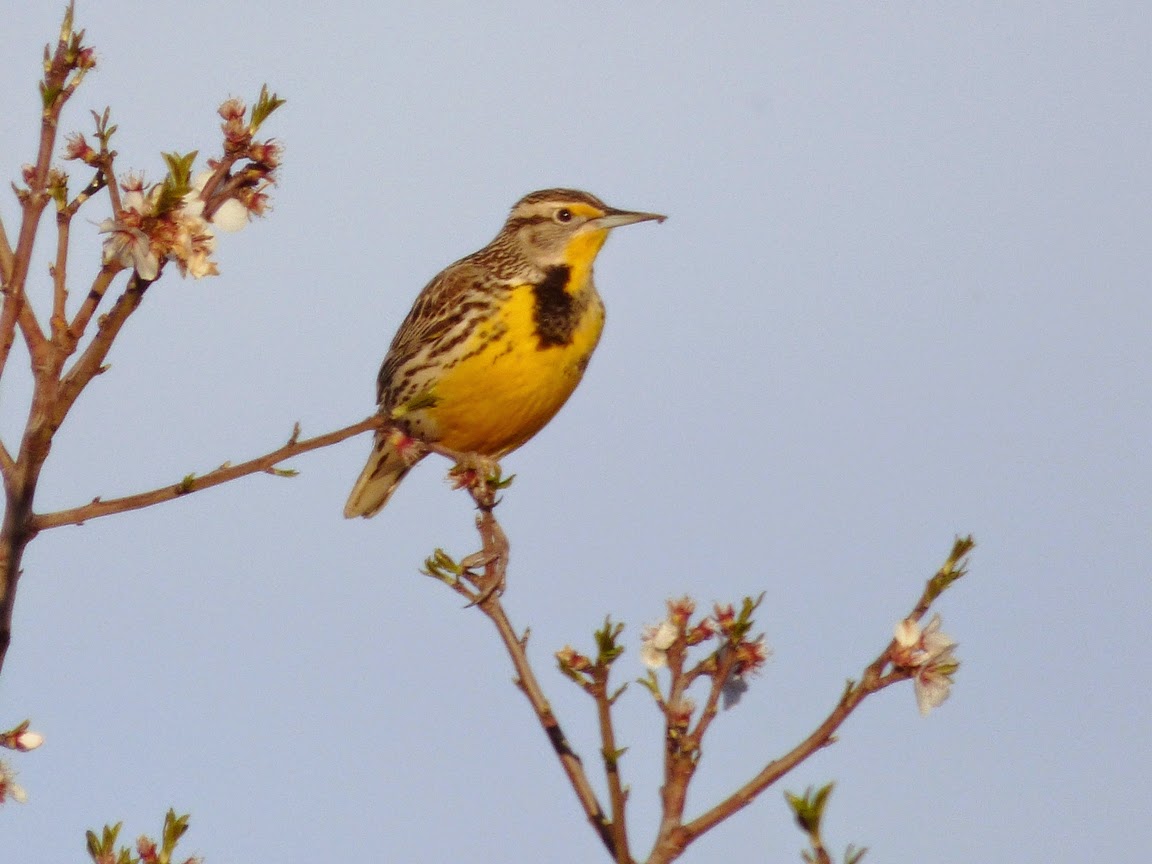
Western Meadowlark on the California Prairielands


One of the most beautiful of bird songs is that of the Western Meadowlark (Sturnella neglecta). I have seen few of them during the winter months, when they spend a lot of time on the ground looking for bugs. They'll sing, but they won't show themselves all that much.

As the spring season arrives they become more visible as the males perch on fence posts and treetops to advertise for love and companionship. We took a drive out into what I call the California prairielands, an increasingly precious region that is losing ground to rapidly expanding (but unsustainable) almond orchards. One might notice the irony that our singing individual is perched on a young almond tree. We were on Warnerville and Willms Road east of Oakdale, are part of the prairie that is particularly beautiful right now (look for some views in a soon to be posted Geotripper blog post).

The Meadowlarks are beautiful birds (aren't most of them?) that range all across the west and midwest of North American continent. There is an Eastern Meadowlark that is barely distinguishable in appearance, but differs in song and feeding style. It is the state bird of six different states: Kansas, Montana, Nebraska, North Dakota, Oregon, and Wyoming.

The Meadowlarks have powerful jaws and sometimes feed by using a method called "gaping" where they stick their long bills in the soil and open their beaks to access seeds and bugs. The Cornell Lab of Ornithology offers additional information about these fascinating birds.

Our bird stayed still long enough to catch a few seconds of singing. Enjoy!