Showing posts with label Kilauea Caldera. Show all posts

Friday, June 9, 2017

Saffron Finch at the Hawai'i Volcanoes Observatory

I'm continuing our discussion of the invasive birds of Hawai'i. Some have more or less replaced those species that have gone extinct, but others are helping prompt the extinction of the few that are left. It's a mixed bag with no easy answers. What one can say is that many of the invasives are beautiful birds. That makes sense, as many of them were caged pets that were released or escaped into the wild.
That's probably the story with the Saffron Finch (Sicalis flaveola), a member of the Tanager family. They are native to South America, and were popular cage birds. They first appeared on Diamond Head in 1965 and spread throughout Oahu. They appeared on the Big Island about the same time and spread across the lowlands. They've ranged into higher elevations and by 2000 they were noted in the village of Volcano next to Hawai'i Volcanoes National Park. That's where I saw them on one of my first trips to the islands in 2002. When I was there last month, they were still living in the same trees adjacent to the Hawai'i Volcanoes Observatory. I've previous posted on some I saw last year on the coast north of Kona.
At the end of the day we returned to the observatory in the midst of a rainstorm. It was still in the same set of trees, and was busy preening. They add a real splash of color to the scene, but their effect on the native birds is not well-known. It's probably not too serious, as they are generally a lowland bird, but I could be wrong.

Monday, May 29, 2017

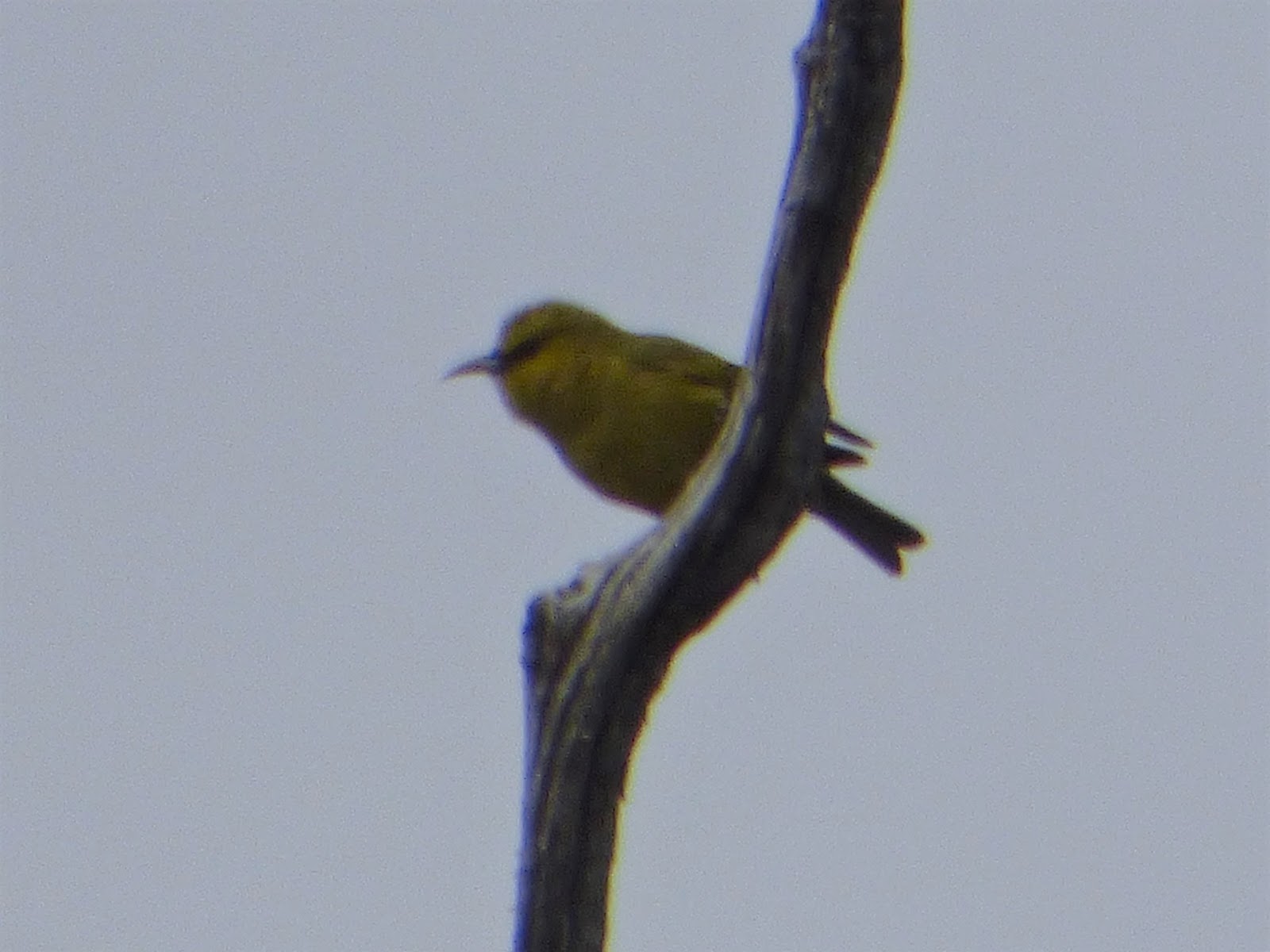
‘Amakihi, One of the Hawaiian Honeycreepers, at Hawai'i Volcanoes National Park

I'm making no claims whatsoever that these pictures are up to my own basic standards, but to paraphrase Donald Rumsfeld's statements about armies, "As you know, you blog with the bird pictures you have. They're not the bird pictures you might want or wish to have at a later time." And these are the only ones I have of one of the unique Honeycreeper species of the Hawaiian Islands, the Hawai'i ‘Amakihi (Chlorodrepanis virens). They don't have the bright red color of the 'apanane, and thus aren't as obvious to me in the field. Their olive-green color is also very similar to the Japanese White-Eye, so I'm sure I've missed a few in the past.
There are populations of the 'Amakihi on the islands of Hawai'i, Molokai, and Maui, and they were considered subspecies, but recent genetic studies have caused them to be classified as separate species. They are common because they can survive in habitats ranging from sea level to 8,000 feet, and they have shown somewhat more resistance to avian malaria that has wiped out so many other species. Along with the 'Apanane, they are considered to be the least endangered of the remaining Hawaiian Honeycreepers (they evolved into around four dozen species in Hawaii, but only a third of them have survived to the modern day).

I saw the bird along the Byron Ledge trail near Kilauea Iki near the summit of the Kilauea volcano in Hawaiian Volcanoes National Park on the Big Island. It was perched in the upper branches of a dead Ohia tree (they often feed on the nectar of the flowers).