Showing posts with label Stanislaus River. Show all posts

Tuesday, November 13, 2018

Getting Very Close to our National Bird


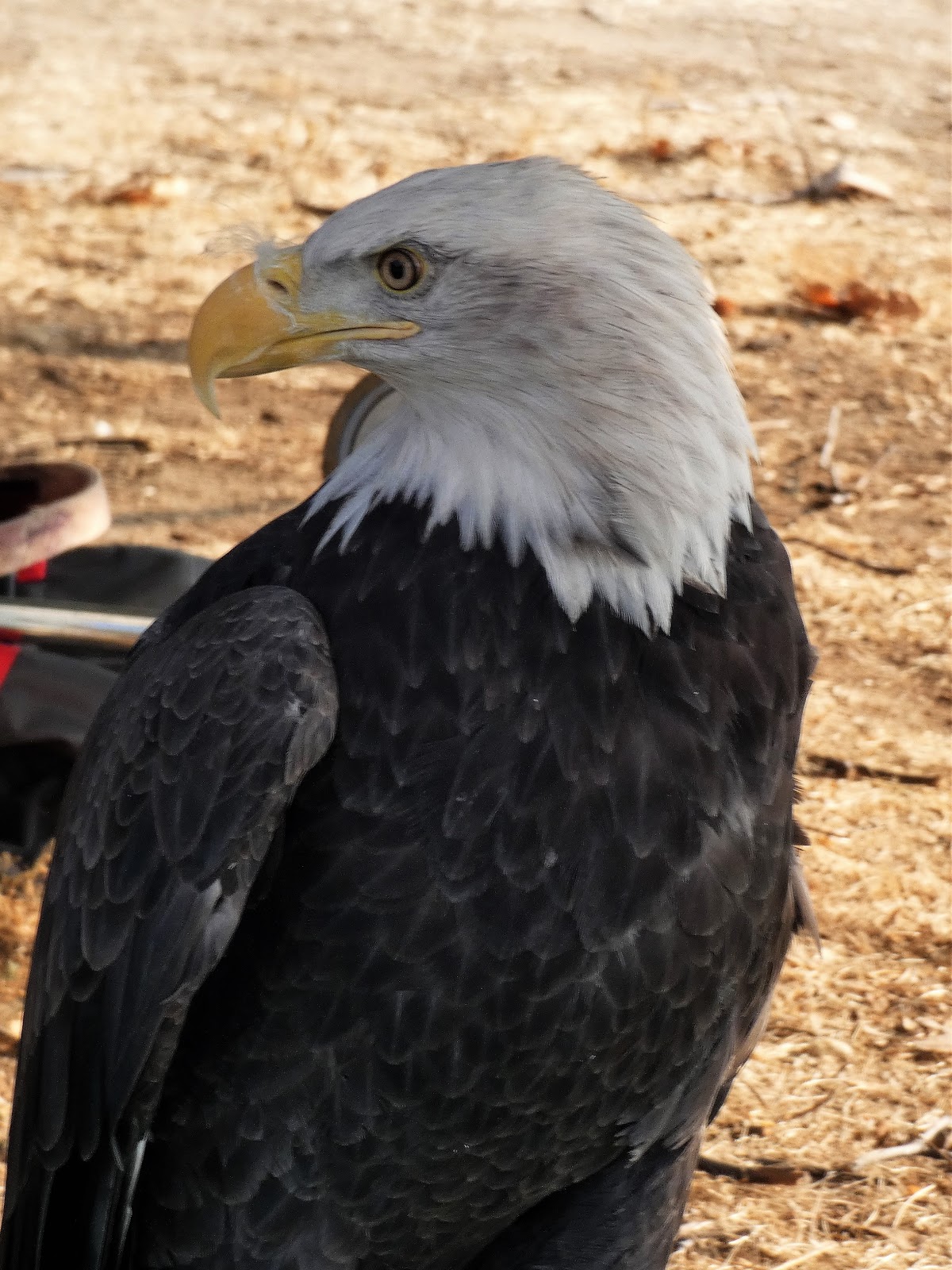
This might not be the right distance to meet a Bald Eagle (Haliaeetus leucocephalus). I grant you that. But my camera does have a pretty good zoom, but this is really close.
It's probably clear that we're not looking at a wild bird. Well, it's wild, but not in the wild. Unfortunately someone apparently shot its wing and the bird has been somewhat tamed and serves as a wildlife ambassador. We were at the Salmon Festival on Saturday at Knight's Ferry on the Stanislaus River.
Bald Eagles aren't at all common in our area but a few of them live here. I've seen them at Turlock Lake and near the Beckwith Platform in the San Joaquin River National Wildlife Refuge.
But never this close!
Here's a more normal distance for a shot of an eagle...

Wednesday, March 29, 2017

More Signs of Spring: Tree Swallows Nesting at Two-Mile Bar Recreational Area

One of the surest signs of spring is the return of the swallows from their winter sojourn in the tropics. There are a number of swallow species in the Great Valley, but one of the earliest to arrive is the Tree Swallow (Tachycineta bicolor). Like most swallows, they chase and consume insects, but the Tree Swallow can utilize other food sources if insects aren't yet abundant.
The Tree Swallows nest in the hollows of tree trunks, but are well-known for utilizing nest boxes. That's where we found the swallows last weekend. Two-Mile Bar Recreational Area is a rafting take-in site on the Stanislaus River between Knight's Ferry and Jamestown, downstream of the monstrous New Melones Reservoir and Tulloch Lake. Nesting boxes have been placed on the property boundary fences a few dozen yards apart for most of the length of the access road.
There was plenty to see of the emerging signs of spring, including the early blooming wildflowers like the Ithuriel's Spears in the picture above (the bees were certainly happy), and the intense green of the grasses and oak trees growing on the volcanic rocks of the Mehrten Formation above the Stanislaus River.

Monday, September 12, 2016

Mountain Quail at Columns of the Giants

We took a short trip up the Stanislaus River this afternoon, taking a short hike to the Columns of the Giants. The columns are volcanic in nature, similar to Devil's Postpile, or the Giant's Causeway in Ireland. Along the way, we spotted a new bird (to me). It was fairly large, moving through the underbrush. I thought immediately of California Quail, but I thought maybe we were a bit high for them (a check of the e-bird map confirmed this).
It was only a moment before I realized that I had encountered a covey of at least a dozen of them. Later, I was able to identify them as Mountain Quail (Oreortyx pictus). Like the California Quail, it is a bird of the far western United States, with a range from northern Baja to the Canadian border and only barely extending into Idaho. Their habitat includes shrubby vegetation in mountainous areas. It has not been reported in my home area in the Great Valley.
They crept slowly up the granite boulders above the trail, and several kept an eye on us from the top of the small ridge. Then they disappeared into the trees, but called out for a while longer. We moved on up the trail.

Saturday, February 28, 2015

Nuttall's Woodpecker at Horseshoe Pond on the Stanislaus River

I've been on somewhat of a tear with woodpeckers of late. There was the Northern Flicker along the Tuolumne River bluffs, as well as a Downy Woodpecker at Turlock Lake Reservoir, the first one I've seen on my bird travels (they're not rare; I've just not been observant). So, the other day we were exploring around Horseshoe Pond on the Stanislaus River, and one more kind of woodpecker made an appearance. It was a Nuttall's Woodpecker (Picoides nuttallii).
Horseshoe Pond appears to be an abandoned gravel quarry that is fed by groundwater. The Stanislaus River follows a bend on the south side of the pond. The site is shaded by cottonwoods and oak trees, with willow thickets as well. It was established as a park in the aftermath of the construction of New Melones Reservoir in the 1970s. The parks were to make up for the loss of a beautiful stretch of river upstream from the dam.
The Nuttall's Woodpecker is a California species, seen in oak woodlands from Northern California to Baja. According to Sierra Nevada Birds by David Lukas (my latest acquisition in the birding book department), the bird is not particularly well-known or well-studied, at least in the Sierra Nevada region. This is supported by the very limited information on the Cornell birding site, mostly single sentences about the bird's nesting feeding habits. Though the bird lives in oak habitat, it doesn't eat acorns. Instead it searches for insects in the bark of trees. Today's bird was a female; the male has a red spot on the head.

What will the next woodpecker be? The Stanislaus County bird list shows 3 more relative common ones (Lewis Woodpecker, Red-breasted Sapsucker, and Hairy Woodpecker), and two more that have been seen, but only rarely (Red-naped Sapsucker, and Yellow-bellied Sapsucker). I'll be watching!

Sunday, January 25, 2015

Bird of the Day: White-headed Woodpecker at Calaveras Big Trees State Park

We headed out into the Sierra Nevada. We've really gone nuts in the gloom of fog, and had to see some sunlight. We ended up at Calaveras Big Trees State Park along Highway 4. While we wandered about the forest we could hear woodpeckers in the forest canopy above, so we were on the lookout. Finally one landed at the top of a dead pine.
The shots were difficult at the extreme zoom, but we got a couple of slightly less fuzzy shots of the White-headed Woodpecker (Picoides albolarvatus) as it pecked away at the treetop. I took a short video as well.

The White-headed Woodpecker is a bird of the western mountains, with a range extending from British Columbia to Southern California, but no further east than Idaho or western Nevada. They live pretty exclusively in montain forests. I've only seen them once before, with equally fuzzy photographic results, at the Columns of the Giants on the Stanislaus River in the Sierra Nevada, a few miles south of Calaveras Big Trees (below). I'll keep at until I get some sharp pictures!