Showing posts with label Red-winged Blackbird (Agelaius phoeniceus). Show all posts

Saturday, March 30, 2024

A Trilogy of (Mostly) Black Birds at the Bear Creek Unit of the San Luis NWR


Yellow-headed Blackbird (Xanthocephalus xanthocephalus)
After last week's discovery of Yellow-headed Blackbirds at the Bear Creek Unit of the San Luis National Wildlife Refuge, we couldn't resist going back to see if we could get a better view of the elusive birds. They generally like to remain hidden in the tule reeds of their favored wetlands and are more often heard than seen. That was still the case when we were there this afternoon, but we stopped the car for awhile to see what would happen. Much to my surprise, a Yellow-headed Blackbird jumped out of the foliage and onto the road not ten feet in front of the car. It started gleaning seeds from the edge of the roadway as if we weren't there. I managed to catch one of my better shots of the bird as a result.

But that wasn't the only unique black bird of the day...

Red-winged Blackbird (Agelaius phoeniceus
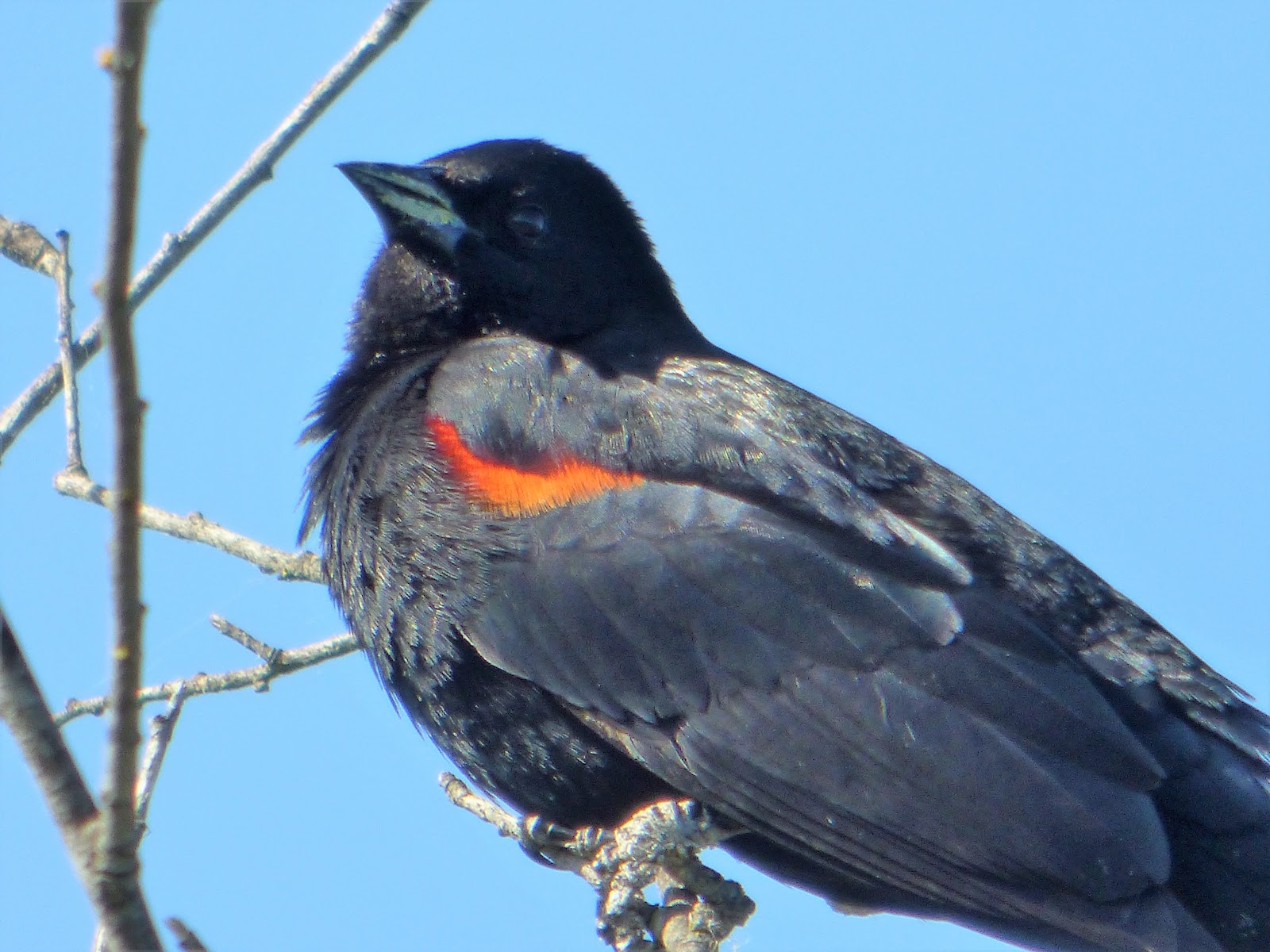
Red-winged Blackbirds (Agelaius phoeniceus) are common wherever marshes or grassy wetlands are found in North America, from Nicaragua to Alaska. They aren't usually hard to find, but I've always had the hardest time photographing them. The lighting has to be practically perfect in order catch the various features of these pure black birds (aside from the red wings of course). Most days I don't even try. But while we were photographing the Yellow-head, a Red-wing landed on a branch only eight feet out the window. It was taunting me, literally, to take its picture, so I did. So in that moment I got what may be the best shots I've ever managed of two different birds.
Black-necked Stilt (Himantopus mexicanus)
The (mostly) black birds weren't done with their surprises though. I'm not the most observant person in the world, but I still miss things, and I've never once noticed Black-necked Stilts on a nest before. But we saw two of them today. They aren't exactly well-hidden nesting sites, but they are presumably safe from predators that don't like swimming. The Stilts form flocks which aid in the defense of nests, and they can become aggressive, even to humans. We didn't test the hypothesis and stayed in the car.
The Bear Creek Unit of the San Luis National Wildlife Refuge includes a 2.25 mile auto tour and two trail loops, the Raccoon Marsh (1.3 miles) and Woody Pond (1.7 miles). The refuge is accessed from Highway 165 south of Hilmar and Turlock, and north of Los Banos. When the ponds are full, the area is a delight for birdwatching and nature observations. It's a small island of the Great Valley wetlands as they once were.

Wednesday, April 5, 2017

Tricolored Blackbird at Willms Pond in the Prairielands

One has to start somewhere. I've noticed that the first chance I ever have to shoot a new species, it is usually under less than ideal conditions, and the pictures are not to my own "stringent" standards (really, I have pretty low standards for pictures). We were out on the prairielands last week, and I had some pretty nice results, between seeing a Burrowing Owl for the first time in years, getting close-ups of a Western Meadowlark, some Horned Larks, and some nesting Tree Swallows. I was on the lookout, however, for a new species.

Tricolored Blackbirds are very similar to the Redwinged Blackbirds, which range across North America, numbering in the tens of millions. The Tricolors are almost a California endemic, found outside the state only in northern Baja, and at some widely scattered nesting sights in eastern Oregon and Washington. Their population is estimated at a few hundred thousand at most and falling, in part because of an unfortunate nesting habit. They prefer to nest in large colonies in open grassy fields, with nests only a few feet apart from each other. In a number of unfortunate cases, those nests were in wheat or alfalfa fields, and the fields were mechanically harvested before the nestlings could escape destruction. The population dropped so precipitously that they were declared an endangered species in California just a few years ago.

Efforts to protect the birds included payments to farmers with large colonies in their pastures to delay the harvest a few weeks. Cooperation has helped to stabilize the population, but they are still in trouble.
Birders had reported that dozens of Tricolored Blackbirds had take up residence at the small stockpond on Willms Road where Mrs. Geotripper and I like to watch for wildlife, so we stopped and waited to see who was out and about. The blackbirds were making a lot of noise in the reeds across the pond, but they only occasionally popped out. It took the highest zoom and a bit of luck to get the pair of shots of unmistakable Tricolors. The white band under the red is the distinguishing feature.
The Redwinged Blackbirds (Agelaius phoeniceus) were out in force as well, and they weren't nearly as bashful as the Tricolors. So, to make up for fuzzy and distant shots of my target species, I've thrown in a couple of close-ups of their close cousins.
The Willms Road pond is especially pretty this time of year, overflowing with water, and surrounded by grassy hills. The owners are kind enough to provide access for fishing and birdwatching, so if you check it out, please be courteous and pick up any garbage that you come across.

Friday, March 3, 2017

Red-wing Blackbirds at the San Luis National Wildlife Refuge

Yeah, spring is just a few weeks away. We were out at the San Luis National Wildlife Refuge a few weeks ago, and the Red-wing Blackbirds (Agelaius phoeniceus) were out in force, wing epaulets blazing bright red and yellow, singing their hearts out.
These birds can be hard to photograph, not because they are particularly shy (they're not), but because their black feathers absorb the light, and one has trouble getting anything but a black shape. Luckily, the sun was behind us and reflected well off their feathers.
The San Luis National Wildlife Refuge preserves the small percentage that remains of the vast wetlands and prairie that once existed across the Great Valley of California. It is a fascinating place to visit and to speculate on the changes we've made to the valley. It was so very nice to see water again in the places that have been so dry for the last five years (the refuges tend to be on the low end of priority when water is divvied out in California).
The birds appreciated the water too...

Saturday, May 2, 2015

A Doomed Romance in One Act, and Red-winged Blackbirds at the Willms Road Pond

Well, the romance was over quickly. One display of those bright red shoulder epaulets from the Red-winged Black Bird (Agelaius phoeniceus), and the Western Kingbird (Tyrannus verticalis) was completely unimpressed. Off to greener pastures for both of them.
We were on our short excursion on Willms Road near Knights Ferry in the Sierra Nevada foothills when we stopped at our favorite little stock pond out on the California prairie. There are usually some interesting birds hanging out, including the Kingbird in the above drama. We almost always see a crowd of Red-winged Blackbirds in the tules and rushes.
The Red-winged Blackbirds are hard to photograph. It's not so difficult to get the bright flash of the red shoulder epaulettes, but unless the light is just right the black body is featureless. I got lucky with a couple of shots this time, with the sunlight reflecting off the feathers of the breast and head of this individual.

The Blackbirds have a melodic song that is sometimes a high-pitched whistle. The males seem to always be busy trying to catch the attention of the ladies. I guess it is the equivalent of catcalls from construction workers in New York...
The stock pond on Willms Road (two or three miles south of Knights Ferry on Highway 108/120) is our local barometer for the severity of the drought. Most years in late April or May, the hills here are still green, but not so much this year. Compare how it looked in March. The pond has water, but perhaps not as much as it should (it's sometimes hard to judge, as the outlet has suffered some erosion damage so it may not be possible to completely fill the pond anymore). It's one of our favorite spots for a few minutes of serenity that's not all that far from home.