Monday, September 26, 2022
Lewis's Woodpeckers on the Tuolumne Parkway Trail
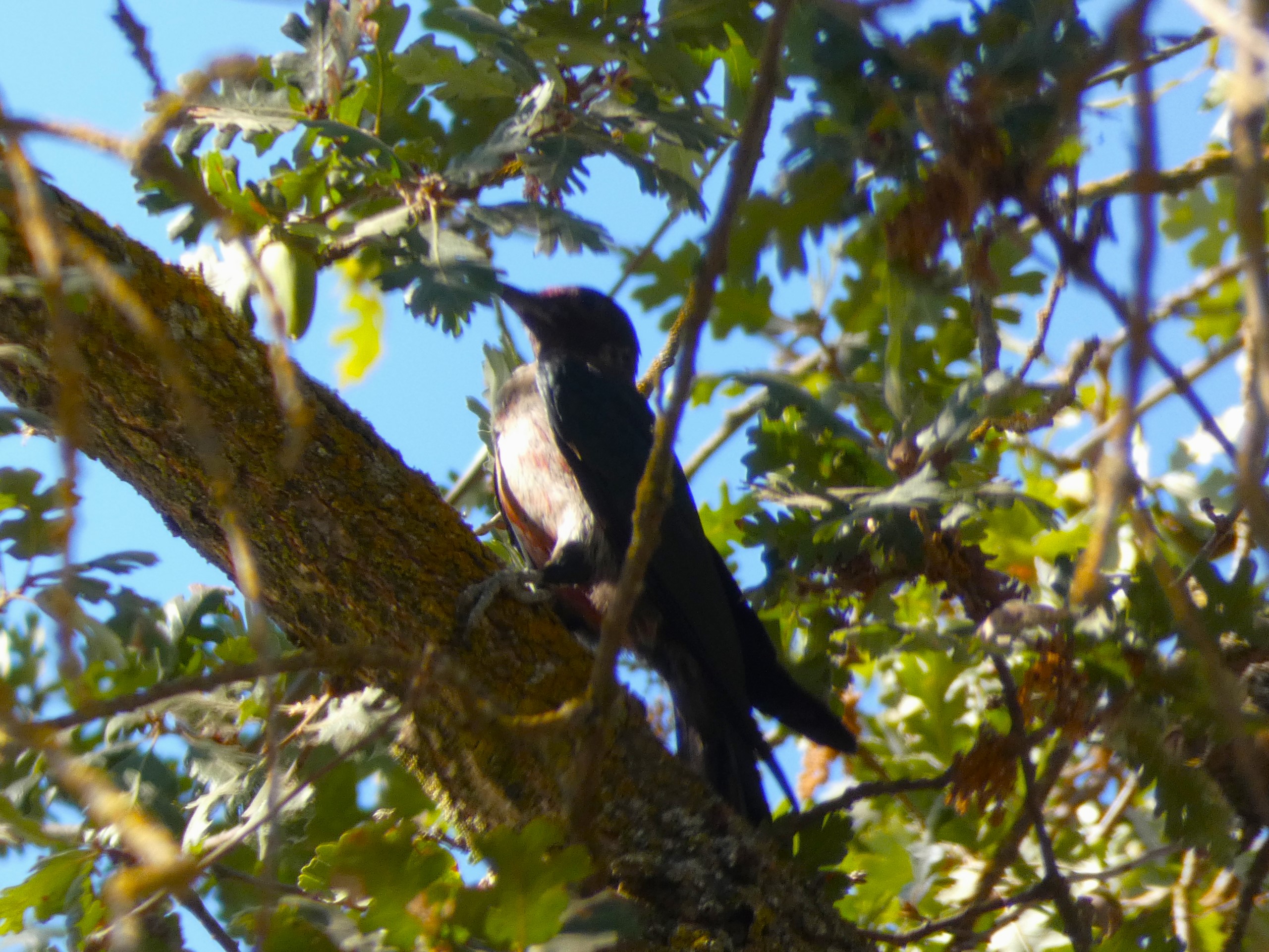
For being called 'woodpeckers', they don't seem to peck wood all that much, since they mostly eat insects that they catch on the fly, or nuts. They usually nest in hollows carved out by other woodpeckers. And their color scheme isn't all that woodpeckerish either, They have a dark green back and of all things, a pink breast. But they are interesting to see, especially when they are traveling out of their normal habitat.
Of course, when you see a new bird, you'll be fumbling with your camera to try to document its presence, and indeed that was the case with me. They were constantly moving and I only got a couple of fuzzy images, but at least you can see the odd color scheme. I sensed this small flock was on the move, but if I see them again, I'll try to get a few nicer shots and add them in!
Saturday, April 30, 2022
Killdeer Babies on the Tuolumne River!
It's always a bit scary for the Killdeer mama (Charadrius vociferus). They love setting their nests on rocky open ground, and the only such ground locally is around the concrete margins of the Waterford sewage treatment facility. The gravelly surface is traversed constantly by maintenance trucks. I do know however that the employees are careful when they know a nest is present, as they will put a pylon out nearby to warn drivers. But there was no evidence that they had detected this nest, so I just worried for weeks as mama tended to the eggs.
Having nests out in the open like the Killdeer prefers is also perilous because of the threat of all manner of predators. There are cats, foxes, otters, and rats in the area, as well as kestrels and ravens. The Killdeer eggs are well camouflaged among the stones, and the bird is famous for its broken-wing strategy of distracting predators away from the nest.
Thursday, April 7, 2022
Finding that First "Special" Bird: Bullock's Oriole on the Tuolumne River
I have these conversations, sometimes imagined, sometimes real, where I feel just a little defensive and want to say "I'm not really a crazy birder, I'm just getting my regular exercise and I don't want to miss it if a really interesting bird or other animal shows up". But I actually am a crazy birder. But doing the same ritual practically everyday of walking at least two miles and counting birds along the way is not really that strange. Compare the strangeness of doing that with running on a treadmill in a gym every day. You run on top of the moving machine, and no scenery goes by. You maybe have a television on the side of the room to stare at, or you have earphones blaring music. To me that's pretty boring.
How cool is it that every single walk has the potential of becoming something wonderful? Like the dad said in Christmas Story, referring to his yet unopened grand prize, "Why there could be anything in there!" Sure, there are birds that one sees every single day throughout the year, the scrub jays, the doves, the mockingbirds, the starlings. But there are almost always little surprises, the birds you see only once in awhile: Spotted Towhees, Nuttall's Woodpeckers, Belted Kingfishers, or Cooper's Hawks. They add that little bit of spice that turns a mundane walk into an interesting one.
But then there are the migrants. They can only be seen during part of the year, some only during the winter, others in the spring and summer. New seasons bring the promise of that "first of season" sighting, the excitement of seeing a beautiful and spectacular bird after an absence of many many months. It's a neat moment that sometimes takes my breath away. It happened yesterday when I saw the first Bullock's Oriole (Icterus bullockii) of the new year. The bird is not totally rare, and I will probably see a few dozen of them over the next few months, but that first moment you realize what you are seeing is just plain special. Especially when they hang out long enough to get pictures.
Left unsaid of course is the even rarer potential of seeing a bird that you have never seen before, or one that no one in the county or state has ever seen. Climate change has resulted in some species ranging farther north than ever before, so the day may come when I will see something really special, like a Vermilion Flycatcher or Summer Tanager on the Tuolumne River. And that, my friends, is why I am "that guy" out there walking every day looking to the sky, instead of tromping on a machine at the gym.
Thursday, March 3, 2022
New Bird on the Tuolumne River Trail! A Peregrine Falcon
I was a bit pressed for time, and conditions were overcast and gloomy, so I wasn't expecting to see all that much, but as I approached the snag, I saw a bird larger than a starling but smaller than a hawk. I always assume it will be a Kestrel, but something seemed "off" about it. It was darker than expected, and I couldn't see the black face bars that distinguish Kestrels. I got the cameral out and took a few pictures, then tried to move closer, but alerted by a loud family on the trail, the bird bolted up the river. I thought it might be Merlin since I saw one there just a few weeks ago, but as I studied the photos on the camera I realized it wasn't that species either. I zoomed in and realized I had a Peregrine Falcon (Falco peregrinus). It is the first one ever reported on the trail, making a total of 150 species now known from the "Parkway" (it's not totally uncommon in the county, but the Tuolumne Parkway has only been watched carefully for the last five years or so)
Seeing the falcon reminded me of my other sighting last year. A friend of mine who works for the local irrigation district had alerted me to the fact that Peregrines had a nest in the cliffs above a small dam on the Tuolumne River at the east end of the county. I was given permission to enter the property to have a look and I wasn't disappointed. The falcons were busy discussing something or another, and were flying from perch to perch on the high rock cliffs.
I've only seen the Peregrine Falcons in a few other places, in Oregon and at the Sacramento National Wildlife Refuge. It was great to finally see one in my own "backyard".
Thursday, February 10, 2022
Energetic Balls of Feathers: Bushtits along the Tuolumne River Trail
But then today I was wandering along the Tuolumne River trail as I often do, and a small group of them perched on a bush just a short distance away. And waited. And waited. Until I decided to pull out the camera and snap a few pictures, and then they twittered away to the next bush. But then they really did let me take a couple of shots before disappearing again.
They breed along the trail. I haven't found any nests yet this year, but they are truly unique and often well-hidden in plain sight. They are sock-like bags made of webs and fibers that look like random plant debris. It is a little unsettling to see the mass moving and squirming, but then it's better when the cute little bird sticks its head out the top to look around.
Sunday, October 24, 2021
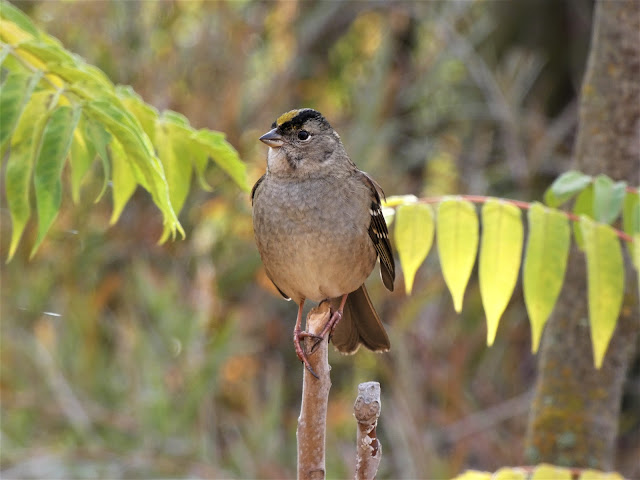
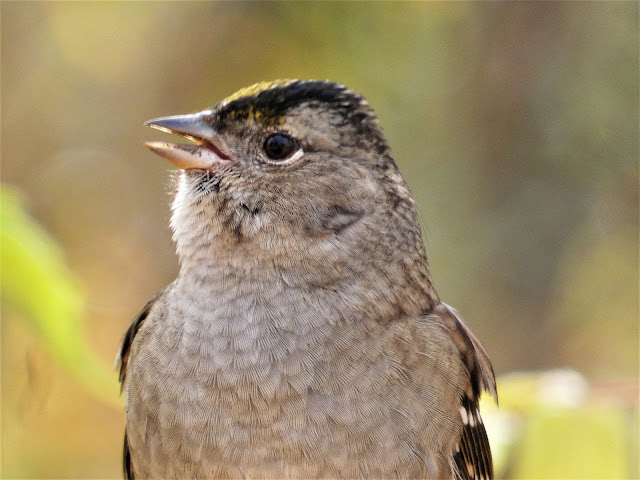
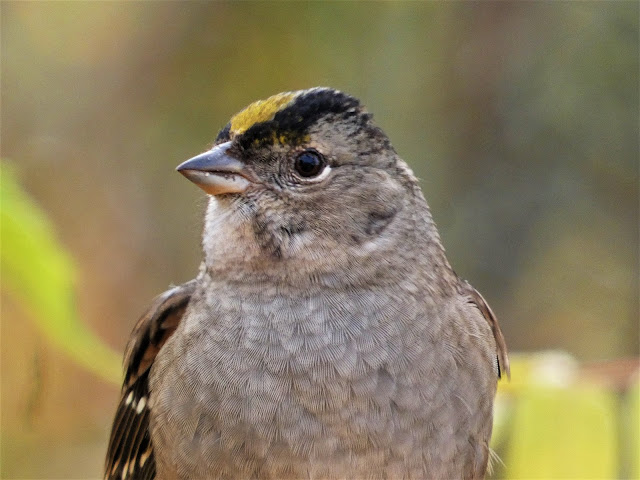
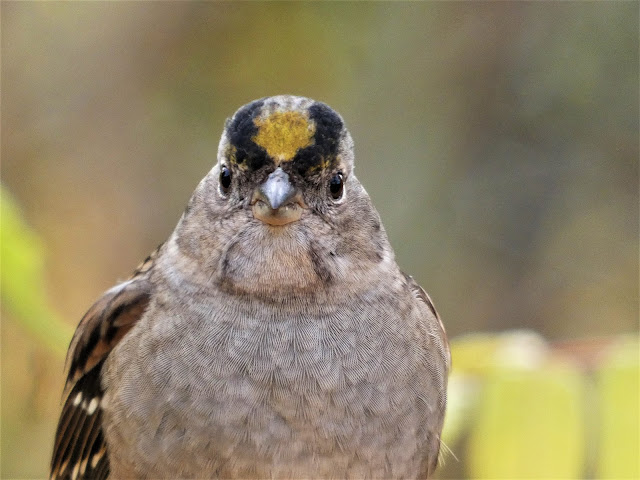
Why are they called Golden-crowned Sparrows?
Those of you who don't live on the Pacific Coast might not recognize this sparrow. It is closely related to the White-crowned Sparrow that is found across North America, but the Golden-crowned only occasionally wanders east of the Sierra Nevada and Cascades, although there have been rare sightings on the Atlantic Coast states and elsewhere. According to AllAboutBirds, the sparrow is one of the more poorly studied species in its Arctic summer home. Maybe there is a job for a budding ornithologist there...
| "I'll thank you not to study ME, good sir" |
Thursday, September 30, 2021
A New Bird on the Tuolumne River! A Pectoral Sandpiper
For years, I've been watching the couple of species of shorebirds that hang out at the water treatment plant on the midway part of the trail. There are almost always Greater Yellowlegs, Least Sandpipers, Spotted Sandpipers, and Killdeers. I get to the point that I don't think other birds will show up, so I don't look for them. This is usually a bad idea in birding!
So it took another birder, someone more perceptive than I, to wander along the bluff, watching the shorebirds in the treatment plant ponds. Yesterday that person was fellow nature blogger Siera Nystrom (Natural History Journal) who walked the trail and noticed a bird that was not like the others. She got some pictures and reported that she had found a Pectoral Sandpiper (Calidris melanotos). It's a special find, as it is rare in the region. It's the first sighting in the county this year, and only the 12th sighting of all time on eBird in the Stanislaus region. The nearest other known bird of this species is presently at the Merced National Wildlife Refuge an hour to the south of the Tuolumne River. So all in all, quite an accomplishment for Siera, and for the bird itself, which happens to be on a very long journey.
The Pectoral Sandpiper is rare around here because the bird is only passing through on a very long migration, and the routes the species follows are mostly in the eastern United States. That migration is pretty extraordinary, as the bird breeds in the far Arctic north, but migrates in winter not just to Mexico or Central America, but into the southern parts of South America!![]() |
| Source: Pectoral Sandpiper Range Map, All About Birds, Cornell Lab of Ornithology |
Once I saw Siera's species report, all I could do was sit on my hands and teach my courses all day. I waited very patiently while the students finished up the last of their labs, and I rushed out to the river trail, camera in hand, hoping against hope that the bird would still be hanging out at the treatment plant. Much to my relief, I saw it right away, because as I said above, "you see what you are looking for". I was able to get a fair number of decent pictures to share. If you decide to seek it out, it is a medium-sized shorebird with yellowish-olive legs. It's slightly bigger than a Killdeer (I think), and definitely smaller than a Greater Yellowlegs. The most distinctive coloration is the brown streaks that run down the breast, but abruptly change over to a white belly.I tried to get a better shot, but this was a Greater Yellowlegs behind the Sandpiper...
There is one other point of distinction about the discovery of this Pectoral Sandpiper. It is the 150th species reported for the Tuolumne River Parkway Trail! It is also the 123rd species seen this year on the river, which is a one-year record, and we still have three more months to find a few more.
Saturday, August 14, 2021
A Real Gem on the Tuolumne River: A Lazuli Bunting
I love the color blue, and I am lucky to have a number of bright blue birds that are common locally, including the Tree Swallow, California Scrub Jay and the Western Bluebird. But there are some blue birds that are exceedingly rare, at least in my experience, including the Blue Grosbeak and the subject of today's post, the Lazuli Bunting (Passerina amoena). They're real gems. If I am lucky, I'll spy them two or three times in a year. It's even rarer to get a half-decent picture.
I saw the first Lazuli Bunting of the year a few weeks ago after a good friend insisted she was hearing one near the trailhead for the Tuolumne River Parkway Trail where I walk nearly every day. Her observation was spot on as I got a brief look at a male. But the pictures were very grainy. Today though, I was walking along the river trail when I spotted a small bird in the distance. I thought it was another sparrow, but it was perched vertically which raised my suspicion that it wasn't a 'normal' bird. I got the binoculars out and saw the chestnut color on the breast, but I still couldn't see it clearly. I carefully drew near and the intense blue color became apparent. The bird was nice enough to hang out long enough to get some of the best pictures I've ever captured.
The Lazuli Buntings are summertime migrants in our region, and indeed across much of the western states and southernmost Canada. Come winter they'll be in Mexico. Although their Latin name means "beautiful sparrow", they are more closely related to the Cardinals and Grosbeaks.
Sunday, March 7, 2021
White-breasted Nuthatches on the Tuolumne River Trail
Monday, February 1, 2021
It's Been Awhile: Bald Eagle on the Tuolumne River Today
I had been seeing Turkey Vultures and Red-tailed Hawks (three of them!) soaring around the western part of the trail, but didn't think much of it. But then a large black shape soared overhead and I saw both a white head and white tail. I tried to get a picture but it was gone. Then I walked back upstream and saw it perched in a cottonwood across the river. Apparently the hawks and the vulture had been expressing a certain amount of concern because they were all circling the perched eagle. The eagle was unperturbed and was still perched in the same spot when I left towards home.
Wednesday, January 13, 2021
Wait, Why Are They Called "Ruby-crowned" Kinglets?
Want a real challenge? Try and capture why they are called "Ruby-crowned" Kinglets. The males have a red patch on their head, and if they are really upset about something, it can be raised, but that happens rarely in my experiences so far. But today I managed to catch a couple of shots so you'll know what to look for on your own attempts!
Monday, January 11, 2021
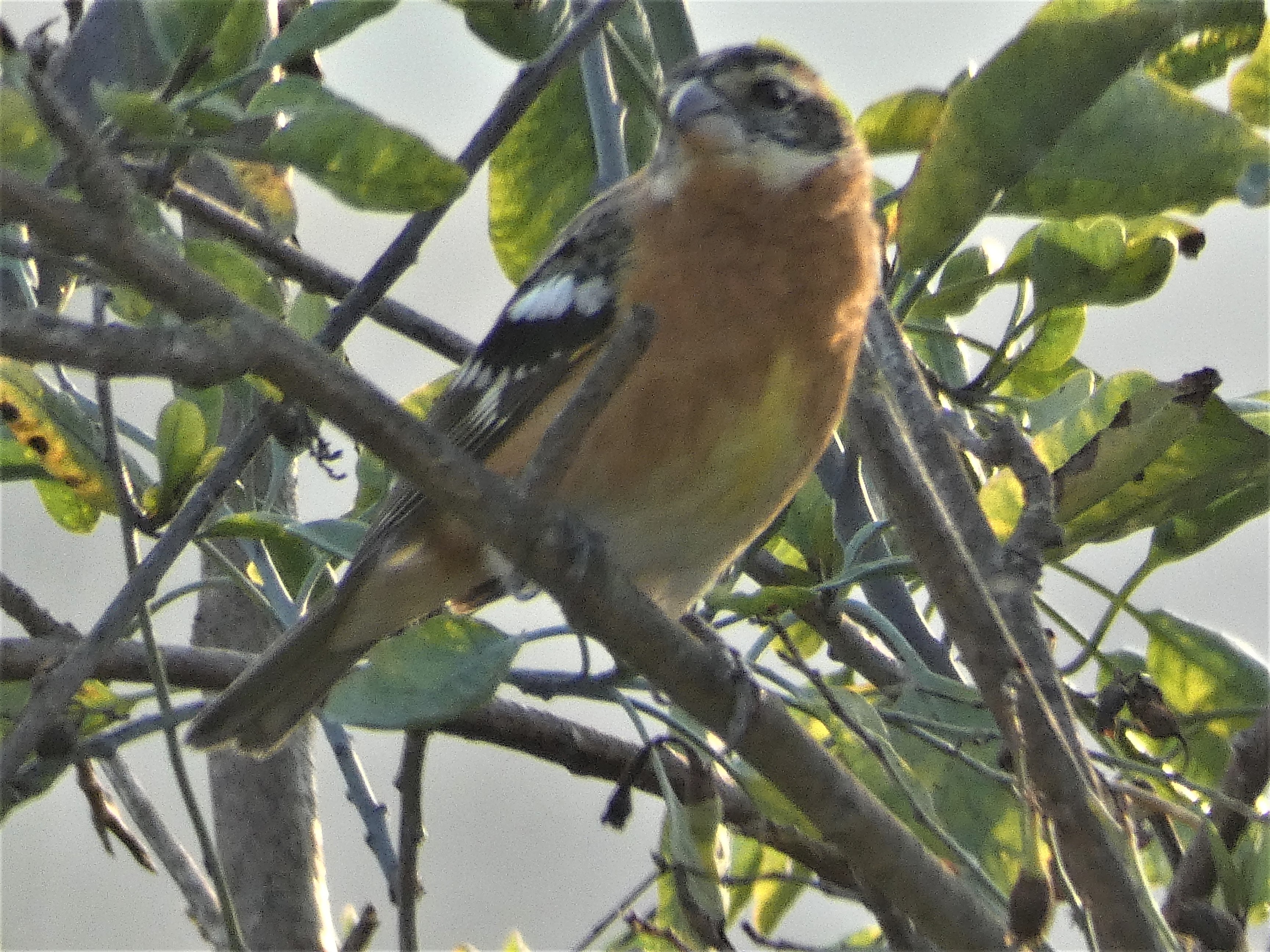
Someone Missed the Text about Migration: Black-headed Grosbeak on the Tuolumne River
I don't know why this bird is still hanging around. They have a diverse diet of bugs, fruits, nuts, and seeds, and maybe this bird has a secure food source, perhaps some neighborhood bird feeders. Maybe it was injured in some way and wasn't able to make the journey with the others. There have been other winter stragglers in this area...last year it was a Hooded Oriole pair that spent the winter along the trail.
Saturday, November 28, 2020
Another Fine Day for Phainopeplas!
The Phainopeplas are really a desert species, most at home in the arid regions of the southwestern U.S. and northern Mexico, especially Baja California. They have been seen more and more in California's Great Valley, presumably as drier and warmer climates begin to prevail as the average temperature of the Earth continues to rise. They are now breeding in the valley as far north as Redding.
Phainopeplas are in the family of the silky-flycatchers, but they are not closely related to other flycatchers found in the United States. According to Ebird, they are most closely related to the Cedar Waxwings.
Saturday, November 14, 2020
Finally a Few Phainopeplas on the Tuolumne River Parkway!
I had better luck the next day, catching a male (the black ones) out in the open. I had trouble figuring out just how many there were, either two or three, including a female.
Today was the best, as a female broke away from the Elderberry thicket and landed on a Russian Olive only a few yards from me. The only difficulty was the blowing wind. The bird stuck around for at least five minutes in perfect range for photos, but was a moving target the whole time.
The Phainopeplas are actually a desert species more likely to be seen in the Southwest states. Apparently they have been expanding more to the north, perhaps related to the changing climate. In any case, a day with Phainopeplas in it is always a fine day!