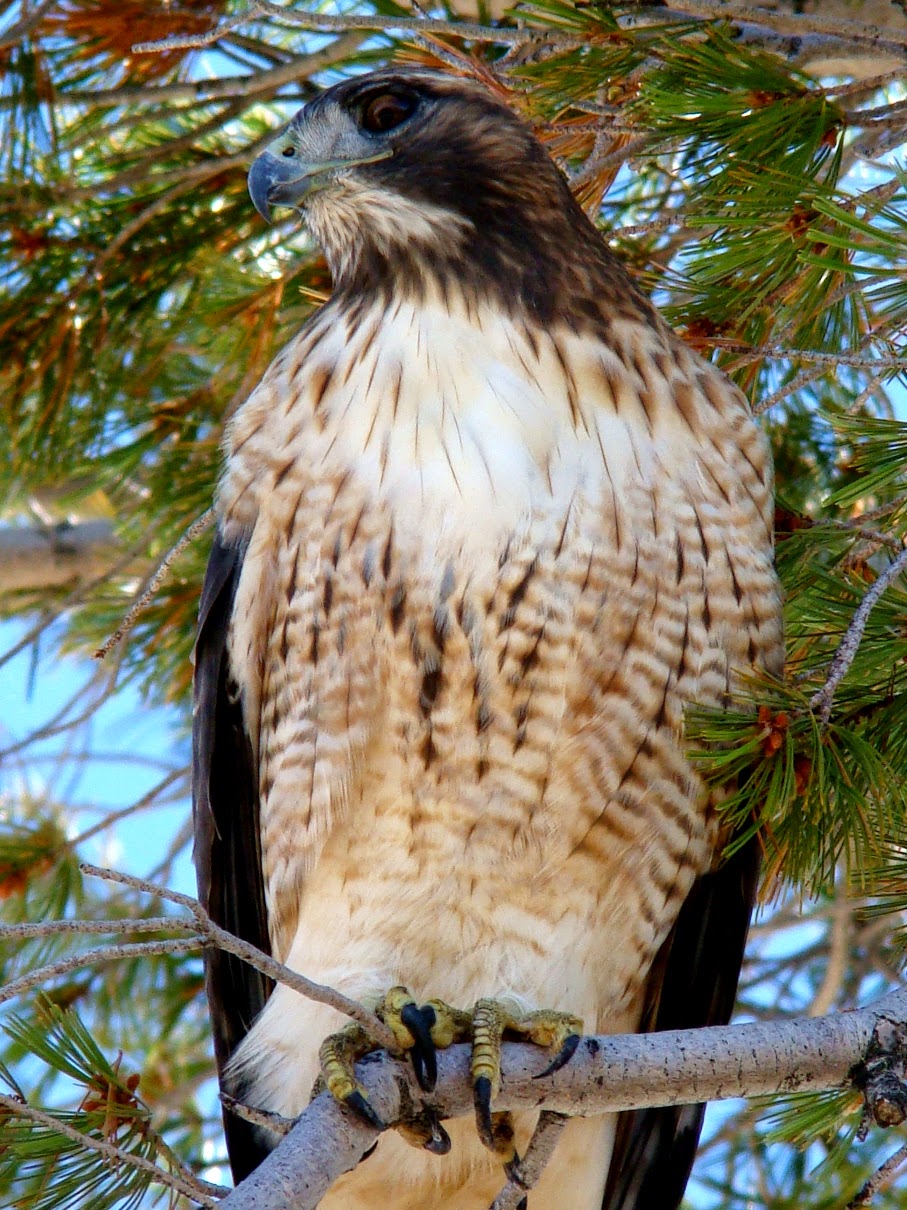
Showing posts with label Red-tailed Hawk. Show all posts

Monday, April 20, 2020

The Babies of Spring: Great Horned Owls and Red-tailed Hawks

One of the wonderful pleasures of spring bird-watching is the possibilities of catching sight of the new chicks. The birds of course go to great lengths to keep their children hidden from predators, but once in awhile one gets lucky and gets a peek at some of the young ones. Today I stopped by the covered bridge a few miles up the Tuolumne River and found that the Great Horned Owls (Bubo virginianus) had hatched and there were at least two chicks in the nest. No matter what stage of life they are in, I find the stare of an owl unsettling.
I haven't been allowed back to work at my campus, but there are no rules against walking around the grounds, so I stopped there last week to see if the Red-tailed Hawks had laid eggs or not. The pair have been around for weeks, but I didn't see them on the nest they used last year, but as I looked carefully I saw something move up there.
Zooming in, one can see there is at least one baby present. I couldn't tell if there were others. They fledged two young ones last year.

Spring rolls on! I'll be watching for the Ospry babies next. There are at least four active nests up the river.

Tuesday, April 16, 2019

The Red-Tailed Hawk Babies are Born! The Newest Raptors at MJC...

The Red-tailed Hawk babies have hatched! I've been watching the activity around the nest since late February when I first noticed the parent hawks building the nest. I feared the eggs might have been lost at one point during a particularly violent windstorm a few weeks ago. I was comforted when the parents were cursing at me in hawk language when I walked by a few days later. Today I thought I saw something move that wasn't "hawk" colored. It was downy white instead. Out came the camera, and there is at least one chick. There may be more...I'll be watching and reporting as I see anything. The hawk baby  (or babies) will be in the nest for around six weeks before they start flying and getting trained in hunting skills.

ADDENDUM: There are TWO chicks (so far)

Thursday, February 21, 2019

Something New at MJC: A Nesting Pair of Red-tailed Hawks


Things have been afoot at MJC's West Campus over the last few weeks. A lot of birds have been agitated by the presence of some Red-tailed Hawks (Buteo jamaicensis). I've seen Red-tails there fairly often, but most of the time they've been soaring high above the campus and over the surrounding territory. Lately though, a pair has been loitering around the sheep pasture and pond on the northwest corner of the campus. The Yellow-billed Magpies and several other species have been rather unhappy about these unwelcome neighbors, and I've seen them trying to harass the Red-tails a couple of times.
I suspected that they might be nesting, but I was having a tricky time confirming it. There are two large nests in a Deodar and a Eucalyptus tree on the south side of the pond, but during the last two weeks I couldn't see any birds occupying either of the nests. Until this week. I spotted one of the hawks carrying nesting material, and it eventually alit in the Eucalyptus and seemed to be watching me.
I walked away towards the other end of the pond and eventually the bird hopped over to the empty nest and started to work on the lining. They are obviously getting ready for babies. That's a first for the campus, at least during the last three years that I've been paying attention to such matters. I'll keep an eye on things and see if I can get some pictures of the young ones....

Friday, January 4, 2019

Red-tailed Hawk Up Close: A Three Day Story...


I don't know what to make of this. I rarely get all that close to Red-tailed Hawks (Buteo jamaicensis) on my travels. When I've gotten close-ups, it was because I was in my car at a wildlife refuge, in essence from a movable blind. When I'm on foot, they tend to give me a wide berth, spooking and flying off long before I approach. And they're usually perched up high, on telephone poles and in the highest trees.
But for the last three days that I've walked the Tuolumne River Parkway Trail, there's been an individual hawk (or several, I can't be sure) that has been perched close to the trail, and who really didn't care that I was there. It was great to get these two shots (above and below) on the first day...

But the next day, on New Year's morning, it happened again! It was perched just fifteen feet or so above the trail on one of the old snags. And it watched patiently while I took pictures again.
In some of the pictures I could see flecks of blood from its last meal.
But today was the most unusual. I saw the bird perched in one of the oak trees just ten feet above the trail. I had to walk by if I was going to get anywhere and I assumed that it would fly long before I approached. But it didn't. It just watched me as I padded closer and pulled up my camera. I was moving slowly of course, but I was amazed that it just watched me. I got the opening picture of the blog, and the one below. And the bird never moved.
It's hard to imagine getting any closer to a wild bird (without getting really scratched up). But that was the way of it. I know other people walked by without spooking it (but they didn't notice the bird either), but I'm still curious why this one didn't flee. It would be nice to know that it's seen me on the trail so many times that it doesn't see me as a threat anymore, but that seems unlikely. Then again, maybe it's thinking "If I could lure that one in, I wouldn't have to hunt again for a couple of weeks..." (cue the Jurassic Park dinosaur attack theme...).

Thursday, October 11, 2018

What's For Dinner? For the Red-tail, it's Something Reptilian...

Red-tailed Hawks (Buteo jamaicensis) have a rather strained and tenuous relationship with the other birds on the West Campus of Modesto Junior College. As often as not I see them being mobbed by crows or magpies, and I'm sure they are guilty of consuming the occasional unsuspecting or careless bird. But tonight it was rather clear that they enjoy reptiles in their diet as well. I was standing by the sheep pond on the northwest corner of the campus, which is pretty much the most wilderness-like part of our campus. I sensed a large bird soar over me and the hawk landed in the tree in front of me with dinner hanging out of its mouth. It was a strange sight, to say the least. It gave me a few quizzical looks and took off for a tree a little farther away to finish dinner without the paparazzi snapping pictures...

Does anyone know what reptile the victim is?

Friday, February 23, 2018

Red-tailed Hawk Hovering for Dinner at the San Joaquin River National Wildlife Refuge

I always try, but I rarely get good pictures of hawks or eagles in flight. It's not easy to focus in on a moving target and get much of a picture, but today was a little bit different. There was a Red-tailed Hawk (Buteo jamaicensis) hovering, or kiting, over the empty fields around the viewing platform on Beckwith Road (part of the San Joaquin River National Wildlife Refuge). It was hovering in place long enough to get focused in. It didn't get any dinner while we watched, but it wasn't for lack of trying.
Things were pretty quiet otherwise at the viewing platform. We saw dozens, maybe a hundred or two of the Sandhill Cranes off in the distance, but no geese. It may be that they were out foraging for food, but it is also possible that they have begun the journey north to the Arctic. The viewing platform usually closes in March when the birds are gone.

Thursday, February 1, 2018

Juvenile Red-tailed Hawk on the California Prairie

We saw quite a few species on our short excursions through the California prairie last weekend. As we drove south from the Willms Ranch stock pond, we passed a juvenile Red-tailed Hawk (Buteo jamaicensis) on Crabtree Road. It didn't worry about us enough to fly off, but it certainly kept an eye on us.
I'm slowly getting better with my identifying of hawk species, but Red-tails can be especially challenging because their coloration is highly variable (in other words, I could be wrong and welcome corrections, as always). The hawk is one of the most visible raptors in North America with a range that extends from Panama and the Caribbean Sea to Alaska and the Arctic Circle.

Saturday, September 16, 2017

Red-tailed Hawks at Pillar Point near Half Moon Bay

The Red-tailed Hawk (Buteo jamaicensis) is probably the most common raptor in northern and central America (it's also endemic here, being found nowhere else in the world). I certainly see them all the time at home, living as I do in the former prairies of the Great Valley in California. They are a long-lived species as well, with at least one known to have survived for thirty years.
This pair caught my eye last weekend when we exploring around Pillar Point north of Half Moon Bay on the California coast. They were perched on the fence surrounding the Pillar Point airfield and didn't fly off as we drove by, so I stopped and snapped a couple of shots.

Little known fact: Every hawk or eagle in the entire world sounds exactly like a Red-tailed Hawk. Well, o.k., not really. But just about every movie hawk or eagle sounds like a Red-tail. It's the stock sound effect. Like the Wilhem scream, or the screech of tires when an airplane lands. The call of the hawk in the real world is wonderful to hear, however.

Wednesday, December 9, 2015

Juvenile Red-tailed Hawk at the Sacramento National Wildlife Refuge

Hawks for me are skittish. Probably with good reason, they don't like it much when humans get too close. So, although I see them often enough, the pictures I get are often pretty distant and fuzzy. We were on our way home after Thanksgiving and made a stop at the Sacramento National Wildlife Refuge near the town of Willows in the northern Great Valley.
There were lots of birds out and about, as this is the big migration season, but some of my favorite shots were of this juvenile Red-tailed Hawk (Buteo jamaicensis). It was perched in a tree only 20 or so feet away from our vehicle. Mrs. Geotripper had to point it out to me because I was focused on distant birds and simply missed it hiding in the foreground!
Actually, It's not such a surprise that I didn't see it right away. The color pattern on its breast was an almost perfect camouflage against the branches and leaves. 
As always, I'm always a bit unsure of my hawk identifications, so I happily accept corrections.

Wednesday, September 9, 2015

Red-tailed Hawk on the West Campus "Mini-wilderness", Where Big Plans are Afoot

Unlike many colleges and schools, our campus has been blessed with a lot of land, and some of it has been kept as undeveloped habitat. I've mentioned quite a few times the mini-wilderness that sits on the northwest side of Science Community Center. It is a drainage pond that has been ignored more or less since the 1940s. It is thick with cattails, and the trees include mature Valley Oaks, Cottonwood and Elms. Sheep occasionally graze the plot, but most of the time it serves as wildlife habitat. I've noted three dozen species of birds hanging out on the little section at one time or another. Last year more than a thousand American Robins wintered in the trees there.
We had some good news about the pond and mini-wilderness last month. We are developing an outdoor education area adjacent to our Great Valley Museum, a facility that will include native vegetation, geological displays, and natural animal habitats. It was to include a pond, but the ongoing drought put that out of the planning. We instead are planning for a vernal pool, a dryland environment that will illustrate one of the Great Valley's most unique habitats. But we'll still get a pond, because one is already in place. We'll be adapting the pond in the mini-wilderness into part of the educational experience with some walkways and an access point for collecting water samples.
I often walk around the pond during my breaks, and today I got a rare treat. A Red-tailed Hawk (Buteo jamaicensis) was patrolling the area and making the other birds a bit nervous. It soared around the campus a couple of times and moved off to the west into the farmlands beyond, but not before perching for a few minutes. I don't see them on campus often, but it's good to know they are around.

Wednesday, August 19, 2015

Red-tailed Hawks, Summer Residents at the Merced National Wildlife Refuge

It was not necessarily the best time of the year to go to a wildlife refuge devoted to protecting winter migrants. In this drought year, there is very little water to spare for the wildlife ponds, and water is life in the Great Valley. But there was indeed life at the Merced National Wildlife Refuge. There was one shallow pond near the auto tour road, and there were egrets, herons, and some sandpipers. There were several owls lurking in the shrubs and cottonwoods. But what we saw more than anything else were the hawks.
The default species around here is the Red-tailed Hawk (Buteo jamaicensis), and that's mostly what we saw. There may have been some Swainson's Hawks soaring overhead, but I didn't get good shots of them (they kept refusing to hold still while flying about).

There is a wildlife blind in the middle of the auto-tour route, but it was obvious that these two were having none of that skulking around bit. It's like they were saying "You're kidding, right? We know you're there".
Merced National Wildlife Refuge is going to get very busy over the next few weeks. Flocks of Sandhill Crane, Snow Goose, and Ross's Goose, and many other species will be arriving for their winter sojourn. We will certainly be back!
I always try my best, but I do make amateur mistakes in bird identification. I'm never insulted by corrections!

Thursday, April 23, 2015

Red-tailed Hawk and Raptor Real Estate: Room With a View

The Great Valley is a great place for raptors. Despite the intense disruption of the natural landscape, they've benefited in some ways. For one, they have received the gift of thousands of potential nesting sites in the form of telephone/electricity transmission lines. I spotted a couple of Red-tailed Hawks (Buteo jamaicensis) on Claribel Road east of Modesto this week, but even more, I spotted lots of nests in the power transmission lines. As nest after nest passed by, I couldn't help but wonder about the sales pitch from a Raptor real estate agent...you can perhaps even imagine the kind of look they give one of their potential customers. Like that look in the picture above...

"Claribel Road is a fine neighborhood for raising a raptor family! We have housing available for every kind of need! And every one has a great view! We've got lots of single family dwellings like the one below..."
"Oh, not quite in your budget? Maybe we can save you a few bucks (or does) with a duplex. As an aside, though, can I suggest you go for the top one? It gets a little messy below sometimes..."
"Still not in your budget? Well...we do have a condominium complex at this tower. I've gotta warn you about those lower floors again. The bottom floor...yuck!"
"Not interested in sharing space with neighbors? May you should consider a do-it-yourselfer, like that family down there. You get to choose your own decor!"
"And there's also that fixer-upper down there. They sure let that place go. It's gonna take a lot of work..."
"Wait! You've been holding out on me! You can afford any place you want? Well, here we go, the mansion! The biggest place on the block! You might have some trouble convincing the current owners to leave, though..."
Next time, maybe we'll take a look at the Osprey nests that have popped up all around here.

Thursday, April 16, 2015

Red-tailed Hawk on the Tuolumne River (And Yosemite, too)

There is a dead snag above the Tuolumne River near the bluffs of the future river walk park. I have to give it a look every time I wander by because there seems to be a different bird perched there every time. Sometimes a Starling, or a Magpie, and once a Turkey Vulture. On Monday it was a Red-tailed Hawk.

Red-tailed Hawks (Buteo jamaicensis) are sometimes described as the "default" choice when trying to identify an unknown raptor. They are common all across North America, and are often the most common raptor species in a given area. Just to make things confusing, they come in a variety of colors, or morphs. One variation is leucistic, almost pure white!

I only got  the one picture that day, but I decided to check the archives for a few other shots, and I was reminded of an extraordinary day in 2010 in Yosemite National Park. It was before my official birding days, but I was always paying attention if they happened to be close by. There was a rockfall off of El Capitan that day that I witnessed, and there was a Red-tailed Hawk in a tree near Sentinel Dome that didn't mind at all our efforts at photography.
I rarely ever think of hawks as slightly comical looking, but cross-eyed does it for me...