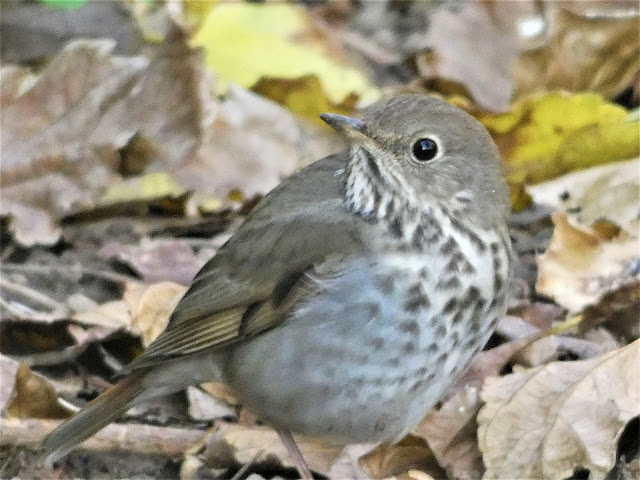
I really love Hermit Thrushes (Catharus guttatus). They are secretive birds, spending much of their time hidden away in the thick underbrush. They live along the Tuolumne River trail that I walk every day, but they are so hard to find that most of 2021 had passed before I saw the first one of the year. Any time I see one there, I'm thrilled, and I call it a good day.
So today I was mowing the lawn (yes, I live in California after all, and it rained a few weeks ago, plus I like to mulch the fallen leaves instead of raking). I was unplugging the mower and happened to look around the corner by the air conditioner, and I saw bird scratching in the leaves. I assumed it was a sparrow, but it looked odd. I quietly stepped back and went in the house for my camera.
I got back and was just astonished to find it was a Hermit Thrush in my own backyard! I am continually amazed the sheer variety of birds that can be discovered in urban settings. In observations from my backyard and short walks in the local neighborhood we've now seen 59 species of birds. Sure, some of them were flying high overhead. No Sandhill Cranes hanging out in the backyard yet for instance, although Great Egrets and Green Herons have in fact fished out of our lily pond a few times (RIP dear old goldfishes). But today counts as one of the most thrilling discoveries.
Showing posts with label backyard. Show all posts
Sunday, January 23, 2022
Tuesday, May 7, 2019
Sometimes They Come to You: Black-headed Grosbeak...in my backyard.
I've been documenting the arrival of some incredibly beautiful tropical migrant birds in our region, species like Hooded Orioles, Bullock's Orioles, Blue Grosbeaks, and Lazuli Buntings. I've had to do a lot of walking along the Tuolumne River in order to see some of them. But one of the last of the special birds on my "list" (the species I really wanted to see again) surprised me but good; it came to me.
Two days ago I made a cursory glance towards the sunflower seed feeder on the back porch. It's usually populated by House Sparrows and House Finches, and occasionally by a California Scrub Jay. But that morning I did a double-take. It was a female Black-headed Grosbeak (Pheucticus melanocephalus) grabbing a morning snack.
The Black-headed Grosbeak migrates out of Mexico and spreads throughout the western United States, and just over the border into British Columbia. I've seen them a fair number of times on the Tuolumne River over the last few years, and I saw one last week up in Yosemite Valley, but they've been scarce so far this year. It was nice to have one come to me for once
The picture below is a male Grosbeak that I saw in Yosemite Valley last weekend.
Saturday, April 13, 2019
Second Sighting of a Hooded Oriole, on the Tuolumne River!
But the second sighting begs the question: "What happened to the first one?" And that's the story of the day.
Hooded Orioles (Icterus cucullatus) are one of the most attractive birds I never knew existed in our region. Once I started looking for new species around five years ago, I concentrated on the one place in the county that the local birding guide said they might be found: Fox Grove on the Tuolumne River east of Modesto. As it turned out, I finally saw and photographed them there (link here). I found them again at Fox Grove the following year (link here). By then I was wondering whether couldn't be found a few miles upstream on my favorite local trail, the Tuolumne Parkway Trail in Waterford. I started watching more carefully and got a single picture of Hooded Oriole in August of 2016. Ironically, I thought it was Bullock's Oriole at the time, but seeing the photograph later on set me straight (link here).
In 2017, I finally saw Hooded Orioles on the trail and got a selection of pictures. But I finally hit 'gold' in 2018. I found a family of the birds nesting in some palms on the bluff above the river.
So this year I've been watching the palms along my walking route (sometimes to the consternation of the homeowners), hoping to see the nest-building process and following the progress of any of the young. I have been watching carefully. With patience. With unceasing vigilance. And nothing. But then earlier this week I happened to glance at the hummingbird feeder in our backyard, and right there, 10 feet away, was a male Hooded Oriole posing for a picture. I called Mrs. Geotripper, and struggled to unpack my camera, but in the end the picture below is all I got to document the sighting, only the third or fourth in the county so far this spring.
And that is why the second sighting this morning down on the river trail was a bit more satisfying than the first one. I only got the one fairly sharp shot, but it was enough. The bird seems to have some nesting material in its mouth, and I saw it fly up towards the palm trees on the bluff where they nested the previous year. I can bet that I'll be watching more carefully in coming weeks!
ADDENDUM: Not two hours after posting this I was pulling weeds in the yard and sat to rest for a few moments. In perhaps 20 minutes I saw the Hooded Oriole twice. I got a fuzzy shot, but I have hopes now for better. Apparently this Oriole is in our yard more often than I thought.
Hooded Orioles (Icterus cucullatus) are one of the most attractive birds I never knew existed in our region. Once I started looking for new species around five years ago, I concentrated on the one place in the county that the local birding guide said they might be found: Fox Grove on the Tuolumne River east of Modesto. As it turned out, I finally saw and photographed them there (link here). I found them again at Fox Grove the following year (link here). By then I was wondering whether couldn't be found a few miles upstream on my favorite local trail, the Tuolumne Parkway Trail in Waterford. I started watching more carefully and got a single picture of Hooded Oriole in August of 2016. Ironically, I thought it was Bullock's Oriole at the time, but seeing the photograph later on set me straight (link here).
In 2017, I finally saw Hooded Orioles on the trail and got a selection of pictures. But I finally hit 'gold' in 2018. I found a family of the birds nesting in some palms on the bluff above the river.
So this year I've been watching the palms along my walking route (sometimes to the consternation of the homeowners), hoping to see the nest-building process and following the progress of any of the young. I have been watching carefully. With patience. With unceasing vigilance. And nothing. But then earlier this week I happened to glance at the hummingbird feeder in our backyard, and right there, 10 feet away, was a male Hooded Oriole posing for a picture. I called Mrs. Geotripper, and struggled to unpack my camera, but in the end the picture below is all I got to document the sighting, only the third or fourth in the county so far this spring.
And that is why the second sighting this morning down on the river trail was a bit more satisfying than the first one. I only got the one fairly sharp shot, but it was enough. The bird seems to have some nesting material in its mouth, and I saw it fly up towards the palm trees on the bluff where they nested the previous year. I can bet that I'll be watching more carefully in coming weeks!
ADDENDUM: Not two hours after posting this I was pulling weeds in the yard and sat to rest for a few moments. In perhaps 20 minutes I saw the Hooded Oriole twice. I got a fuzzy shot, but I have hopes now for better. Apparently this Oriole is in our yard more often than I thought.
Thursday, July 26, 2018
Birding from 18 Inches Away: Baby Mockingbird out the Kitchen Window
Sometimes birders will travel the lengths of the world to get close to our feathered colleagues, but sometimes they appear, well, REALLY close to home. Like outside the kitchen window. There was a commotion this morning in the front yard, a region of our neighborhood mostly given over to Northern Mockingbirds (Mimus polyglottos). It appeared to involve a pair of the aforementioned Mockingbirds and a local cat (not ours, although ours was watching carefully out the window. I checked out the kitchen window and saw this very young chick perched 18 inches away outside the window, pretty much unaware of our presence. I couldn't tell it there was a problem, or if this was just the normal progression of exploring outside the nest (the adult birds have chased the cat away).
Wednesday, October 18, 2017
An Oak Titmouse, the Quintessential California Bird, in my Backyard
I don't report on birds from my backyard very often. I have several feeders, but for the most part they attract California Scrub Jays, House Finches and European (House) Sparrows. But once in awhile a more unusual bird will show up. The White Crowned Sparrows have arrived on their fall migration, for instance, and today there was a Black Phoebe in the yard, which I've only seen there once before. But the other bird was a surprise, because I've never seen one here ever: an Oak Titmouse (Baeolophus inornatus).
It was fairly cautious, waiting until the other birds left the feeder, and quickly grabbing a bit and then retreating to the Mulberry tree. It came back four times, and I tried to be ready, but only got these couple of slightly overexposed shots. I'll have to spend more time back there "relaxing".
The Oak Titmouse is about as close as a bird can be to being a California endemic species without actually being one. Like the Acorn Woodpecker, it ranges through the California oak woodlands that extend from the northern edge of Baja California to the hills and mountains of southern Oregon. There is a closely related species in Nevada called the Juniper Titmouse. They were once considered to be a single species, but there are differences in their coloration, and also in their songs. They are almost completely isolated by the Sierra Nevada with only a small area of overlap in northwest corner of the state.
It was fairly cautious, waiting until the other birds left the feeder, and quickly grabbing a bit and then retreating to the Mulberry tree. It came back four times, and I tried to be ready, but only got these couple of slightly overexposed shots. I'll have to spend more time back there "relaxing".
The Oak Titmouse is about as close as a bird can be to being a California endemic species without actually being one. Like the Acorn Woodpecker, it ranges through the California oak woodlands that extend from the northern edge of Baja California to the hills and mountains of southern Oregon. There is a closely related species in Nevada called the Juniper Titmouse. They were once considered to be a single species, but there are differences in their coloration, and also in their songs. They are almost completely isolated by the Sierra Nevada with only a small area of overlap in northwest corner of the state.
| A bonus shot of a White-crowned Sparrow, which also visited this morning |
Wednesday, May 31, 2017
Black-chinned Hummingbird in the Backyard
I'm not done with my posts on Hawaiian birds; I finished with the natives, but there are lots of other birds to see there. But in the meantime, in the immortal words of Dorothy of Oz, "There's no place like home". I was told in no uncertain terms by the birds in the backyard to refill the birdfeeders. There was noise all day, but the most insistent individual was a little female Black-chinned Hummingbird (Archilochus alexandri). It quite literally flew by my face, landed on the mostly empty feeder, then perched in the nearby Crepe Myrtle tree and stared at me. The message was clear...
The Black-chinned Hummingbird is a western species with a range extending from Washington to southern Mexico and eastward as far as Texas. They do well in urban settings (they love feeders) so their population has been increasing. I've seen quite a few of them along the Tuolumne River.
Wednesday, March 8, 2017
Bird-watching in the Yard? Nah, Never Anything Interesting...What?
Sometimes one might think that birdwatching in the yard is slightly monotonous. I've found that's not actually true, as I've probably seen two or three dozen species in my own, but I've never seen this in my 26 years at this address. Two snakes, yes. An occasional possum, yes. But leaving for work this afternoon, it was a Wild Turkey (Meleagris gallopavo). It had been in my front yard, but got up and wandered off down the street (unnoticed by quite a few neighbords!).
We had been working in the back yard a little earlier in the day and heard some odd vocalizations that we couldn't identify or locate, but I'm thinking it might have been the Turkey hiding out behind the fence.
The lesson? Don't sell your yard short as a place to see interesting birds!
We had been working in the back yard a little earlier in the day and heard some odd vocalizations that we couldn't identify or locate, but I'm thinking it might have been the Turkey hiding out behind the fence.
The lesson? Don't sell your yard short as a place to see interesting birds!
Saturday, February 11, 2017
Audubon's (Yellow-rumped) Warbler Hiding in Plain Sight
There have been precious few chances for birdwatching of late, just stolen moments during lunch breaks, or a rare jaunt down to the Tuolumne River. I've been inundated by a combination of work and home projects. So it was that I was digging away in the backyard and stopped for a breather. Because I didn't have my camera, a Ruby-crowned Kinglet practically landed on my head. I went for the camera and the Kinglet was gone, but there were dozens of Yellow-rumped Warblers (Setophaga coronata) hopping about in the Mulberry trees. I got a couple of shots in the dying afternoon light.
I always thought "Yellow-rumped" was kind of an insulting name for a bird, and I later found that others thought the same thing. They had better reasons for not liking the name, because it had four distinct subspecies that were clearly different from each other. For years, arguments have raged over whether they were subspecies or distinct and different species altogether. The pendulum is swinging back towards separate species, based on DNA and genetics research. I'm fine with that, since the little rumps would become Audubon's Warblers, a name with much more charisma and gravitas. Although, I have to admit that my first post on the Yellow-rumps had the greatest number of hits of any post on this blog. Since most of my hits come from Google searches, I don't want to speculate why.
Thursday, December 31, 2015
Sometimes Only For a Moment: Cedar Waxwings in the Backyard
Sometimes you only get the shortest moment. I was sitting in the
backyard watching some small birds flitting among the branches when a
small flock of five or six Cedar Waxwings (Bombycilla cedrorum) landed in my Mulberry tree.
I got just a couple of shots, wondering if they were going to stick around. They didn't stay but maybe 10-15 seconds before heading west. At times during the winter, I've had flocks of fifty or more roost in our flowering pear tree overnight. They're kind of eerie at night because they don't make any noise at all. They just stare at you, if anything.
Obviously they are colorful and pretty birds. They love fruits and berries when they can get them, but will chase after bugs if they need to. Their chicks can survive on fruit alone which saves them from Cowbird parasites in the nest. The Cowbird chicks can't live on the vegetarian diet.
The Flowering Pear didn't produce much fruit this year, so I don't know if I'll be seeing many of these birds in our yard this winter, but we'll see. You'll be the first to know!
I got just a couple of shots, wondering if they were going to stick around. They didn't stay but maybe 10-15 seconds before heading west. At times during the winter, I've had flocks of fifty or more roost in our flowering pear tree overnight. They're kind of eerie at night because they don't make any noise at all. They just stare at you, if anything.
Obviously they are colorful and pretty birds. They love fruits and berries when they can get them, but will chase after bugs if they need to. Their chicks can survive on fruit alone which saves them from Cowbird parasites in the nest. The Cowbird chicks can't live on the vegetarian diet.
The Flowering Pear didn't produce much fruit this year, so I don't know if I'll be seeing many of these birds in our yard this winter, but we'll see. You'll be the first to know!
Wednesday, December 16, 2015
Yellow-rumped Warblers in the Backyard
I've seen a lot of interesting birds in the last few months, both with traveling out of state and on local field trips. Sometimes it is easy to forget that there are times when the birds will come to you. I haven't had a lot of chances to sit in the backyard, but the falling leaves are forcing me to do some work out there. While I was doing the requisite yardwork, I remembered how surprised I was to find that there were some cute birds practically under my nose. In particular, a dozen or so Yellow-rumped Warblers (Setophaga coronata) spend the off-season in my Mulberry trees. I just don't see them as much until the leaves fall.
Of all the backyard birds, only the Mockingbirds seem less concerned with my presence. There are lots of finches and house sparrows, but they retreat if I come out on the porch. But the warblers don't seem to change their behavior. If anything, judging from the top picture, they are copping a bit of an attitude!
Subscribe to:
Posts (Atom)

