Showing posts with label Hooded Oriole (Icterus cucullatus). Show all posts

Monday, January 25, 2021

Someone Else Missed the Text on Migration: Hooded Orioles in my Backyard

Spring is such a wonderful time along the Tuolumne River as I eagerly await the arrival of my favorite tropical migrants: the Black-headed Grosbeaks, Blue Grosbeaks, Bullock's Orioles, the Lazuli Buntings, and perhaps my all-time favorite, the Hooded Oriole (Icterus cucullatus). But the birds have not entirely cooperated this year, as I discovered that a Black-headed Grosbeak was in fact wintering along the Tuolumne River. But even in that context, today was a real shocker.
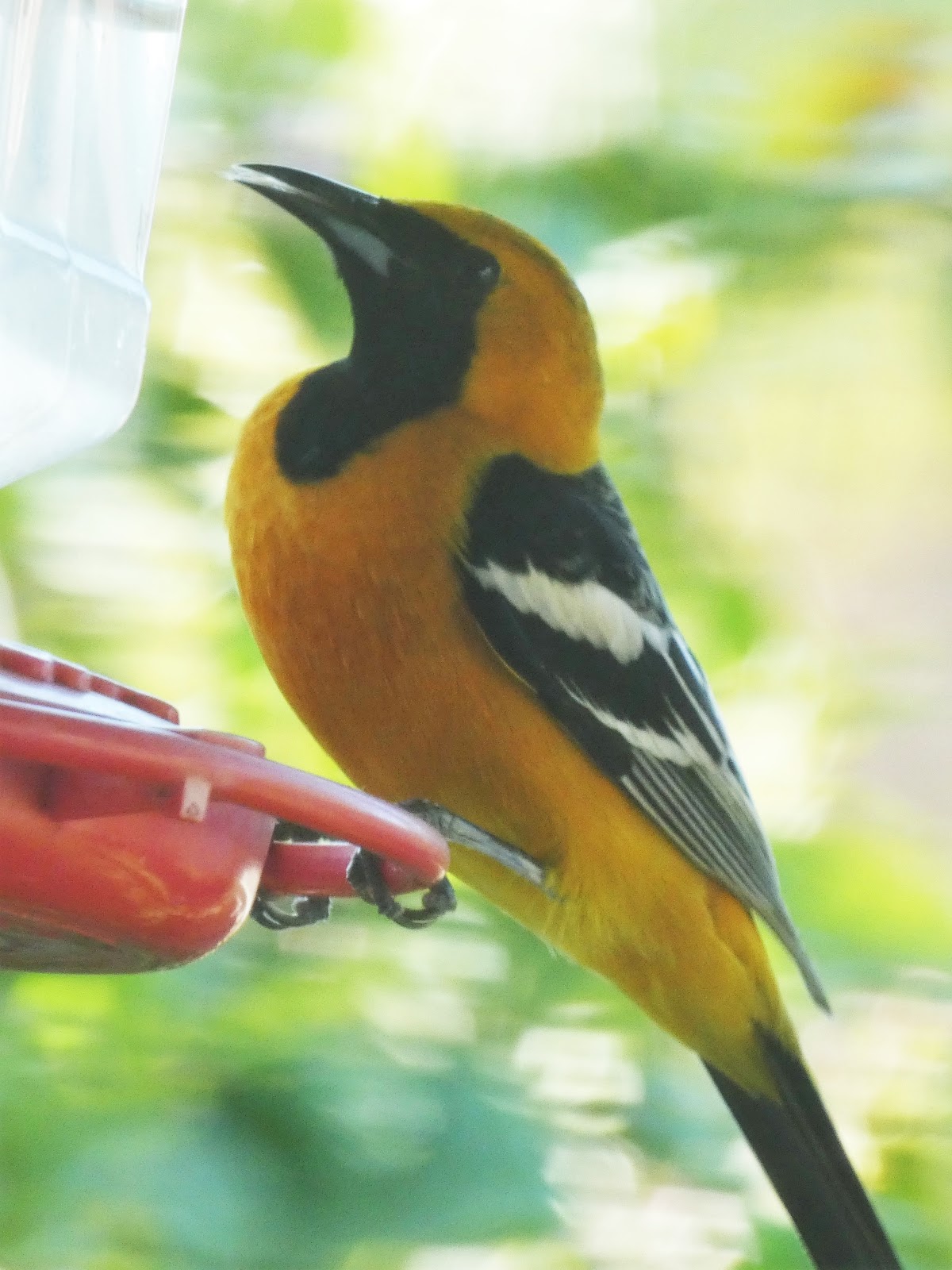
I just happened to look out the window at the hummingbird feeder this morning and saw an unusually large bird perched there. I realized with a shock that it was a Hooded Oriole! Such things need documenting, so I grabbed my camera and got a few shots before it flew off. I thought it might come back after a bit, so I kept the camera handy and sure enough a few minutes later it came by again, and gave me a sharp stare. But then, the another surprise...

A few minutes later the Oriole had come back, but when I looked at the tail, I realized it was not the same bird. The tail was yellow, not black. This was a second Oriole, and it was a female! I never got  shot of the head, so a picture of a bird butt will have to suffice. The birds came back about five hours later, and I got a more convincing look at the female, but no pictures.

This is actually the second time that I've witnessed a Hooded Oriole pair over-wintering near the Tuolumne River. There was a pair that spent the 2020 winter in some palm trees overlooking the Tuolumne River Parkway Trail, and I am curious as to whether these are the same birds. If they have a secure winter food source, why make the perilous journey to Mexico and Central America? My yard is only a half mile from the palms where last year's birds stayed.
 

Saturday, June 20, 2020

My Favorite "Summer" Visitor: Hooded Orioles on the Tuolumne River

There are not a lot of places to see Hooded Orioles (Icterus cucullatus) in our county in the Great Valley of California. We are pretty close to the northern edge of their range in the United States, although they are being seen farther and farther north as the climate warms.
I followed the advice of local birders and searched the palm trees at Fox Grove a few miles downstream to find them for the first time. Not long after I discovered that some were nesting in palms along the Tuolumne Parkway Trail, a fact that thrilled me to no end.
This year offered a big surprise, as a pair seemed to have not migrated to Mexico last winter, and stayed in the palms along the river. For a time they were the only Hooded Orioles reported in the entire Great Valley, and one of only four in the entire state of California. They've continued to hang out this summer, so this is a compilation of pictures I've managed to capture over the last few months during my daily walks. The more plainly colored individual is a female.
They are one of my favorite birds, as you might guess!

Friday, February 21, 2020

It's Back! Or it Never Left...Hooded Oriole on the Tuolumne River

Hooded Orioles (Icterus cucullatus) are beautiful birds that winter in the tropics and visit our region for the spring and summer, adding a bright splash of color to our river environment. There is a set of palm trees where they nested for at least the last two years, and I was delighted every time I spied one of them during my walks.

So it was that last December 4, and again on December 11 I saw a male and female in the palm trees, at a time when only three Hooded Orioles were known to be anywhere in the entire state of California. It was a shock, but then I didn't see them again all through January and most of February. At least until today. I actually searched the palms pretty carefully hoping the orioles were still around with no luck, but then mere moments later I saw the male on a tree in a backyard just down the street. It stayed still long enough for pictures, and then as it flew off I thought I saw a second one, but I couldn't be sure.

These could be super early spring migrants, but I suspect these are the same birds I saw in December, and that they stayed in the region. But if they did stay, they hid well because I watched for them every day as I walked the trail.

Wednesday, December 11, 2019

At Least He Isn't Lonely...A Second Hooded Oriole This Winter on the Tuolumne River!


The other day I posted about what I thought must be the loneliest bird in all of California. There was a male Hooded Oriole (Icterus cucullatus) hanging out near the oriole nesting site on the bluffs above the Tuolumne River, and they are not supposed to be here in the state right now. Literally all of them migrated to Mexico and Central America many weeks ago, and there have been no sightings of any in the state in the last month except for three birds in the far south part around San Diego.

So I was on my walk today and of course I was watching out for the Oriole and much to my surprise, there it was. Except something was different...it didn't have the prominent black chin patch that distinguishes the mature males. The one last week did. I can now say there are TWO Hooded Orioles in Central California, and they are probably hanging out with each other (the site was only a few yards from where I saw the other one last week). This one is either a female, or an immature male. I don't know why they are still here, but I've developed a complicated hypothesis...

I've been seeing all the "traditional" Christmas movies this week, "National Lampoon's Christmas Vacation", "Elf", "Home Alone", "Die Hard", and so on, including the great classic (biting my tongue as I say that) "Christmas with the Kranks". If you aren't familiar with the premise, the Kranks were going to have their first Christmas without their daughter (who was in Peru), so they decided to skip Christmas and take a cruise in the tropics. Their daughter decided to come home, and hilarity ensued (sort of).

Regarding these two Hooded Orioles, I see kind of an opposite situation. I imagine I heard this conversation between them...

"Look, EVERYONE is migrating to the tropics for Christmas. They ALWAYS do, and it's a long way, and hard and dangerous. I think we should just stay put and skip Christmas this year."

"I don't know, Luther. There must be a reason everyone goes. But okay, if you think it's a good idea"

Four weeks later...thirty degrees and foggy outside.

"Luther, if you ever have a feather-brained idea like this again, keep it to yourself..."

Does anyone have a better idea?


Wednesday, December 4, 2019

The Bird That Shouldn't Be There: Hooded Oriole on the Tuolumne River


Today's walk along the Tuolumne River was extraordinary. I got there just as the latest storm ended, so there were no people on the trail, but lots of birds were enjoying the respite from all the hikers and exercisers. I counted 29 species, including one bird seen for the first time on this stretch of the river, a Bufflehead. There were also some that I haven't seen in a long time, including the first winter arrival of the Common Goldeneye, a flock of Northern Shovelers, and a Green Heron. It was actually kind of astounding.

But nothing surprised me more than the bird I saw on the top of the bluff at the east end of the water treatment plant. At first, I only saw the shape, and I thought it might be a mere Mockingbird, but something about it made me flip on the camera and take a closer look. I saw the bright yellow breast, the black chin, and my jaw dropped. It was a Hooded Oriole!

To understand just how odd this is, is to realize that the Hooded Oriole (Icterus cucullatus) is a bird of the tropics, and we are at the northern end of its range here in the Central Valley of California...in the SUMMER. They all migrate to Mexico and Central America for the winter. Literally all of them. There have been just three sightings of Hooded Orioles in California in the last 30 days, and all three were in southern California.

I don't know the story of this particular bird. It was hanging out just a few hundred feet from the palm trees where some Orioles nested last spring, so this could be one of the individuals that I photographed many times last summer. Maybe it was injured in some way and wasn't able to join the migration. Or maybe it just missed the bus. But in any case, I saw a bird today that shouldn't be there. Which explains the poor quality of the picture: I barely had time to focus before it flew away.

Wednesday, July 24, 2019

The Babies are Growing Up! Hooded Oriole on the Tuolumne River Parkway Trail

Time passes quickly when you're having fun...or you're traveling thousands of miles. I've been on the road for four of the last five weeks, and when I wasn't traveling, I was unpacking and packing again. Somehow it's been a month since I last posted any birds!

I've been thinking a lot about home since I was away so long. I've been watching a group of Hooded Orioles along the bluffs above the Tuolumne River since last spring. They had a nest somewhere in a group of palm trees, and I've seen at least three individuals at one time or another. This morning it was an immature male that I assume was one of the babies. Those palms were home for these birds, and so far for this male, it has been the only home it has ever had. But that will change in a matter of weeks. Hooded Orioles are tropical migrants, and they will soon be flying south for winter in their other home somewhere in Mexico or Belize.
But I'm pretty sure the birds will be back. Hooded Orioles are not common in our region, but this is the third year that I've seen the species, all within a few hundred yards of the palm trees on the bluff. Somehow they find this particular spot after a journey of a few thousand miles. I guess when you have a home, you never forget where it is.

I'll miss their bright colors when they leave!

Saturday, April 20, 2019

Well, I Never....Really? In my own Backyard? Hooded Orioles

It's been a week now since I reported seeing a Hooded Oriole in my backyard. It was an astounding moment, being that Hooded Orioles (Icterus cucullatus) have been one of my most challenging species to observe. In the three weeks since the first sighting in our county, only about five birders have reported seeing any at all.
It turns out, though, that as rare as they seem to be around the region, they're a common sight in my backyard. Our hummingbird feeder is not in an easily visible spot from inside our house. There's no place to sit and watch it. We have to notice feeding birds as we walk from one room to another, and despite this, I've seen an oriole at the feeder at least a dozen times now. And yesterday, the oriole visitors included at least one female!

Like many bird species, the female Hooded Orioles are not quite as showy and colorful as the males, but they are quite beautiful just the same. They are almost entirely yellow with black and white wings. The fact that there is at least one pair in the immediate vicinity leads me to wonder if there is a nest nearby. The orioles weave hanging nests constructed in part from palm leaf fibers, so our neighborhood palm trees are getting increased scrutiny these days...

Saturday, April 13, 2019

Second Sighting of a Hooded Oriole, on the Tuolumne River!

But the second sighting begs the question: "What happened to the first one?" And that's the story of the day.

Hooded Orioles (Icterus cucullatus) are one of the most attractive birds I never knew existed in our region. Once I started looking for new species around five years ago, I concentrated on the one place in the county that the local birding guide said they might be found: Fox Grove on the Tuolumne River east of Modesto. As it turned out, I finally saw and photographed them there (link here). I found them again at Fox Grove the following year (link here). By then I was wondering whether couldn't be found a few miles upstream on my favorite local trail, the Tuolumne Parkway Trail in Waterford. I started watching more carefully and got a single picture of Hooded Oriole in August of 2016. Ironically, I thought it was Bullock's Oriole at the time, but seeing the photograph later on set me straight (link here).

In 2017, I finally saw Hooded Orioles on the trail and got a selection of pictures. But I finally hit 'gold' in 2018. I found a family of the birds nesting in some palms on the bluff above the river.

So this year I've been watching the palms along my walking route (sometimes to the consternation of the homeowners), hoping to see the nest-building process and following the progress of any of the young. I have been watching carefully. With patience. With unceasing vigilance. And nothing. But then earlier this week I happened to glance at the hummingbird feeder in our backyard, and right there, 10 feet away, was a male Hooded Oriole posing for a picture. I called Mrs. Geotripper, and struggled to unpack my camera, but in the end the picture below is all I got to document the sighting, only the third or fourth in the county so far this spring.
And that is why the second sighting this morning down on the river trail was a bit more satisfying than the first one. I only got the one fairly sharp shot, but it was enough. The bird seems to have some nesting material in its mouth, and I saw it fly up towards the palm trees on the bluff where they nested the previous year. I can bet that I'll be watching more carefully in coming weeks!

ADDENDUM: Not two hours after posting this I was pulling weeds in the yard and sat to rest for a few moments. In perhaps 20 minutes I saw the Hooded Oriole twice. I got a fuzzy shot, but I have hopes now for better. Apparently this Oriole is in our yard more often than I thought.

Wednesday, July 4, 2018

Finally Found Them! Hooded Orioles on the Tuolumne River

Some birds just don't want to be found, which is perfectly understandable. But a bird that is as brightly colored as a Hooded Oriole (Icterus cucullatus) seems to be begging to be seen, but the species simply isn't all that common around here. It's more of a tropical species, and something like 98% of them spend winters in Mexico, and only half of them come over the border to breed in the U.S., primarily in the southwest desert regions, especially places rich in palm trees.
I've seen Hooded Orioles on parts of the Tuolumne River, but despite keeping careful watch for the last few months, I had not seen any this year. It turns out that palm trees are the key to finding them, at least on the river trail. The palms are where they build their unique hanging basket nests. There aren't any palm trees on the main trail, but there are several in yards on the bluff adjacent to the trail near the water treatment plant. I saw the flash of yellow and the curved beaks, and realized I'd finally found an Oriole family. The immature male was chasing mom around like a hungry teenager.

Tuesday, August 8, 2017

Hooded Oriole on the Tuolumne River

I got what for me is a rare sight on my morning walk today: a male Hooded Oriole (Icterus cucullatus). I've seen them nesting in the palm trees at Fox Grove where Geer Road crosses the Tuolumne several miles downstream, and I've seen one at the other end of the trail on a single occasion, but that's it.
There are a bunch of different bird species gorging themselves on wild elderberries along the trail lately: Bullock's Orioles, Robins, California Scrub Jays, Western Kingbirds, Starlings, and a few others. I've been finishing the exercise part of my walk, and then just standing under the oaks to see who's lurking nearby. Today's visitor was a pleasant surprise.

The Hooded Orioles are a migrant tropical species, and I live pretty close to the northern edge of their range. In a few weeks they will leave the area for their winter homes in Mexico.

Saturday, April 29, 2017

Hooded Orioles at Fox Grove

After my unsuccessful attempt at sighting Hooded Orioles in Hemet last week (I found Acorn Woodpeckers instead), I wanted about the closest thing to a sure thing as I could get. That would be Fox Grove on the Tuolumne River between Waterford and Modesto. They regularly nest in the palms around the Wildlife Center, and I've seen them there a few times in past years.
The Hooded Orioles (Icterus cucullatus) are a species of the southwest and Mexico, coming north in spring to breed. They build interesting hanging nests out of fibers of the palm fronds (of which I haven't yet captured images).
I was picking up dinner at the BBQ joint up the highway and stopped in and found a couple of the Orioles flitting from palm to palm. As usual, I have yet to capture a sharp shot, but these are among the best yet that I've gotten.
The females are not nearly as showy as the males, but I did manage to catch a shot of one of them.

Sunday, August 7, 2016

Bullock's Orioles (and others) on the Tuolumne River Parkway

Once you've identified them the first time around, you start seeing them more often. I saw a Bullock's Oriole (Icterus bullockii) a bit over a week ago on the Tuolumne Parkway Trail in Waterford, and then the other day I got a look at more of them. Mama was apparently feeding a young teenager in the fig trees that arch over the trail. I'll have to enjoy them while I can. In a few weeks they'll be migrating south for the winter.
A few moments later I saw a male Oriole a few yards away up in the cottonwood tree, but should have realized it was actually a Hooded Oriole (Icterus cucullatus). The yellow head is the giveaway. That of course makes me wonder if I misidentified the female and juvenile too, but my impression is that the bills aren't curved enough to be Hooded Orioles, and they have too much white coloring on their breasts. I'm open to correction!

Friday, April 1, 2016

Another Sign of Spring! Hooded Oriole at Fox Grove

The Hooded Orioles (Icterus cucullatus) are back. The birds spend the winter in southern Mexico and migrate north to breed. They prefer palms for nesting, so they tend to go no farther north than the Central Valley in California and the southern tier states of the Four Corners along with Texas.

The local birders report that some palm trees along the Tuolumne River at Fox Grove east of Modesto is a reliable nesting area, so I searched there last year and got two fuzzy pictures. I check out the grove again today, and saw lots of Starlings and doves in the palms. As I was about to leave, I saw one more dark silhouette that I thought was one more Starling, but it was moving a bit differently than the others. I zoomed in, and it was a Hooded Oriole!
Of course, the pictures are slightly fuzzy again, but that just means I'm going to work a bit harder to get good pictures next time...

Tuesday, May 5, 2015

Hooded Oriole at Fox Grove on the Tuolumne River

The Stanislaus Audubon Society publishes a guide called "The Birding Sites of Stanislaus and Merced Counties" (available through the website or from the store at the Great Valley Museum). It's a great resource for finding birding locations in our region, and it had one almost cryptic passage about Fox Grove, a fishing access park on the Tuolumne River between Modesto and Waterford. It mentioned only one kind of bird: the Hooded Oriole (Icterus cucullatus). I hadn't seen any yet in my birding adventures, so I stopped by the park for a few minutes this afternoon. I didn't really think I would see anything, but the sun was setting, the birds were chirping, and a hawk was screeching in the trees above. I saw a few other birds, but then I saw what looked like an oddly colored bird very high in the palm trees, and snapped a few shots. They are a bit fuzzy, but I realized a short time later that I had my first Hooded Oriole! I'll be working as I always do to get sharper pictures the next time around.
The brightly colored Hooded Oriole is more of a tropical species, spending much of the year in Mexico and Central America. During the summer they move north for breeding purposes, and we live pretty close to the northern margins of their range in California. They prefer desert oasis environments with their palm trees, but they have done well with the ornamental palms found in much of central and southern California. They build unique hanging nests among the palm fronds.