Showing posts with label Sialia mexicana. Show all posts

Tuesday, April 12, 2022

Just How Close Do You Want to Get? Western Bluebird on the Sabercat Trail

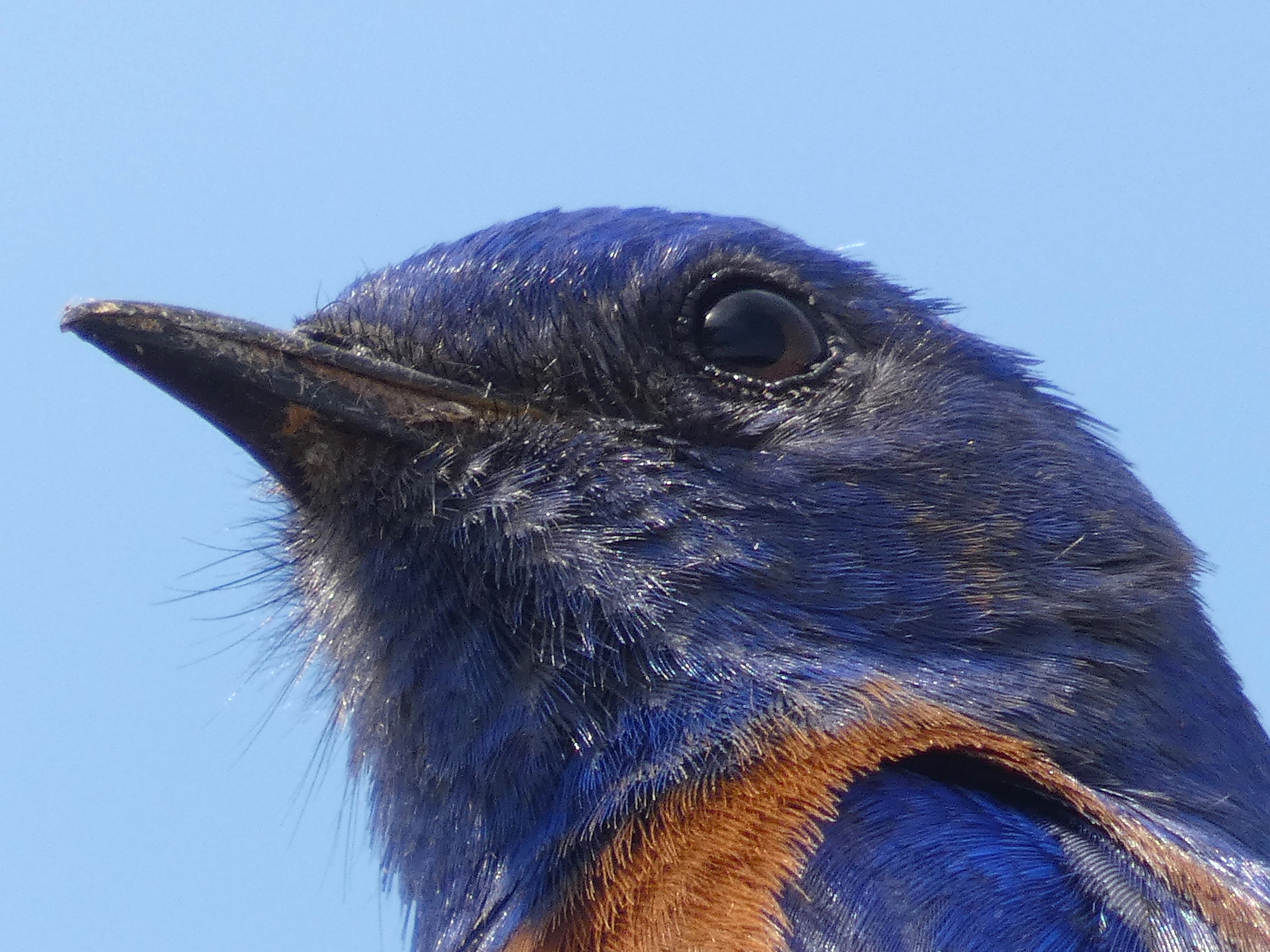
By color scheme alone they are one of my favorite birds. I'm just partial to blue that way, the darker the better (I've noticed this about favorite minerals as well: go azurite!). Western Bluebirds (Sialia mexicana) are not rare, but I don't see them nearly often enough.
I was walking on the delightful Sabercat Trail in Fremont the other day with my family, and a pair of Western Bluebirds were perched on tree stakes right next to the trail, and really didn't seem all that concerned about our presence. I was please to get a couple of up close and personal shots of both the male (above) and less colorful female (below).

Western Bluebirds are one of the arguments for not cutting down old snags and burnt dead trees. They are cavity nesters, but they don't have the ability to carve such nests like the woodpeckers. They instead let the woodpeckers do the work and take over after they have moved on. Bird boxes work well for them as well.
Such a nice moment on the trail!

Thursday, August 2, 2018

Western Bluebirds (and babies) at Humboldt Redwoods State Park


We're continuing our journey to cooler places (two weeks ago...I'm baking right now). We spent our first night at Albee Creek Campground, a quiet little campground off the main highway in Humboldt Redwood State Park in Northern California. Albee Creek is a former homestead that is now a break in the forest with a meadow and even a small grove of apple trees.

There were a number of birds about, but the prettiest were the Western Bluebirds (Sialia Mexicana). There was a family, or several families, and I was able to get pictures of some of the slightly plainer looking females who were busy feeding some fledglings (above, with the spotted breast). The males are a showier bright blue, but in this instance I didn't get clear shots (check the archives to the right if you want to see a few; they are a favorite of mine to post).
The apples weren't quite ripe, so we didn't see any bears like we did last year, but Mrs. Geotripper heard one right outside our tent in the middle of the night. I of course slept through the whole thing.

Saturday, March 17, 2018

An Argument for Looking Closer at Little Birds: Western Bluebirds on the West Campus

Before I  became a geologist, all rocks were gray, and there were a few crystals, but all of them were quartz. Then, a small bit of education intervened and my eyes were opened to a vast and complicated world inhabited by a dizzying array of rocks and thousands of kinds of beautiful and colorful minerals. It was a revelation that changed my life and led me into the career I've enjoyed now for more than thirty years.
Jumping ahead a few decades, birds have become my new minerals. A decade ago, I pretty much figured the birds I saw in the neighborhood and at work fell into a few categories: sparrows, pigeons, and crows. And they were little gray things, just like the rocks once were. So imagine my surprise when I found I lived in one of the more critical bird habitats in the country. Nearly a thousand bird species have been identified in the lower 48 states, and almost a third of them have been sighted at one time or another in Stanislaus County where I live. There are plenty of reasons for the biological richness: mild winters, providing shelter for many migrant species; and a wide variety of habitats, including foothills, prairies, rivers and flood plains, and mountain slopes. Despite being a rank amateur at bird watching, I soon had identified more than a hundred species.
One of my favorites of my new world are the Western Bluebirds (Sialia Mexicana), as evidenced by the fact that this is the 14th time I've posted pictures of them. They're irresistibly colorful. I saw these during my recent wanderings on the West Campus of MJC, which turns out to be a pretty good habitat for bird watching, with more than 60 species seen so far. They'll probably be headed for the hills very soon as spring arrives. They are actually more of a woodland bird in their breeding choices, and move into the Sierra Nevada or the Coast Ranges.
I'm not an expert, and my blog has become just the 300th most-read bird blog, but I've enjoyed writing about my discoveries, and I've appreciated hearing from those who have been along for the journey!
Tuesday, July 25, 2017

Juvenile Western Bluebird at the Black Diamond Mine

I still catching up on the richness of birds that I've seen and photographed this summer. Back in May our Geology Club took a tour of the underground mines at Black Diamond Mine Regional Park in the Pittsburg-Antioch area of the Sacramento Delta.
As we walked up the valley towards the mine entrance, I saw a LGB (little gray bird) that I couldn't immediately identify (there are lots of little gray birds that I haven't yet learned to identify quickly). After watching it move around, I began to suspect it was a baby rather than an adult, so I started looking for the mother.
Pretty soon I spied momma, and realized that the little one was a Western Bluebird (Sialia mexicana), one of my favorites, judging from the number of posts I've put up (this is the 13th).

Black Diamond Mine was a source of coal and glass-making sands a century ago (California is not known as being much of a coal mining region, but the energy demands in the late 1800s led to the use of even marginal coal deposits). The park is a pleasant place for hiking and bird-watching. Many of the scars of the mining have faded away.

Wednesday, April 12, 2017

Western Bluebirds Continue as One of the Most Colorful MJC Birds

They're one of my favorite sights on the west campus of Modesto Junior College where I work, the Western Bluebird (Sialia mexicana). The campus has an unusually large greenspace with lots of mature trees, dating from the property's origin as a hospital for wounded World War II soldiers. I extended my evening walk to the far eastern reaches of the property where there are as of yet no buildings, just a large grove of trees including oaks, palms, eucalyptus, lemon (!), cottonwood, ash, and Monterey Pines. I've seen hawks and kestrels out that way, being no surprise when seeing the large concentration of ground squirrels in the grassy area below. I saw this male (the more brightly colored one) and female in a pepper tree near Bluegum Avenue.

I think this is my twelfth post on Western Bluebirds, which is about right compared to my pleasure at encountering them. They spend a fair part of the year elsewhere, most likely up the slopes of the nearby Sierra Nevada, so I'm catching all the pictures I can right now!

Thursday, February 23, 2017

Western Bluebirds in a Changed "Mini-wilderness" on Campus

The storms of 2017 are changing many things. It's been a week since I wandered over to our campus "mini-wilderness", a drainage pond that has a grazing area for sheep from our agricultural unit as well as a collection of old and maturing trees (some are 70 years old). It's been a good spot for seeing a variety of birds. Today I was shocked to see that not one, but two huge Eucalyptus trees had fallen during the weekend. It appears that the first one to fall took out the second.

As I continued walking around the pond, a Western Bluebird (Sialia Mexicana) alit on the fence post only a few yards away from me. These beautiful birds tend to be a little more cautious in my presence, but maybe the coming spring is releasing some of their inhibitions. It stayed in place while I got some of the sharpest pictures I've ever managed to capture of these colorful creatures.

Wednesday, January 18, 2017

Western Bluebirds on the Campus Quad

It's been gloomy of late, what with six days of rain, and five days of fog and overcast skies. The conditions weren't ideal for photographing birds, but while I wandered the campus on Tuesday, I did run across a number of Western Bluebirds (Sialia mexicana) in the main quad. Nothing else was likely as a photography target, so I snapped a couple of shots in the gray conditions. They are beautiful birds even if the prevailing skies are not!

Tuesday, March 22, 2016

Western Bluebirds on the West Campus

I haven't seen many Western Bluebirds (Sialia mexicana) of late, more from not getting out enough as much as any other reason, but I got a few shots today. I was wandering on the west campus of Modesto Junior College. Practically all birds are pretty in one way or another, but I have a soft spot in my heart for the deep blues of birds like these (and the obnoxious Scrub Jays).
The local bluebirds may be winter visitors, and if so, they'll probably head back up in the hills before long. I have seen quite a few along the Tuolumne River in all seasons. I will no doubt post more shots when I see them again. They're irresistible!

Friday, January 8, 2016

Birds of MJC: A Bevy of Bluebirds

Happy New Year! May you be blessed by the Bluebird of Happiness this year!
It's taken a long time to post my first birds of the new year. There has been a lot going on, and none of it in the form of birding. But that changed a little bit today.
If you aren't one of my local readers, MJC refers to the school where I teach, Modesto Junior College in California's Great Valley. It's turned out to be a pretty nice place to watch for birds. There are the many normal urban birds, the gulls, crows, mockingbirds, and Scrub Jays. But there is also a drainage sump on the campus dating from World War II that has grown into a small woodland that approximates a pond ecosystem and wild bird habitat. I've identified more than forty species so far on campus.
I was on campus today preparing for the new semester that begins on Monday. There were very few people out and about, and in their absence, the small birds were active all across the campus quad. The reason was obvious: some of the decorative trees still had lots of berries to eat. What are those pink berries, by the way? I'm not a botanist (and many would say not a birder either).
"I don't know either, but you can't have mine"
I haven't seen Western Bluebirds (Sialia mexicana) in months around here (they may have been around, I just miss them). There were at least a dozen of them on the quad today. I was delighted. Without all the students walking by, they didn't seem to mind the tall guy with the camera.
I think they spend the summer in the Sierra foothills and higher mountains, and move down into the valley for the winter. 
The females are the more drab of the two sexes. They have a bit of a blue blush but are mostly gray on top. Both sexes have the buff and white in front.
It was so nice to see them again!

Thursday, September 3, 2015

Western Bluebirds on the Tuolumne River at Basso Bridge

We took a little picnic on the Tuolumne River at Basso Bridge this afternoon. I've become ever more aware of the treasure we have in this waterway that flows through our region. So much of the river environment has been expropriated for gravel pits, pastures, irrigation canals, mining and other consumptive uses that the original riparian habitat can be hard to find. That's been changing in recent years as some of the scars slowly heal and the river vegetation begins to return.
Basso Bridge was an older river crossing that has been replaced by a modern concrete highway. Only pedestrian traffic is allowed on the bridge these days. There is a parking lot for fishing access, and a county park (the Joe Domecq Wilderness) across the highway. I went all over the pond and river bank looking for some bird activity in the hot afternoon, and no one was out and about so I went back to the parking lot. It was only then that I noticed the birds were watching me! There were several Western Bluebirds (Sialia mexicana) in the tree next to the car.
They flew down to the river for a drink and then wandered off, doing their thing. We headed back home...

Sunday, July 5, 2015

Western Bluebird Family at the Tuolumne River Bluffs

I was home briefly from my travels (a situation that will be rectified very soon as we hit the road tomorrow), and I wanted to see who was out and about at the future Tuolumne Bluffs Park in Waterford. I saw two kinds of woodpecker, but couldn't get adequate shots of them, but as I was leaving I saw three birds on the wires above. They seemed to be different from each other, and upon closer inspection they were, but the difference was from age and gender, not species.
All three birds were Western Bluebirds (Sialia mexicana), but only one of them was clearly blue from the view I had, the male. I don't know that it was specifically a family grouping, but three birds in close proximity like this made it seem likely. The female is above, and the juvenile is in the picture below.
I hadn't been to the future park in more than a month, so there were some big changes. The groundbreaking ceremony for the park took place about two weeks ago, and graders have begun leveling the dirt parking area on the bluff. I am feeling ambiguous about the park in the sense that they will be paving over what had once been an open field, but they don't seem hell-bent on destroying the old trees yet, and the finished park will provide access to the river trail via a metal stairwell. The walk will follow the Tuolumne River upstream for two miles to Appling Park, and I am really looking forward to some explorations along that route when it is finished.

Tuesday, March 24, 2015

Western Bluebird at the Future River Park in Waterford

This little Western Bluebird (Sialia mexicana) might look bedraggled, but I think it's actually quite happy (the Bluebird of happiness?). Things have been quite dry out here (in case you haven't heard, we are in the midst of a horrific drought), but some of the irrigation canals are being primed, and there was an inch or two of water in the bottom. He was preening in the old tree next to the canal.

The canal is the one that passes through the future river park in Waterford. The park will be situated on some bluffs that overlook the Tuolumne River, and a stairwell will descend to the floodplain with a healthy-looking riparian habitat. I'm looking forward to the completion of the project, as I think it will open up some excellent birding possibilities. We will see...

Tuesday, October 14, 2014

Bird of the Day: Return of the Western Bluebirds to the Campus and the Pasture!


One of my favorites seems to have returned to the region, presumably coming down from the foothills of the Sierra Nevada. I haven't seen the Western Bluebirds (Sialia mexicana) in a couple of months, but yesterday I saw the one in the picture above down the street from my house, and this afternoon I saw a bunch in the agriculture area of our west campus. It's a delight to have them back! As they get used to the student traffic on campus I expect to get less fuzzy shots in coming weeks.