Showing posts with label Bombycilla cedrorum. Show all posts
Friday, February 22, 2019
What's Everyone Yelling About? Cedar Waxwings at the MJC West Campus
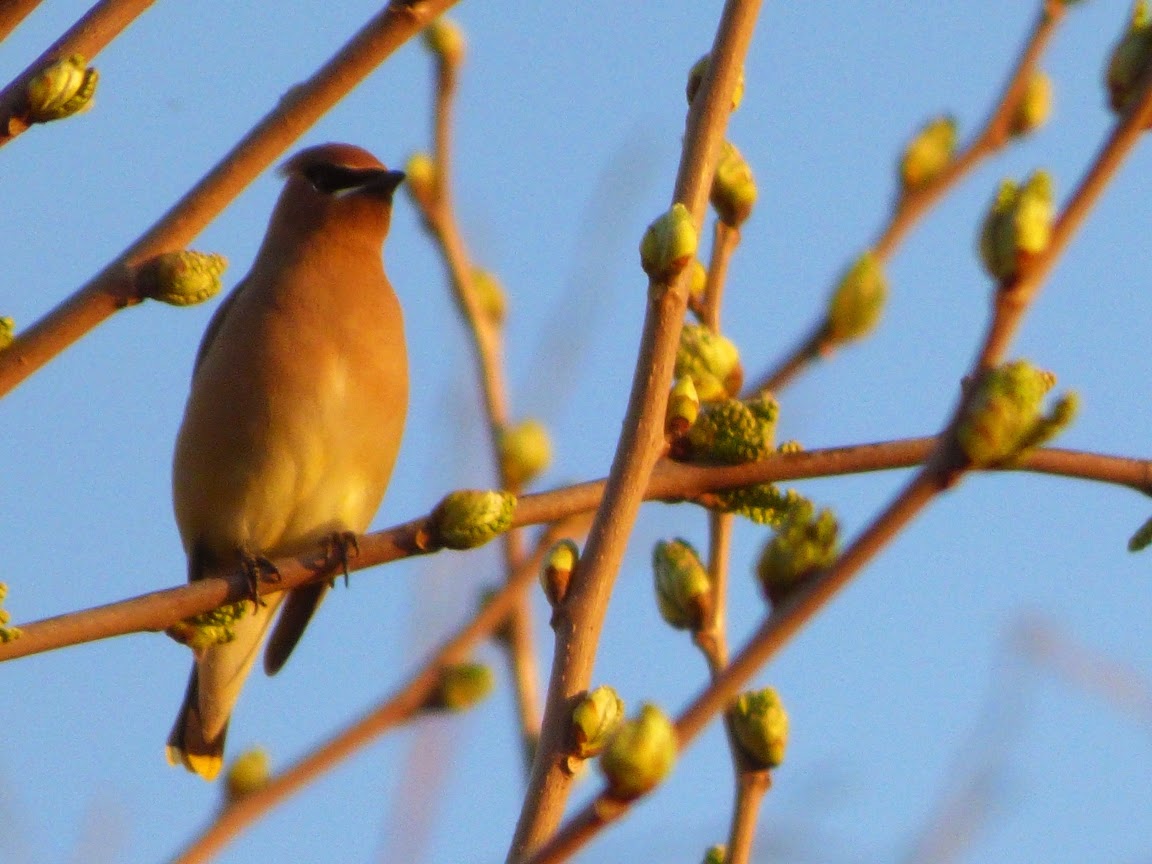
Cedar Waxwings (Bombycilla cedrorum) always strike me as quiet unassuming birds. I've had flocks of dozens in my flowering pear tree that were so quiet that I almost missed them entirely (it doesn't help that their call is so high-pitched that I can't hear them).
I was wandering around the northwest corner of the west campus of Modesto Junior College yesterday, near the "mini-wilderness" of the sheep pasture. There's a watering tank that birds often utilize, and yesterday was no exception. There were several dozen Cedar Waxwings flitting about in the trees, and eight or nine at a time were getting water. I snapped a few pictures from a distance and didn't notice until later that they looked as if they were yelling at each other.
What was that all about?
Tuesday, January 8, 2019
A Little Cross-species Bathing...Not That There's Anything Wrong With That...
A second later the two birds separated and looked my way. And if looks could kill, I would have been in trouble...that Cedar Waxwing was romping in the water with an American Robin (Turdus migratorious)! The scandal of it all!
Ah, to each their own, I say. I carried on with my errands.
Sunday, November 18, 2018
Decorating Christmas Trees, Avian-style: Cedar Waxwings on the Tuolumne River
It's getting to be the holiday season, and folks are thinking of trimming and decorating Christmas trees. The avian folks along the Tuolumne Parkway Trail had their own idea of how a tree should be decorated, using around 145 of themselves as ornaments. These beautiful birds are Cedar Waxwings (Bombycilla cedrorum), who tend to show up around here in the fall and winter as they migrate south.
I couldn't get near enough for a close-up, so here's a shot from last January at MJC...
Saturday, January 6, 2018
Cedar Waxwings on the West Campus of MJC
School has not yet begun at MJC (that's coming on Monday), so the West Campus quad has been particularly deserted throughout the holiday break. The campus has an attractive array of different kinds of trees, and when the students aren't milling about, the birds move in.
I was walking from one end of the quad to the other, delivering a print job to the duplicating office, and I saw seven species of bird in the 300 foot stroll. The others will show up as posts one of these times, along with all the birds from my visit at the Sacramento NWR a few days ago (yes, I've gotten behind).
It's probably clear that my favorite sighting was the flock of Cedar Waxwings (Bombycilla cedrorum). The birds have such beautiful (and slightly comical) plumage, and their presence seems to be limited to just a few weeks in the spring and fall. Their name comes from the bright orange wax deposits that sometime appear on their wingtips. The function is unknown, but maybe related to attracting mates.
The birds were eating what I think were toyon berries, which are ripe right now, and which were probably the reason I saw so many birds in the quad. I was able to get some of these shots because they were perched in a tree next to the second floor of the building I was running errands in.
I was walking from one end of the quad to the other, delivering a print job to the duplicating office, and I saw seven species of bird in the 300 foot stroll. The others will show up as posts one of these times, along with all the birds from my visit at the Sacramento NWR a few days ago (yes, I've gotten behind).
It's probably clear that my favorite sighting was the flock of Cedar Waxwings (Bombycilla cedrorum). The birds have such beautiful (and slightly comical) plumage, and their presence seems to be limited to just a few weeks in the spring and fall. Their name comes from the bright orange wax deposits that sometime appear on their wingtips. The function is unknown, but maybe related to attracting mates.
The birds were eating what I think were toyon berries, which are ripe right now, and which were probably the reason I saw so many birds in the quad. I was able to get some of these shots because they were perched in a tree next to the second floor of the building I was running errands in.
Tuesday, May 16, 2017
More Migrants on the Tuolumne River: Cedar Waxwings!
I mentioned in the last blog how much I love our migrant bird species. The Orioles have arrived, and so have a number of others. I saw a couple of yellowish birds flitting in the trees at the Tuolumne River Parkway trailhead the other day, and caught a few fuzzy images, but not really good enough to post. It was enough to identify them as Cedar Waxwings (Bombycilla cedrorum).
A day or two later I was out walking again and saw a flock of birds fleeing a hawk and eventually they settled down in a dead cottonwood tree along the river. I got some much sharper shots, though at some greater distance.
The Cedar Waxwings are colorful birds, with yellow breasts and distinctive "raccoon" masks around their eyes. They can make noise, but I rarely hear them vocalize (A year or two ago I had an entire flock in my front yard tree and I didn't notice them for hours).
I live roughly at the northern boundary of the bird's winter range (from here all the way to Central America), and they migrate north for breeding, so I've mostly seen them during the spring and fall migration.
Sunday, October 2, 2016
It's Fall! The Cedar Waxwings are Passing Through
It's one of the signs of the changing of the seasons: every fall and spring, the Cedar Waxwings (Bombycilla cedrorum) migrate through our region on their way to Mexico and Central America (fall) or the Pacific Northwest and southern Canada (spring). I was walking along the Tuolumne River this afternoon when I saw an unfamiliar bird flit through the oak tree. I tried to see where it was perching and slowly realized that there were quite a few of them hidden among the branches. I got these couple of pictures before a flock of 20-25 took off and headed east.
They've perched occasionally in my flowering pear tree in the front yard allowing me to get some close-up photos. I'll keep you posted!
Wednesday, March 16, 2016
Cedar Waxwings Gather in the West Campus "Mini-wilderness"
Oh, how I love the little Cedar Waxwings! They visit the region during their spring and fall migrations elsewhere, and will camp out on available perches. Sometimes the perches are in my front yard, along the Tuolumne River, or sometimes in our unofficial bird refuge on the West Campus of MJC, the "mini-wilderness".
The mini-wilderness is actually a drainage reservoir that often has a shallow pond, a cattail thicket, and a small oak and eucalyptus woodland. There is a dead cottonwood tree that seems to host a different flock of birds each evening. There has been a day of Red-winged Blackbirds, European Starlings, American Robins, Yellow-billed Magpies, and an occasional solitary Egret. But today I was thrilled to see a large flock of Cedar Waxwings (Bombycilla cedrorum)
The pond has swelled in the last few days as a result of the intense storms of the first half of March. In addition to the roosting birds in the cottonwood tree (center of the picture), there have been Mallard Ducks and Canada Geese.
The Waxwings were high up in a tall tree, so I got no close-up shots. I got some nice ones a few weeks ago, so here is a replay of one of my favorite shots of one of my favorite birds...
Thursday, December 31, 2015
Sometimes Only For a Moment: Cedar Waxwings in the Backyard
Sometimes you only get the shortest moment. I was sitting in the
backyard watching some small birds flitting among the branches when a
small flock of five or six Cedar Waxwings (Bombycilla cedrorum) landed in my Mulberry tree.
I got just a couple of shots, wondering if they were going to stick around. They didn't stay but maybe 10-15 seconds before heading west. At times during the winter, I've had flocks of fifty or more roost in our flowering pear tree overnight. They're kind of eerie at night because they don't make any noise at all. They just stare at you, if anything.
Obviously they are colorful and pretty birds. They love fruits and berries when they can get them, but will chase after bugs if they need to. Their chicks can survive on fruit alone which saves them from Cowbird parasites in the nest. The Cowbird chicks can't live on the vegetarian diet.
The Flowering Pear didn't produce much fruit this year, so I don't know if I'll be seeing many of these birds in our yard this winter, but we'll see. You'll be the first to know!
I got just a couple of shots, wondering if they were going to stick around. They didn't stay but maybe 10-15 seconds before heading west. At times during the winter, I've had flocks of fifty or more roost in our flowering pear tree overnight. They're kind of eerie at night because they don't make any noise at all. They just stare at you, if anything.
Obviously they are colorful and pretty birds. They love fruits and berries when they can get them, but will chase after bugs if they need to. Their chicks can survive on fruit alone which saves them from Cowbird parasites in the nest. The Cowbird chicks can't live on the vegetarian diet.
The Flowering Pear didn't produce much fruit this year, so I don't know if I'll be seeing many of these birds in our yard this winter, but we'll see. You'll be the first to know!
Monday, November 23, 2015
First Sighting of Cedar Waxwings this Fall!
One if my favorite times of the birding year is the arrival of the Cedar Waxwings (Bombycilla cedrorum) in our area. I saw a flock the other day on campus, but they were far away, as was my camera. This afternoon I took a short break at Fox Grove on the Tuolumne River between Modesto and Waterford.
I saw another flock of yellowish birds in the distance, and the telephoto confirmed it was a group of Cedar Waxwings. There were maybe two dozen of them in the dead cottonwood tree.
The birds come through the region while migrating between the tropics of Central America and Canada. They are year-round residents in the northern states. They feed primarily on fruits, which protects them from the nesting antics of cowbirds: the cowbird chicks can't live on the fruit diet and generally don't survive. The waxwings will supplement their diet with the occasional bug, however.
I'm hoping they'll return to the flowering pear in my front yard soon. They always surprise me when they arrive, because they are almost motionless and silent when they bed down for the night, and I therefore don't notice them except by chance. Then I feel a little creeped out as they stare at me...
Fox Grove is a 64 acre county park along the Tuolumne River between Modesto and Waterford. Some of the park is groomed (and ecologically barren) grass, and there is a large colony of feral cats. On the other hand, a lot of the park is recovering riparian habitat, and there are some good birding opportunities. I haven't spent a lot of time there, although I saw a Hooded Oriole there last spring.
I saw another flock of yellowish birds in the distance, and the telephoto confirmed it was a group of Cedar Waxwings. There were maybe two dozen of them in the dead cottonwood tree.
The birds come through the region while migrating between the tropics of Central America and Canada. They are year-round residents in the northern states. They feed primarily on fruits, which protects them from the nesting antics of cowbirds: the cowbird chicks can't live on the fruit diet and generally don't survive. The waxwings will supplement their diet with the occasional bug, however.
I'm hoping they'll return to the flowering pear in my front yard soon. They always surprise me when they arrive, because they are almost motionless and silent when they bed down for the night, and I therefore don't notice them except by chance. Then I feel a little creeped out as they stare at me...
Fox Grove is a 64 acre county park along the Tuolumne River between Modesto and Waterford. Some of the park is groomed (and ecologically barren) grass, and there is a large colony of feral cats. On the other hand, a lot of the park is recovering riparian habitat, and there are some good birding opportunities. I haven't spent a lot of time there, although I saw a Hooded Oriole there last spring.
Sunday, March 22, 2015
They're Out There. They're Watching You. Silently...
![]() |
| There are probably thirty birds in this tree... |
![]() |
| And probably more than a hundred in these trees. |
Cedar Waxwings (Bombycilla cedrorum) are sweet little birds who grace my neighborhood only a few days or weeks at most out of the year. They're colorful and quiet and beautiful. But sometimes they freak me out just a little bit.
![]() |
| And more than a dozen here... |
![]() |
| At least you can see these individuals. And they see you. |
In any case, the Cedar Waxwings are back in the neighborhood for a few days, and I'm always happy to see them. I'm pleased that they like our pear tree so much that they'll spend a few nights there, creepy silence or not.
They may just be the most colorful bird found around these parts.
You just have to try and not let that stare get to you...really, they're probably just sleeping...
Saturday, December 6, 2014
Bird of the Day: The Cedar Waxwings are Back!
I love the moment when I realize the Cedar Waxwings are back. They are pretty much the most colorful bird that ever visits my home neighborhood. Based on my extensive observations (of one year duration), they come through our village, eat up as many berries and fruits as they can find, spend a few nights in my flowering pear tree, and then move on.
The Cedar Waxwings (Bombycilla cedrorum) breed in Canada and otherwise spend summers north of my Great Valley town. They will winter as far south as Central America, according to the Cornell range maps. The name "waxwing" derives from the bright red waxy deposit on their wingtips (best seen in the photograph above).
In a way, the Cedar Waxwings paved the way to my starting this blog. I've been blogging over at Geotripper for something like six years, and birds were beginning to make more and more appearances on a blog that I mostly devoted to geological subjects. I actually apologized in this blog post post about Cedar Waxwings for putting in too many bird posts (no one was complaining, mind you). As my catalog of avian photographs grew, I realized I wanted to start a separate blog for my new-found hobby. The nice thing about blogging is that you don't have to be an expert, so here you have it, an amateur bird journey.
The Waxwings can pretty much survive solely on fruits and berries, which has two profound effects on their well-being. Cowbirds will sometimes lay eggs in Waxwing nests. Like many other birds, the Waxwings won't recognize that the big chick isn't one of their own, and will feed them. Unfortunately, the Cowbird chick can't thrive on fruit alone, and often dies. On the other hand, some fruits will start to rot and ferment. Cedar Waxwings have been known to get drunk, much to their detriment (just like human drunks!).
The Waxwings are gregarious and gather in fairly large flocks. There were at least sixty or seventy of them in the two trees I was standing under this morning. A similar number of them roosted in my flowering pear tree last January. I have to admit that they creeped me out just a little back then. I had pulled up in the driveway after a late evening at the lab when something made me glance up. They weren't making a single sound, or moving, but sixty or seventy birds were staring at me. I had a brief moment of Hitchcockian angst. All was forgiven the following morning when they gamely let me photograph them from a close angle.
I hope they'll hang out a bit longer and find their way two blocks to my front-yard tree. They are such gorgeous birds!
The Cedar Waxwings (Bombycilla cedrorum) breed in Canada and otherwise spend summers north of my Great Valley town. They will winter as far south as Central America, according to the Cornell range maps. The name "waxwing" derives from the bright red waxy deposit on their wingtips (best seen in the photograph above).
In a way, the Cedar Waxwings paved the way to my starting this blog. I've been blogging over at Geotripper for something like six years, and birds were beginning to make more and more appearances on a blog that I mostly devoted to geological subjects. I actually apologized in this blog post post about Cedar Waxwings for putting in too many bird posts (no one was complaining, mind you). As my catalog of avian photographs grew, I realized I wanted to start a separate blog for my new-found hobby. The nice thing about blogging is that you don't have to be an expert, so here you have it, an amateur bird journey.
The Waxwings can pretty much survive solely on fruits and berries, which has two profound effects on their well-being. Cowbirds will sometimes lay eggs in Waxwing nests. Like many other birds, the Waxwings won't recognize that the big chick isn't one of their own, and will feed them. Unfortunately, the Cowbird chick can't thrive on fruit alone, and often dies. On the other hand, some fruits will start to rot and ferment. Cedar Waxwings have been known to get drunk, much to their detriment (just like human drunks!).
The Waxwings are gregarious and gather in fairly large flocks. There were at least sixty or seventy of them in the two trees I was standing under this morning. A similar number of them roosted in my flowering pear tree last January. I have to admit that they creeped me out just a little back then. I had pulled up in the driveway after a late evening at the lab when something made me glance up. They weren't making a single sound, or moving, but sixty or seventy birds were staring at me. I had a brief moment of Hitchcockian angst. All was forgiven the following morning when they gamely let me photograph them from a close angle.
I hope they'll hang out a bit longer and find their way two blocks to my front-yard tree. They are such gorgeous birds!
Subscribe to:
Posts (Atom)