What's the most populous bird on the Hawaiian Islands? Visitors might suspect Mynas or Zebra Doves, given their ubiquitous presence in the tourist areas of the islands, but it's quite possibly this one, the Japanese White-eye (Zosterops japonicas). They are pretty little birds, but tend to be hard to see in the vegetation given their green color. There may be hundreds of thousands of them on the islands, and they can be found from sea level to 9,000 feet, and in both dry and wet forests.
It would be nice if they were one of the native species of the islands, but alas they are not. They were introduced in the late 1920s to help in agricultural pest control, but in a sense they themselves became pests. They may be a vector in spreading avian diseases, and they have been documented exploiting food sources in the higher altitude forests at the expense of native species.
Still, as with many of these invasive species, they are colorful and fun to watch. I saw this pair while walking through the "Bird Kipuka" (Kipuka Puaulu) in Hawai'i Volcanoes National Park on the Big Island. My previous post on the species had the better pictures (see it here), but this pair was doing something that was unusual looking. It appeared that one was grooming or picking lice off the other. I don't know for sure, but I'm sure there's someone out there who can tell me what they are doing.
I shot a short video to provide some more context. Enjoy!
Once again, in the category of "it seemed like a good idea at the time", someone decided to release a few dozen Himalayan pheasants at the Pu’u Wa’awa’a Ranch on the Big Island of Hawai'i. I'm guessing it was for hunting purposes. They didn't do much for a decade or so, but they reached some kind of population tipping point and began to spread. Their range has expanded across most of the forestlands of the Big Island, and a few have been seen on Maui and Oahu. These are the Kalij Pheasants (Lophura leucomelanos).
I've seen them most often at the Bird Kipuka (Kipuka Puaulu) in Hawai'i Volcanoes National Park. They certainly add a splash of color to the forest floor, but their role in spreading disease or disrupting food sources for the native bird species is not clear. They sure are a shock when you are walking along a trail looking up and practically trip over them.
I'm continuing our discussion of the invasive birds of Hawai'i. Some have more or less replaced those species that have gone extinct, but others are helping prompt the extinction of the few that are left. It's a mixed bag with no easy answers. What one can say is that many of the invasives are beautiful birds. That makes sense, as many of them were caged pets that were released or escaped into the wild.
That's probably the story with the Saffron Finch (Sicalis flaveola), a member of the Tanager family. They are native to South America, and were popular cage birds. They first appeared on Diamond Head in 1965 and spread throughout Oahu. They appeared on the Big Island about the same time and spread across the lowlands. They've ranged into higher elevations and by 2000 they were noted in the village of Volcano next to Hawai'i Volcanoes National Park. That's where I saw them on one of my first trips to the islands in 2002. When I was there last month, they were still living in the same trees adjacent to the Hawai'i Volcanoes Observatory. I've previous posted on some I saw last year on the coast north of Kona.
At the end of the day we returned to the observatory in the midst of a rainstorm. It was still in the same set of trees, and was busy preening. They add a real splash of color to the scene, but their effect on the native birds is not well-known. It's probably not too serious, as they are generally a lowland bird, but I could be wrong.
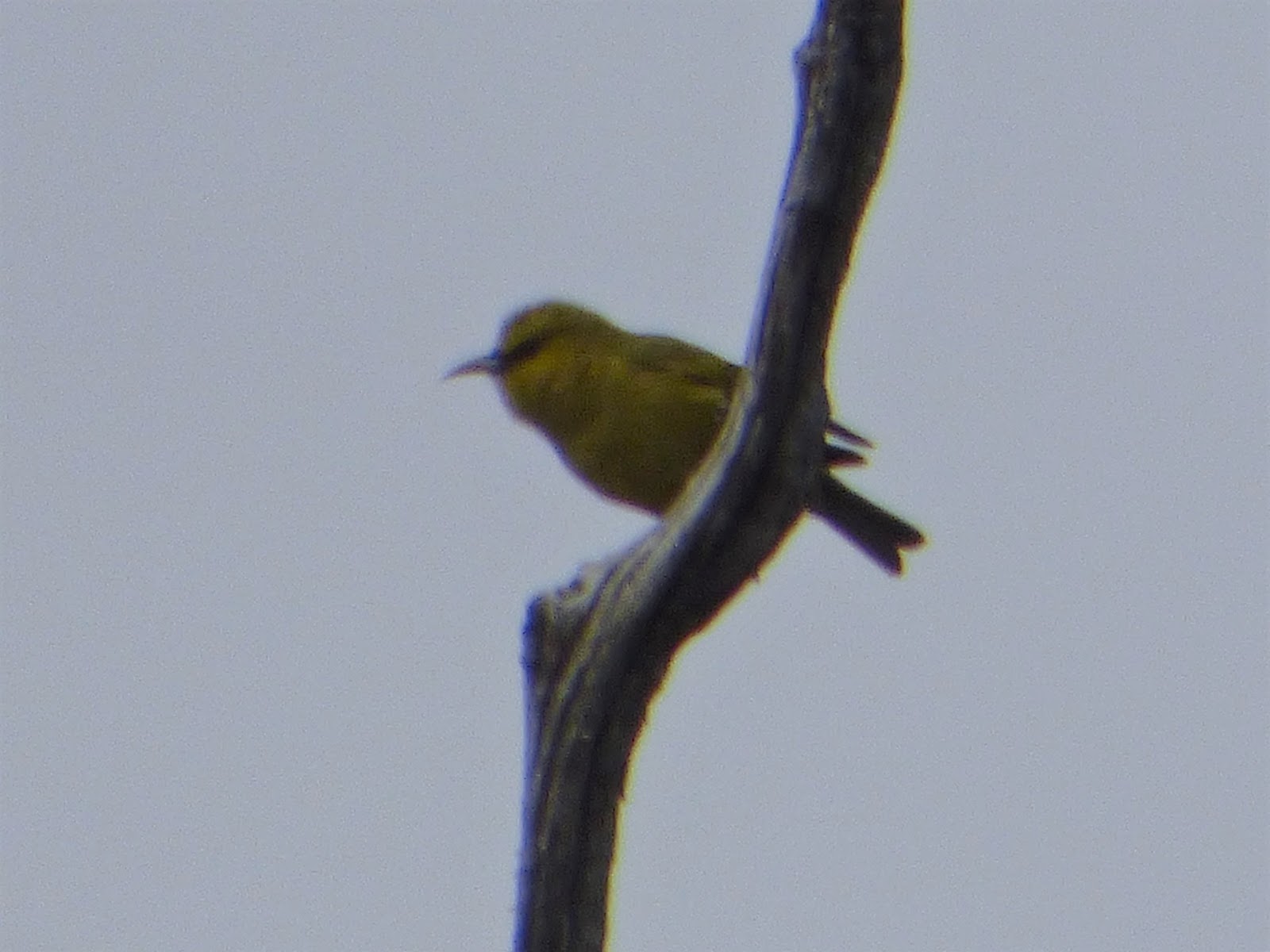
I'm making no claims whatsoever that these pictures are up to my own basic standards, but to paraphrase Donald Rumsfeld's statements about armies, "As you know, you blog with the bird pictures you have. They're not the bird pictures you might want or wish to have at a later time." And these are the only ones I have of one of the unique Honeycreeper species of the Hawaiian Islands, the Hawai'i ‘Amakihi (Chlorodrepanis virens). They don't have the bright red color of the 'apanane, and thus aren't as obvious to me in the field. Their olive-green color is also very similar to the Japanese White-Eye, so I'm sure I've missed a few in the past.
There are populations of the 'Amakihi on the islands of Hawai'i, Molokai, and Maui, and they were considered subspecies, but recent genetic studies have caused them to be classified as separate species. They are common because they can survive in habitats ranging from sea level to 8,000 feet, and they have shown somewhat more resistance to avian malaria that has wiped out so many other species. Along with the 'Apanane, they are considered to be the least endangered of the remaining Hawaiian Honeycreepers (they evolved into around four dozen species in Hawaii, but only a third of them have survived to the modern day).
I saw the bird along the Byron Ledge trail near Kilauea Iki near the summit of the Kilauea volcano in Hawaiian Volcanoes National Park on the Big Island. It was perched in the upper branches of a dead Ohia tree (they often feed on the nectar of the flowers).
So...the other day I was all excited about FINALLY seeing and catching pictures of an 'Apanane (Himatione sanguinea) at Hawai'i Volcanoes National Park. The thing is, I wasn't birding at the time. I was participating in a geology field studies trip, and any birds I saw off in the distance were icing on the cake. I didn't have the time to watch quietly and carefully, nor was I in the best place to see them. But the other day was different. We headed up to Hawai'i Volcanoes National Park for the expressed purpose of checking out some of the best birding spots in the park, particularly the Moana Loa Road and the Kipuka Puaulu, the "bird kipuka". And the 'Apanane were quite evident! I probably saw a hundred or more, and some were close enough to capture some images.
What do you think these two are arguing about? One shouting and the other with its nose in the air!
To the extent that most people are not birders, and that the native birds of Hawai'i mostly live above 4,000 feet because of avian malaria spread by mosquitoes at lower elevations, and that only a small part of the human population of the islands live at that elevation, I suspect that even most Hawaiians don't get many chances to see these colorful birds. But in the right circumstances they are fairly common. Kipuka Puaulu is an ideal choice, as it is an isolated island of mature rainforest surrounded by young lava flows (that is the basic definition of a kipuka, an area missed by lava flows). The isolation helps to keep out the mongooses and feral cats who have destroyed many a bird population. Fencing has also kept out cattle and goats that would destroy the underbrush that supplies food and shelter to the birds.
I walked to the upper end of the loop where some ancient "grandfather" Ohia trees had died but left tall snags and I realized that dozens and dozens of birds were flitting around. I finally got some of the close-up shots I had been hoping for, and more.
There was another bird I got a couple of pictures of, but I was totally unsure of what species I was seeing. I downloaded the images and went to work with my bird guide, and came up empty. There was nothing that looked like the bird in the picture below. After I while I looked at the beak again and realized it was the same curving beak as the 'Apanane. This was a juvenile! They don't look very much like their parents...
Several million years ago, a small finch species, either pregnant or part of a small flock, got blown off course and somehow survived a tortuous passage over two thousand miles of ocean to land on the newly emergent Hawaiian Islands. The circumstance seems unlikely, but it only had to happen once. The birds discovered some kind of food that kept them alive, but over time, the populations became isolated as they searched for different food sources. Some were scattered on other islands. Over time they evolved, eventually diverging into four dozen or more species. These so-called Honeycreepers were more diverse than Charles Darwin's celebrated Galapagos finches. Time (and human intervention) was not kind to most of the species, and many went extinct. Today there are only a dozen or so left, and some of them are exceedingly rare (as in less than a dozen birds remaining). The reasons are many, but the biggest cause in recent time has been the spread of avian malaria, caused by introduced species of mosquitos. Today, most of the Honeycreepers survive in high-altitude forests where it is too cold for the mosquitos.
I've only seen a few of the Honeycreepers, perhaps just three species, and I've captured decent shots of none, which explains their absences from these pages so far. I'm on the Big Island this week, however, and I spent the last two days in Hawai'i Volcanoes National Park. We were exploring the edge of an intriguing pit crater called the Devils Throat when I saw a bird soaring on the far side. It landed for a few moments and I was able to confirm: it was a Honeycreeper called the 'Apanane (Himatione sanguinea). These are the pictures I got, at extreme zoom from about 150-200 meters away.
The bright red plumage of the 'apanane
found its way into many robes of royal Hawaiians, but the birds were prolific enough to escape extinction when the islands were colonized. They are considered secure for the time being as long as an "island" of cooler air remains above the 4,000 foot level where mosquitos can't thrive (some of the birds may be developing resistance to malaria as well). Their current population on the islands is estimated to be just over a million individuals. And I finally photographed one of them!
The Devils Throat lava pit. I love my camera; the pictures above were on a bird in the shrubs on the opposite rim several hundred feet away.