Showing posts with label Ross's Goose (Anser rossii). Show all posts

Monday, November 29, 2021

Some Close-Up Shots at the Sacramento National Wildlife Refuge

Snow Goose (Chen caerulescens) with juvenile
One thing about having relatives in Oregon is that we get to travel north during the Thanksgiving and Christmas holidays. Doing so brings us in close proximity to the Sacramento National Wildlife Refuge near Williams in California's Great Valley. We usually manage to eke out a stop during our long drives between states, but we missed a year because of the accursed pandemic. 

Ross's Goose (Anser rossii)
We were thus especially looking forward to a tour of the auto-loop this morning and we were not disappointed. California's Great Valley (called by some uncreative souls the Central Valley) is a major wintering habitat for millions of migrating geese, swans, cranes, and ducks. 95% of the valley has been co-opted by agricultural development, so the few wetlands preserved as refuges are critical to the bird's survival. There were thousands of Snow Geese (Chen caerulescens) and Ross's Geese (Anser rossii) present in the ponds. They can be tricky to distinguish from a distance, but if you compare the photos above you can see the Snow Geese have a dark lining like lipstick on their beaks, which are also longer. The Ross's Geese are smaller overall as well.


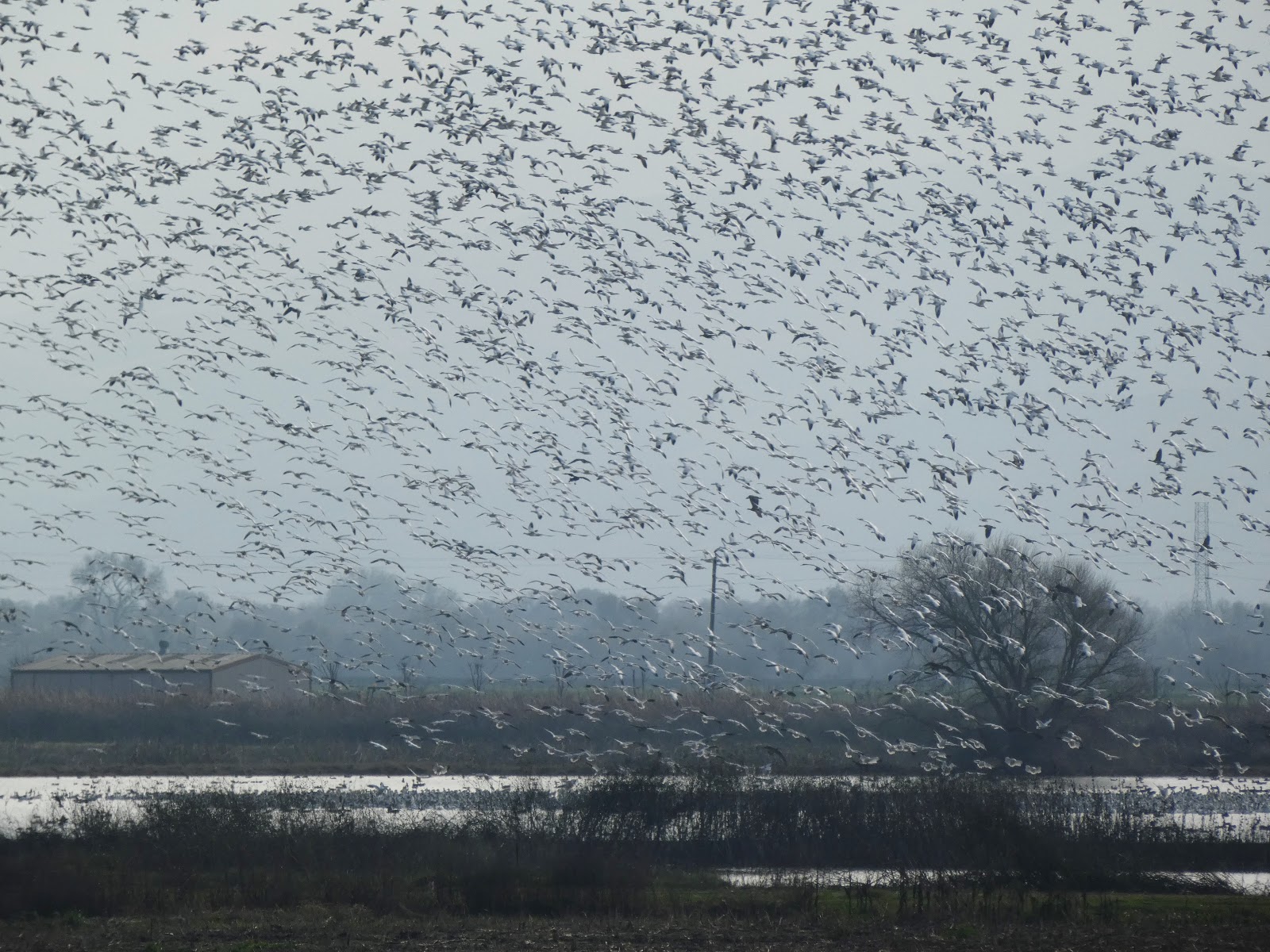
When I mention that there were thousands, I was not exaggerating...they filled the skies, and the sound of their squawking in any other setting (for instance a horror movie) would be terrifying.

Great Blue Heron (Ardea herodias)
There were some Great Blue Herons present, and they seemed rather accustomed to the large iron-clad beasts rumbling by on the road. I don't often get a chance to be so close to them.

We are used to seeing many of these birds at the refuges in our own backyard, but the Sacramento refuge is a more dependable place for spying a Bald Eagle (Haliaeetus leucocephalus). Or should I say it spied us? This one was only 20-25 feet above us.


The adult was watching over two juveniles in the next tree. It takes them a few years to get "bald", but the huge beak is always distinctive.


Our biggest thrill was catching sight of a Peregrine Falcon (Falco peregrinus). We had finished with the eagles and told ourselves we were out of time and that there weren't any birds that would stop us from finishing the loop, but of course only 200 yards down the road we had this falcon politely posing for us. Of course, we stopped and spent an inordinate amount of time taking pictures. We made it home in time to pick up our precious kitties from the kennel, but only barely.


Wednesday, January 22, 2020

One of Nature's Most Awesome Displays, and only 10 Miles from my College


I find it staggering sometimes that I lived in the Modesto area for more than two decades before I discovered that one of the most awesome displays of nature was taking place only a short distance away. I've watched plenty of nature documentaries about the vast bird flocks of the Serengeti Plains of Africa, and dreamed of seeing such incredible sights for myself, all the while not realizing that a similar drama could be seen only ten miles outside of my town.

The Great Valley of California is a 400 mile long trough of agricultural fields that once were grassy savannahs and wetlands that support millions upon millions of migratory birds. When the region was colonized, the prairies were erased by agricultural fields and orchards, and the refugia for the migratory birds disappeared. Environmentalists and conservationists began to lobby for preserving and rebuilding some of the wetlands resulted in the establishment of a string of wildlife refuges up and down the valley. They amount to 5% or less of the original landscape, and are not really enough to support the huge bird populations, but it is better than what existed a half century ago. Each winter the refuges host hundreds of thousands of geese (Snow, Ross's, Aleutian Cackling, and Greater White-Fronted), as well as Sandhill Cranes, and millions of ducks.

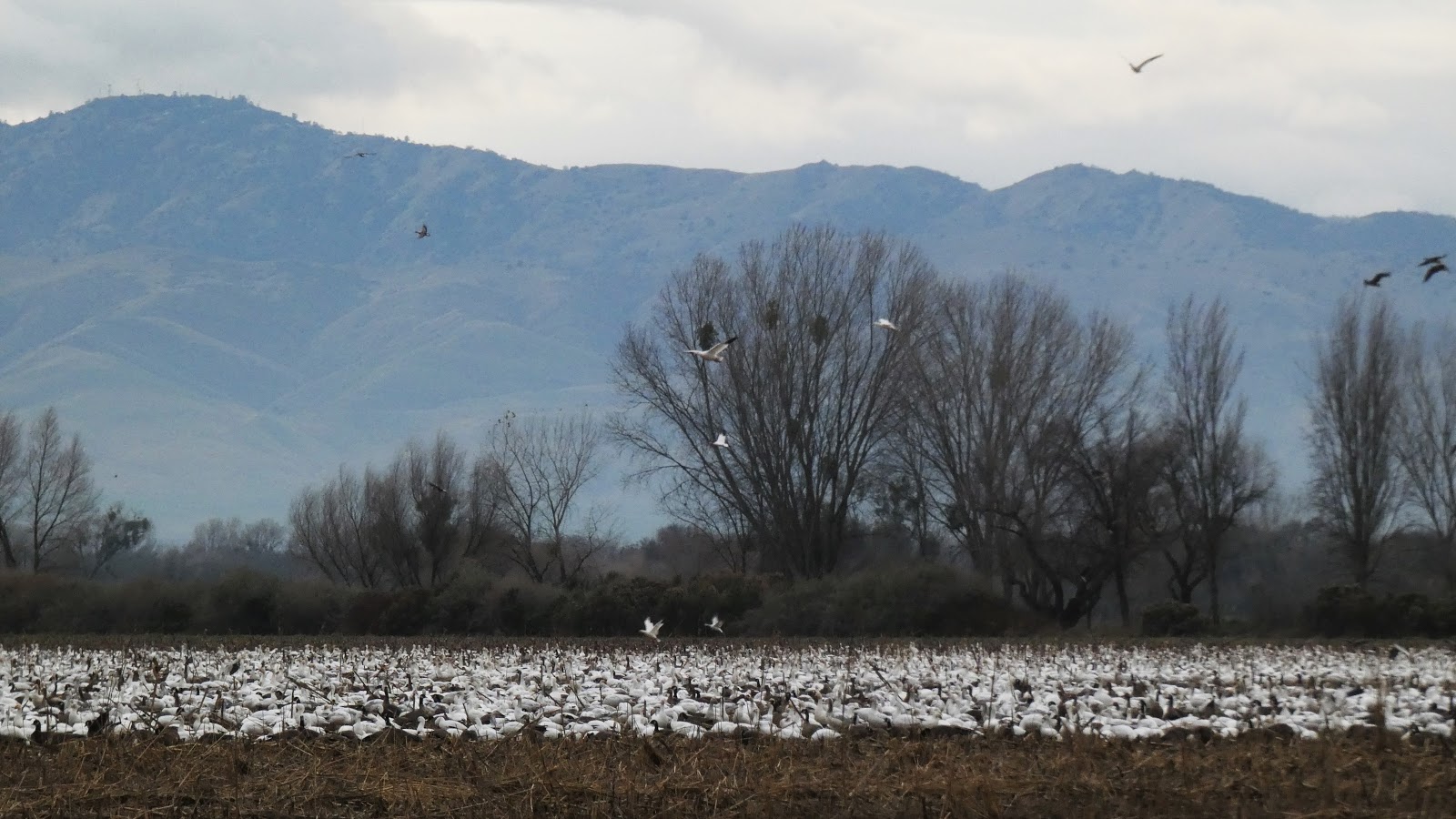
I went out to the Beckwith Road Viewing Platform west of Modesto to have a look tonight at the San Joaquin River National Wildlife Refuge. The platform overlooks hundreds of acres of land planted with corn solely meant to feed the geese and cranes. Every evening during the fall and winter, thousands, maybe tens of thousands of geese fly in for the night and gather into a single gigantic flock, a sea of white Snow and Ross's Geese, with an outer ring of Aleutian Cackling Geese. It's best when they are not disturbed so they can conserve their energy, but occasionally something will happen and the entire flock will take flight all at once. That happened while I was watching. I don't know if it was a coyote, or an eagle, but something startled the birds and off they went. It was stunning.

I was taking video, and as the birds began to settle back in, I noticed a single goose, an iconoclast, a loner, who had refused to take off like the others. You can see it at the end of the video. I wonder what it was thinking...

Thursday, March 8, 2018

Ross's Geese at the Merced National Wildlife Refuge: Preparing for a long journey north...


They are still there by the thousands, but not for very much longer. The Ross's Goose (Anser rossii) spends winters at a few select refuges in California's Great Valley, but when spring arrives, they will migrate thousands of miles north to the Arctic. Their favored breeding grounds are on Baffin Island, the shoreline of Hudson Bay, and the shore of the Arctic Sea.

The Ross's Goose is smaller than most goose species but they are very similar in appearance to the Snow Goose. Both are completely white except for the black wing tips, but the beak of the Ross's is pink. The Snow Goose beak is pink on top, but with a black outline around the "lips". It doesn't help that they like to gather together with Snow Geese in huge flocks.

We got these pictures at one of our favorite places in the Great Valley, the Merced National Wildlife Refuge. There were hundreds of them visible from the autotour route, but there may have been several thousand hidden in the interior of the refuge. But not for very much longer. Like the Sandhill Cranes, they are getting restless, and ready to fly to their summer homes.

The