Showing posts with label San Luis National Wildlife Refuge. Show all posts

Saturday, March 30, 2024

A Trilogy of (Mostly) Black Birds at the Bear Creek Unit of the San Luis NWR


Yellow-headed Blackbird (Xanthocephalus xanthocephalus)
After last week's discovery of Yellow-headed Blackbirds at the Bear Creek Unit of the San Luis National Wildlife Refuge, we couldn't resist going back to see if we could get a better view of the elusive birds. They generally like to remain hidden in the tule reeds of their favored wetlands and are more often heard than seen. That was still the case when we were there this afternoon, but we stopped the car for awhile to see what would happen. Much to my surprise, a Yellow-headed Blackbird jumped out of the foliage and onto the road not ten feet in front of the car. It started gleaning seeds from the edge of the roadway as if we weren't there. I managed to catch one of my better shots of the bird as a result.

But that wasn't the only unique black bird of the day...

Red-winged Blackbird (Agelaius phoeniceus
Red-winged Blackbirds (Agelaius phoeniceus) are common wherever marshes or grassy wetlands are found in North America, from Nicaragua to Alaska. They aren't usually hard to find, but I've always had the hardest time photographing them. The lighting has to be practically perfect in order catch the various features of these pure black birds (aside from the red wings of course). Most days I don't even try. But while we were photographing the Yellow-head, a Red-wing landed on a branch only eight feet out the window. It was taunting me, literally, to take its picture, so I did. So in that moment I got what may be the best shots I've ever managed of two different birds.
Black-necked Stilt (Himantopus mexicanus)
The (mostly) black birds weren't done with their surprises though. I'm not the most observant person in the world, but I still miss things, and I've never once noticed Black-necked Stilts on a nest before. But we saw two of them today. They aren't exactly well-hidden nesting sites, but they are presumably safe from predators that don't like swimming. The Stilts form flocks which aid in the defense of nests, and they can become aggressive, even to humans. We didn't test the hypothesis and stayed in the car.
The Bear Creek Unit of the San Luis National Wildlife Refuge includes a 2.25 mile auto tour and two trail loops, the Raccoon Marsh (1.3 miles) and Woody Pond (1.7 miles). The refuge is accessed from Highway 165 south of Hilmar and Turlock, and north of Los Banos. When the ponds are full, the area is a delight for birdwatching and nature observations. It's a small island of the Great Valley wetlands as they once were.

Thursday, March 28, 2024

Tracking the Elusive Yellow-headed Blackbird at the San Luis National Wildlife Refuge

It doesn't happen every year. Since Mrs. Geotripper and I have been birdwatching, we've found this incredibly beautiful bird only 10 times since 2018. So it's always a thrill when we catch sight of one. It's the Yellow-headed Blackbird (Xanthocephalus xanthocephalus).
The birds are found in wetland environments all across the western states, but they generally aren't abundant in California according to the e-bird sightings maps. In our region they are generally migrating to breeding grounds elsewhere, mainly in the high plains of the Midwest and Canada.
I've only seen the species twice in Stanislaus County. Our best luck has been a particular stretch of road on the Bear Creek Unit of the San Luis National Wildlife Refuge in Merced County a few miles south of Turlock. There's a 2.5-mile auto tour through some of the wetlands and we've seen the birds there six times over the last six years. Given that record we decided to give it a shot last week, and we were thrilled to catch at least nine of them preening and singing among the reeds.

One of the more unique traits of the Yellow-headed Blackbird is its song. It seems kind of like a trade-off with the beauty of the bird. It's described in several ways, but the screeching of torn metal works best for me. See what you think in the video that we captured...

Spring is a great time to see many of my favorite birds, which seem to be predominately yellow: Yellow Warblers, Bullock's Orioles, Hooded Orioles, Black-headed Grosbeaks (actually more orange I guess), and the Western Kingbirds. These Yellow-headed Blackbirds were special.

Saturday, February 5, 2022

Winter Days at the National Wildlife Refuges of the Great Valley, and Remembering What Once Was

Cross-posted from Geotripper (it's about California birds after all)  What's the largest number of birds you've ever seen from one spot?

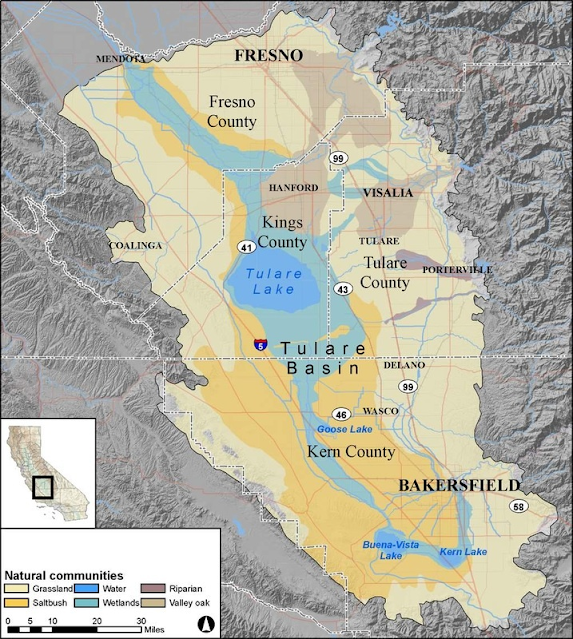
The Great Valley of California is a great place to see a lot of birds in one place. In pre-colonist days, the 400-mile-long valley was a prairie that was watered by a series of rivers flowing from the adjacent Sierra Nevada. There was enough water that even in historical time there were two immense lakes between Bakersfield and Fresno, Tulare Lake and Buena Vista Lake. Before water diversions for irrigation caused it to dry up, Tulare Lake was the largest freshwater lake west of the Mississippi.
Source: Quora
The mild winter climate of California led to the adoption of the wetlands and marshes of the Great Valley as the favored seasonal home of millions upon millions of waterfowl and other migratory birds of the arctic and far north. I can hardly begin to imagine what a wintertime journey through the pre-European Great Valley must have been like.
The ecological role of grazer in the refuges is occupied by a handful of deer and lots of sheep and cows to make up for the now-extinct megafauna

But historical accounts and paleontology can provide us some idea. In addition to birds, the vast prairies supported huge herds of tule elk, deer, antelope, and even bison. Prior to 12,000 years ago, the plant-consuming animals included giant ground sloths, mammoths, mastodons, horses, and camels. The birds and grazing animals were the prey of an imposing array of predators including the recently departed California Grizzly Bear, black bears, wolves, mountain lions, coyotes, and foxes. The pre-12,000-year crew included saber-toothed cats, dire wolves (bigger than wolves of today), American Lions, jaguars, and the immense Short-faced Bear, an animal that would have made a Grizzly think twice about a confrontation. The reason for the almost simultaneous extinctions of the species of the so-called 'mega-fauna' is a subject of contention among geologists, paleontologists and anthropologists (the role of humans has not been ruled out).
This cuddly little Short-faced Bear can be seen at the Fossil Discovery Center near Madera
I was thinking about this as we made our customary winter journeys to the local national wildlife refuges in and around Modesto and Merced. The main units open to visitation include the Merced, the San Luis (including the separate Bear Creek Unit), and the San Joaquin River National Wildlife Refuges. Although the boundaries of these refuges tend to be very square or rectangular and they are crisscrossed by maintenance roads, they are the only places that come close to recreating the primeval landscape that once existed.
The national wildlife refuge system grew out of a number of motives, some noble, others not so much. When wetlands of the valley were drained and planted with crops, millions of birds found their ancestral winter homes gone. With nowhere else to go, many of the geese and others began to forage on the tilled fields to the distress of the farmers. Instead of massacring untold numbers of birds, a series of refuges were established up and down the valley to provide a haven and food for at least some of the migrants. Of course, the refuges were also designed to preserve populations of the birds so they could be shot. Much of the refuge funding comes from the sales of hunting permits.

Snow Geese at the San Luis National Wildlife Refuge

So that is where are today. The refuges provide forage for millions of migratory cranes, geese, swans and ducks (in many they grow fields of corn for the singular purpose of feeding the birds). The birds are too crowded, and diseases can spread if the flocks are not managed properly, but it is a better situation than having no refuges at all. Some species, especially the Aleutian Cackling Goose, have been brought back from the brink of extinction (once down to just 300 or so birds, the population is more than 100,000; they mostly shelter at the San Joaquin NWR just west of Modesto). And yearly, more and more abandoned farmlands are being converted to the original riparian habitat to allow for population growth. 

I don't do video often, but the one at the top seemed necessary because I was looking at what I believed was the largest single grouping of birds I've ever seen (and I've been exploring these refuges for 7-8 years now). It required about a 180-degree pan. On the other hand, there is nothing in the world quite like watching thousands of geese taking flight all at once. When we were at the San Luis NWR last week, the serene view was of several thousand Snow Geese and Tundra Swans. It's not really a good thing for the birds to be scared into the air, as it uses precious energy, and they could get hurt. But a helicopter flew overhead at a low elevation, and it spooked the geese (the swans seemed like they could care less) and several thousand took flight. I caught the flight on video, and you can clearly hear the helicopter. I took a picture of the craft thinking to report it, but it turned out to be medi-flight out on an emergency call.  

The number of birds and the variety of birds at the local refuges is truly astounding. We saw 50 species at the San Luis Refuge last week and 46 at the Merced Refuge yesterday. The really good birders will report 60-65 in a single trip. And the birds are beautiful. Here are some that caught my eye this last week.
This Great Egret was at the San Luis NWR. Both refuges offer "auto-tours" where visitors stay in their cars (kind of like those African savannah tours, but there aren't any lions trying to eat you). The cars serve as blinds, startling birds far less than humans bumbling around.
We were looking for swans and saw large white birds off in the distance. They turned out to be American White Pelicans. They may be the most ungainly-looking birds on the ground but are positively graceful in flight. And they are huge.
The blue bill of the Ruddy Duck is rather distinctive.
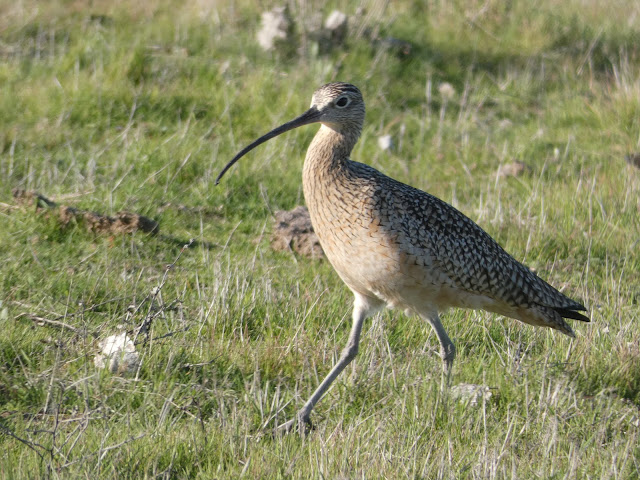
The prize for wildest beak goes to the Long-billed Curlew. I guess they can reach bugs and worms in the mud and soil that other birds can only dream of.
The Greater White-fronted Goose may be one of the more unfamiliar goose species around the valley. I've seen only a few in urban settings. Like the others, they are long-range migrants.
One of the special treats for the last two or three years has been a female Vermilion Flycatcher that decided to spend winters at the Merced NWR. This is the extreme north end of their range, and only a few are ever seen on a yearly basis in Stanislaus or Merced counties. Global warming may be allowing them to expand northward, and it may be only a matter of time before the scattered males and females find each other and start making little flycatchers.
This is an American Avocet, another bird that has a crazy bill that is good for probing deep in the mud.
There are a goodly number of raptor species that live in the refuges. One of the most beautiful is the White-tailed Kite. We thought we were done with photo opportunities when we reached the open grasslands at the end of the auto-tour at Merced, but this kite was perched on the sole tree eyeing the ground squirrels (and they were eyeing it).
The last bird of the day was the biggest surprise of all because it was the first time I had seen it in several years. It's a Black-bellied Plover, and it's not all that rare. It's just that I don't always know to look for it or recognize it when I see it. And it doesn't have a black belly. The males grow it when breeding season comes along.
Sunset at the Merced NWR
We here in the Great Valley sometimes forget that it is indeed a great valley, and that there are treasures that lie just beyond the boundaries of our cities. The auto-tours at Merced and San Luis provide opportunities for all, but those who want to walk will find a number of nice level trails. I especially recommend the Pelican Trail at the San Joaquin River National Wildlife Refuge. It passes through a series of diverse habitats and offers the greatest diversity of birds outside of the Modesto Water Treatment Plant (seriously, sewage ponds attract a lot of birds!). Check it out sometime, or any of the others up and down the valley.

Saturday, December 19, 2020

Up Close and Personal with a Loggerhead Shrike

The Loggerhead Shrike (Lanius ludovicianus) is an interesting bird. It is most closely related to songbirds, but in life is more like a small raptor, consuming a diet of large insects, amphibians, reptiles, mammals, and even some smaller bird species. They prefer open grasslands with occasional trees or fences to perch and hunt from. I have yet to see one along the Tuolumne River Trail, but we see them fairly often at our local wildlife refuges. I've photographed them many times, but never quite this close.
We were on the Waterfowl Auto-tour at the San Luis National Wildlife Refuge south of Turlock yesterday, avoiding all manner of human contact, but seeing lots of birds. The Shrike is often one of the first we encounter, with the fencing of the Tule Elk compound being a favored spot for the bird. Yesterday was no exception, but unlike past experiences this one didn't retreat when we stopped and rolled down the windows. These are the closest pictures I've ever achieved.


Monday, April 8, 2019

Another Tropical Migrant! Yellow-headed Blackbird at the San Luis National WIldlife Refuge

Yesterday was pretty exciting as such things go. I started the morning with a discovery of Bullocks Orioles on the Tuolumne River, but Mrs. Geotripper wasn't with me, and she wanted to see some birds as well, so in the late afternoon we headed south into Merced County to have a look at the Bear Creek Unit of the San Luis National Wildlife Refuge. We hoped to repeat our February sighting of a White-tailed Kite, but other than that, I wasn't sure what to expect. The Arctic migrants have bugged out already, so we mainly expected the resident species of ducks, blackbirds and shorebirds. In the back of my mind, though, there was the hope of seeing a Yellow-headed Blackbird (Xanthocephalus xanthocephalus).

We don't see these beautiful birds very often. They haven't even been reported in Stanislaus County as of yet this year, and there have been only a few in Merced County, mainly at the Merced NWR, and the main unit of the San Luis NWR. We've seen them twice previously, and in the same place: along the auto-tour of the Bear Creek Unit. I had reason to hope, and I wasn't disappointed! We passed dozens and dozens of Red-winged Blackbirds but I finally saw one that seemed bigger. It was silhouetted in the sun, but I was pretty sure I saw a flash of yellow around the head. I zoomed in and confirmed it; it was a Yellow-headed Blackbird!
We ultimately saw six or seven of them, all males. It's possible they were guarding their territories, with the females hidden on their nests, but they could also just be passing through. The birds spend the winter in Mexico and Texas and move north as far as Canada to breed.
The have a call that must be heard to be believed. If you were hoping for a lilting melody like their relatives the Red-winged Blackbirds, or say, a meadowlark, you are going to be bitterly disappointed. We tried to capture the sound but did succeed. Try to imagine the grating sound of metal on metal, like a damaged car door that doesn't shut right and scrapes the frame. You can hear it here: https://www.allaboutbirds.org/guide/Yellow-headed_Blackbird/sounds.

Tuesday, February 26, 2019

What To Do With a Dinner Invitation When You're All Tied Up

First off, it really sucks to be the snake in this little narrative. It was on the losing end of the battles that occur in the "circle of life".  One eventually has to accept that everything in nature is ultimately trying to eat everything else in nature. Even the top predators are going to be consumed by scavengers eventually. We'll just hope that the reincarnation of the little snake has a better ending the next time around.
We were driving the Bear Creek Unit auto tour at the San Luis National Wildlife Refuge last weekend when we spotted a Great Blue Heron with something hanging from its beak. After a few moments we realized it was a small snake. As a last defensive measure it seems to have tied itself into a knot, but it didn't work. As we watched, the Heron gulped down the entire snake, knot and all.
Great Blue Herons are large birds and are thus one of the top predators in the freshwater marsh environment. They eat fish, amphibians, reptiles, and small mammals. They have their own problems with predators, however. We witnessed a dramatic confrontation between Bald Eagles and Great Blue Herons in Victoria, B.C. a few years ago. They can presumably be attacked by wolves or coyotes as well.
And thus, the "tail end" of the drama, but actually the head went last. It was a somewhat stunning act to witness.

Sunday, February 3, 2019

Flying Kites at the San Luis National Wildlife Refuge (Bear Creek Unit)


No, not those kite things on a string. These were White-tailed Kites (Elanus leucurus) at the San Luis National Wildlife Refuge. We were thrilled to see not one, but two of them, and even better, I got the best pictures I've ever managed to take.  I don't see the White-tailed Kites very often, maybe only four or five times, and so they've only made two appearances on this blog. I even got the eyes, and that hasn't happened before.
The San Luis National Wildlife Refuge is one of the premier places in California for bird watching. The main visitor-related portions of the refuge include a new visitor center and two marvelous auto-tour routes along with a number of hiking trails. There's even a large compound where visitors can see one of the few herds of California's unique Tule Elk. On eBird, more than a thousand bird counts have been conducted here.

But there's sort of a step-child at the refuge. It's called the Bear Creek Unit. It's northwest of the main part of the refuge, but is easily accessed from Highway 165. There is a two-mile long auto-tour, but only just over a hundred birding reports have ever been conducted there. I'm not sure why, but the area just didn't get the visitation. Sometimes there is a simple lack of water in the wetlands so few birds are around. Yesterday we had the place to ourselves aside from one other car. And there were quite a few birds out and about, including several thousand Red-winged Blackbirds. And...two White-tailed Kites!
The refuge system in the Great Valley preserves in some cases and works in others to reconstruct the native ecosystem that existed here in the millennia before colonizers established the vast network of farms and ranches. The valley is critical winter habitat for millions of migratory birds, and they survive only because of the string of refuges up and down the landscape. It was marvelous to experience the sky and prairie yesterday during a break in the huge storm that slammed into California this weekend.

Sunday, October 7, 2018

They're Back! The Return of the Sandhill Cranes

Some very beautiful birds are back from their summer sojourn in the wilds of the far north. The Sandhill Cranes (Grus canadensis) have been sighted over our county for the last two weeks, but this weekend was our first real chance to see if they are back in large numbers at our local wildlife refuges. They are! We saw at least 260 of them at the San Luis National Wildlife Refuge and another 400 at the Merced National Wildlife. That's only a fraction of what is to come, however. In a few weeks there will be on the order of 15,000 cranes overwintering at the San Joaquin, San Luis, and Merced refuges. They'll be sharing the refuge with tens of thousands of Snow Geese, Ross's Geese, Greater White-fronted Geese and others who are still on their way, but have yet to arrive. The winter is a fascinating time in the Great Valley of California.

The birds have a unique deep-toned bugling call that can be heard over several miles. There have been times that I've heard them high overhead, but so far away that I couldn't find them in the sky. It's one of the harbingers of the fall season around here.

Friday, April 6, 2018

Green-Winged Teal at the San Luis National Wildlife Refuge

My duck education continues. As I noted in my last post, duck identification has lagged many other species, since I haven't seen too many kinds along my river walks. But I continue to visit the local wildlife refuges, and I keep seeing new species (not rare species mind you, just species I haven't noted before). Today the species is our smallest duck, the Green-winged Teal (Anas crecca). The second, rather poorer photo shows the reason for their name.
The Green-winged Teal is a winter visitor to the region. They migrate into Canada for breeding, so it's probably not that many weeks before they will disappear from our region.

I need to remind myself every so often what a remarkable place this is that I live in. The wildlife refuges of the Great Valley either preserve, or are attempting to reconstruct, the original savannas and wetlands that were the original heritage of our valley. 90-95% of the original landscape has been transformed into agricultural fields. Wandering through the grasslands and marshes, one is seeing a part of California that was almost eliminated. It is a privilege to wander these lands.

Thursday, April 5, 2018

Northern Pintails at the San Luis National Wildlife Refuge

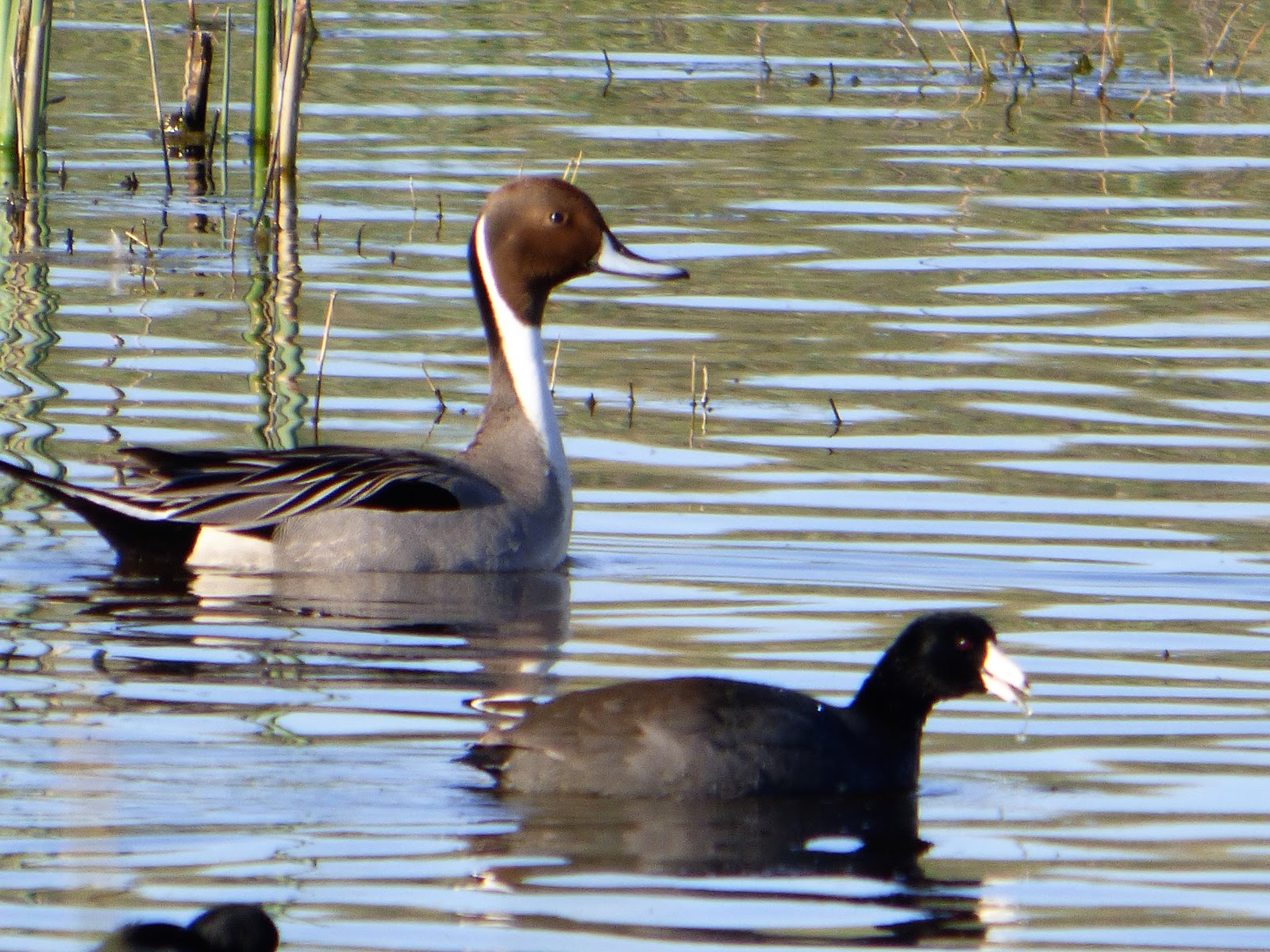
That's an American Coot in the foreground
Birding is not the easiest new hobby to get into. The rewards begin early, it is true, as one discovers that there are far more species in a given area than one ever expected, and the discoveries and first sightings come fast and quick. But then one realizes that there are dozens of species, there are hundreds of them, and more than a few of them are hard to tell apart from one another. And then there is the inexperience that comes of not seeing a particular environment enough to get familiar with the species found there. I'm getting pretty good at identifying most of the birds I see along the Tuolumne Parkway Trail where I go three or four times a week, but the nearby bird refuges, which I might see only once every three or four weeks, are overwhelming. There are so many birds. I'm good with most of the geese species now, but the ducks bedevil still me. In any case, I'm slowly learning, and one that I have little trouble identifying, the Northern Pintail (Anas acuta), is one of my favorites.
eBird starts their description of the bird as "elegant", and it's true. They have such a formal bearing, and the males have gorgeous lines and colors. They winter all across the United States and Central America, and in the summer they head north in large numbers to breed on the tundra. Not all of them move north. The Central Valley of California is one of the southernmost places where they can be found all year. Once the tens of thousands of geese leave to go north, the Northern Pintails seem to become more visible in the open water.

I saw these on the Waterfowl Auto-tour at the San Luis National Wildlife Refuge. I was surprised to find that even though I've seen them a number of times over the last three years, and even got pictures, I've never actually posted any of them on the blog. So enjoy their stunning debut!

Wednesday, April 4, 2018

Belted Kingfishers at San Luis National Wildlife Refuge and the Tuolumne River

I don't get a lot of sharp focused pictures of Belted Kingfishers (Megaceryle alcyon). Just like any smart bird, they like to steer clear of humans (or at least me), especially those that patrol the Tuolumne River along the Parkway Trail in Waterford. I hear them constantly, chattering and complaining about me disturbing their territory. But I rarely get close enough for pictures.
We were at the San Luis National Wildlife Refuge on two successive weekends, and along the Waterfowl Auto-tour, I saw the same Kingfisher perched on the wires above the irrigation canal at the south boundary of the refuge. The first weekend was overcast, and the picture (as usual) was a bit fuzzy, but the next weekend was sunny, and I finally got a picture I liked (at the top). The chestnut band across the chest marks this one as a female.

Later that week, I was on my usual river walk when I heard the familiar chatter coming from the inaccessible thickets at the western end of the trail. I spotted the male from the top of the stairwell and got this one relatively good shot, but by the time I got to the base of the stairs, it had flown away downstream.