Showing posts with label Killdeer (Charadrius vociferus). Show all posts

Saturday, April 30, 2022

Killdeer Babies on the Tuolumne River!

The pictures are not as clear as I would like, but you can see them! The Killdeer chicks were born this week!
It's always a bit scary for the Killdeer mama (Charadrius vociferus). They love setting their nests on rocky open ground, and the only such ground locally is around the concrete margins of the Waterford sewage treatment facility. The gravelly surface is traversed constantly by maintenance trucks. I do know however that the employees are careful when they know a nest is present, as they will put a pylon out nearby to warn drivers. But there was no evidence that they had detected this nest, so I just worried for weeks as mama tended to the eggs.

Having nests out in the open like the Killdeer prefers is also perilous because of the threat of all manner of predators. There are cats, foxes, otters, and rats in the area, as well as kestrels and ravens. The Killdeer eggs are well camouflaged among the stones, and the bird is famous for its broken-wing strategy of distracting predators away from the nest.

Still, I was distressed to see that the nest seemed to be abandoned in the last few days, and I worried, but today I saw the almost comically small killdeer chicks running around after their mother.


Friday, May 8, 2020

Baby Killdeer on the Tuolumne River Trail

 A first for me: a baby Killdeer (Charadrius vociferous). I was watching for the Killdeer eggs to hatch last year at our Outdoor Nature Lab at the Great Valley Museum, but I was out of town when they were born, and they were gone by the time I got back. I've been watching a nesting Killdeer along the trail for the last few weeks, but those babies haven't hatched yet. But tonight I was walking near the eastern end of the water treatment plant when I saw a couple of shorebirds in the distance. One was big, and the other wasn't. I focused in and realized it was a young Killdeer following its parent. There's no telling precisely how old it is. They are able to walk as soon as their feathers dry after hatching.

Thursday, June 6, 2019

Let's Catch that Bird with the Broken Wing! The Killdeer of the Great Valley Museum Outdoor Nature Lab

It's an omen of sorts, or maybe a blessing by nature.

The Killdeer (Charadrius vociferous) is the mascot or icon of the Great Valley Museum, as can be seen on our various logos. There is a good reason for this: the bird survives quite well in the valley environment, both on the dry prairies and in the river/delta wetlands.

We had a major moment take place this week: after 35 years of proposals and dashed hopes, and after a year of fenced-off construction zones, the fences came down and yesterday people could walk freely along the paths of our new Outdoor Nature Lab. It is a marvelous microcosm of the environment of the Great Valley, with native vegetation and native rock exposures from the prairies at the confluence of the Great Valley and the Sierra Nevada foothills. Interpretive signs will soon be posted, and activities will soon be available for our local children to learn about their local natural environment.
Our local species are already responding to the newly completed environment, and in particular, the Killdeer, our icon. We noticed almost right away that a pair was moving around the grounds, and we suspected there might be a nest. Someone soon found it, but I don't know how they ever saw it.

How good are you at nest-finding? It's in this picture...can you find it?
The eggs will be incubated for 22-28 days, and when they hatch, the chicks will be able to walk as soon as their feathers dry off. Given such a vulnerable location, just sitting out on the ground, one has to wonder how they can survive out there in the open prairie.


It involves deception, of course. If the danger is from a browsing cow or deer, the parents will make a big display to cause the animals to graze in another direction. But if the danger is a predator that might eat the eggs and/or the parents, the birds will do a fascinating "broken-wing" dance that will catch the attention of the fox or raccoon and the birds will lead the animal away from the nest. We were subjected to the dance while we took a short look at the nest. Check out the video of the display below.

What a wonderful welcome to the next stage of our service to nature education in our community!

Thursday, September 21, 2017

Our Campus Mascot, the Killdeer


The birding environment on my campus has not been all that conducive to species sightings of late. It's obvious why; there are students and faculty everywhere. Even the "mini-wilderness", the drainage basin on the edge of campus has been quiet. There's no water. Until the rains begin again, there's not much for the birds there. The other day, though, I had a reason to visit the campus on a weekend, and there was a bit more going on. With no one around, the birds were exploring the open spaces on the campus.

I was lucky enough to catch a couple of Killdeers (Charadrius vociferous) patrolling one of the empty parking lots. The Killdeer is kind of a mascot for our campus and the Great Valley Museum), being the only bird that appears on our logos.

The Killdeer is found across most of the North American continent and the range extends some distance into South America. They are members of the Plover family, which are usually shorebirds, but the Killdeer willingly spends lots of time in dry environments as well, eating a diet consisting mostly of insects.

They will raise their young in open fields, scraping out a nest directly on the ground.  They've nested in the vacant field north of our Science Community Center, the site of our future Outdoor Education Center, so hopefully the native vegetation that we intend to plant will continue to attract them. They are known for their practice of pretending to have a broken wing to draw predators away from their nests.


Wednesday, March 1, 2017

Killdeer at the San Luis National Wildlife Refuge

Is there anything more striking than the fiery eye of a Killdeer (Charadrius vociferus)? They are certainly interesting to watch for other reasons, but that eye just commands one's attention. We were on a short exploration a couple of weeks ago at the San Luis National Wildlife Refuge, and one of them was kind enough to hang around close enough for a few pictures.

Killdeers are members of the Plover family are named for their unique call, not for anything violent they might do to a deer. They are found across all of northern and central America, and have done well living close to humans. They are ground-nesters, and as such have developed a dramatic broken-wing act designed to draw predators away from their nests.
The San Luis National Wildlife Refuge preserves a portion of the floodplain of the San Joaquin River and Bear Creek on the floor of the Great Valley south of the town of Turlock. There are three auto tours, and eight nature trails that provide access. The Killdeer was seen along the Bear Creek Unit auto-tour, a loop of about two miles just off of State Route 165 (Lander Road). The road passes a variety of riparian wetlands and grassy prairie. We'll be back in a few weeks, because the abundant rains this year promise a stunning wildflower show.

Tuesday, April 12, 2016

Field of Dreams: Killdeer in the future Outdoor Education Laboratory

I've not posted for several weeks. It's the last few weeks of the semester and things are hectic, leaving little time for explorations and walks. I noticed something today from my third floor laboratory. There has been a lot of construction going on across the campus, mostly involving the design and alignment of a road around the north end of campus. A worker was putting up some markers along the north edge of our future Outdoor Education Laboratory, which is intended to be a small natural habitat on campus that will replicate some of the natural ecosystems of the Great Valley.  The work was causing a commotion, as a number of Killdeer (Charadrius vociferus) were voicing their objections to his presence.
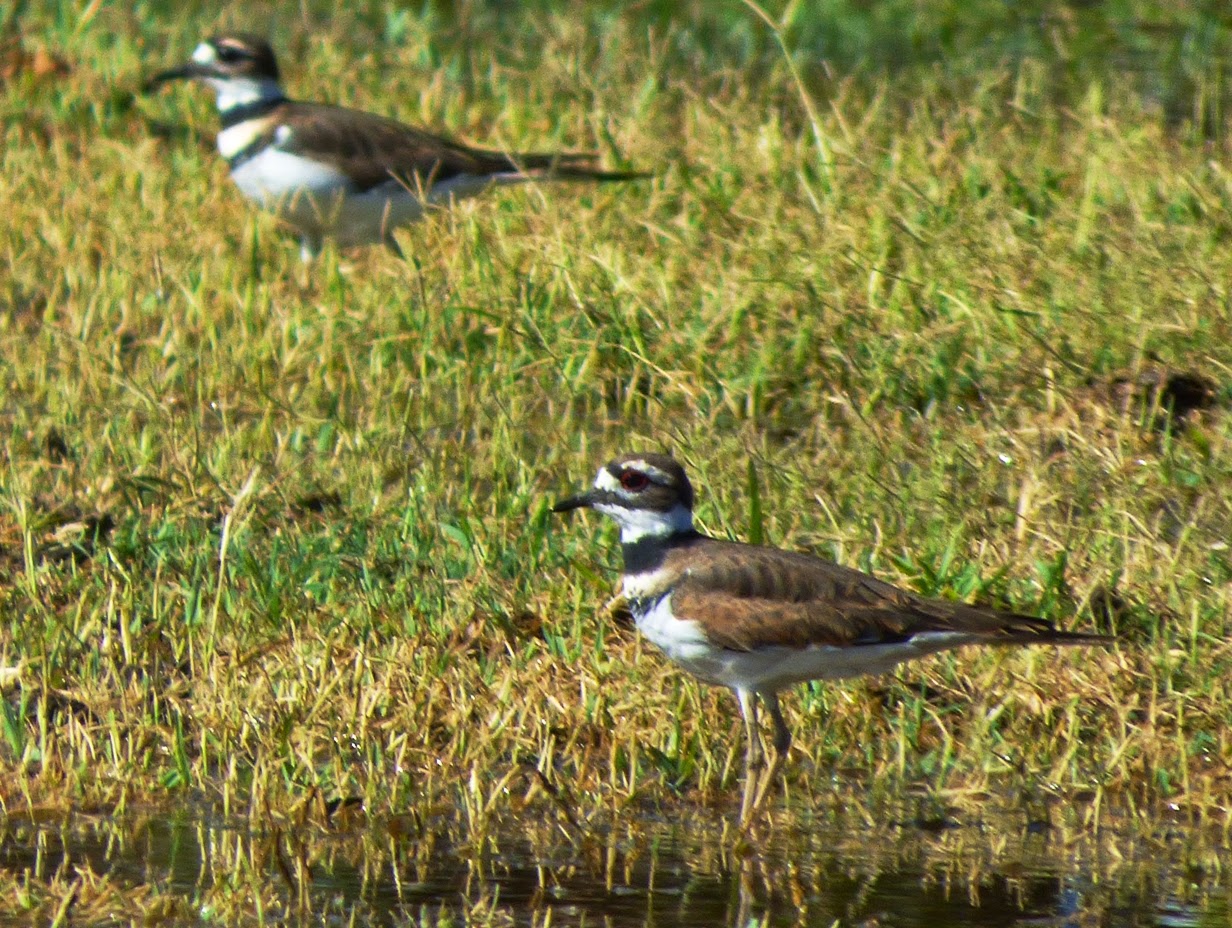
I'm curious to know if our Outdoor Education is already in operation. I didn't see the Killdeer doing their iconic "broken wing" distraction, but I'm wondering if they maybe have a nest out in the weeds somewhere in the midst of the future habitat. Nature may be claiming its spot.

We've been fighting for an outdoor education facility on this campus for more than thirty years, and it is our understanding that it is finally going to happen. We haven't been kept in the loop on the planning, so I hope it doesn't get screwed up. There is a lot of potential value in having something more than displays in a museum. Displays are important, but imagine the thrill of learning something inside the museum, and then stepping outdoors and witnessing the phenomena in real life. It's priceless..
The field of dreams! I hope it won't turn out to be a broken dream.

Wednesday, March 2, 2016

Killdeer at the Merced National Wildlife Refuge

There were lots of big "charismatic" migratory birds at the Merced National Wildlife Refuge a few days ago, but there were also some very nice smaller birds who tend to be found on the refuge all year round. One of them is the Killdeer (Charadrius vociferus). I see them at work and in my own neighborhood, but they are pretty skittish. For whatever reason, this one didn't retreat as we drove up, and I was able to get a few close shots.

They aren't called Killdeers for any murderous proclivities. They're named for their unique call, which is a "kill-deer", of all things. It's one of the most distinctive sounds on the California prairie. The Killdeer is the mascot of the Great Valley Museum of Natural History as well.
It's a beautiful bird!

Friday, November 14, 2014

Bird of the Day: Killdeer at the Merced National Wildlife Refuge

With the very charismatic large migratory birds arriving at the wildlife refuges in our valley this month, it is easy to overlook the beautiful year-round residents. I'm always happy to see the Killdeer at the wetlands, and was pleased with the shots I got last Monday.

Thursday, October 23, 2014

Bird of the Day: Killdeer in the Pasture and the West Campus


The Killdeer (Charadrius vociferus) is one of the most distinctive and common birds I see out in the pastures near my house, along the irrigation canals, and on the West Campus of my school. They are a member of the Plover family, but given the arid nature of our valley, they are often a long way away from water.
I most often see them in the pasture among the livestock, or on gravel parking areas on our west campus. Sometimes they ignore me as I walk by and other times they walk ahead, complaining the whole way.
I just love their huge orange-rimmed eyes!
They build nests on the ground, which seems kind of precarious, but the birds are masters of distraction when predators come around. They do the "broken-wing" ploy better than just about any other bird.
The birds are abundant across the country, and do well in areas preempted by humans, so they are not considered endangered in any particular way, though their populations have declined by 30% or so in the last forty years.
Their distinctive call (a "kill-deer" sound) and their erratic movements make them among the most watchable birds I see when I am out walking. I think of them as one of the clowns of the avian world, but that's just me anthropomorphizing. Mostly, they are just beautiful birds.

The top picture was from yesterday, but the rest are collected from the archives of the last year from when I first started seriously photographing birds.


Monday, September 15, 2014

Bird Watching in (Semi) Urban Settings, Part One: The Pasture


I don't live in a very interesting place, especially for a geologist. It's a flat valley floor (a corner of California's Great Valley) given over to agriculture and urban development. It might have once been an open prairie, but today it consists of a small farming town east of Modesto surrounded mostly by almond orchards and corn fields. On the whole, it isn't much of a place for finding birds.
When I started my new hobby of photographing bird species, I wasn't expecting much in my own backyard. When I was walking around the neighborhood for exercise I started to realize that a surprising number of birds were living within a few blocks of my house, especially in the pasture between my house and the local elementary school. It was once slated to become a housing development, but the recession put an end to those plans, so a small herd of cows continues to graze there.
Orchards, with row after row of the same kind of tree, don't make for particularly good habitat, and neither do houses. But the pasture offers grasses and insects, and a variety of trees around the edges (walnut, oak, sycamore, and a few ornamental sequoias) provide shelter. An irrigation canal runs through the middle of the pasture, providing water through the summer (rainfall leaves puddles in the canal during the winter).
The number and variety of birds varies with the seasons. The migratory species pass through occasionally, and I saw the greatest variety in the spring. The fewest birds were in the driest dustiest part of summer. I'm looking forward to seeing the changes coming up this fall (and hoping for some early rainstorms to break up the horrific drought).
I've seen six bird species at the feeders in my yard: House Finch, Lesser Goldfinch, Western Scrub Jay, Western Mockingbird, and Anna's Hummingbird. Within a week or two of walking through the pasture and along the irrigation canal the species count for my neighborhood was up to more than twenty.

What's the take from this? No one could ever mistake my little suburban pasture as an exciting place (notice how I picked sunset shots to dress it up). But it is a wonderful thing to know that an adventure of sorts lies just beyond my neighborhood block, and such a principle is probably true for most people wherever they may be living. Urban jungles still have some green space, and some hint of the original diversity of birds species may be found there. I have two or three other sites that have revealed some interesting bird sightings. I'll review them shortly in another post.

I'm intending to follow up with what I've been doing to my poor friends on Facebook and make a nearly daily posting of the latest bird sightings, which will include oftentimes the same birds (I'm actually starting to recognize some of them). So here are two of yesterday's birds, common visitors in the pasture: Killdeer (Charadrius vociferus). There were a dozen or more searching for bugs in the flooded corner of the pasture. Their call has become a familiar sound on my walks.