Showing posts with label Yosemite National Park. Show all posts

Monday, November 1, 2021

A Very Intelligent Bird: Common Raven at Yosemite National Park


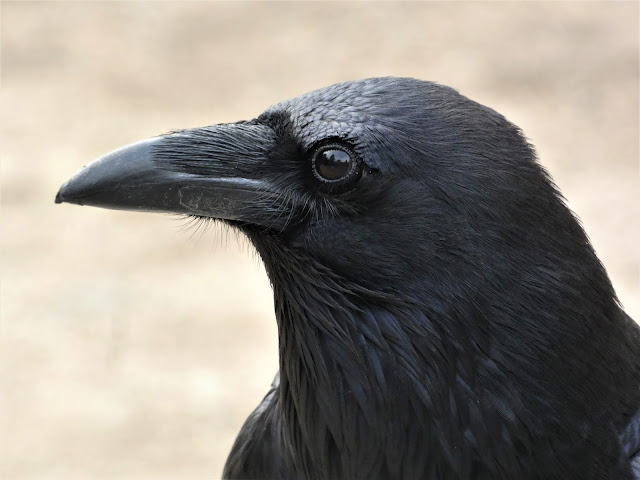
It's hard to imagine a more ubiquitous bird at my favorite national parks than the Common Raven (Corvus corax). No matter how harsh the climate, the bird has found a way to adapt. In the driest climate in the American West, Death Valley, the Raven has often been the only bird present. I've seen them in practically every environment I've explored. The birds have thrived alongside humans and are considered pests in a few quarters, but I've always admired their intelligence and creativity.

I was at Yosemite National Park this weekend and I saw dozens of them, but one stood out, the star in the picture above. It was at the edge of a meadow below El Capitan, and it allowed me to get some close shots before I realized it could care less about me and Mrs. Geotripper, because it turned out we were standing in front of a fast-food bag someone had left next to their car. As we moved on, the bird jumped down and started to work on the folded-up bag. It really wanted to know what was inside.

Photo by Mrs. Geotripper

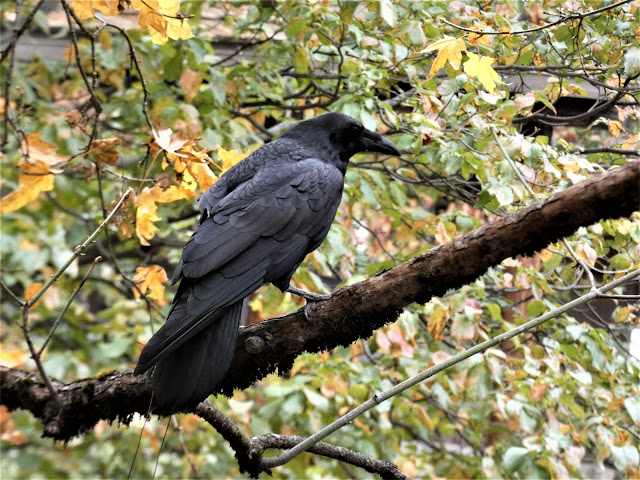
Instead of just tearing it open, the bird used its beak and foot to unfold the top. It started to remove and inspect the trash within one piece at a time, but it felt uncomfortable putting its head all the way in for the deepest bits. Once again, instead of tearing it open, it simply grabbed a corner with its beak, and turned the bag upside down, spilling the contents. It scored a banana peel and one or two fries for its trouble. The bird displayed a rather organized approach to getting to its goal.

Some would insist the bird was spreading garbage about, but really, the humans had done the garbage spreading. It was just making sure that none of the food inside was going to waste...
Thursday, October 25, 2018

American Dipper in Yosemite Valley


John Muir said it well:

"He is the mountain streams’ own darling, the humming-bird of blooming waters, loving rocky ripple-slopes and sheets of foam as a bee loves flowers, as a lark loves sunshine and meadows. Among all the mountain birds, none has cheered me so much in my lonely wanderings, —none so unfailingly. For both in winter and summer he sings, sweetly, cheerily, independent alike of sunshine and of love, requiring no other inspiration than the stream on which he dwells. While water sings, so must he, in heat or cold, calm or storm, ever attuning his voice in sure accord; low in the drought of summer and the drought of winter, but never silent." The Mountains of California, 1894

I've seen Water Ouzels, known officially today as American Dippers (Cinclus mexicanus) on a few rare occasions, but not recently, and none that I've been able photograph. Only one has made an appearance in my county (Stanislaus), which caused a stir in the birding community in the winter of 2017-18. I never got a chance to look for that individual, but I finally got to see one this last weekend up in Yosemite Valley. I was walking along the Merced River near the Curry Village tent cabins when I saw some strange movements of a bird. It was, well, dipping.
The dippers are one of the most aquatic of birds, spending most of their time swimming, walking underwater, and dipping in mountain streams of unpolluted water. They don't migrate, staying in the same general area winter and summer, but they range over an immense region, from northern Alaska to Central America. They mostly eat aquatic insects and their larvae.

I only got two half-decent pictures, but the video came out a bit better. Enjoy!

The

Sunday, October 21, 2018

That Quiet Tapping You Hear? It's a Yosemite Red-Breasted Sapsucker


It was the quiet tapping that threw me. I was in Yosemite Valley on Friday, leading a geology field studies course. I had a bit of free time, so I walked along the Merced River in the vicinity of the Camp Curry tent village. I wasn't seeing or hearing very many birds. But then, as I was stepping up the banks of the river to meet my students, I heard a quiet tapping noise.
If I was in the dark house of a horror movie, the tapping would have been terrifying, but out in the woods it was just curious. I thought "woodpecker" of course, but I'm used to the sound of woodpecking being very loud. I started searching the trees overhead, and soon found the source of the noise: a Red-breasted Sapsucker (Sphyrapicus ruber). I saw one of these when I was in Washington some time ago, but this was the first I've seen here in California.
The bird comes by its name righteously. It punches horizontal lines of shallow holes in the trunks of trees, causing them to bleed sap, which the Sapsucker laps up. The sap also traps bugs, so several other kinds of birds will find sustenance from the Sapsucker's handiwork.

I was pleased that the bird could care less that I was standing beneath the tree. I even had enough time to get a few seconds of video of the bird at work.

Wednesday, May 2, 2018

Black-headed Grosbeaks in Yosemite Valley

The invasion of the brightly colored tropical migrants continues! I had occasion to be in Yosemite Valley yesterday in the midst of some spectacular thunderstorms (the occasion was "I wanted to go spend the afternoon in Yosemite with Mrs. Geotripper"). We stopped for a moment to take pictures of some big rocks (specifically the Three Brothers) and we realized that there were bright orange-colored birds flitting about in the trees overhead. As always I thought "orioles" first, but a look at the stocky beak quickly told me that we were seeing Black-headed Grosbeaks (Pheucticus melanocephalus) instead. I had seen the male of the species only once before (last Thursday to be precise), so this episode provides support for the idea that one sees what one is looking for, and doesn't see what one is not looking for. They haven't been in Yosemite Valley for very long. They've been reported by only six observers on eBird, the first report having come in on April 21st.
We moved up the valley and ended up at Mirror Lake. While enjoying the spectacular view of Mt. Watkins over the reflecting waters of the "lake" (really a wide spot in the stream), I heard an insistent, but pretty bird song in the trees above. After a few moments I located another Black-headed Grosbeak trying to draw the attention of the ladies. The video appears below.


The watch for the spring migrants shall continue!

Wednesday, June 3, 2015

Mountain Bluebirds Building Nests in Tuolumne Meadows at Yosemite

I've never claimed to be the most successful birding enthusiast around. I'm still seeing common birds for the first time. Case in point: today was the first time I've seen a Mountain Bluebird (Sialia currucoides). I've seen their valley cousins, the Western Bluebirds, hundreds of times now, but this was the first time for these brightly colored Sierra Nevada residents.
We were on the last day of our nearly two-week excursion across the southwest, and we came home via Tioga Pass and Yosemite National Park. We stopped at Tuolumne Meadows to take in the beautiful scenery when I saw something blue rustling through the grass. It was a bluebird, actually two of them, male and female, and it looked like they we picking up nesting materials. They were moving fast, so I only got a few blurry shots, especially of the female.The fact that her beak was full of grass strands is what told me they were doing nest preparations.
They both suddenly flew up into the tree overhead and I searched until I found the crevice far above that they were using for a nest. The Mountain Bluebirds nest in tree cavities, but they don't carve them. They usually take over abandoned woodpecker holes, and as such are in competition with Tree Swallows.
I've always been partial to the color blue, and hope that now that I've seen a pair of the Mountain Bluebirds that there will be many more! It's always a good excuse to head up into Yosemite in any case.

Monday, May 18, 2015

Yellow-rumped Warbler in the Yosemite High Country near Bridalveil Creek


The high country of Yosemite National Park is just beginning to come into spring. The snow melted early and the spring will be short, but the woods are starting to come alive with bird songs. We took a short camping trip last week, taking advantage of someone's canceled camp reservations, which gave us time to explore Glacier Point Road. There is a nice little meadow near Bridalveil Creek that is a nice stop to gather in the peace and quiet before braving the crowds at Glacier Point. It's a nice spot for spotting birds.
The most colorful bird we saw in the meadow was a Yellow-rumped Warbler (Setophaga coronata). It was hopping about in the forest duff, and eventually flew into the Lodgepole Pines lining the edge of the meadow. The birds are good at clearing out bugs in the forest, especially some of the beetles that are capable of killing the trees.

The Yellow-rumped Warblers are common birds all across North America, although they are only seen during the migration season in parts of the midwestern states. In their breeding season, they are one of more colorful birds you'll see in the region excepting maybe the Tanagers.
How Yosemite looks without granite cliffs!

Thursday, May 14, 2015

White-headed Woodpecker at the Mariposa Sequoia Grove in Yosemite. And Bears.

It's been a slow week for blogging, but a busy week where everything else is concerned. I've got plenty of bird backlogs, so I will start trying to catch up. Today's feathered friend is a White-headed Woodpecker (Picoides albolarvatus) who was busy exploring the forest at the Mariposa Sequoia Grove in Yosemite National Park. We were visiting the park on Sunday after I scored the single remaining campsite in Yosemite Valley (a lucky moment where someone canceled). We spent a few hours in the grove, listening to a large number of birds and enjoying the peaceful scene.
When we left the grove and started down the highway, we saw a touron traffic jam up ahead. A mother bear and cub had just crossed the road and were doing their thing in the forest, and of course everyone had to stop and take pictures. Including me, of course. I did have the good sense to find a safe parking spot, but I could be judged on the fact that I was standing on the edge of the highway with a steep drop on one side, a bear on the other, and traffic driving by. But, by golly, it was bears!
P.S.: Lest you think I was being totally too close to the bears, they were 150-200 feet up the hill from me being good and doing bear stuff. I have a very nice zoom on the camera.

Saturday, January 17, 2015

Birds of the Day: Ravens at the Swinging Bridge in Yosemite

The Common Raven (Corvus corax) is hardly "common". I tend to think of them as rather extraordinary. They are one of the most intelligent and adaptable birds there are. I see them thriving in some very tough environments, like the dry deserts of Death Valley, and highest peaks of the Sierra.
They can be pests sometimes, in the sense that as an opportunistic scavenger, they do quite well at stealing food from picnickers, not unlike Yogi Bear. They take smaller prey when they can, but humans do such a great job of making food available that it's just easier to hang out where people eat, and take what isn't being watched.
Just the same, they exude a certain air of wisdom and they have interesting personalities. These Ravens were hanging around the Swinging Bridge picnic area in Yosemite Valley.