Showing posts with label Sturnella neglecta. Show all posts

Thursday, October 26, 2017

Western Meadowlark in the Volcanic Barrens of the Sierra Nevada Foothills

The western foothills of the Sierra Nevada are one of the least-known parts of the range. Every year, millions of tourists drive quickly through the grasslands on their way to Yosemite Valley or the recreational lakes towards Sonora Pass. They pay little heed to the barren landscape, but in so doing they are missing out on one of the most dramatic parts of the geological story of the Sierra Nevada.

Nine or ten million years ago, the Sierra Nevada was a different place. The range was lower, and Cascades-style volcanoes were active in the summit regions around Sonora and Ebbets Passes. There may not have been large-scale glaciers, but the volcanoes may have been covered with snow at times, and erupting ash would have produced volcanic mudflows (lahars) that traveled dozens of miles down the western slopes. The mudflows came to rest in the foothills where today the deposits are called the Mehrten Formation.

In some circumstances, the volcanic muds could produce rich soils, but yearly rainfall is only enough for prairie grasses to grow. It's not a desert, but it's not a woodland either. The grasslands do provide excellent habitat for the Western Meadowlark (Sturnella neglecta), and it's a rare trip when I don't see one in the area. These pictures are from a short excursion a week or two ago on Willms Road near Knights Ferry on the Stanislaus River. One can just make out the bird on the rocks in the foreground of the first picture, but zooming in I got a better view. I love the colors of the lichens on the rocks.

Tuesday, May 9, 2017

Western Meadowlark at the San Luis National WIldlife Refuge

I don't know what it is about springtime (well, maybe I do), but the Western Meadowlarks (Sturnella neglecta) are very visible these days. We were touring the San Luis National Wildlife Refuge to see who would still be hanging about after the Sandhill Cranes and Snow Geese left for their Arctic breeding grounds, and found that the meadowlarks were guarding their breeding territory.
This one was camped in a bush right next to the road, and didn't really care that I rolled down the window and picked up a camera. As long as I didn't invade his territory, he seemed fine with my presence. Being only 20 or so feet away, it's about as close as I ever get to a bird.

Tuesday, April 4, 2017

Western Meadowlark in the Prairielands above Knight's Ferry

After torturing you with fuzzy indistinct photos of the Burrowing Owl I saw on Sunday in the prairielands, I thought it only fair to share with you one of the sharpest shots I've gotten lately, that of a Western Meadowlark (Sturnella neglecta) that was perched on a fencepost only a few hundred yards from where I saw the owl. It was hardly bothered at all that we stopped the car just a few yards away, as it was far more interested in catching the attention of the ladies
We were driving Willms Road south from Knights Ferry to take in the vernal pools, the birds, and hopefully some wildflowers. We had the windows down, and the song of the meadowlark could be heard along the entire distance. They are out in force this time of the year.

Tuesday, February 28, 2017

A Cold Western Meadowlark at the Stone Lakes National Wildlife Refuge


I have a delightful backlog of bird pictures. With my time and attention on a great many other things of late, it's fun to finally work back through the last couple of weeks and see what I've missed in the picture files. In the middle of January I dropped someone off at Sacramento Airport, and on the trip back home I stopped by the Stone Lakes National Wildlife Refuge only to find it flooded and closed. All was not lost however. As I sat at the closed entrance gate, a Western Meadowlark (Sturnella neglecta) alit on the post. I slowly lowered the window and listened to its delightful song (and shot a short video as well). Be sure to turn up the volume a little bit!

Saturday, November 26, 2016

Western Meadowlark on the Oregon Coast

I'm sure it's not unusual, but walking along the Siuslaw River estuary on the central Oregon coastline, I was expecting to see all manner of shorebirds, and the odd crow or maybe even a Bald Eagle that has been said to be lurking nearby. I wasn't really expecting to see a Western Meadowlark (Sturnella neglecta), but that was what I got pictures of this morning. Thinking back, it wasn't that strange, as the vegetated dunes that characterize this section of the Oregon coast are covered with grasses that make for excellent habitat for the Meadowlarks. In any case, it's always a delight to see one.

Saturday, April 2, 2016

One of the Prettiest of Songs: A Western Meadowlark on Willms Road


Meadowlarks have one of the prettiest bird songs around. I grew up hearing them on my Grandparent's ranch when I was a child, so whenever I hear them these days, I briefly turn eight years old again, when an acre was a trackless wilderness in which all manner of adventures could be had.
We were on Willms Road, which travels south from Knights Ferry on the Stanislaus River in the foothills of the Sierra Nevada. Being spring, the Western Meadowlarks (Sturnella neglecta) are singing their hearts out, and one stayed on the fencepost long enough to be videoed, but my photos came out a bit fuzzy, so enjoy the two shots below from an earlier trip in the southern Mother Lode.
Besides their beautiful songs, the Meadowlarks are quite striking in their plumage as well.

Sunday, February 7, 2016

Western Meadowlark at the San Luis National Wildlife Refuge - Their Land and Ours

These Western Meadowlarks (Sturnella neglecta) were out and about yesterday at the Tule Elk enclosure at the San Luis National Wildlife Refuge. Spring is just around the corner; the grass is already green and growing, and the trees can't be far behind.
 We were out on a 'lark', and ended up at the refuge. As we drove along the autotour, I was reflecting on the horrible events at the Malheur National Wildlife Refuge, where armed thugs took over the park headquarters and threatened to kill anyone who tried to root them out. It angered me beyond words, but I wrote words anyway over at Geotripper (link here). But as the bird songs continued I relaxed and ended up thoroughly enjoying the afternoon sojourn.
The Western Meadowlarks were singing for mates, and it seemed that practically all the other birds were as well. After four years of drought and dryness, it was so nice to see an explosion of life.

Friday, November 20, 2015

Western Meadowlark at the Merced National Wildlife Refuge

On our visit to the Merced National Wildlife Refuge a few weeks ago, we were mostly on the lookout for the big arriving migrants like the Sandhill Cranes and Snow Geese. But we also kept an eye out for some of the year-round residents, and along one stretch, we heard a familiar song. It was a Western Meadowlark (Sturnella neglecta) on the opposite side of the levee from the ponds.

The Meadowlarks are not necessarily endangered, but like many native birds, they have suffered population losses since the 1960s, due to habitat loss. The losses continue in our area as rangelands give way to almond orchards.

I didn't get any video this time out, but a few months back I caught a meadowlark singing in the Sierra Nevada foothills. Enjoy!
 

Thursday, April 2, 2015

Western Meadowlark near Turlock Lake

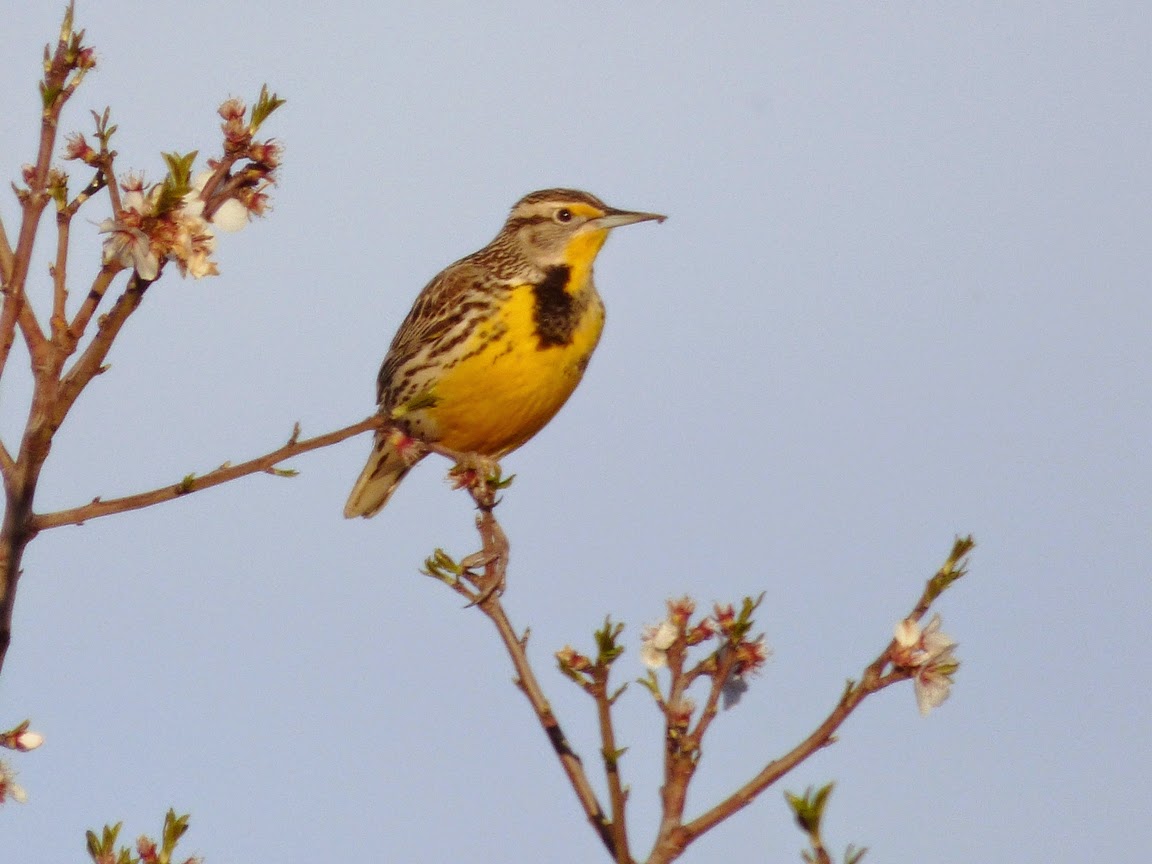
The Western Meadowlark (Sturnella neglecta) has such a breathtakingly beautiful song, but it has some beautiful coloring as well. I was out near Turlock Lake State Recreational Area on Davis Road the other day where I saw a dozen or more spread out along the fences enclosing the grazing lands. One of them was kind enough not to panic when my car rolled to a stop. It was a bit coy about showing off the brilliant yellow and black breast, though.

The winter migrants have mostly left for the northlands, but I've been seeing more of our year-round birds and southern migrants. I saw a single Kingbird earlier this week, but on Davis Road I saw several dozen. Spring is definitely here!

Monday, March 2, 2015

Western Meadowlark on the California Prairielands


One of the most beautiful of bird songs is that of the Western Meadowlark (Sturnella neglecta). I have seen few of them during the winter months, when they spend a lot of time on the ground looking for bugs. They'll sing, but they won't show themselves all that much.

As the spring season arrives they become more visible as the males perch on fence posts and treetops to advertise for love and companionship. We took a drive out into what I call the California prairielands, an increasingly precious region that is losing ground to rapidly expanding (but unsustainable) almond orchards. One might notice the irony that our singing individual is perched on a young almond tree. We were on Warnerville and Willms Road east of Oakdale, are part of the prairie that is particularly beautiful right now (look for some views in a soon to be posted Geotripper blog post).

The Meadowlarks are beautiful birds (aren't most of them?) that range all across the west and midwest of North American continent. There is an Eastern Meadowlark that is barely distinguishable in appearance, but differs in song and feeding style. It is the state bird of six different states: Kansas, Montana, Nebraska, North Dakota, Oregon, and Wyoming.

The Meadowlarks have powerful jaws and sometimes feed by using a method called "gaping" where they stick their long bills in the soil and open their beaks to access seeds and bugs. The Cornell Lab of Ornithology offers additional information about these fascinating birds.

Our bird stayed still long enough to catch a few seconds of singing. Enjoy!