Showing posts with label San Joaquin River National Wildlife Refuge. Show all posts

Friday, February 7, 2020

Preparing for a Long Journey...The Sandhill Cranes of the San Joaquin River National Wildlife Refuge


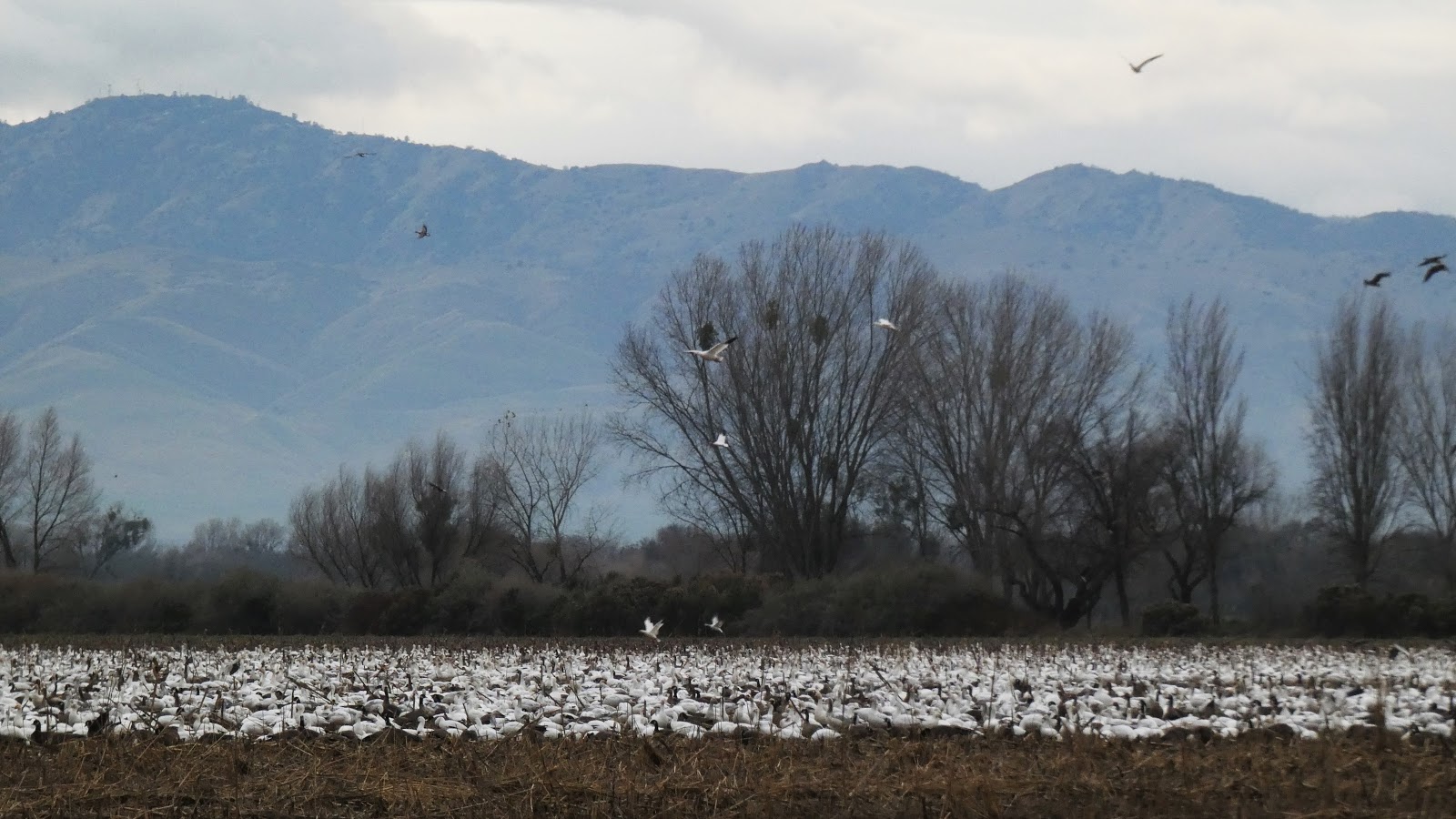
These last few days have been truly beautiful in the Great Valley of California. A couple of weak low pressure systems blew out the dust and pollution and we've had a series of gorgeous sunrises and sunsets. I had a few minutes after a lab today, and decided to see what was going on at the viewing platform at the north edge of the San Joaquin River National Wildlife Refuge. One never really knows what to expect...last week there were around 10,000 Snow and Ross's Geese gathered in a single gigantic flock near the road. It much different tonight. The Snow Geese were off in another part of the refuge, and the fields were being patrolled by hundreds and hundreds of Sandhill Cranes (Grus canadensis).
The cranes have been here since September, wintering in the mild climate of the valley. But the season is starting to feel more and more like spring, and the birds are getting restless. Within a few short weeks they'll be gone, headed north towards the Arctic to breed and fatten up during the summer months.
Sandhill Cranes are one of the most dramatic species to grace our local environment. They are large birds, standing almost four feet tall, and they have a unique style of dancing when they are flocking together. I'm going to miss their purring call when they're gone, but it's nice to know we can look forward to their return once the weather starts to turn cold again.


Wednesday, January 22, 2020

One of Nature's Most Awesome Displays, and only 10 Miles from my College


I find it staggering sometimes that I lived in the Modesto area for more than two decades before I discovered that one of the most awesome displays of nature was taking place only a short distance away. I've watched plenty of nature documentaries about the vast bird flocks of the Serengeti Plains of Africa, and dreamed of seeing such incredible sights for myself, all the while not realizing that a similar drama could be seen only ten miles outside of my town.

The Great Valley of California is a 400 mile long trough of agricultural fields that once were grassy savannahs and wetlands that support millions upon millions of migratory birds. When the region was colonized, the prairies were erased by agricultural fields and orchards, and the refugia for the migratory birds disappeared. Environmentalists and conservationists began to lobby for preserving and rebuilding some of the wetlands resulted in the establishment of a string of wildlife refuges up and down the valley. They amount to 5% or less of the original landscape, and are not really enough to support the huge bird populations, but it is better than what existed a half century ago. Each winter the refuges host hundreds of thousands of geese (Snow, Ross's, Aleutian Cackling, and Greater White-Fronted), as well as Sandhill Cranes, and millions of ducks.

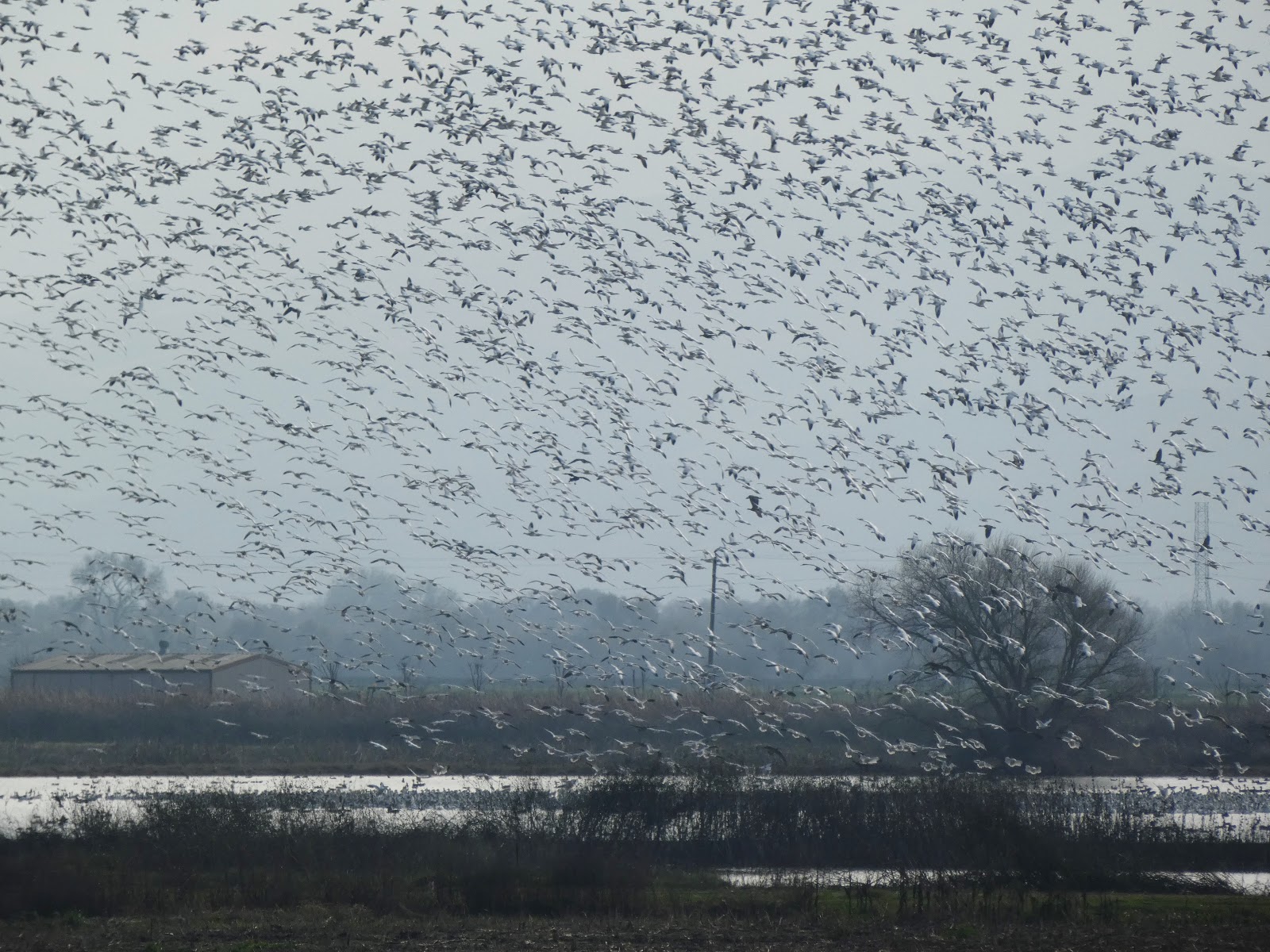
I went out to the Beckwith Road Viewing Platform west of Modesto to have a look tonight at the San Joaquin River National Wildlife Refuge. The platform overlooks hundreds of acres of land planted with corn solely meant to feed the geese and cranes. Every evening during the fall and winter, thousands, maybe tens of thousands of geese fly in for the night and gather into a single gigantic flock, a sea of white Snow and Ross's Geese, with an outer ring of Aleutian Cackling Geese. It's best when they are not disturbed so they can conserve their energy, but occasionally something will happen and the entire flock will take flight all at once. That happened while I was watching. I don't know if it was a coyote, or an eagle, but something startled the birds and off they went. It was stunning.

I was taking video, and as the birds began to settle back in, I noticed a single goose, an iconoclast, a loner, who had refused to take off like the others. You can see it at the end of the video. I wonder what it was thinking...

Saturday, February 2, 2019

The Most Soothing Birdcall: Sandhill Cranes at the San Joaquin River National Wildlife Refuge

They don't call them songbirds for nothing. Many birds produce wonderful melodies that lift the heart and all that kind of thing, but for a soothing calming moment few birds can match the purring of the Sandhill Crane (Grus canadensis).
The Sandhill Cranes spend their summers far to the north in Canada or Alaska, but in winter they come to the Great Valley by the tens of thousands. For the past two weeks more than a thousand of them have been grazing and foraging in the cut cornfields visible from the viewing platform on Beckwith Road (the corn is grown specifically to feed the geese and crane who winter here). The platform is part of the San Joaquin River National Wildlife Refuge and the birds have been quite close during my last few visits. And they are beautiful to photograph.
This afternoon some of them were hanging out in the fallow field near the viewpoint that is (already!) starting to bloom.
I've never managed to capture their soothing song before, but this week I got some pretty good video, and the birds were quite vocal.

The viewing platform is located near the west end of Beckwith Road out of Modesto, about 8 miles west of the Vintage Faire Mall. It will be open for another month or so while the geese and cranes await the thawing of the lands up north. It will be very quiet without the Sandhills!

Wednesday, October 31, 2018

It's a Snipe Hunt! I Found Mine at the San Joaquin River National Wildlife Refuge


When I was a scout back in another era we often introduced the new guys to our trip by conducting a snipe hunt, chasing imaginary birds with paper sacks in the dark. For some reason we never caught any. I had no idea at the time that snipes actually existed, but they do.
I was out at the San Joaquin River National Wildlife Refuge the other day looking for migrant geese. I certainly found some at the viewing platform on Beckwith Road, several thousand Aleutian Cackling Geese, Sandhill Cranes, and even a handful of Snow Geese.
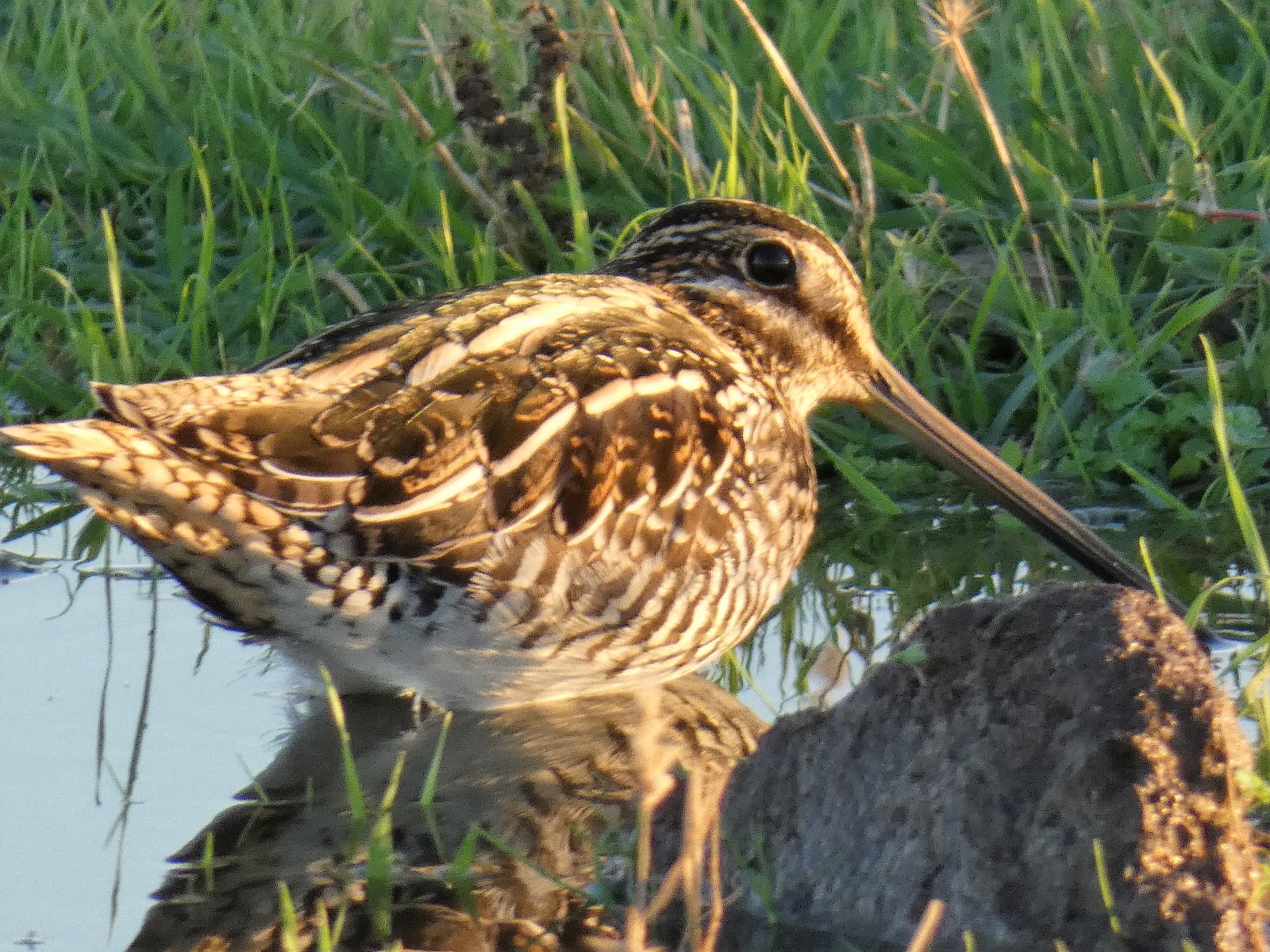
There is no open water at the Beckwith Viewing Platform except in the great distance, so it isn't the best place to be searching for shorebirds. But on the way east along the access road there are a few seasonal ponds that are good for birdwatching. This time around my search for a Wilson's Snipe (Gallinago delicate) was successful, although to be honest I didn't know I was searching for it. Six of them were feeding in the mud along the shoreline of the pond.
 One of the more noticeable features of the snipe is the location of their eyes in the middle of their skull. This arrangement allows them to see behind as well as ahead. They can see a predator coming from far off, which goes a long way towards explaining why our snipe hunts were never successful all those years ago.
Two Wilson's Snipes with a Greater Yellowlegs


Monday, October 29, 2018

The Second Wave Has Arrived, With Harbingers of a Third: The Aleutian Cackling Geese at Beckwith Road

Momentous things are happening in the Great Valley this month! Wave after wave of migratory birds are starting to arrive at the string of national wildlife refuges up and down the valley floor. The Sandhill Cranes arrived in large numbers several weeks ago, constituting the "first wave" (this, by the way, is my entirely made-up description; I'm no biologist. I'm just reporting what I've been seeing). We saw hundreds and hundreds of them last week in the Merced National Wildlife Refuge, and I saw a few hundred of them at the San Joaquin River National Wildlife Refuge. There were also a few dozen Greater White-fronted Geese at both refuges, but not in large numbers.
But this week there was a big change at the San Joaquin River National Wildlife Refuge. I stopped by on Tuesday and again on Saturday to find a huge flock of several thousand Aleutian Cackling Geese (Branta hutchinsii). The corn in the section near the viewing platform on Beckwith Road had been cut so the birds were foraging for food.
The Cackling Goose strongly resembles the Canada Goose and was once classed as a subspecies. Subsequent studies showed enough differences that they are considered separate species today. They are noticeably smaller and their necks are short than those of the Canada Goose. They breed on just a few of the Aleutian Islands and most of them migrate to just a small area of the Central Valley, primarily the San Joaquin River National Wildlife Refuge. The birds were actually thought to be extinct for a few decades after 1938, due to over-hunting in the valley and the introduction of foxes in their breeding grounds in Alaska. A few hundred individuals were discovered on an isolated island and the bird was placed on the endangered species list soon after in 1967. The foxes were removed from the breeding islands and hunting was controlled and the birds rebounded. They now number more than 120,000.
There was a harbinger in the crowd of Cackling Geese which you may have noticed in some of the pictures above. It was the presence of seven or eight Snow Geese. They are another Arctic breeder, and they are on their way south too. In another two or three weeks there will be tens of thousands of them at the refuges (my official "third wave").
The viewing platform on Beckwith Road is about eight miles west of the Vintage Faire Mall in Modesto. It's open now and free to visit. If you want the challenge of a hike you can go across the San Joaquin River on Highway 132 and go a few miles south to another section of the refuge. The Pelican Trail is about 4 miles total with a variety of different riparian habitats. It's not unusual to run across three dozen bird species or more.
The Great Valley is often thought of as a dusty, flat and boring place. It often is. But there are treasures hidden here. A visit to the national refuges during the winter migrations is as spectacular as a trip through the African savanna, especially in those moments when tens of thousands of geese take flight all at once. It is well worth your time if you ever happen to be passing through.

Here's a video of the flight...


Monday, March 12, 2018

The Last Days of Winter in the Great Valley (and a Bald Eagle)


We spent part of the weekend out at the coast, but coming home in Bay Area traffic was no fun. As we approached the Great Valley, we decided to get off the main highway and check out things at the Beckwith Road Viewing Platform, part of the San Joaquin River National Wildlife Refuge. At times during the winter season, tens of thousands of Aleutian Cackling Geese, White-fronted Geese, Snow Geese, and Ross's Geese will congregate in the fields around the platform. But winter is almost over and the huge flocks are beginning to disappear as they begin their northward migration.

We saw just a few dozen White-fronted Geese near the platform, and saw or heard little else. If the geese were there, they were well hidden. We spent some time enjoying the rabbits at the thicket around the platform and searched for Towhees and sparrows. We were finally ready to go, so we started driving slowly east along the northern boundary of the refuge.
Photo by Mrs. Geotripper

Then we heard a lot of goose noise, and stopped again to try and see why. It didn't take long to find out why...there was a Bald Eagle (Haliaeetus leucocephalus) lurking at the edge of the pasture. I don't know if they prey on the geese, but their agitation certainly made it seem so. It turned out that there were still a few hundred Snow Geese hiding out in the distant shrubs.
I've seen a number of Bald Eagles in the last few years, but most of them have been in the Pacific Northwest. They are resident in the local region, but not overly common. I've only seen one at this spot in the past, in 2015 (see the pictures here). A check of eBird indicates a sighting of two eagles in November of 2017, but no other reports since 2016.
Bald Eagles are big birds. Really big. Cows were strolling in front of the eagle, providing a sense of scale. Their wingspan can exceed six feet, which became apparent when it took off, again in front of the cow.
It was a great ending to our weekend!

Thursday, March 1, 2018

The Sandhill Cranes are Getting Restless


I wonder sometimes which they consider "home". Is it the Great Valley of California where they spend the winter, thriving on the grains and grasses that grow all year? Or is it their breeding grounds across the northern tier states or farther north in the Arctic (see their complicated range in the map below from Birds of North America). The answer, from their point of view, is pointless. It's just where life for them happens. One can't go to far with anthropomorphizing birds like I'm doing here.

Still, I sense a disturbance in the force as I've watched them the last few weeks. They know they are going to be leaving soon. I don't know what signals the moment to leave...the angle of the sun in the sky? The temperature? If it is temperature, they are a little bit confused right now. A week or two back it was as warm as April, but the end of February brought freezing temperatures. But in any case, they'll be heading north soon.
There are still hundreds of them in the area if you want a last look. The first picture was taken last weekend at the Merced National Wildlife Refuge. The other pictures are from a month ago at the San Joaquin National River Wildlife Refuge, but a visit last week confirmed that they are still there.
These are such grand and graceful looking birds, and though it seems strange to put it this way, their call is almost like loud cat purring. And the sound carries long distances. I've heard them flying high overhead, but couldn't locate them in the sky. If you live in a place where they visit for part of the year, they are worth an afternoon to see and observe. But if you live in the Modesto area as many of my readers do, your time is running out. They are preparing to leave soon.


Friday, February 23, 2018

Red-tailed Hawk Hovering for Dinner at the San Joaquin River National Wildlife Refuge

I always try, but I rarely get good pictures of hawks or eagles in flight. It's not easy to focus in on a moving target and get much of a picture, but today was a little bit different. There was a Red-tailed Hawk (Buteo jamaicensis) hovering, or kiting, over the empty fields around the viewing platform on Beckwith Road (part of the San Joaquin River National Wildlife Refuge). It was hovering in place long enough to get focused in. It didn't get any dinner while we watched, but it wasn't for lack of trying.
Things were pretty quiet otherwise at the viewing platform. We saw dozens, maybe a hundred or two of the Sandhill Cranes off in the distance, but no geese. It may be that they were out foraging for food, but it is also possible that they have begun the journey north to the Arctic. The viewing platform usually closes in March when the birds are gone.

Wednesday, January 24, 2018

Sandhill Cranes and the Great Valley That Once Was, and in Places, Still Is

These beautiful birds are among the reasons I took up bird photography a couple of years ago. I was astounded to find that Sandhill Cranes (Grus Canadensis) congregated by the tens of thousands very close to where I live, and I was not the least bit aware of it.

Living in the Central Valley of California (which I agree should always be called the Great Valley) is an exercise in frustration and futility. The natural environment, the greatest savanna environment in the United States, was almost completely co-opted by agricultural development, and then by urban development. It's not a great place for people to live...most of the jobs are poorly-paid manual labor, the soil, air and water are infused with pesticides, herbicides, and particulate air pollution, and health problems, especially asthma and related respiratory illnesses are rampant. Education is a low priority to those in power. We are consistently the first to suffer in economic downturns, and the last region to recover from them.
And yet there is still a greatness to this valley. In terms of the natural environment, dedicated people have worked tirelessly for decades to preserve the remnants of the rich ecosystem, and have worked even harder to rebuild some of the habitats as abandoned farmlands have come available. Thousands of acres of river floodplains have been replanted with native vegetation. There is now a string of wildlife refuges along the 400 mile length of the valley that provide shelter for the millions of winter migrants, the Sandhill Cranes, the Aleutian Cackling Geese, the Snow and Ross's Geese, and many others.
The Great Valley that existed hundreds and thousands of years ago is still available to observe and enjoy, and often only a few miles from the homes of everyone who lives here. In the Modesto-Turlock area, there are the San Luis and San Joaquin River National Wildlife Refuges. The Beckwith Road viewing platform (part of the San Joaquin refuge) is only an eight mile excursion from Modesto's biggest shopping mall. I was there last night and had a real treat. The Sandhill Cranes are elegant large birds, beautiful to photograph, but they are a bit wary (with good reason) of human beings. They tend to stay towards the interior of the refuge, being heard more than seen off in the distance.
It's deep into winter now, and food stores are kind of low. The refuge managers grow fields of corn and other crops for the sole use of the birds, and they'll plow down the corn in sections so the birds can feed easily. Once those crops are gone, the birds make do, and last night they were roaming the plowed fields close to the road and viewing platform. I got some of my closest shots in a long time.

This is part of the valley as it once was, and still is. It belongs to all of us, and it is right in our own backyard. And to our coastal and urban center friends, don't forget that there are some incredible sights to see on the valley floor when you are on your way to Yosemite or to one of the Sierra ski resorts. For our international visitors, there are more places to see than the travel brochures hint at. If you are interested in the natural world want to see some of the real California, not just the tourist meccas, then check out these places. The refuges are worthy of a look.

Tuesday, December 12, 2017

10,000+ Geese Taking Flight at the San Joaquin River National Wildlife Refuge

Three Sandhill Cranes soar against a backdrop of hundreds of geese
I lived here for a quarter century absolutely ignorant of the dramatic scenes taking place just west and south of my home. Each winter tens of thousands of Snow Geese, Ross's Geese, Cackling Geese, and White-fronted Geese as well as Sandhill Cranes take the long journey out of the Arctic Circle and head for California's Great Valley. They converge on a series of wildlife refuges that wind up and down the valley like a string of pearls. They bide their time through the winter and then when spring comes they head north again to breed.
They once ranged across the entire valley, but agricultural development has stolen away 95% of their habitat, leaving precious little living space. Refuge managers will often grow fields of corn to provide food for the hungry birds.
They spend their days foraging around the region but as the sun sets low on the horizon they start to settle into a large field where they can bunch together. This evening the flock was pretty close to the viewing platform on Beckwith Road about 10 miles west of Modesto. When I first arrived about 25 minutes before sunset, there were just a few hundred birds in the field, but more were arriving by the minute. Soon there was a thousand, and then ten thousand. The noise was deafening (the amount of gossiping going on was appalling!).
Occasionally something would startle the birds and many of them would take flight all at once, circling like a bird tornado over the field until whatever got them going resolved itself. Who knows what it might have been. I've seen coyotes lurking in the area, as well as Bald Eagles.
Soon an entire sector of the pastureland was covered with thousands of birds settling in for the night, but as I was turning to go, there was one more disturbance. There was a sound like a jet plane throttling upwards to take off and thousands of birds were once again in the air.
I caught a short video of the moment. Sorry for the shaky cinematography. I've been watching too many crime procedurals lately. Or else I was just kind of excited...


Wednesday, November 22, 2017

Showing the Way to a Peaceful Thanksgiving Feast: Great Egret and a Great Blue Heron Share a Space


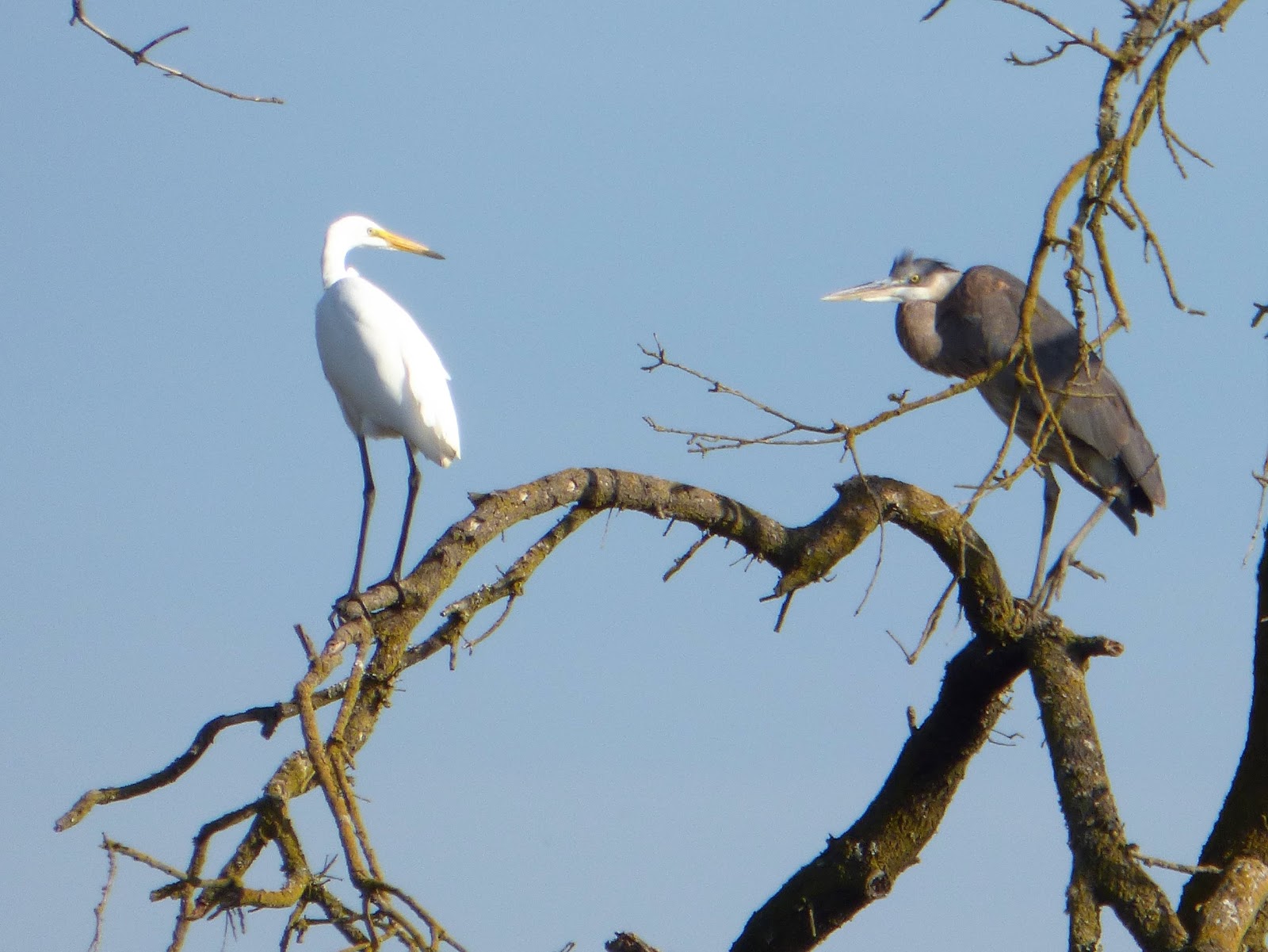
I don't why this made me think of Thanksgiving, but I was walking out at the San Joaquin River National Wildlife Refuge this afternoon when I saw a Great Egret (Ardea alba) and a Great Blue Heron (Ardea herodias) sharing a branch on a tree by the slough. I saw two different, yet related species occupying close quarters, and doing so quite peaceably.
Doesn't the heron in flight remind you of a dragon?
There was plenty of other activity in the thickets below, and if you have ever heard herons arguing, you know it can be a shocking and unpleasant noise. Maybe that's what made me think of relatives arguing over a Thanksgiving table. I'm happy that I usually don't have that problem.

It's not the first time that I've seen egrets and herons in close proximity, but it always catches my attention. Although they share the same genus, the Great Egret has a range that extends to all the major continents, but mostly in tropical climes. They are very rarely found in Alaska, Canada, or Siberia, for instance. The Great Blue Heron ranges a bit farther north, but is restricted to northern and central America.
In any case, I saw these two enjoying the afternoon sunshine together, and thought about how nice it can be when folks get along with others. I'm going to be doing a lot of driving in the next few days, so if I don't get the chance later, I hope that you have many things to be thankful for, and that your time in these next few days is precious and memorable, wherever and however you spend it.