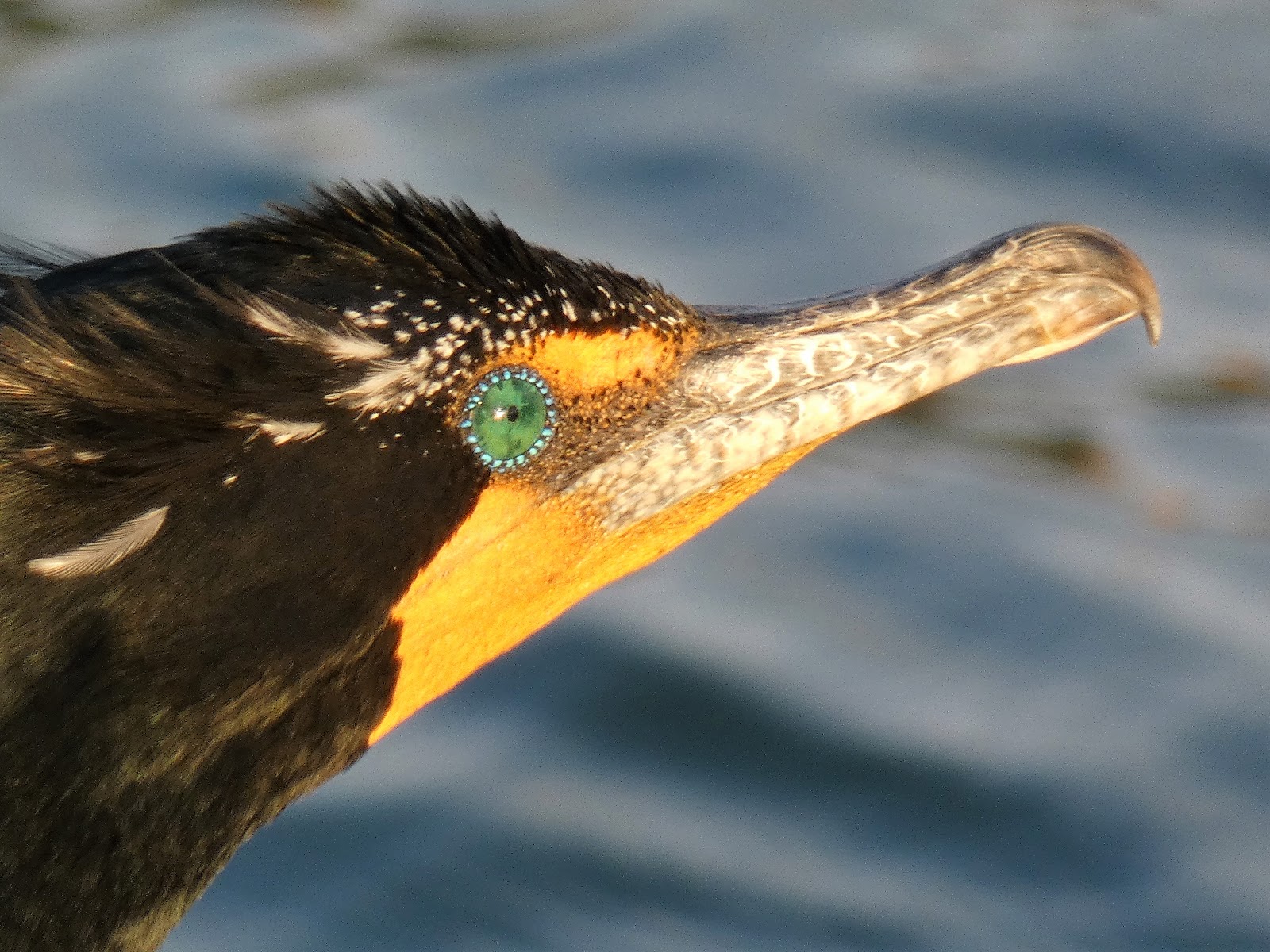
It is one of the most alien-like eyes in nature, in my view. I mean, sure, there's reptilian eyes with their cold emotionless stare, and goat's eyes with their horizontal slits, but nothing can quite compare to turquoise stare of a Double-crested Cormorant. I rarely get near enough to them in the wild to get closeup pictures, but there is one that lives in Warrior Lake at the campus of CSU Stanislaus, where I teach part-time. It is much more acclimated to people and so doesn't retreat as I walk by.
The Double-crested Cormorants, like all their cousins, are consummate fish hunters. Unlike most fishing birds, they dive into the water and chase their prey under the surface. To do so, they can't be overly buoyant and thus they have fewer oils in their feathers. They can get sort of waterlogged, in other words. As a consequence, they will spend a portion of their day drying off, like this one was doing when I happened by.
Showing posts with label Double-crested Cormorant (Phalacrocorax auritus). Show all posts
Wednesday, March 6, 2019
Wednesday, March 28, 2018
Holy Cow, What the Heck is That?? Oh, and Have You Ever Wondered Why They Call it Double-Crested?
Yikes, did I ever see something strange today. I've always noticed Double-crested Cormorants (Phalacrocorax auritus) during our travels at the local bird refuges, but I have never gotten a really close look. They've always been off in the distance, or skittered away if we got too close. I had no idea what I was missing.
I was wandering around on the CSU Stanislaus this afternoon, and was distracted by the dozens of Canada Geese, American Coots, and Mallard Ducks, especially since there were some cute little chicks showing up with them. I was walking by about ten feet from yet another black-colored bird, and almost didn't notice it was...not...like...the...others. The long hooked bill and orange face immediately marked it as a Cormorant, but I had never seen such eyes before.
Then I noticed the odd feathers on the head and finally realized why it is called "double-crested" (I vaguely wondered, but never looked it up). During the breeding season, the males develop the head feathers, apparently because the lady Cormorants are impressed by such things. I'm glad to know that humans aren't subject to such strange whims.
So, yeah, I'm pretty impressed by a bird that I've noticed, but never seen up close. It's described in some guides as "primitive" looking, and I definitely get dinosaur vibes when I look at this individual.
I was wandering around on the CSU Stanislaus this afternoon, and was distracted by the dozens of Canada Geese, American Coots, and Mallard Ducks, especially since there were some cute little chicks showing up with them. I was walking by about ten feet from yet another black-colored bird, and almost didn't notice it was...not...like...the...others. The long hooked bill and orange face immediately marked it as a Cormorant, but I had never seen such eyes before.
Then I noticed the odd feathers on the head and finally realized why it is called "double-crested" (I vaguely wondered, but never looked it up). During the breeding season, the males develop the head feathers, apparently because the lady Cormorants are impressed by such things. I'm glad to know that humans aren't subject to such strange whims.
So, yeah, I'm pretty impressed by a bird that I've noticed, but never seen up close. It's described in some guides as "primitive" looking, and I definitely get dinosaur vibes when I look at this individual.
Wednesday, March 21, 2018
Photo-bombed by a Double-Crested Cormorant
We were at the end of a day of birding along the Waterfowl auto-tour at the San Luis National Wildlife Refuge. There was one last pool I was watching for, as it is a favorite roosting spot for Great Blue Herons and Great Egrets. What found instead were a couple of Double-crested Cormorants (Phalacrocorax auritus) who were seriously showing off as soon as pulled out the camera. It really looked like they were mugging for us. It's more likely that it was drying its wings, something they do after diving for fish. Still...
Tuesday, February 9, 2016
Double-crested Cormorants at San Luis National Wildlife Refuge. Would Hitchcock be Proud?
It was a beautiful evening at the San Luis National Wildlife Refuge between Turlock and Los Banos. We were along Salt Slough, a tributary to the San Joaquin River, watching beavers or muskrats and various small birds flitting thorough the trees. But we couldn't shake the feeling that we were being watched...
I looked harder into the trees to find that we were being watched. I had a momentary thought of scenes from a Hitchcock movie concerning avians instead of aliens, but it was clear the birds were simply settling in for the night.
They were a flock of Double-crested Cormorants (Phalacrocorax auritus). They are the most common Cormorant in the United States, with a range that includes the entire lower 48 states and Alaska.
These birds probably could be forgiven if they harbor anti-human impulses a la "The Birds". They were hunted and shot in large numbers a century or more ago, and in the sixties they were nearly done in by the use of DDT. They've rebounded and are generally doing well in most places.
I looked harder into the trees to find that we were being watched. I had a momentary thought of scenes from a Hitchcock movie concerning avians instead of aliens, but it was clear the birds were simply settling in for the night.
They were a flock of Double-crested Cormorants (Phalacrocorax auritus). They are the most common Cormorant in the United States, with a range that includes the entire lower 48 states and Alaska.
These birds probably could be forgiven if they harbor anti-human impulses a la "The Birds". They were hunted and shot in large numbers a century or more ago, and in the sixties they were nearly done in by the use of DDT. They've rebounded and are generally doing well in most places.
Subscribe to:
Posts (Atom)