Showing posts with label Bald Eagle (Haliaeetus leucocephalus). Show all posts

Monday, November 29, 2021

Some Close-Up Shots at the Sacramento National Wildlife Refuge

Snow Goose (Chen caerulescens) with juvenile
One thing about having relatives in Oregon is that we get to travel north during the Thanksgiving and Christmas holidays. Doing so brings us in close proximity to the Sacramento National Wildlife Refuge near Williams in California's Great Valley. We usually manage to eke out a stop during our long drives between states, but we missed a year because of the accursed pandemic. 

Ross's Goose (Anser rossii)
We were thus especially looking forward to a tour of the auto-loop this morning and we were not disappointed. California's Great Valley (called by some uncreative souls the Central Valley) is a major wintering habitat for millions of migrating geese, swans, cranes, and ducks. 95% of the valley has been co-opted by agricultural development, so the few wetlands preserved as refuges are critical to the bird's survival. There were thousands of Snow Geese (Chen caerulescens) and Ross's Geese (Anser rossii) present in the ponds. They can be tricky to distinguish from a distance, but if you compare the photos above you can see the Snow Geese have a dark lining like lipstick on their beaks, which are also longer. The Ross's Geese are smaller overall as well.


When I mention that there were thousands, I was not exaggerating...they filled the skies, and the sound of their squawking in any other setting (for instance a horror movie) would be terrifying.

Great Blue Heron (Ardea herodias)
There were some Great Blue Herons present, and they seemed rather accustomed to the large iron-clad beasts rumbling by on the road. I don't often get a chance to be so close to them.

We are used to seeing many of these birds at the refuges in our own backyard, but the Sacramento refuge is a more dependable place for spying a Bald Eagle (Haliaeetus leucocephalus). Or should I say it spied us? This one was only 20-25 feet above us.


The adult was watching over two juveniles in the next tree. It takes them a few years to get "bald", but the huge beak is always distinctive.


Our biggest thrill was catching sight of a Peregrine Falcon (Falco peregrinus). We had finished with the eagles and told ourselves we were out of time and that there weren't any birds that would stop us from finishing the loop, but of course only 200 yards down the road we had this falcon politely posing for us. Of course, we stopped and spent an inordinate amount of time taking pictures. We made it home in time to pick up our precious kitties from the kennel, but only barely.


Monday, February 1, 2021

It's Been Awhile: Bald Eagle on the Tuolumne River Today

My friends in the Pacific Northwest, Alaska and Canada might not be much impressed by a sighting of a Bald Eagle on the Tuolumne River Parkway Trail today. But it was memorable. I saw not a single one on the trail last year (a good friend saw one, though). In fact, I only saw one anywhere in the entire county last year. The last eagle I saw here hung around for a few short weeks in 2019, and that was the first recorded sighting for that part of the river ever (although neighbors have told me of past sightings).

I had been seeing Turkey Vultures and Red-tailed Hawks (three of them!) soaring around the western part of the trail, but didn't think much of it. But then a large black shape soared overhead and I saw both a white head and white tail. I tried to get a picture but it was gone. Then I walked back upstream and saw it perched in a cottonwood across the river. Apparently the hawks and the vulture had been expressing a certain amount of concern because they were all circling the perched eagle. The eagle was unperturbed and was still perched in the same spot when I left towards home.


Tuesday, December 24, 2019

Avian Dinosaurs: Bald Eagles at the Sacramento National Wildlife Refuge

Sometimes I am reminded that the dinosaurs never actually went extinct. They were decimated certainly, and their present-day species don't look all that much like their ancient ancestors, but there are occasional clues to their dinosaurian past. The claws of a Bald Eagle (Haliaeetus leucocephalus), for instance. We were at the Sacramento National Wildlife Refuge just before Christmas, and saw several of birds at close quarters.
How close are the birds to the dinosaurs? Dinosaurs are classed as reptiles, but the reptiles we know today, the lizards, snakes, turtles, and crocodiles, were separate evolutionary lines in the Permian and early Triassic, before the dinosaurs even arose. The crocodilians are the closest of these ancient relatives, but they were already on their own evolutionary path during the Jurassic and Cretaceous periods when the dinosaurs were dominating the terrestrial habitats of the planet.
The birds on the other hand developed from the dinosaurs, descending from small theropod carnivores similar to the Velociraptor or Deinonychus, monsters made famous in the Jurassic Park movies. Evidence has emerged in recent decades that many dinosaurs may have in fact sported feathers (which are modified scales). Many bird embryos support teeth that are later resorbed during development.
In any case, that's what I was thinking about as we came across at least three Bald Eagles while traveling the auto tour route at the Sacramento Refuge. There were a couple of immature individuals and one adult. They were accustomed to automobiles passing by so they didn't retreat as we passed by, enabling me to get a zoomed view of their claws.
One juvenile was still hanging out with mom, while the other was on its own. They were a sight to see in the rain (that's why they all looked a little scruffy; they were generally soaked).

Tuesday, August 6, 2019

Bald Eagles Nesting at Neah Bay, Washington

Our trip to British Columbia didn't have a great many chances for birdwatching. Teaching a field course is like that...time after time, I'll be talking to the students about rocks or something, and some bird, quite often an unusual species will be hopping from branch to branch behind the students. I want desperately to lift the camera and start snapping away, but I'm a professional, darn it. I grit my teeth and keep talking, and students never have any idea the inner struggle I'm going through.
In any case, I had a lucky moment on our first day of our trip, when we headed out to the Olympic Peninsula in Washington. The gang was touring the Makah Cultural Center at Neah Bay and I stepped out for a moment. I heard a bit of a commotion outside the museum and I looked high into a fir tree just behind the museum and saw a pair of Bald Eagles (Haliaeetus leucocephalus) attending to their nest. There was a lot of activity, but I never got a look at any young eagles.

Sunday, June 23, 2019

Notes From the Road: Bald Eagle at the Mima Mounds Natural Area Preserve

It's summer as of yesterday, and so of course Geotripper and Mrs. Geotripper are on the road to parts unknown. We'll meet in a few days with our students and explore British Columbia and the Olympic Peninsula along with other fascinating locales. On the one hand, that means a chance to see some new birds, but on the other, blogging is likely to be spotty.

It didn't take us long to see a bird that is only occasionally seen in our region, but is relatively common in the Pacific Northwest: the Bald Eagle (Haliaeetus leucocephalus). It was flying above the prairies of the Mima Mounds Natural Area Preserve, a fascinating place with an interesting geologic story, soon to appear over at Geotripper.

More bird reports are expected to follow!

Friday, February 8, 2019

Bald Eagle on the Tuolumne River Update: It's Still There!


It was pretty exciting to see a Bald Eagle in our neck of the woods last Wednesday. And I was pretty sure it was a one-time sighting given that I've been walking the trail non-stop for three or four years, and I never saw one before two days ago. I figured it was on the way to Turlock Lake where the fishing might be better.

I was busy with errands today, but as the sun was setting and the rain was starting to fall I decided to do a quick check of the river. And it was there, just a few hundred yards farther upstream. Even better, it was just across the river from the trail. I had the chance to get a few more pictures, from a closer vantage point.

It may be gone tomorrow, but it would sure be interesting to see how things change around here if it decides to hang out for a while...

Wednesday, February 6, 2019

New Bird Today on the Tuolumne River: A Bald Eagle!


Sometimes a new bird discovery is a quiet affair. The other day, for instance, I saw my first Fox Sparrows along the Tuolumne Parkway Trail (I've seen them elsewhere, but not on the home trail). They were quietly scratching away in the dirt looking for food while I took a few pictures.

But sometimes things are a little more dramatic. I was out on my normal walk on the river trail checking out the hawks and an uncharacteristically large grouping of Double-crested Cormorants, meaning the day was already a success in my mind. Then I saw the hawk take off and my attention shifted for moment when a very large bird appeared close by, flying low over the river. I had the impression of a light hindquarter and overall dark color, and even thought "Bald Eagle?" but I hadn't gotten a good look at all.

Suddenly there was some shouting above me, from the top of the bluff. "Garry, did you see that?" I don't usually expect to hear my name coming from up in the sky, but I quickly remembered a friend who lives in a house on the bluff overlooking the river. I asked if it was a Bald Eagle (Haliaeetus leucocephalus) and they said yes. I headed upstream as quickly as I could in the vain hope that the eagle had landed somewhere, but it eluded my careful search.

I returned to the trailhead vacillating about whether to report the eagle on eBird. It occurred to me to check with my friend on the bluff when I finished hiking, and it turned out that they watched it land in a tree up the river. It was right next to where I had been searching, but I had missed it entirely. They mentioned that I might get a better view from the access road for the Water Treatment Plant. I drove over, and there it was! I went home and got Mrs. Geotripper and we headed back and got some pictures of the first Bald Eagle reported on the Tuolumne Parkway River Trail (the first time it's been officially reported anyway; my friends tell me they've seen an eagle fly by once in a while during winter).

Tuesday, November 13, 2018

Getting Very Close to our National Bird


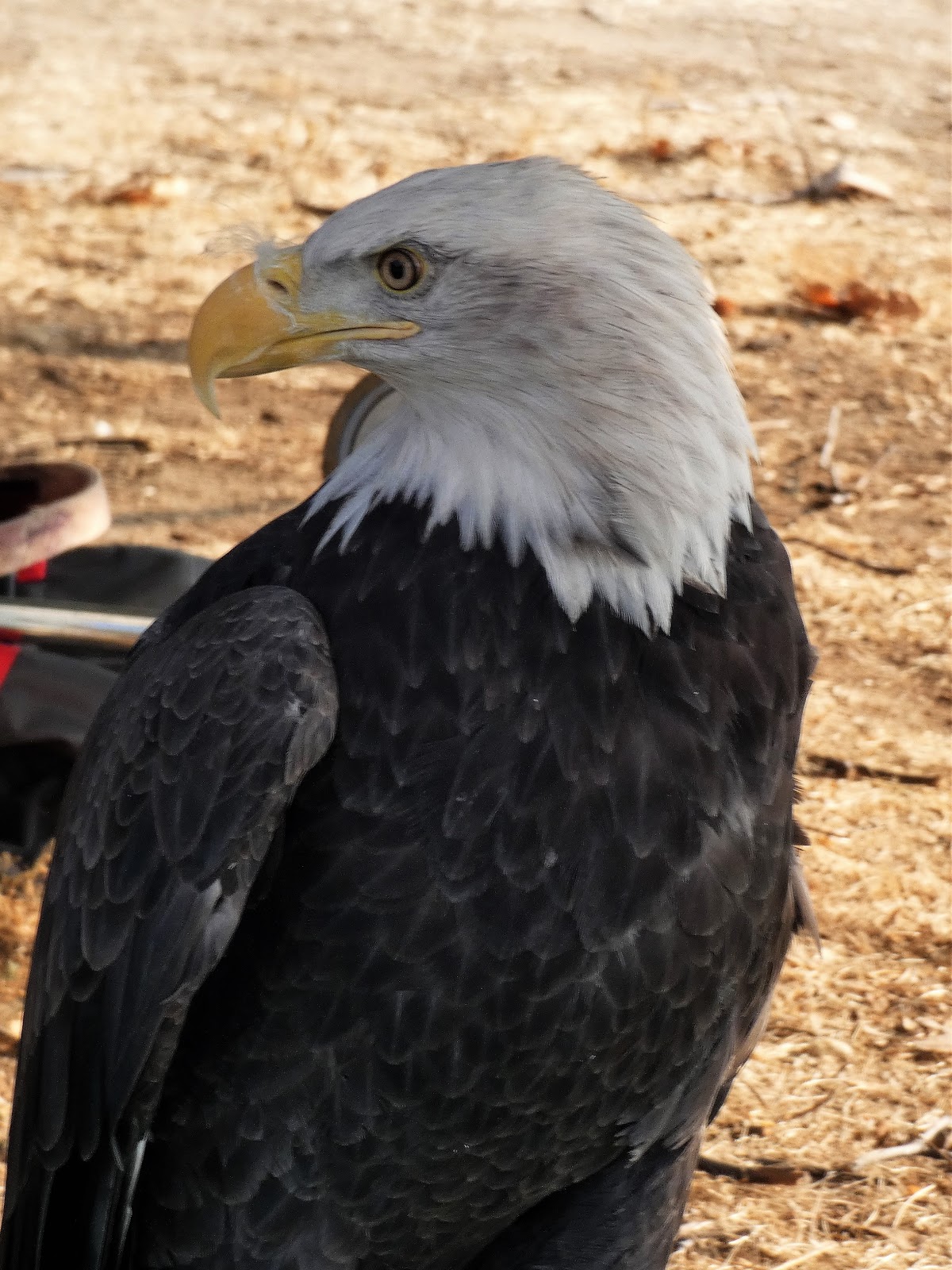
This might not be the right distance to meet a Bald Eagle (Haliaeetus leucocephalus). I grant you that. But my camera does have a pretty good zoom, but this is really close.
It's probably clear that we're not looking at a wild bird. Well, it's wild, but not in the wild. Unfortunately someone apparently shot its wing and the bird has been somewhat tamed and serves as a wildlife ambassador. We were at the Salmon Festival on Saturday at Knight's Ferry on the Stanislaus River.
Bald Eagles aren't at all common in our area but a few of them live here. I've seen them at Turlock Lake and near the Beckwith Platform in the San Joaquin River National Wildlife Refuge.
But never this close!
Here's a more normal distance for a shot of an eagle...

Friday, July 27, 2018

Bald Eagles at Cape Disappointment State Park in Washington


A unique viewpoint of a Bald Eagle at Cape Disappointment, WA. Photo by Mrs. Geotripper
We don't see Bald Eagles (Haliaeetus leucocephalus) all that often in the Central Valley. They're around, but usually over the wetlands and reservoirs where we spend less time. They are more abundant far to the north since, more or less by definition, there are more wetlands and coastlines. So we get inordinately excited when we get to see them.
We spent a couple of weeks in the Pacific Northwest, and saw them in a few places. We spent a night at Cape Disappointment State Park in Washington, and saw our first eagle in the pines along the shoreline of the Columbia close to the river's mouth.
The next morning we set forth in the unending search for coffee and food, and went out on the beach at Seaview, just a few miles up the coast from Cape Disappointment. There were a lot of large dark-colored birds gathered on the beach with this eagle just down the shoreline a bit. The birds turned out to be Turkey Vultures working on some kind of carrion, and the eagle had either finished with its share, or was waiting for a chance at the mess, but was outnumbered by vultures.
I've been reading how Bald Eagles are a major nuisance in parts of Alaska, especially Dutch Harbor where the fishing boats dock. Some people have even been injured when they have gotten between an eagle and some kind of food source. But here in the lower 48 states, they are less populous and more fun to observe.

Monday, March 12, 2018

The Last Days of Winter in the Great Valley (and a Bald Eagle)


We spent part of the weekend out at the coast, but coming home in Bay Area traffic was no fun. As we approached the Great Valley, we decided to get off the main highway and check out things at the Beckwith Road Viewing Platform, part of the San Joaquin River National Wildlife Refuge. At times during the winter season, tens of thousands of Aleutian Cackling Geese, White-fronted Geese, Snow Geese, and Ross's Geese will congregate in the fields around the platform. But winter is almost over and the huge flocks are beginning to disappear as they begin their northward migration.

We saw just a few dozen White-fronted Geese near the platform, and saw or heard little else. If the geese were there, they were well hidden. We spent some time enjoying the rabbits at the thicket around the platform and searched for Towhees and sparrows. We were finally ready to go, so we started driving slowly east along the northern boundary of the refuge.
Photo by Mrs. Geotripper

Then we heard a lot of goose noise, and stopped again to try and see why. It didn't take long to find out why...there was a Bald Eagle (Haliaeetus leucocephalus) lurking at the edge of the pasture. I don't know if they prey on the geese, but their agitation certainly made it seem so. It turned out that there were still a few hundred Snow Geese hiding out in the distant shrubs.
I've seen a number of Bald Eagles in the last few years, but most of them have been in the Pacific Northwest. They are resident in the local region, but not overly common. I've only seen one at this spot in the past, in 2015 (see the pictures here). A check of eBird indicates a sighting of two eagles in November of 2017, but no other reports since 2016.
Bald Eagles are big birds. Really big. Cows were strolling in front of the eagle, providing a sense of scale. Their wingspan can exceed six feet, which became apparent when it took off, again in front of the cow.
It was a great ending to our weekend!

Monday, January 8, 2018

Bald Eagles at the Sacramento National WIldlife Refuge

We've never had a disappointing trip to the Sacramento National Wildlife Refuge between Williams and Willows in California's Great Valley. We usually make it there during our trips north at Thanksgiving and Christmas, but we sometimes drop in during the summer if we are traveling that way.
There was a lot going on when we came through at the end of December. I literally was stepping out of the car at the visitor center parking lot when someone pointed out the Bald Eagle (Haliaeetus leucocephalus) sitting in the eucalyptus trees a few yards away. We saw four more of them along the six mile auto-tour route, two adults and two juveniles.
I know that folks farther north don't get quite as excited at seeing this interesting bird since they are more common up north, but I've only seen a couple of them in our region, so this is more of an event for me. I read interesting accounts of the hundreds of eagles that pester fisherman and residents of fishing villages in Alaska.
Still, these thieving lazy birds (by some accounts, including Benjamin Franklin) are interesting to watch. They do have that certain bearing...

Thursday, August 17, 2017

A Bald Eagle at the Rocky Creek Bridge in Oregon

It's probably no secret that I'm in Oregon this week attempting to see the total Solar eclipse. Time will tell if we manage to find a spot in the path of totality, but in the meantime we have having a great time visiting family and seeing the sights. Among them was a Bald Eagle (Haliaeetus leucocephalus), which we saw during a short stop at Rocky Creek Bridge near Depoe Bay.
The Eagle was first sighted flying across the small cove carrying a good-sized fish (and being harassed by a gull who was hoping for the eagle to loose its grip). Someone better versed in fish will have to determine the species.
The Eagle flew to a tree across the cove and alit in a fir. The Bald Eagle is relatively common in the Pacific Northwest, so folks up this way probably don't get all that excited to see them, but I've only seen them a few times down in California, so this was kind of exciting.

Rocky Creek Bridge was built in 1927, linking Otter Creek to Depoe Bay. It was bypassed by Highway 101 in 1955 and was closed for a time, but was later reopened to allow a scenic loop to follow along the sea cliffs below 101. The wave action in the small cove is hypnotic.