Showing posts with label Florence. Show all posts

Friday, November 24, 2023

Red-Breasted Sapsucker at the Dunes

I don't get many chances to see Red-breasted Sapsuckers (Sphyrapicus ruber). They live in our area, and I've seen them at Modesto Junior College, Cal State Stanislaus, and on my beloved Tuolumne River, but only a few times at each spot. We are on the road for Thanksgiving up in Oregon along the Pacific Coast, and we were taking a short walk today at Holman Vista near the beautiful town of Florence.
At first we didn't see a single bird, but once we reached the vista point itself and stopped moving, the birds started making themselves known, including a Wrentit, some Northern Flickers, a Spotted Towhee, and a juvenile Bald Eagle soaring high overhead. But it was the bright red head of the Sapsucker that really caught our attention. It was moving around a lot, but settled on a tree trunk for a moment, allowing me to get a couple of shots.

Sutton Creek, which flows below Holman Vista, is part of a deflation basin. Historically this area was a dune system, but the planting of a European dune grass sort of "overstabilized" the dunes. The grasses trapped sand right along the beach forming the higher ridge seen on the left. Beyond the beach however, wind blew away the sand, leaving behind a basin in which trees and shrubs could take root. Occasional ponds and streams provide water and food, so a large variety of birds and other animals moved in.


Wednesday, November 30, 2022

Those Tropical Kingbirds! A Fun Coincidence...

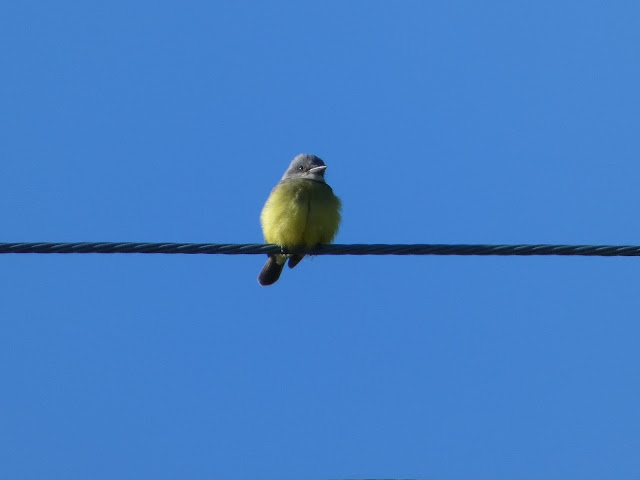
Tropical Kingbird, Florence Oregon, Nov. 2022
In October of 2020 during the height of the Covid epidemic, I was beginning the habit of walking the Tuolumne River Trail in Waterford every day for exercise and birdwatching. I saw many interesting birds, over 120 species that year, but on that day in October, the bird I saw was memorable, although I didn't know it in that moment. What I thought I saw was a Western Kingbird. It was a bird that should have been far away in Central America, being a long-range migrant. It was wildly out of season. So I took pictures to document it, and sent copies to some local birders. I was told immediately that it wasn't a Western Kingbird at all, but that it was instead a Tropical Kingbird (Tyrannus melancholicus), a bird I hadn't even heard of before, as it was a bird more native to Mexico and southern Texas. What's more, it was the first sighting of the species ever in Stanislaus County. So that was all very exciting at the time.

Jumping forward to the present day, I was up north in Oregon, in Florence for Thanksgiving. Although there was little time for intense birding, I kept my camera close by and while walking through Old Town Florence, I saw a bird on the wires above that seemed a bit out of place. It was more yellow than the species I was expecting to see. I snapped the picture above and realized it was a Kingbird. I checked for the tail markings that would have meant Western Kingbird, but they weren't there. Cassin's Kingbirds simply aren't found that far north, and it didn't have those tail markings either. I knew that despite their rarity, some Tropical Kingbirds were known to range pretty far north along the coast. So I checked the eBird records and found that one or two had been seen in the immediate vicinity over the last few weeks. I had found the second Tropical Kingbird I had ever seen!
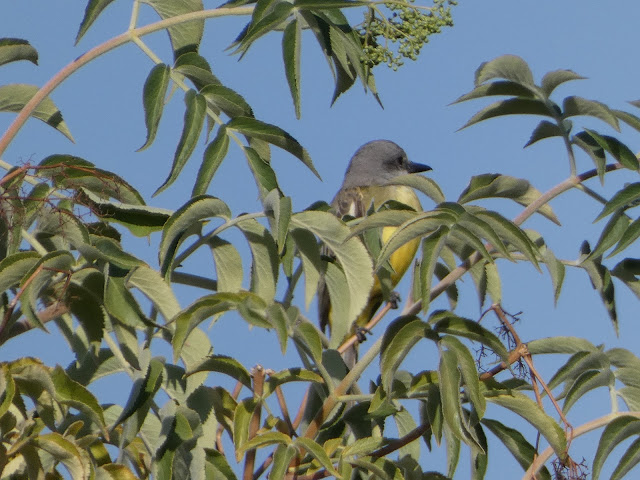
Tropical Kingbird at CSU Stanislaus, Nov. 2022
I got back to the motel and reported the bird and checked my email. Much to my surprise I found that a Tropical Kingbird had been sighted in Stanislaus County that very day! It was on the campus of CSU Stanislaus, where I teach a couple of courses. It was only the second sighting ever in the county, and it stayed in the area long enough for half a dozen birders to catch a view. Being six hundred miles away, I felt I had little chance of getting a look, but I headed down there today to teach my classes. Wouldn't you know, there it was right outside the Science Building. I got just one lousy shot before it flew off, but I got to see the rare visitor.

An interesting convergence of sightings...
 
The Tropical Kingbird from the Tuolumne River in 2020


Sunday, December 1, 2019

Red-Necked Grebe in the Siuslaw River Estuary at Florence, Oregon

Thanksgiving is not one of the times that I expect to see a great many birds. I'm usually traveling through the Cascades and Siskiyou Mountains in winter-like conditions, and this year was no exception. But then I arrive at my destination on the Oregon coast at Florence, and I have better luck. Florence lies along the estuary of the Siuslaw River. A lot of birds winter in the region where temperatures are more mild. The waters of the Pacific moderate the local conditions.
I saw some interesting birds over the holidays, but the last night I was watching the gulls and Buffleheads near the marina when I saw I different bird. I got pictures and realized I had come across a new bird for me, a Red-necked Grebe (Podiceps grisegena). It's a bird I have little chance of ever seeing back home. The last time anyone saw one in my county was in 2008.
Red-necked Grebes breed far to the north in the Arctic, but spend winters along the coast as far south as the LA/San Diego coast. They eat fish, amphibians, and invertebrates.

The Siuslaw River rises in the Coast Ranges of Oregon and flows 110 miles to the sea. The river is not particularly large, but it has a huge estuary that is influenced by the tides as far upstream as 26 miles. The lower river has miles of wetlands that provide critical habitat for birds and other wildlife. It is one of few Oregon rivers that is undammed, but logging has had a huge effect on the health of the river.

Sunday, December 30, 2018

Back From the Brink: Peregrine Falcon at the Sacramento National Wildlife Refuge

I saw a particular bird species for the first time on Thursday after hoping to see one of them for years. It was a Peregrine Falcon (Falco peregrinus), one of the iconic success stories of the environmental movement. The species was on the brink of extinction because of DDT contamination, but the banning of the pesticide allowed populations to slowly recover. Although they are no longer on the endangered species list, their total world population is only around 140,000 individuals. But for all my searching, I'd never seen one until last week when I visited family in Florence, Oregon for the holidays.

Now, I realize that Florence is not the location I mentioned in the title of the blog. That's the funny part. It was dusk and the bird was so distant that I only got a few fuzzy shots that were only good enough to identify the bird. The best shot, much photoshopped, is below.
Fast forward to Saturday. We were on the long drive home, but we can rarely resist the urge to see what's going on at the Sacramento National Wildlife Refuge in California's Great Valley near the town of Williams. There is a marvelous six-mile auto tour through the refuge. We were on the back half of the drive when I saw an unfamiliar bird up on of the trees. Very much to my surprise it was another Peregrine Falcon! And this time I got pictures!
It was a great trip through the refuge, but I was deeply bothered by one thing: no one was minding the shop. The visitor center and bathrooms were closed and there was no law enforcement anywhere. Technically people could have driven in and vandalized anything they wanted. They could even have shot birds There was in fact shooting going on in the distance, but I don't know if it was legal or not). It was the partial government shutdown of course. Trump has left our national parks, monuments and refuges unprotected because of his obsession with a useless wall. He has much to answer for.

Friday, July 13, 2018

Rufous Hummingbird in Florence, Oregon

We are on the road again (that's what geo-tripping is all about). We're along the Oregon coastline finding a way to stay cool, and have found ourselves in Florence. I was walking to the Harbor Vista County Park when a hummingbird caught my eye. Hummingbirds are generally a tropical species, so I tend to expect just one or two possible species this far north, primarily an Anna's. But this one had gold tones, so I realized right away I had spotted a Rufous Hummingbird (Selasphorus rufus).
The Rufous Hummingbird is a world-class migrant, traveling nearly 4,000 miles from southern Mexico to Canada and Alaska. I've seen them only a few times, once last spring on the Tuolumne River (definitely a migrant), once in Southern California (a winter shot), and now I can add a summer sighting in the Pacific Northwest.

Friday, December 30, 2016

Bald Eagle at the Sacramento National Wildlife Refuge (and one in Oregon)

Photo by Mrs. Geotripper
I spent the better part of two weeks in the Pacific Northwest visiting relatives for the holidays, and I knew we had a good chance to glimpse some Bald Eagles (Haliaeetus leucocephalus), seeing as they are more common up that way. We did in fact see a few, but few decent pictures emerged from my efforts. On the way home, we stopped, as we almost always do, at the Sacramento National Wildlife Refuge, and wouldn't you know there was a Bald Eagle hanging out on a small island right next to auto-tour road in the refuge. Mrs. Geotripper got the best shot (above).
The Sacramento Refuge has a very scenic backdrop for bird viewing, with the highest part of the California Coast Ranges to the west, Lassen Peak and other volcanoes to the north, and the Sutter Buttes to the southeast.
We mentioned our excitement about seeing eagles on our Facebook page, and found out that two of them were sitting in a tree next to the Oregon house that we had just left! It's too ironic. Anyway, I did actually see one of those eagles in Oregon, but it was high above, and I got just this fuzzy shot of it soaring over my head.

Saturday, November 26, 2016

Western Meadowlark on the Oregon Coast

I'm sure it's not unusual, but walking along the Siuslaw River estuary on the central Oregon coastline, I was expecting to see all manner of shorebirds, and the odd crow or maybe even a Bald Eagle that has been said to be lurking nearby. I wasn't really expecting to see a Western Meadowlark (Sturnella neglecta), but that was what I got pictures of this morning. Thinking back, it wasn't that strange, as the vegetated dunes that characterize this section of the Oregon coast are covered with grasses that make for excellent habitat for the Meadowlarks. In any case, it's always a delight to see one.