First off, it really sucks to be the snake in this little narrative. It was on the losing end of the battles that occur in the "circle of life". One eventually has to accept that everything in nature is ultimately trying to eat everything else in nature. Even the top predators are going to be consumed by scavengers eventually. We'll just hope that the reincarnation of the little snake has a better ending the next time around.
We were driving the Bear Creek Unit auto tour at the San Luis National Wildlife Refuge last weekend when we spotted a Great Blue Heron with something hanging from its beak. After a few moments we realized it was a small snake. As a last defensive measure it seems to have tied itself into a knot, but it didn't work. As we watched, the Heron gulped down the entire snake, knot and all.
Great Blue Herons are large birds and are thus one of the top predators in the freshwater marsh environment. They eat fish, amphibians, reptiles, and small mammals. They have their own problems with predators, however. We witnessed a dramatic confrontation between Bald Eagles and Great Blue Herons in Victoria, B.C. a few years ago. They can presumably be attacked by wolves or coyotes as well.
And thus, the "tail end" of the drama, but actually the head went last. It was a somewhat stunning act to witness.
Showing posts with label Great Blue Heron (Ardea herodias). Show all posts
Tuesday, February 26, 2019
Thursday, May 17, 2018
Great Blue Heron on Lake Washington
No close-ups of any birds tonight. This is just a very pretty moment on our last night in the Seattle area. We were walking along the shoreline of Lake Washington after sunset, looking for the beaver we saw the other day. Instead we had a peaceful view of a Great Blue Heron (Ardea herodias) fishing in the twilight.
The Great Blue Herons seem particularly common around the Puget Sound, which is no surprise given the widespread freshwater wetlands and saltwater habitats that they thrive on. They tend to range farther north than some of their relatives, especially the egrets. I watched them in an intense fight with a pair of Bald Eagles in Victoria on Vancouver Island a couple of years ago.
Wednesday, November 22, 2017
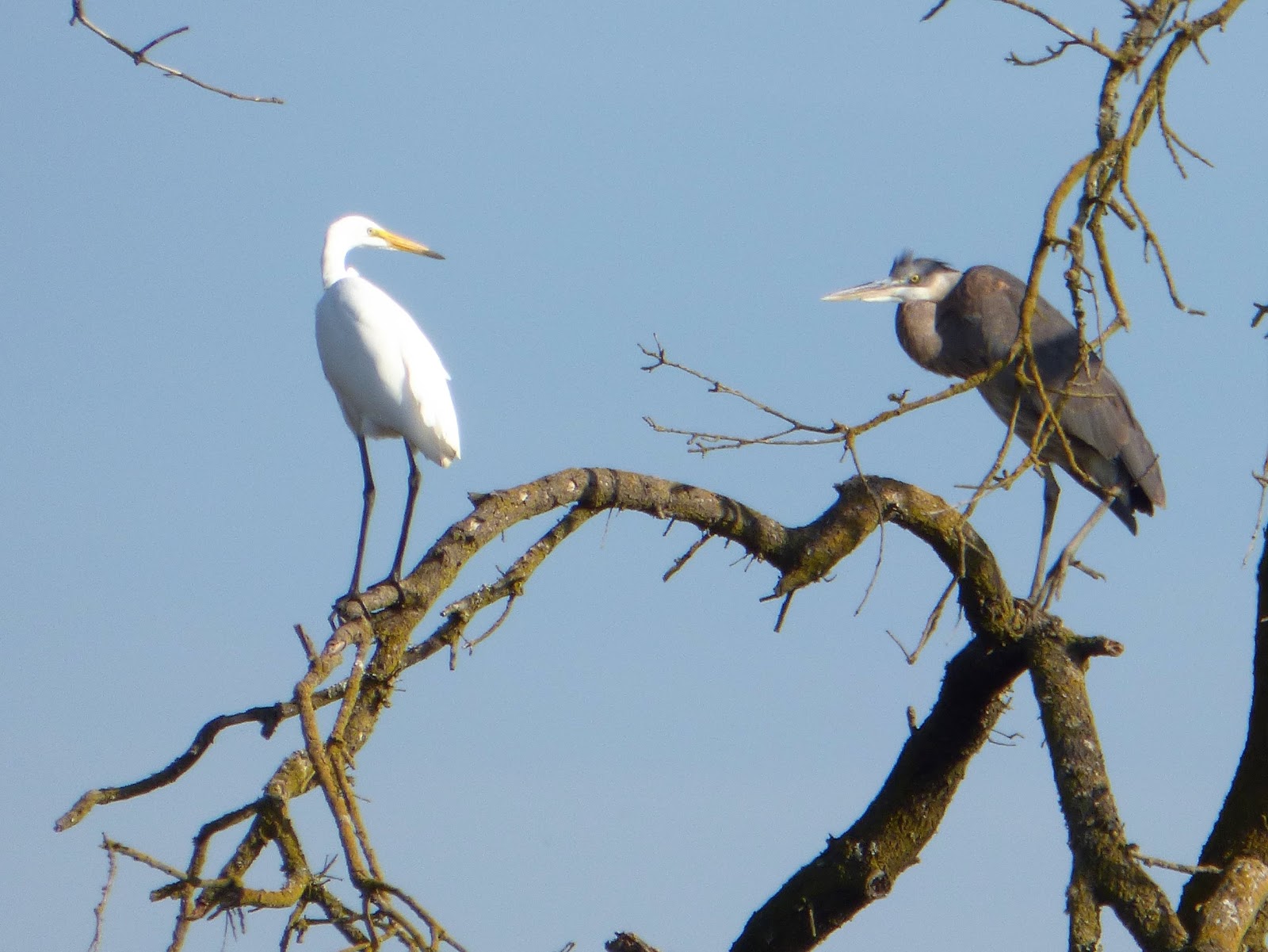
Showing the Way to a Peaceful Thanksgiving Feast: Great Egret and a Great Blue Heron Share a Space
I don't why this made me think of Thanksgiving, but I was walking out at the San Joaquin River National Wildlife Refuge this afternoon when I saw a Great Egret (Ardea alba) and a Great Blue Heron (Ardea herodias) sharing a branch on a tree by the slough. I saw two different, yet related species occupying close quarters, and doing so quite peaceably.
| Doesn't the heron in flight remind you of a dragon? |
In any case, I saw these two enjoying the afternoon sunshine together, and thought about how nice it can be when folks get along with others. I'm going to be doing a lot of driving in the next few days, so if I don't get the chance later, I hope that you have many things to be thankful for, and that your time in these next few days is precious and memorable, wherever and however you spend it.
Saturday, September 16, 2017
Some "Great" Birds at the San Luis National Wildlife Refuge: A Great Blue Heron, and a Great Egret
There's some anticipation in the air these days. The summer's heat is still lingering, although not so bad as before. Birds have been kind of scarce on my recent explorations, but I've been seeing a few
V-shaped formations high in the sky. The season is changing, and the winter migrants will be arriving soon. For no particular reason, we wandered down to the San Luis National Wildlife Refuge during the afternoon. No one promises much in the way of birdwatching at this time of year when the swamps and marshes are all dried up. But when we arrived, the feeling of anticipation was palpable. The water managers were just starting to flood some of the long-dry marshes. Few birds had yet discovered the water, but there were some.
I saw the Great Blue Heron (Ardea herodias) first, perched openly on the dead snag. It actually took me a moment to notice that one of the roots below was not a root, but was instead a Great Egret (Ardea alba) standing in the reeds.
The San Luis National Wildlife Refuge is one of our treasures, tens of thousands of wetland acres managed in such a way as to mimic the wilderness prairie that existed for thousands of years before the arrival of humans. Millions of birds flock to the Great Valley for the winter, and these refuges, representing a mere five percent of the original landscape, allow them to survive and even thrive. The refuges are understaffed and starved of funds, and they deserve better. If you are ever in the Great Valley during the late fall, winter, or spring, the San Luis Refuge is an incredible place to visit. There are three auto-tours, and a number of hiking trails are available. The visitor center is new, and is a great place to start your exploration.
V-shaped formations high in the sky. The season is changing, and the winter migrants will be arriving soon. For no particular reason, we wandered down to the San Luis National Wildlife Refuge during the afternoon. No one promises much in the way of birdwatching at this time of year when the swamps and marshes are all dried up. But when we arrived, the feeling of anticipation was palpable. The water managers were just starting to flood some of the long-dry marshes. Few birds had yet discovered the water, but there were some.
I saw the Great Blue Heron (Ardea herodias) first, perched openly on the dead snag. It actually took me a moment to notice that one of the roots below was not a root, but was instead a Great Egret (Ardea alba) standing in the reeds.
The San Luis National Wildlife Refuge is one of our treasures, tens of thousands of wetland acres managed in such a way as to mimic the wilderness prairie that existed for thousands of years before the arrival of humans. Millions of birds flock to the Great Valley for the winter, and these refuges, representing a mere five percent of the original landscape, allow them to survive and even thrive. The refuges are understaffed and starved of funds, and they deserve better. If you are ever in the Great Valley during the late fall, winter, or spring, the San Luis Refuge is an incredible place to visit. There are three auto-tours, and a number of hiking trails are available. The visitor center is new, and is a great place to start your exploration.
Tuesday, August 22, 2017
Great Blue Heron at Silver Lake, Washington
I haven't posted on Great Blue Herons (Ardea herodias) much of late, primarily because I haven't come across any. They are found around wetlands all over the west, and have shown up a fair amount on this blog, but the ones I've seen in my normal haunts have been kind of skittish and fly off before I can get any shots.
I've been all over the Pacific Northwest for the last week and a half, ostensibly to chase an eclipse (maybe you've heard about it somewhere), although the fact that we've visited various sets of parents, siblings, and a grandparent suggests other motives as well. In any case, we were on our way to the Seattle area, and decided to camp for a night at Seaquest State Park on the shore of Silver Lake. The lake came into existence around 4,000-5,000 years ago when a huge debris avalanche from Mt. St. Helens blocked a tributary to the Toutle River. The lake is about four miles long, but the western end is filled with water lilies and other pond vegetation, and thus is an excellent habitat for the herons. This particular individual was quite patiently feeding and hardly moved while I watched, so all the pictures had the same pose.
Silver Lake is a great setting for a quick look at Mt. St. Helens if you are traveling on Interstate 5. It's only five miles off the interstate, and there is an excellent interpretive center about St. Helens, and a the one mile long nature trail that we were following when I caught this picture.
I've been all over the Pacific Northwest for the last week and a half, ostensibly to chase an eclipse (maybe you've heard about it somewhere), although the fact that we've visited various sets of parents, siblings, and a grandparent suggests other motives as well. In any case, we were on our way to the Seattle area, and decided to camp for a night at Seaquest State Park on the shore of Silver Lake. The lake came into existence around 4,000-5,000 years ago when a huge debris avalanche from Mt. St. Helens blocked a tributary to the Toutle River. The lake is about four miles long, but the western end is filled with water lilies and other pond vegetation, and thus is an excellent habitat for the herons. This particular individual was quite patiently feeding and hardly moved while I watched, so all the pictures had the same pose.
Silver Lake is a great setting for a quick look at Mt. St. Helens if you are traveling on Interstate 5. It's only five miles off the interstate, and there is an excellent interpretive center about St. Helens, and a the one mile long nature trail that we were following when I caught this picture.
Friday, March 24, 2017
Great Blue Heron on the Colorado River in Grand Canyon
The Herons are such stately creatures, and it seemed extra special to see one in such a dramatic setting. We were a mile or two downstream from Vasey's Paradise, a spot where small waterfalls burst out of the canyon walls. We were in the Redwall Limestone, a layer that is riddled with caverns and fissures. When exposed along the river, the groundwater flowed freely at the surface
Sunday, November 27, 2016
Great Blue Heron at Ashland, Oregon
I guess I have to admit that I like Great Blue Herons (Ardea herodias), since they've been profiled here six times now. including a life-and-death struggle with Bald Eagles on Vancouver Island a year ago. We were taking a short break this afternoon at the roadside rest near Ashland, Oregon, when Mrs. Geotripper spotted a heron in the nearby field. I snapped a few pictures, as well as a video of the heron hunting. It's fascinating to watch how they hold themselves so steady as they walk forward. Although it didn't catch anything while I filmed, I can't doubt that some kind of amphibian or bug became a meal tonight. They seem very patient...
Friday, February 19, 2016
Great Blue Heron at the San Luis National Wildlife Refuge
Some birds are just plain majestic. We were at the San Luis National Wildlife Refuge a couple of weeks ago, and while we watched for beavers in the Salt Slough a Great Blue Heron (Ardea herodias) landed a few yards away.
The herons are a familiar sight in wetlands all across North America, but I never fail to be impressed by their grace and beauty. Except when they are chasing my goldfish in the backyard pond (which thankfully has only happened once).
The San Luis National Wildlife Refuge is part of a nationwide network of wetlands and other habitats that protect hundreds of species of birds and other animals. Their very existence is a recognition that we are stewards of the planet, and all creatures that live on it. That philosophy is under attack in some quarters, and the armed takeover of the Malheur Refuge in Oregon was a horrible and repugnant example of the mindset of a small minority. I wrote about this a short time ago at Geotripper: http://geotripper.blogspot.com/2016/02/these-lands-belong-to-all-of-us.html.
The herons are a familiar sight in wetlands all across North America, but I never fail to be impressed by their grace and beauty. Except when they are chasing my goldfish in the backyard pond (which thankfully has only happened once).
The San Luis National Wildlife Refuge is part of a nationwide network of wetlands and other habitats that protect hundreds of species of birds and other animals. Their very existence is a recognition that we are stewards of the planet, and all creatures that live on it. That philosophy is under attack in some quarters, and the armed takeover of the Malheur Refuge in Oregon was a horrible and repugnant example of the mindset of a small minority. I wrote about this a short time ago at Geotripper: http://geotripper.blogspot.com/2016/02/these-lands-belong-to-all-of-us.html.
Tuesday, November 10, 2015
Great Blue Heron on the Tuolumne River
I was privileged last weekend to participate in a canoe trip sponsored by the Tuolumne River Trust, a short expedition from La Grange to Old Basso Bridge. We traveled about three miles of the river in the lower foothills of the Sierra Nevada. The TRT is a marvelous organization dedicated to protecting the integrity of the Tuolumne watershed from the headwaters in Yosemite National Park to the mouth of the river in the Great Valley and San Francisco Bay.
I was a bit worried about dunking my camera in the "raging" river (the turbulence resulted more from me rocking the canoe than any rapids on the river). But I couldn't resist getting some pictures of the very handsome Great Blue Heron (Ardea herodias) that we saw patiently hunting fish in the shallows. They are very statuesque birds.
There will be a write-up on the paddling trip before long over at Geotripper. In the meantime, enjoy our very large blue bird!
I was a bit worried about dunking my camera in the "raging" river (the turbulence resulted more from me rocking the canoe than any rapids on the river). But I couldn't resist getting some pictures of the very handsome Great Blue Heron (Ardea herodias) that we saw patiently hunting fish in the shallows. They are very statuesque birds.
There will be a write-up on the paddling trip before long over at Geotripper. In the meantime, enjoy our very large blue bird!
Tuesday, July 14, 2015
Life and Death Drama at Beacon Hill Park, Victoria, BC
The evening started out peacefully enough. We were in Beacon Hill Park, one of the most beautiful in Victoria, out for an after-dinner walk at sunset. We were strolling through the small Japanese Park and pond, when a man pointed out a juvenile Great Blue Heron (Ardea herodias) which he said was just learning to fly. It was perched just a few feet over my head, and was staying perfectly still.
It was marvelous having a chance to see such a grand bird up so close, even if its plumage made it look slightly ridiculous.
I've watched herons plenty of times before, and never really heard them make much noise. I wouldn't yet know their call if I heard it (you can follow this link to hear their normal call: http://www.allaboutbirds.org/guide/Great_Blue_Heron/id).
I walked under a conifer along the pond and saw a familiar white coating that looked like snow but most certainly wasn't. There was a heron rookery overhead. About this time we heard an ungodly screeching up in the trees. I figured it was some kind of domestic dispute, or maybe juveniles calling for food, but there seemed to be an urgency, or even panic in the calls. I was starting to realize that something was off, but I couldn't see what was going on clearly high overhead.
I could see now that there were adult herons perched strategically all around the pond, as if acting like sentries. The man I had talked to before said that he thought they were looking out for the juvenile, that it might be having trouble getting back to its nest. That seemed reasonable, and Mrs. Geotripper and I walked on.
Then, Mrs. Geotripper saw them, flying into the pines on the east side of the pond. There were two Bald Eagles on the prowl, and they looked like they meant business. And that business didn't involve their usual diet of fish.
The drought that has affected California is far more widespread. The snows of winter were a fraction of normal in the Pacific Northwest, and the salmon runs this summer have been disastrously low. Some of the eagles are looking to other prey, and heron chicks have been part of their diet. They were raiding the heron rookery.
The drama hasn't been confined to this year, I later found. Eagles drove off the entire heron colony at Beacon Hill Park in 2007, and I haven't been able to find when they came back, but they were there, but clearly living with the constant threat of attack. What a stressful existence.
I know it's the circle of life and all that, but I was glad not to witness nature raw in tooth and claw this particular evening. The eagles were lurking, but the herons were harassing them, trying to drive them off. They weren't going to be surprised.
Postscript: Reading up on the Great Blue Herons of Vancouver Island, I found that they are a subspecies (Ardea herodias fannini), that live on the Pacific Coast from Alaska to the Olympic Peninsula in Washington. Information about the subspecies can be found by clicking here.
It was marvelous having a chance to see such a grand bird up so close, even if its plumage made it look slightly ridiculous.
I've watched herons plenty of times before, and never really heard them make much noise. I wouldn't yet know their call if I heard it (you can follow this link to hear their normal call: http://www.allaboutbirds.org/guide/Great_Blue_Heron/id).
I walked under a conifer along the pond and saw a familiar white coating that looked like snow but most certainly wasn't. There was a heron rookery overhead. About this time we heard an ungodly screeching up in the trees. I figured it was some kind of domestic dispute, or maybe juveniles calling for food, but there seemed to be an urgency, or even panic in the calls. I was starting to realize that something was off, but I couldn't see what was going on clearly high overhead.
I could see now that there were adult herons perched strategically all around the pond, as if acting like sentries. The man I had talked to before said that he thought they were looking out for the juvenile, that it might be having trouble getting back to its nest. That seemed reasonable, and Mrs. Geotripper and I walked on.
Then, Mrs. Geotripper saw them, flying into the pines on the east side of the pond. There were two Bald Eagles on the prowl, and they looked like they meant business. And that business didn't involve their usual diet of fish.
The drought that has affected California is far more widespread. The snows of winter were a fraction of normal in the Pacific Northwest, and the salmon runs this summer have been disastrously low. Some of the eagles are looking to other prey, and heron chicks have been part of their diet. They were raiding the heron rookery.
| Photo by Mrs. Geotripper |
I know it's the circle of life and all that, but I was glad not to witness nature raw in tooth and claw this particular evening. The eagles were lurking, but the herons were harassing them, trying to drive them off. They weren't going to be surprised.
| Two very different birds in one tree. |
Saturday, December 27, 2014
Bird of the...day? Week? Great Blue Heron on the Siuslaw River in Oregon
I've spent most of the last week on the road and mostly out of internet access, but I have been seeing a few nice birds along the way. This morning I was walking on the tidal flats at the mouth of the Siuslaw River in Florence, Oregon, and spied a beautiful Great Blue Heron (Ardea herodias) in the mud. It seemed supremely unconcerned with my presence, and never changed position or moved.
In this stretch the river mouth is wide and is influenced more by tidal changes than river flow. The mudflats are exposed twice a day, providing lots of food for the resident birds.
Saturday, November 22, 2014
Bird of the Day: Great Blue Heron at Burro Canyon in Arizona
I was on the road this weekend in the Lower Sonoran Desert northwest of Phoenix, Arizona, and we made a short stop at Burro Creek Campground just off the highway about 60 miles north of Wickenburg. The canyon containing Burro Creek has steep walls of volcanic basalt and conglomerate and a more or less permanent year-round stream, though it was barely flowing when we stopped in.
It was the middle of the day so we didn't expect to see much in the way of birds, with only a few photos of a Say's Phoebe to show for our trouble (it's like fishing, of course, the serenity and peace being the real point of our exploration whether we see birds or not).
Then I saw a huge bird flying down the canyon, and then it turned and started flying back towards us. I was able to get a few slightly grainy shots of the beautiful bird in flight, and then I could see where it landed in the distance. It was a Great Blue Heron (Ardea herodias).
Our previous shot of a Great Blue Heron was at pretty close range at the refuge near our home. This individual was a bit more wary of us, never coming close. However far, it's an amazing bird to see.
It was the middle of the day so we didn't expect to see much in the way of birds, with only a few photos of a Say's Phoebe to show for our trouble (it's like fishing, of course, the serenity and peace being the real point of our exploration whether we see birds or not).
Then I saw a huge bird flying down the canyon, and then it turned and started flying back towards us. I was able to get a few slightly grainy shots of the beautiful bird in flight, and then I could see where it landed in the distance. It was a Great Blue Heron (Ardea herodias).
![]() |
| Where's Waldo the Blue Heron? |
Saturday, October 25, 2014
Bird of the Day: Great Blue Heron at San Luis Wildlife Refuge
How can a bird look graceful and ungainly at the same time? Great Blue Herons (Ardea herodias) are beautiful birds, and I'm always delighted to see them when we are out and about. A few weeks back we traveled down to the San Luis National Wildlife Refuge near Los Banos in the Great Valley to see if there were any early migratory arrivals. We had a delightful time, but ironically we didn't see the Heron in the bird refuge. This one was hanging out in a plowed field just outside the refuge boundary.
They tend to be a little skittish when I'm around, but this one didn't seem too bothered by the head and camera hanging out of the car window. It waited patiently for us to take our pictures and continued watching for whatever was tasty in the field.
The herons are found all over North America, especially around wetlands. I've even seen them in my small backyard, but for an unwelcome reason. I looked out one day and saw one in our little fishpond. Before I realized what was going on, most of my goldfish had been consumed. There is a reason I fill the pond with 25 cent feeder goldfish instead of expensive Koi! Thankfully the fishapocalypse has only happened twice over the years.
One of their most amazing abilities is the flexibility of their necks. They can pretty much "coil" them up and strike like a snake, catching fish, frogs, gophers, and practically anything else in range.
We are looking forward to visiting the refuge again during the winter and spring seasons. It's a time when our "boring" valley is at its finest.
They tend to be a little skittish when I'm around, but this one didn't seem too bothered by the head and camera hanging out of the car window. It waited patiently for us to take our pictures and continued watching for whatever was tasty in the field.
The herons are found all over North America, especially around wetlands. I've even seen them in my small backyard, but for an unwelcome reason. I looked out one day and saw one in our little fishpond. Before I realized what was going on, most of my goldfish had been consumed. There is a reason I fill the pond with 25 cent feeder goldfish instead of expensive Koi! Thankfully the fishapocalypse has only happened twice over the years.
One of their most amazing abilities is the flexibility of their necks. They can pretty much "coil" them up and strike like a snake, catching fish, frogs, gophers, and practically anything else in range.
We are looking forward to visiting the refuge again during the winter and spring seasons. It's a time when our "boring" valley is at its finest.
Subscribe to:
Posts (Atom)