Showing posts with label Western Tanager (Piranga ludoviciana). Show all posts

Saturday, May 2, 2020

Another Tropical Migrant Arrives: Western Tanager on the Tuolumne Trail

These weeks of spring are when my personal favorite treasures arrive in the vicinity of the Tuolumne River Parkway Trail, and every walk is a little adventure when one of those treasures might be seen for the first time this year. This week the treasures included my first Western Tanager (Piranga ludoviciana). For all their fiery color, they can be hard to spot because they prefer to hang about in the top of the canopy of the oak trees lining the trail. This one was no exception. You can't really tell from the camera perspective, but this male was almost directly overhead, craning his neck to look down at me.
The Western Tanager winters in Central America and Mexico, and in summer migrates farther north than any other tanager species. Very few other tanager species are ever even seen in my part of California. There are a lot of them that I am looking forward to seeing one day: Summer Tanager, Hepatic Tanager, maybe even a Scarlet Tanager. I'll have to spend time in Southern California or Arizona to even have a chance.

Meanwhile, the Tuolumne River Parkway Trail has finally been "discovered". The pandemic has of course (with great justification) severely limited people's ability to travel, and recreation opportunities have been highly restricted. Day by day I've noticed more and more people along the trail to the point that the parking lot that I thought was laughably large is almost full on weekends. The nice thing about the trail is that there are four or five different spots where people can go off the main trail and go down to the riverbank and spread out. Most people have been decent about maintaining the physical distancing. The only discouraging part is the increase in trash and garbage (come on people, you carried it in, you can carry it out), and the couple of airheads who think the trail is a motorcycle track, and that the river is appropriate for motorboats and jet-skis. It's so jarring to have one of those mechanical monsters go flying by (and not to mention extremely dangerous; I'm surprised no one has been hurt yet).

Wednesday, July 31, 2019

Tanagers on the Tuolumne!

I'm trying to put together a few posts on the birds I saw while traveling in the Pacific Northwest, but I keep getting interrupted by beautiful birds more or less in my own backyard. I've been taking my customary walks early in the morning along the Tuolumne Parkway Trail, and there are plenty of pretty birds about, but not a lot of surprises this week. Well, except for this morning when I saw a Western Tanager (Piranga ludoviciana) in the oaks at the west end of the trail near the stairwell. I'm 90% sure I saw a female yesterday, but didn't get any pictures.

It's just a little bit unusual to see them on the valley floor at the height of summer. The tanagers tend to be a mountain species, and are more common in the forests of the Sierra Nevada at this time of year. They'll become more numerous next month as they start migrating south to Mexico for the winter. They are one of my favorite birds because, frankly, I'm attracted to bright coloration!

Sunday, April 28, 2019

The Latest Arriving Tropical Migrant on the Tuolumne Parkway Trail: A Western Tanager

The colors remind me of tinted calendar pictures and postcards from the 1930s that I recalled seeing at my grandmother's house long ago. Back then, it was the very difficult problem of producing color photos of any kind. Today, it's what happens when you use a photo app to try and eliminate dark shadows from a digital photograph. But in any case today's photos show the latest arrival on the Tuolumne River Parkway Trail from its winter home in the tropics: a Western Tanager (Piranga ludoviciana).

I admit I was feeling a tiny bit discouraged at the lack of any new migrants, since it had been a good two weeks since I had sighted some of the other "first of season" arrivals like the Bullock's and Hooded Orioles and the Ash-throated Flycatcher. I'm still watching out for Black-headed and Blue Grosbeaks, Lazuli Buntings, and a variety of flycatchers that should also be in the region by now. But today all those discouraging feeling were swept away. I had been walking for nearly two hours, and had seen a nice collection of different species, but I saw a flash of yellow in the upper parts of the last big oak tree along the trail. It took me several moments to locate it again, and I got a dozen really poor shots that would have served no purpose other than confirming my identification. Then I got a pair of half-decent shots aside from the dark shadows. After a moment it flew off, followed by another tanager! At that point I lost them.

If you are wondering about the original shots, here they are. You are welcome to judge which is actually better...


Tuesday, September 25, 2018

Some Migrants are About to Leave: Western Tanager on the Tuolumne River

One of the great joys of fall is watching for the new arrivals and migrants who pass through our region. I've seen some beautiful warblers and flycatchers on my recent walks. But there are the wistful goodbyes as well. The Rufous Hummingbirds will be moving on, as will the Buntings and Grosbeaks. The sad part is that we never know if a particular observation will be the last view of a particular species for a whole season. That was the case yesterday with my sighting of a Western Tanager (Piranga ludoviciana). Will it be the last one for awhile? I'm secretly hoping that by saying so I'll get an even better sighting tomorrow.

The tanagers will be returning soon to the tropics of Mexico and Central America, but I got at least one last view of this female (the males are much brighter with flaming red heads). The top picture is about as close as I've ever gotten to one of these beautiful birds. It actually came to me, landing on the branches hardly six feet away, long enough for a single sharp picture, and then it headed up into the oak canopy where I got a couple more fuzzier shots.

Saturday, May 26, 2018

Western Tanagers on the Tuolumne River, and My Confession of Ignorance

There was a time not that long ago when I thought birding wouldn't be interesting because there didn't seem to be all that many kinds of colorful birds like those in the tropics, or on islands like Hawai'i. This was pure ignorance on my part, and I freely admit it. I've seen the same phenomena in my area of expertise (such as it is) in geology: people who don't know any better think that practically all rocks are gray and uninteresting (note: they are not).
Once I started paying attention, I was astounded at how wrong I was. One of the most shocking examples that shook me out of my ignorance was the sighting of a Western Tanager on a trip up Clark Fork of the Stanislaus River in the Sierra Nevada north of Yosemite National Park. Those pictures from 2014 were part of the inspiration that led to the start-up of this blog.
The Western Tanagers migrate from Central America to the American West as far north as British Columbia and Alberta. They are more commonly found in conifer forests like the Sierra Nevada where I saw that memorable specimen in 2014. When seen in the valley, they are often just passing through. And so it was that I did not expect to see any along my stretch of the Tuolumne River.
But then to my surprise I saw one or two of them in 2016, and then again in 2017. I was not happy with any of the shots I got at the time. Then in late April of this year I got yet another single crappy picture, but I posted it anyway thinking it would be the only one I would see this year. I was wrong.
Because I have been taking almost daily walks along the Tuolumne River this month, I've started to pick out the patterns and habits of several resident tanagers. I don't see them every day, but as you can see, I've managed to get a fair collection of half-decent pictures.

Now, if I could just get a handle on the habits of those beautiful Grosbeaks and Orioles....

Friday, April 27, 2018

Seasonal Explosion of Orange and Yellow: Western Tanager on the Tuolumne River

I'm posting a fuzzy poorly composed picture of a Western Tanager (Piranga ludoviciana) for "Murphy's Law" reasons: if I put up a bad picture, it increases the chance of getting a good picture the next day because I don't tend to put up back-to-back posts of the same species. And I want a better picture! The Western Tanager is a very pretty bird, and I only rarely see them along my stretch of the Tuolumne River. This sighting a few days ago was the first of the season (it was one of the other orange and yellow explosions of that morning). I certainly hope to see a few more.

That's not to say that I haven't taken a nice picture of a Tanager. It was the picture below (along with a few others) that I took in 2014 up at Clark Fork in the Sierra Nevada that may have given me the impetus to jump into birding in a more serious way. Seeing such a brightly colored bird in an environment that I had always assumed was populated by drab species really captured my imagination and I started looking at bird species in a new light.

Tuesday, August 1, 2017

Bashful Western Tanager on the Tuolumne River

I know they are out there. I've seen them, fleeting glances as they flit among the treetops, studiously avoiding any opportunity to be captured on digital media. I'm talking about what is probably the most colorful bird found in our area (Wood Ducks notwithstanding): the Western Tanager (Piranga ludoviciana).  I had traveled all the way to Arizona and the Grand Canyon to catch sight of one a week or so ago, but then I was out walking along the Tuolumne River this morning, and saw that flash of color out the corner of my eye. It was feeding on elderberries on the slope covered by beavertail cacti.
I've seen them along the Tuolumne, but never got a good shot under decent light conditions. It could have been today, but the bird was feeling perfectly comfortable hiding behind the clump of elderberry leaves.

The tanagers will only be in the area for another month or so. Come winter, they will fly south into Mexico and Central America to spend the winter. Until then, I'll keep trying to capture an entire bird!

Thursday, July 20, 2017

Western Tanager and Tourons at the North Rim of Grand Canyon

Photo by Mrs. Geotripper
Being in a national park can cause people to do things they normally wouldn't in any other place. For example, if you ever have the privilege to explore Yellowstone National Park, you will encounter people who are fine drivers everywhere else. But if an elk or bison is seen at the side of the road (or Heaven forbid, a Wolf or Grizzly Bear), they will screech to a stop, disregarding all other traffic, and get out to take pictures. It doesn't matter if they are blocking traffic, others will get out to see what the commotion is about anyway. After awhile, a ranger has to come along and break up the traffic mess. No wonder they've secretly adopted the term "touron". But at least I never do that kind of thing...
Can you see what caused me to stop in the middle of the highway? Photo by Mrs. Geotripper

I was at the North Rim of Grand Canyon National Park these last few days, and there were thankfully no tourist traffic jams, the reason being that there were hardly any tourists (the North Rim gets only about 10% of the park's visitors; it's one of the great charms of that section of the park). And so it was that I was the one trying to start a traffic jam...and it wasn't for a wolf, or an elk, or a bison. No, it was for a bird. It happened to be the only bird that would have caused me to hit the brakes and stop in the middle of the highway: it was a Western Tanager (Piranga ludoviciana).
Photo by Mrs. Geotripper
There were actually two tanagers, a male and a female. It says something about the relative drabness of the female that neither me or Mrs. Geotripper caught a shot of the girl. We were under pressure though; we weren't stopping traffic, but we were on a blind curve. We grabbed our cameras and snapped as many shots as we couldn't in 45 seconds or so.

I was glad we got the pictures we did, but they can never add up to the tanager we saw back home in California on the Clark Fork of the Stanislaus River in the Sierra Nevada a few years ago. You can check out those pictures and a short video at this link: http://geotripper.blogspot.com/2014/05/up-close-and-personal-with-western.html

Wednesday, August 31, 2016

Yellow Warbler (and a Western Tanager) on the Tuolumne River

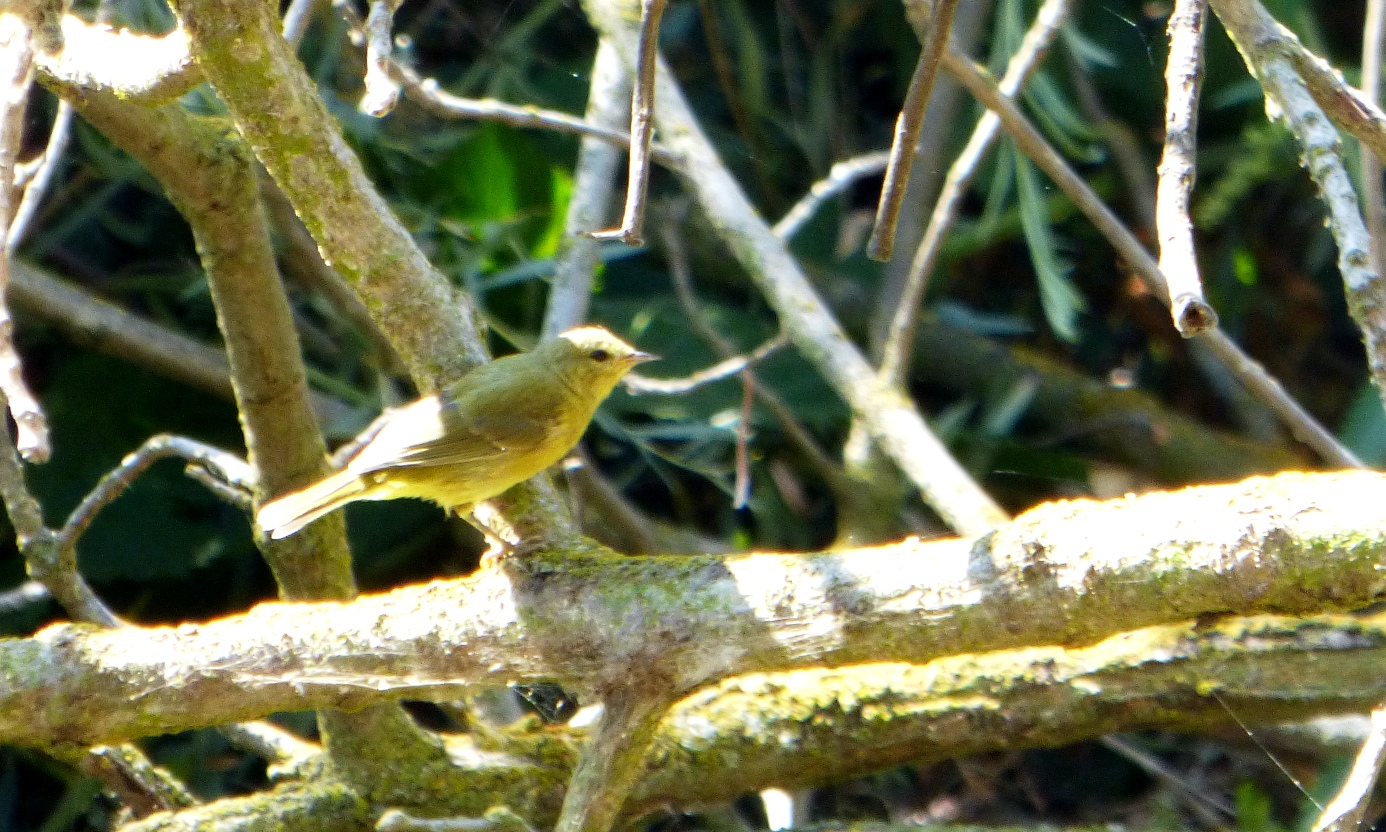
A couple of weeks ago I saw a Yellow Warbler (Setophaga petechia) for the first time, and posted a fuzzy picture. I said I'd work harder to get a less fuzzy photograph next time around, and that finally happened today. It's only one photograph, because the bird perched above me for only the most fleeting of moments, but that's what you get sometimes. I was on my normal walk on the Tuolumne Parkway Trail in Waterford.
The one I still need to work on is the Western Tanager (Piranga ludoviciana). In that same post a few weeks ago, I had a very poor shot of a Tanager along the same section of trail, and I saw one again about a week ago. Unfortunately it was almost completely silhouetted in the shadows, and I had to really work the contrast to bring out the colors of the bird (above). The image is sharper, but I'm still not happy yet. I guess I'll just have to keep walking...

Update 5/22/18: I'm pretty sure that's not a Yellow Warbler at the top, but I don't know exactly what it is: an Oriole? A female Tanager? Some help would be appreciated!

Friday, August 5, 2016

Yellow Warbler and Western Tanager on the Tuolumne River

The pictures aren't up to my personal standards for non-fuzziness, but I was able to add some new birds to my tally of species seen along the Tuolumne River where it flows into the Great Valley at Waterford. Neither of the birds are rare, but it's the first time I've seen them along the Tuolumne Parkway Trail. My personal count is up to 55 species, and I know there are many more to be found.

There was a specific snag where I've seen a number of birds over the last two years, but much to my surprise, the snag was gone this morning. I worked my way through the brush and found the tree fallen into the ravine. And there on the branches of the fallen tree was a Yellow Warbler (Setophaga petechia). Yellow Warblers are common and widespread, ranging from Northern Alaska and Canada to the tropics of Central and South America. So why haven't I seen any before? I've gotta get better at this!
I will never get pictures of a Western Tanager (Piranga ludoviciana) that can improve on those that I took in May of 2014 (below), but up to now I've not seen a tanager along the Parkway Trail. In a sense, I still haven't, because I snapped the picture above thinking it was something else. It wasn't until I was going over the shots that I realized this bird had an orange head. Just so you can see what these beautiful birds look like, here is one of the 2014 pictures:

Sunday, December 7, 2014

Bird of the Day: Western Tanager along Clark Fork in the Sierra

I have been photographing birds seriously for a year now, so I will be occasionally digging into the archives for some interesting shots. Since we've reached the gloomy days of early winter, I thought a splash of color might be just the thing for today. This post appeared in Geotripper last May:

Seasoned birders won't be surprised at the excitement a rank amateur like myself feels the first time he or she sees an interesting bird up close. Western Tanagers (Piranga ludoviciana) are relatively common forest and woodland birds across the western United States and Mexico and I'm sure they are seen often by the experts.  I've only been seriously seeking out new species for the last five months (*12 months now*), so I still get to experience the joy of seeing something new and different on a fairly regular basis as I add to the list of observed species.
I've known about Western Tanagers for a long time, but I've never been close enough with an adequate camera to actually get decent photographs of one, but that changed today (*last May*). We were exploring the upper reaches of the Stanislaus River in the Sierra Nevada of California, and as I was driving down the Clark Fork Road at the end of the day, I saw a flash of yellow out of the corner of my eye. I hit the brakes, hoping against hope that I wouldn't spook the brightly colored male.
He didn't spook. I snapped a few distant shots, and then backed up the car hoping to get closer (I know that sounds like an odd way to do it, but from only forty or so feet away, getting out of the car would have spooked it more, I think). He hung around, as if he was observing me (a large rival in his territory?).
The tanagers are a large and diverse group of passerine birds centered mostly in the American tropics, but the Western Tanager ranges farther north than any other species, as far southern Alaska. For being so brightly colored, they are not often seen, as they tend to hang out in the upper canopy of the forest. I felt privileged to spend a few minutes observing this one, from basically all angles. Was he sending me a message with this last shot?

Brightly colored birds often carry the seeds of their own destruction because their feathers may be in high demand for one reason or another. Looking at the tanager reminded me of the large number of species of Honeycreepers that once existed in the Hawaiian Islands. A few of them are still hanging in there (two out of the original 51 species), but most of the others are extinct or nearly so, in part because Hawaiian royalty centuries ago demanded robes made out of their brightly colored feathers (habitat loss, malaria, and competition with invasive species and predators were major factors as well). The tanagers, with their wide range across all the western states avoided such a fate, but they were for a time considered agricultural pests and were poisoned or shot. They are protected today, and their numbers have grown to where they are a "species of least concern".

It was a privilege to see one up close and personal today.

PS: Mrs. Geotripper took a short video of the same bird...