Showing posts with label Mother Lode. Show all posts

Sunday, April 15, 2018

Great Horned Owl Nestling in the Mother Lode Foothills


A few weeks back we were taking some back roads to Merced Falls to check on the Osprey nests. It was just a day or so after one of the intense thunderstorms that hit the region in March. The storm caused widespread flooding and several bridges were washed out (many haven't been repaired yet). We had to turn off our route because of one of the washouts, and passed what we thought was yet another hawk nest. But in the rear view mirror I saw the unmistakable profile of a Great Horned Owl (Bubo virginianus), and stopped to make sure.
Momma Owl flew off, but we had a look at the nestling. Today, we were driving the same road and noted that the young nestling was a fair bit bigger and a bit more curious about the goings-on in the world outside the nest. We didn't see momma today, but the baby is looking pretty healthy.


Tuesday, January 30, 2018

What? Another Burrowing Owl?

I don't usually post about the same bird on successive days, but it turns out that Mrs. Geotripper was not with me yesterday when I sallied forth and discovered a Burrowing Owl (Athene cunicularia) in the prairies east of my town in the Sierra Nevada Foothills. The odd thing is, I've seen Burrowing Owls only three times, and the three sightings were within a hundred yards of each other, even while years apart. Mrs. Geotripper wanted to get pictures of her own so we headed back out to Willms Road near Knights Ferry.
The funny thing is, we saw a fourth owl in a different spot, on Crabtree Road. So the spell is broken. I'll probably finally start seeing them everywhere now. If it illustrates how hard they can be to detect in their home environment, see if you can locate the owl in the first picture. It's there, honest! Mrs. Geotripper got the clearest close-up, seen below.

Sunday, January 28, 2018

Burrowing Owl on What Remains of the California Prairie

I don't know why this is...Burrowing Owls (Athene cunicularia) live all over North and South America, especially on grasslands of the western United States, but for all my searching I've only seen them three times, and those three times were within a hundred yards of the same spot. Go figure.
Can you see the owl in this picture?

It was a beautiful spring-like afternoon, despite being late January. We've had a little bit of rain, enough to bring on some grass growth, although it may fade early, as we are below 50% of normal precipitation and no storms are on the horizon. I decided to see what was happening at the Willm's Ranch stock pond, a prairie water hole that has provided some nice birding for us in the past.
I was on the road a mile or two south of the pond, where an ephemeral creek crosses the road. I first saw a Burrowing Owl there more than a decade ago. My pictures were limited by a 3x zoom on my primitive digital camera. The second sighting was much more recently, on April 2 of last year. My car startled the owl, which took off and landed a few hundred yards away in an alcove. I got a few less than perfect pictures, and put up a post anyway.

Today I spied the owl just a few dozen yards from the road, and it didn't move, much to my delight. I snapped lots of pictures this time around. Now to see if I can't locate a few elsewhere!


Sunday, January 7, 2018

A Rare Sight: Vermilion Flycatcher at Dawson Lake

We did something today we've never done before. News had spread of an extremely rare sighting of a bird in our county, only the fourth time it's been seen here, and the first time it was seen in a publicly accessible place. So we did it. We went looking for it as if we were actual birders. It was a Vermilion Flycatcher (Pyrocephalus rubinus).
Source: Cornell Lab of Ornithology
The Vermilion Flycatcher is more of a tropical species, and we lie north of their normal range. Obviously, a few individuals get "lost" and end up outside their usual habitat, as happened with this one. I note that a female flycatcher has been reported this month at the Merced National Wildlife Refuge. I imagine they are both feeling a bit lonely (the male has been hanging out with a Black Phoebe, a related species).
Mrs. Geotripper tried her hand at sharpening one of the shots
Our chances of actually seeing the bird weren't great. It was said to be patrolling a barbwire fence at the north end of Dawson Lake, but there are a great many such fences out there, and they weren't close to the highway (La Grange Road, just south of Highway 132). We lucked out though, because a birder was already parked there and he knew which fence to keep an eye on. It was a long ways off, far enough that I could not make out birds with the unaided eye. But after about fifteen minutes of scanning the slope with the camera set to highest zoom, I spied it. I snapped as many pictures as I could, but don't expect a whole lot of detail. But you can't miss a bird this colorful!
If you live in the area and want to have a look, drive east on Highway 132 to La Grange Road about 18 miles east of Waterford. Turn right (south) on La Grange and drive a mile or two until you see the Dawson Lake, a small irrigation reservoir, off to the right (west). Park at the bridge that crosses a corner of the upper lake. The fence is across the dry arm of the lake directly to the west (below). The bird patrols for bugs, going from fencepost to fencepost every 90 minutes or so, according to Rich, the birder we talked to. The lake property is privately owned, so don't jump the fence (bad form in any case to do that sort of thing).

Even if you don't see the flycatcher, don't be too disappointed. Dawson Lake is a local birding hotspot, and there are plenty of other birds to be seen. This afternoon we saw cormorants, mergansers, geese, Acorn Woodpeckers, egrets, and lots of small songbirds.

Wednesday, October 25, 2017

Horned Lark on the California Prairie (what's left of it, anyway)

Although I no doubt had seen them, I didn't recognize Horned Larks (Eremophila alpestris) until early last year during my travels through the remaining prairies of Central California. At a distance I mistook them for Meadowlarks. I was on a work errand in the Sierra Nevada foothills a few days ago, helping to select rocks (well, really giant boulders) that will become part of our Outdoor Education Laboratory next to our Science Center. I was near Knights Ferry and Willms Road, so I took ten minutes to check out the prairie off to the south. It didn't take long to find a few of the Horned Larks (and some Meadowlarks too).
The birds have declined in the last few decades, to only about 30% of their former population. There are probably plenty of factors, but humans are behind most of them. The biggest factor is probably loss of habitat as more and more prairie is plowed under in service to nut orchards (in our area at least), and the essentially unrestrained use of pesticides that has caused the insect population on our planet to plummet drastically (recent reports suggest that 70-80% of bugs have disappeared in recent decades). There's the cliché of the canary in the coal mine to describe the harbinger of things to come, but a new version would be the disappearing Larks of the prairie.

I've been kind of depressed lately that we really have arrived at the Silent Spring that Rachel Carson wrote about half a century ago.
In case you were wondering why they are called "horned" larks...

Saturday, April 2, 2016

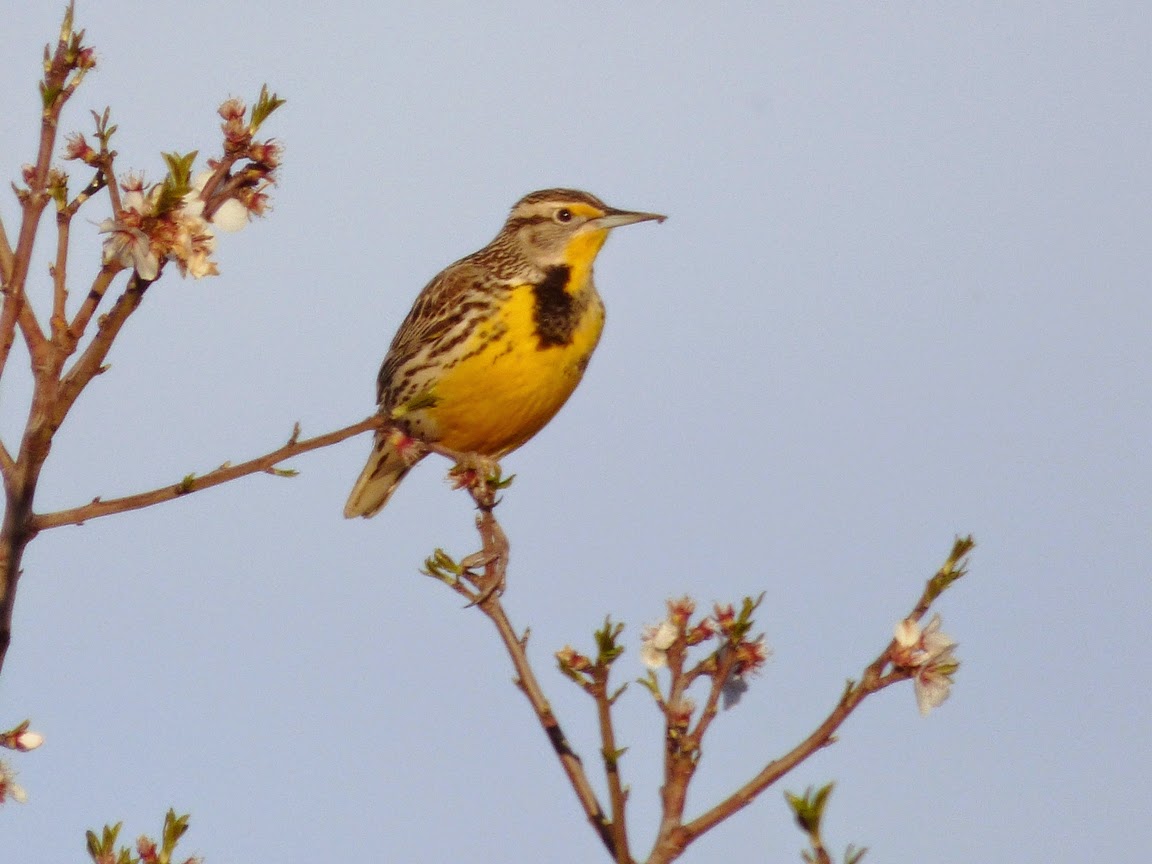
One of the Prettiest of Songs: A Western Meadowlark on Willms Road


Meadowlarks have one of the prettiest bird songs around. I grew up hearing them on my Grandparent's ranch when I was a child, so whenever I hear them these days, I briefly turn eight years old again, when an acre was a trackless wilderness in which all manner of adventures could be had.
We were on Willms Road, which travels south from Knights Ferry on the Stanislaus River in the foothills of the Sierra Nevada. Being spring, the Western Meadowlarks (Sturnella neglecta) are singing their hearts out, and one stayed on the fencepost long enough to be videoed, but my photos came out a bit fuzzy, so enjoy the two shots below from an earlier trip in the southern Mother Lode.
Besides their beautiful songs, the Meadowlarks are quite striking in their plumage as well.

Sunday, January 31, 2016

Mute Swans and Clearing Storm at Dawson Lake, Sierra Foothills

Another storm came through this morning, one of half a dozen this month that have dropped five inches of rain on the valley floor. That's not a complaint, not in the least. The drought remains, and every drop counts. We are actually ahead of normal rainfall and snowpack for the first time in five years.
The sun came out in the late afternoon, so we ran up the road to Dawson Lake near La Grange in the Sierra Nevada foothills. It was windy and cold as the last of the storm clouds drifted away, so not many birds were out and about. There were two Mute Swans (Cygnus olor, which translates to "swan - swan") on the lake.
Mute Swans are the birds of legend and myth in Europe and Asia, but they are not native to North America. They were brought here in the 1880s for the "enhancement" of ponds and gardens. Many escaped, and they have spread to various localities across the country. Because of their voracious appetites and aggressive nature, they have displaced native birds, including some rare and endangered species.
Just the same, there are just two of them at Dawson Lake, and they are graceful beautiful birds. They were a very nice complement to the rippling lake waters and setting sun. The storms are clearing out, for now.

Sunday, April 19, 2015

A Violet-Green Swallow near Table Mountain in the Sierra Nevada

I took a hike to the top of Table Mountain in the Sierra Nevada Mother Lode today. It wasn't a birding trip, but there were a few of them about, including some swallows that were moving very fast over the grassy meadows. One of them finally sat still long enough for a couple of pictures, and I was able to see the green coloring of the Violet-green Swallow (Tachycineta thalassina). I've seen them before in the Mono Lake area, but this was the first I've identified on this side of the mountain (due more to my lack of attention than any kind of rarity on their part). These birds, like their cousins the Tree Swallows, are residents of western North America, ranging from Central America and Mexico to northern Alaska, depending on the time of year. They prefer open woodlands, which is just where I found them.

Table Mountain is a unique geologic and biologic environment. You can read more about this strange place over at Geotripper (click here).

Monday, March 2, 2015

Western Meadowlark on the California Prairielands


One of the most beautiful of bird songs is that of the Western Meadowlark (Sturnella neglecta). I have seen few of them during the winter months, when they spend a lot of time on the ground looking for bugs. They'll sing, but they won't show themselves all that much.

As the spring season arrives they become more visible as the males perch on fence posts and treetops to advertise for love and companionship. We took a drive out into what I call the California prairielands, an increasingly precious region that is losing ground to rapidly expanding (but unsustainable) almond orchards. One might notice the irony that our singing individual is perched on a young almond tree. We were on Warnerville and Willms Road east of Oakdale, are part of the prairie that is particularly beautiful right now (look for some views in a soon to be posted Geotripper blog post).

The Meadowlarks are beautiful birds (aren't most of them?) that range all across the west and midwest of North American continent. There is an Eastern Meadowlark that is barely distinguishable in appearance, but differs in song and feeding style. It is the state bird of six different states: Kansas, Montana, Nebraska, North Dakota, Oregon, and Wyoming.

The Meadowlarks have powerful jaws and sometimes feed by using a method called "gaping" where they stick their long bills in the soil and open their beaks to access seeds and bugs. The Cornell Lab of Ornithology offers additional information about these fascinating birds.
Our bird stayed still long enough to catch a few seconds of singing. Enjoy!

Sunday, October 19, 2014

Bird of the Day: Western Bluebird at the Kennedy Tailings Wheels in Jackson, CA


By my own self-imposed rules, I'm trying not to repeat a species on my "Bird of the Day" posts until I've run out of new ones. I've decided I can make exceptions for vastly better pictures of a species, and also those of a different gender. Thus, since the pictures I posted a few days ago of a Western Bluebird were fuzzy and indistinct, and also males of the species, we are seeing Western Bluebirds today, the females. Like many bird species, they are less vividly colored than the males.
Is this one of the Angry Birds?

These Western Bluebirds (Sialia mexicana) were at the Kennedy Mine Tailings Wheels Park in Jackson up in the Sierra Nevada Mother Lode. We were on a geology field studies trip, but had a few moments of spare time as the students explored the full length of the park.

The bluebirds eat insects and sometimes berries, living for most of the year in the mid-elevations of the mountains, up to 5,000 feet or so. Some will move to lower elevations in the winter, and indeed they have been showing up in the pasture back home, and on our west campus.

The site, the Kennedy Tailings Wheels in Jackson, is part of the history of the Gold Rush in California. The Kennedy Mine was one of the largest of the Gold Rush, ultimately producing 1.7 million ounces of gold from around 150 miles of tunnels reaching a depth of nearly 6,000 feet beneath the surface. The mine produced a great deal of waste material, and when a mishap occurred that sent poisonous waste through town and into the water supply (hey, accidents happen you know), they were compelled to send their wastes elsewhere. The giant wheels were designed with buckets that lifted the material to a flume at a higher level, and eventually over two ridges to a newly constructed reservoir. What was once a barren hillside in a mining/industrial complex is today a quiet corner of mature oak trees and ponderosa pines, with a nice collection of birds to watch for.