Life is uncertain right now, and things are chaotic, but it is sometimes nice to know in the midst of sadness and troubles that the natural world continues, and beauty is still all around us. I've been trying to keep some balance by getting out on the Tuolumne River Trail (usually by myself of course), and today including a treat.
It's always a pleasant surprise the first time you see them. They will be here by the thousands in a week or two, but there are always those few leaders who arrive before the others. When you see one for the first time you might mistake it briefly for a mockingbird until you see the bright flash of yellow on their frontside. These are the Western Kingbirds (Tyrannus verticalis), and they've arrived on the Tuolumne River this week. I saw two of them this morning. It's a sure sign that spring has arrived (the first one seen in our county was literally on the day of the spring equinox).
The birds have been wintering in Mexico and Central America, but soon they will be all over the United States and southernmost Canada to breed during the summer.
Stay healthy all. Hiking and walking while maintaining physical distance is still allowed, and is safe if you avoid any crowds.
Showing posts with label Western Kingbird. Show all posts
Tuesday, March 24, 2020
Monday, January 13, 2020
The Birds of Del Puerto Canyon - A Place That Could Soon Be Damned
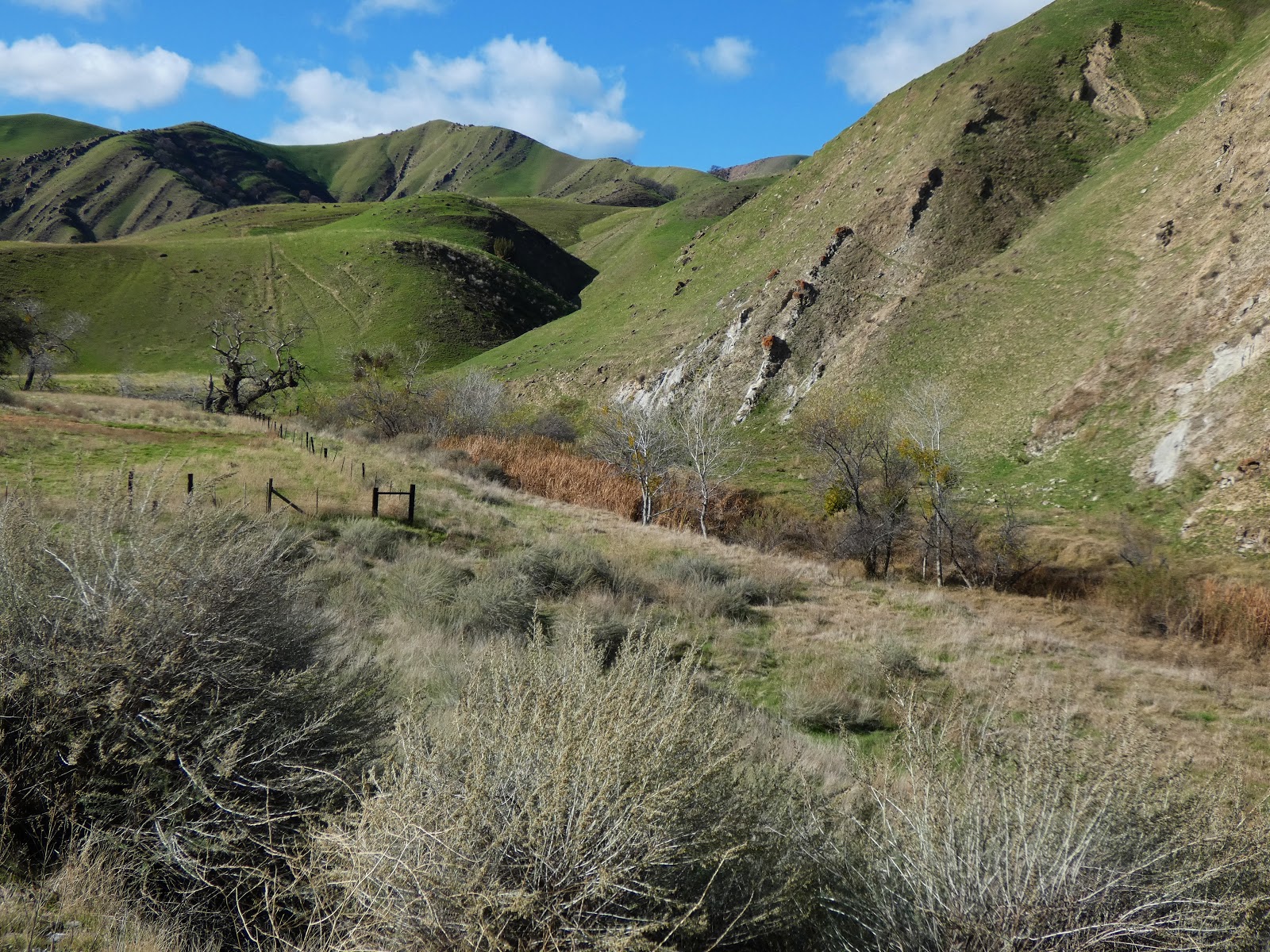
| This portion of the canyon would be inundated by the proposed reservoir. |
The Diablo Range is one of the principle "sub-ranges" of the California's Coast Ranges, running more than 100 miles from Highway 46 at Polonio Pass to the Sacramento-San Joaquin Delta. There are only a few major highways that cross the range, principally the Altamont Corridor and Pacheco Pass at San Luis Reservoir. There are a handful of state parks that preserve a portion of the range, mainly Henry Coe and Mt. Diablo, but for the most part the lands are privately owned and are given over mainly to grazing and ranching. Only one paved road provides access to the interior of the range north of Pacheco, and that is the winding route of Del Puerto Canyon.
| Loggerhead Shrike |
Del Puerto is the only public access to the mountain range in Stanislaus County, and as such is one of very few places where anyone can study the unique bird life (and many other animals) in this intriguing place. But now there are plans afoot to eliminate much of that access, and indeed to severely impact the natural environment. There are plans to build a large dam that will inundate five miles of the extraordinarily scenic canyon.
| Savannah Sparrow |
The canyon is one of the most important bird habitats in Stanislaus County, offering a significant variety of ecosystems, including riparian wetlands, grassland prairies, oak woodland, and a unique serpentine soil-based gray pine habitat. The eBird archives record more than 160 species of birds in the canyon
| Killdeer |
| Bullock's Oriole, a summer migrant in the canyon |
| Black-headed Grosbeak, another summer migrant |
| Western Tanager |
| Say's Phoebe in the lower canyon |
| Northern Harrier in the proposed dam site |
| Western Kingbird in the lower canyon |
There will be many reasons offered as to why this reservoir is SO necessary, and how there will be SO many benefits. But the question needs to be asked, what is this taking away from all of us?
If you are on Facebook, check out https://www.facebook.com/groups/463664377903706/
Read the Environmental Impact Report at this link. If Del Puerto Canyon has significance to you, please respond and be active in the opposition! If you have expertise in any of the areas that will affected, you need to be heard from.
There are several important meetings and deadlines coming up very soon:
1/15 3:30pm Protest. Corner of Ward and Sperry
1/15 4:00pm Public Meeting. Hammon Senior Center 1033 West Las Palmas, Patterson
1/21 6:30pm City Council Meeting. 1 Plaza Circle. - request they take a stand, voice concerns
1/27 5:00pm Public Comments DUE. ahansen@delpuertowd.org OR Anthea Hansen PO Box 1596 Patterson CA 95363
1/28 9:00am Board of Supervisors Meeting 1010 10th St Modesto CA - voice concerns, they have final decision
Wednesday, May 15, 2019
Hey, That's Avian Harassment! When the Little Guys Get to Win
Allow me a few moments to relate a story...
Those who've known me in my latter fatter days will have a hard time believing that I was once half the man I am today. I mean that literally; I was 6'2" and weighed 130 pounds. That meant that I was better adapted to competing on the cross-country team as opposed to, say, football. We did okay in those days, but the real winners among our high school teams were the water polo players. Big, heavy, but buoyant, those guys fought dirty underwater and made mincemeat of the other teams in the conference.
Somewhere along the way, someone suggested a tackle football game between the monstrous water polo players and the skinny, mostly short cross-country runners. To say we looked overmatched was an under(water)statement. But come the end of the season (when injuries wouldn't be as consequential) the game was on. If you consider that I was the main lineman and tackle, you can guess at the effectiveness of both defense and offense. It was going to be a bloodbath.
But it wasn't.
We were small, nimble, and fast. When they tried a run up the middle, we mostly got knocked over, but we got up and swarmed the ball carrier. They scored a few touchdowns. When we had the ball, we linemen got knocked over every time, but the quarterback could run fast, and so could the receivers. When the game was over, we prevailed. The little guys were victorious for once!
I remembered that game from so many years ago because of two pictures I took this week. They're grainy and out of focus, but they show hawks being harassed by much smaller birds. In the first picture, a Western Kingbird (Tyrannus verticalis) is chasing and attacking a Red-shouldered Hawk (Buteo lineatus) above the Tuolumne River Parkway Trail in Waterford. The other shows a Northern Mockingbird (Mimus polyglottos) attacking a Red-tailed Hawk (Buteo jamaicensus) on the campus of CSU Stanislaus. The action is called mobbing, and the smaller birds are defending their nests from predation, or protecting their territory. The small agile birds are generally not in a great deal of danger because of their speed and mobility, not unlike a bunch of small thin cross-country runners playing football against big heavy water polo players.
Those who've known me in my latter fatter days will have a hard time believing that I was once half the man I am today. I mean that literally; I was 6'2" and weighed 130 pounds. That meant that I was better adapted to competing on the cross-country team as opposed to, say, football. We did okay in those days, but the real winners among our high school teams were the water polo players. Big, heavy, but buoyant, those guys fought dirty underwater and made mincemeat of the other teams in the conference.
Somewhere along the way, someone suggested a tackle football game between the monstrous water polo players and the skinny, mostly short cross-country runners. To say we looked overmatched was an under(water)statement. But come the end of the season (when injuries wouldn't be as consequential) the game was on. If you consider that I was the main lineman and tackle, you can guess at the effectiveness of both defense and offense. It was going to be a bloodbath.
But it wasn't.
We were small, nimble, and fast. When they tried a run up the middle, we mostly got knocked over, but we got up and swarmed the ball carrier. They scored a few touchdowns. When we had the ball, we linemen got knocked over every time, but the quarterback could run fast, and so could the receivers. When the game was over, we prevailed. The little guys were victorious for once!
I remembered that game from so many years ago because of two pictures I took this week. They're grainy and out of focus, but they show hawks being harassed by much smaller birds. In the first picture, a Western Kingbird (Tyrannus verticalis) is chasing and attacking a Red-shouldered Hawk (Buteo lineatus) above the Tuolumne River Parkway Trail in Waterford. The other shows a Northern Mockingbird (Mimus polyglottos) attacking a Red-tailed Hawk (Buteo jamaicensus) on the campus of CSU Stanislaus. The action is called mobbing, and the smaller birds are defending their nests from predation, or protecting their territory. The small agile birds are generally not in a great deal of danger because of their speed and mobility, not unlike a bunch of small thin cross-country runners playing football against big heavy water polo players.
Tuesday, April 23, 2019
More Tropical Spring Migrants: Western Kingbird on the Tuolumne River
I've been enjoying the arrivals of the tropical migrants in our region after the long winter. The Hooded Orioles, the Bullock's Orioles, the Yellow-headed Blackbirds, and the Rufous Hummingbirds have all shown up in recent weeks in our region. I've also seen Ash-throated Flycatchers, but don't have good photographs yet. But one of the first was the Western Kingbird, a tyrant flycatcher (Tyrannus verticalis). I actually saw the first one a month ago on March 23rd, but there were so many distractions as one tropical yellow bird after another kept showing up.
It's a thrill to see one the first time, but as the spring carries on, more arrive, and they become one of the more abundant species on the California prairie. They winter in Mexico and Central America, and migrate widely across western North America.
Saturday, March 24, 2018
A Sure Sign of Spring! FOS Western Kingbird at the San Luis National Wildlife Refuge
I don't usually post bird blogs back-to-back, but I was working on the last one with the Spotted Towhees yesterday and didn't quite finish because we went birding today. It took just a few minutes to post the Towhee, and I wanted to get this one posted as well, since the spring equinox occurred just four days ago. One of the sure signs of impending spring around here is the arrival of the Western Kingbird (Tyrannus verticalis). Around here, melting snow is not an issue, and the grass has been green since the rains fell in January. So the Kingbirds are it. We were driving along the auto-tour at the San Luis National Wildlife Refuge, and we saw a lone bird perched on the fencing for the elk enclosure. It never turned around to give us a better view, but the yellow breast and black narrow bill pegged it as a Kingbird. I posted the sighting at eBird, and realized just how few have been seen so far. Note in the screen capture below that there are only eight sightings in the entire region (and pretty much none north of Sacramento).
Compare that sparse distribution with the total number of sightings for the whole year. There are a lot more Western Kingbird on their way north from the tropics!
PS: FOS - First-of-Season
![]() |
| Western Kingbird sightings in 2018 so far. |
PS: FOS - First-of-Season
Tuesday, July 11, 2017
Western Kingbird on the Tuolumne River
Western Kingbirds (Tyrannus verticalis) make quite a few appearances on my blog. I think it is because they are a migrant, and their appearance and disappearance coincides with the change of seasons (they spend winters in the tropics). There is nothing so special as a change of seasons in today's post, just what I thought was a pretty nice picture. I've been sticking to my commitment to walk nearly every day, and put in three miles along the Tuolumne River. In contrast to yesterday's cornucopia of interesting species, today I saw nothing of particular interest. Yesterday's Kingfishers, for instance, were nowhere to be seen, and neither were the Red Foxes. I got back up the stairwell at the parking area, and in fine OCD manner saw that I had taken 5,063 steps, and I could make it a nice even 5,280 (three miles) if I did a lap around the parking lot. So I did, and finally saw an interesting bird in one of the trees lining the parking area.
Tuesday, March 21, 2017
Western Kingbirds arriving in California: San Luis National Wildlife Refuge
One can tell when spring is coming around here in California's Great Valley. There's the greenery, of course, but (sorry, snowbound friends) it tends to be green most of the winter, the grass anyway. The real signs of spring are the comings and goings of the migratory birds. The geese and cranes are getting ready to start their long flights north to the Arctic while other birds, the tropical species, start moving in to spend the summer here.
One of the tropical birds is the Western Kingbird (Tyrannus verticalis). They spend the winter in southern Mexico and Central America, but spend the summers in western North America, with a few going as far as southern Canada.
Our excursion to the San Luis National Wildlife Refuge a week ago included several sightings of Kingbirds. The sun was on the wrong side for sharp pictures, but I was pleased with the backlit shot above of one taking off. I'm sure we'll have several more opportunities this summer!
One of the tropical birds is the Western Kingbird (Tyrannus verticalis). They spend the winter in southern Mexico and Central America, but spend the summers in western North America, with a few going as far as southern Canada.
Our excursion to the San Luis National Wildlife Refuge a week ago included several sightings of Kingbirds. The sun was on the wrong side for sharp pictures, but I was pleased with the backlit shot above of one taking off. I'm sure we'll have several more opportunities this summer!
Thursday, January 19, 2017
Cassin's Kingbird on the West Campus: Is Spring Early?
(Updated)There were a couple of surprises on our west campus today. I was out for the usual walk at lunchtime and was out in a remote corner of the campus near the drainage pond. There was a bird in the top of the tree that looked out of place, a bird with a certain amount of attitude. It had the yellow breast of the goldfinch, but was way too large, and the beak was wrong. I started to realize that even though spring has not yet arrived, the Western Kingbird (Tyrannus verticalis) has. Postscript: Or is it a Cassin's Kingbird (Tyrannus vociferans)? On reexamination I'm seeing the white tail tips, and lack of white outside tail feathers. Either way, I'm surprised to see one this month. Update: Stanislaus County birders tell me it is a Cassin's.
The Kingbirds are tropical species who only spend summers here in the far north, so I don't know how unusual this might be. Spring may be arriving earlier these days as the climate warms. I'll be watching to see if this one has buddies near by (they tend to be very territorial in the breeding season, though). If anyone can clear this up, I'd appreciate your comments!
Monday, March 28, 2016
The First Western Kingbird of the Season!
One of the first of our tropical migrants has arrived in our region (who knows when they really arrived, but this was the first I've seen). The Western Kingbird (Tyrannus verticalis) typically spends the winter in Central America, migrating north to breed across the western United States and even a bit into Canada.
I was walking the Tuolumne River Parkway Trail this afternoon, seeing few birds, but on the way back to my house, this Kingbird was posing on the fence in the pasture. Within a few weeks they should be present in large numbers. I'm already missing the Sandhill Cranes, who've headed north, but our tropical visitors go a long ways towards healing the sense of loss.
Tuesday, August 11, 2015
A Last Look at the Western Kingbirds on the Tuolumne River
Oh, it's nothing bad that's going to happen to the birds, it's just that in the next few weeks they will all disappear from the area and migrate to their winter homes in Mexico and Central America. The Western Kingbird (Tyrannus verticalis) is fairly abundant in our area from March to late August or September. They breed across the western States and into southern Canada.
These are spunky little birds. They don't hesitate to harass and chase away Kestrels and Red-tailed Hawks if they feel threatened. They are also one of the few species that recognize the eggs of parasitic Cowbirds in their nests. The two that I photographed today could care less that I was hanging out. They had other things to do.
I've seen the Kingbirds at all my normal haunts, the pasture, the Tuolumne Bluffs (the future park), my campus "mini-wilderness" and others. Today was a new spot, only because I've started walking there in the last week. It's the Tuolumne River Parkway, a new river trail that will eventually follow the Tuolumne from one end of my town to the other. It's right at the boundary between the Sierra Nevada foothills and the floor of the Great Valley. The trail is still under construction, but parts are already accessible. It's where I saw the Black-chinned Hummingbird the other day, and the Gray Fox.
I'm looking forward to the completion of the trail. It will make a nice 3 mile walking loop with a half mile through the riparian environment. I've seen quite a few birds in the area already.
These are spunky little birds. They don't hesitate to harass and chase away Kestrels and Red-tailed Hawks if they feel threatened. They are also one of the few species that recognize the eggs of parasitic Cowbirds in their nests. The two that I photographed today could care less that I was hanging out. They had other things to do.
I've seen the Kingbirds at all my normal haunts, the pasture, the Tuolumne Bluffs (the future park), my campus "mini-wilderness" and others. Today was a new spot, only because I've started walking there in the last week. It's the Tuolumne River Parkway, a new river trail that will eventually follow the Tuolumne from one end of my town to the other. It's right at the boundary between the Sierra Nevada foothills and the floor of the Great Valley. The trail is still under construction, but parts are already accessible. It's where I saw the Black-chinned Hummingbird the other day, and the Gray Fox.
I'm looking forward to the completion of the trail. It will make a nice 3 mile walking loop with a half mile through the riparian environment. I've seen quite a few birds in the area already.
Saturday, May 2, 2015
A Doomed Romance in One Act, and Red-winged Blackbirds at the Willms Road Pond
Well, the romance was over quickly. One display of those bright red shoulder epaulets from the Red-winged Black Bird (Agelaius phoeniceus), and the Western Kingbird (Tyrannus verticalis) was completely unimpressed. Off to greener pastures for both of them.
We were on our short excursion on Willms Road near Knights Ferry in the Sierra Nevada foothills when we stopped at our favorite little stock pond out on the California prairie. There are usually some interesting birds hanging out, including the Kingbird in the above drama. We almost always see a crowd of Red-winged Blackbirds in the tules and rushes.
The Red-winged Blackbirds are hard to photograph. It's not so difficult to get the bright flash of the red shoulder epaulettes, but unless the light is just right the black body is featureless. I got lucky with a couple of shots this time, with the sunlight reflecting off the feathers of the breast and head of this individual.
The Blackbirds have a melodic song that is sometimes a high-pitched whistle. The males seem to always be busy trying to catch the attention of the ladies. I guess it is the equivalent of catcalls from construction workers in New York...
The stock pond on Willms Road (two or three miles south of Knights Ferry on Highway 108/120) is our local barometer for the severity of the drought. Most years in late April or May, the hills here are still green, but not so much this year. Compare how it looked in March. The pond has water, but perhaps not as much as it should (it's sometimes hard to judge, as the outlet has suffered some erosion damage so it may not be possible to completely fill the pond anymore). It's one of our favorite spots for a few minutes of serenity that's not all that far from home.
We were on our short excursion on Willms Road near Knights Ferry in the Sierra Nevada foothills when we stopped at our favorite little stock pond out on the California prairie. There are usually some interesting birds hanging out, including the Kingbird in the above drama. We almost always see a crowd of Red-winged Blackbirds in the tules and rushes.
The Red-winged Blackbirds are hard to photograph. It's not so difficult to get the bright flash of the red shoulder epaulettes, but unless the light is just right the black body is featureless. I got lucky with a couple of shots this time, with the sunlight reflecting off the feathers of the breast and head of this individual.
The Blackbirds have a melodic song that is sometimes a high-pitched whistle. The males seem to always be busy trying to catch the attention of the ladies. I guess it is the equivalent of catcalls from construction workers in New York...
The stock pond on Willms Road (two or three miles south of Knights Ferry on Highway 108/120) is our local barometer for the severity of the drought. Most years in late April or May, the hills here are still green, but not so much this year. Compare how it looked in March. The pond has water, but perhaps not as much as it should (it's sometimes hard to judge, as the outlet has suffered some erosion damage so it may not be possible to completely fill the pond anymore). It's one of our favorite spots for a few minutes of serenity that's not all that far from home.
Saturday, March 28, 2015
Western Kingbird on the bluffs above the Tuolumne River
I wandered out to the future river park in Waterford today, and saw my first Western Kingbird of the season. They spend their winters in Central America and migrate north to breed across the western United States. I saw quite a few of them last year, so I've been watching for their return.
The Kingbirds are in the flycatcher family, and like to spend time in open fields with high perches. They'll dive down to capture bugs on the fly. They are very territorial during the breeding season, sometimes chasing away much larger birds like Kestrels and Hawks.
From its appearance here, it looked like it was about to chase me off! Or yawning...
The Kingbirds are in the flycatcher family, and like to spend time in open fields with high perches. They'll dive down to capture bugs on the fly. They are very territorial during the breeding season, sometimes chasing away much larger birds like Kestrels and Hawks.
From its appearance here, it looked like it was about to chase me off! Or yawning...
Subscribe to:
Posts (Atom)


%2Bat%2Bthe%2Bfuture%2Briver%2Bpark.jpg)