Showing posts with label Ross's Goose. Show all posts

Saturday, February 5, 2022

Winter Days at the National Wildlife Refuges of the Great Valley, and Remembering What Once Was

Cross-posted from Geotripper (it's about California birds after all)  What's the largest number of birds you've ever seen from one spot?

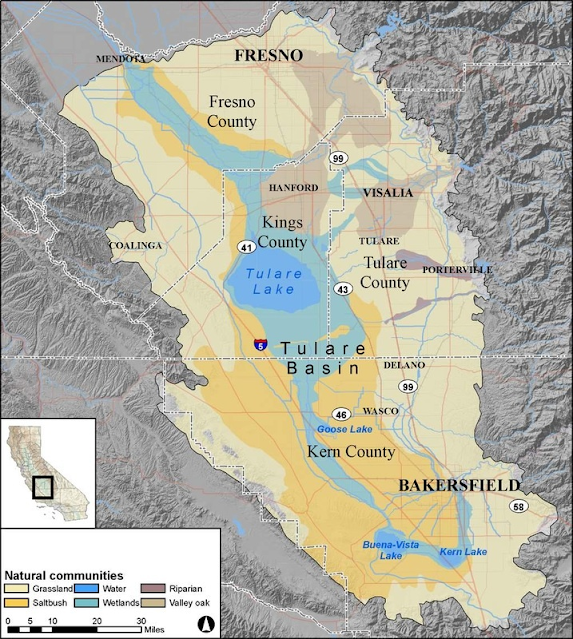
The Great Valley of California is a great place to see a lot of birds in one place. In pre-colonist days, the 400-mile-long valley was a prairie that was watered by a series of rivers flowing from the adjacent Sierra Nevada. There was enough water that even in historical time there were two immense lakes between Bakersfield and Fresno, Tulare Lake and Buena Vista Lake. Before water diversions for irrigation caused it to dry up, Tulare Lake was the largest freshwater lake west of the Mississippi.
Source: Quora
The mild winter climate of California led to the adoption of the wetlands and marshes of the Great Valley as the favored seasonal home of millions upon millions of waterfowl and other migratory birds of the arctic and far north. I can hardly begin to imagine what a wintertime journey through the pre-European Great Valley must have been like.
The ecological role of grazer in the refuges is occupied by a handful of deer and lots of sheep and cows to make up for the now-extinct megafauna

But historical accounts and paleontology can provide us some idea. In addition to birds, the vast prairies supported huge herds of tule elk, deer, antelope, and even bison. Prior to 12,000 years ago, the plant-consuming animals included giant ground sloths, mammoths, mastodons, horses, and camels. The birds and grazing animals were the prey of an imposing array of predators including the recently departed California Grizzly Bear, black bears, wolves, mountain lions, coyotes, and foxes. The pre-12,000-year crew included saber-toothed cats, dire wolves (bigger than wolves of today), American Lions, jaguars, and the immense Short-faced Bear, an animal that would have made a Grizzly think twice about a confrontation. The reason for the almost simultaneous extinctions of the species of the so-called 'mega-fauna' is a subject of contention among geologists, paleontologists and anthropologists (the role of humans has not been ruled out).
This cuddly little Short-faced Bear can be seen at the Fossil Discovery Center near Madera
I was thinking about this as we made our customary winter journeys to the local national wildlife refuges in and around Modesto and Merced. The main units open to visitation include the Merced, the San Luis (including the separate Bear Creek Unit), and the San Joaquin River National Wildlife Refuges. Although the boundaries of these refuges tend to be very square or rectangular and they are crisscrossed by maintenance roads, they are the only places that come close to recreating the primeval landscape that once existed.
The national wildlife refuge system grew out of a number of motives, some noble, others not so much. When wetlands of the valley were drained and planted with crops, millions of birds found their ancestral winter homes gone. With nowhere else to go, many of the geese and others began to forage on the tilled fields to the distress of the farmers. Instead of massacring untold numbers of birds, a series of refuges were established up and down the valley to provide a haven and food for at least some of the migrants. Of course, the refuges were also designed to preserve populations of the birds so they could be shot. Much of the refuge funding comes from the sales of hunting permits.

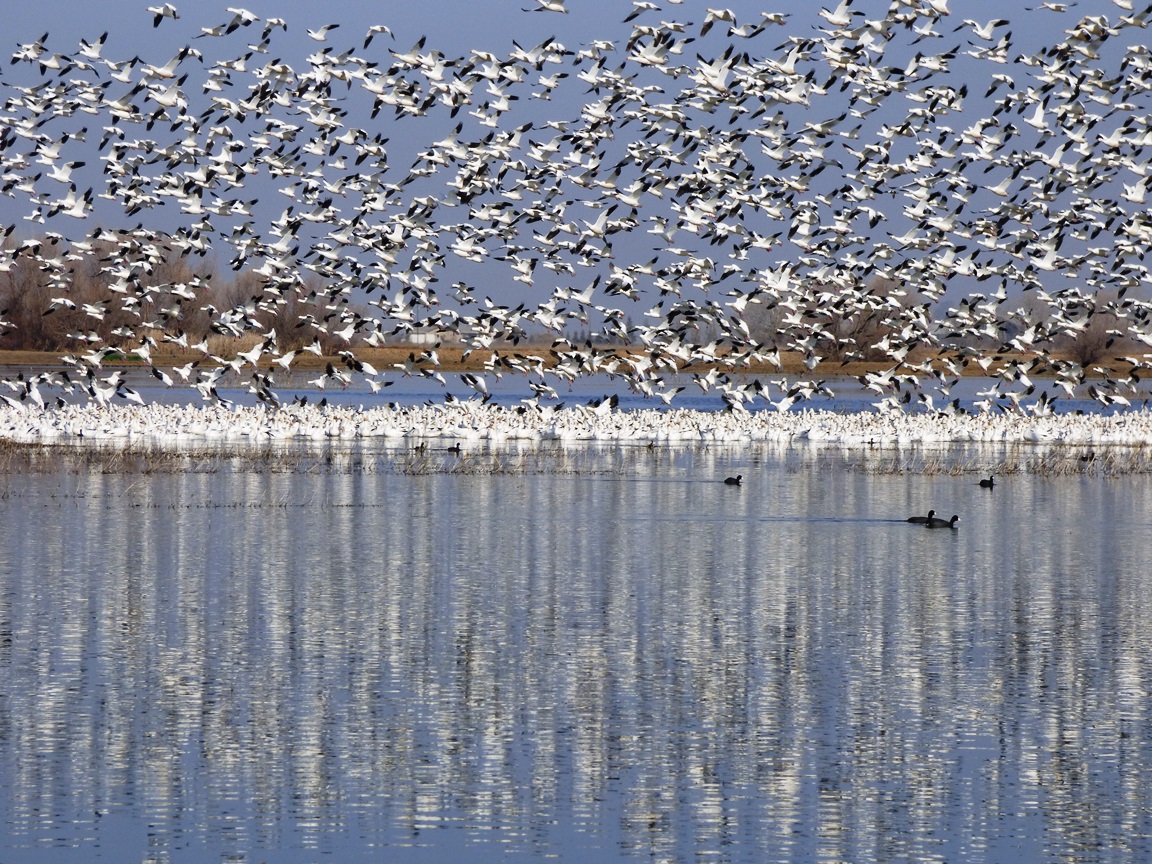
Snow Geese at the San Luis National Wildlife Refuge

So that is where are today. The refuges provide forage for millions of migratory cranes, geese, swans and ducks (in many they grow fields of corn for the singular purpose of feeding the birds). The birds are too crowded, and diseases can spread if the flocks are not managed properly, but it is a better situation than having no refuges at all. Some species, especially the Aleutian Cackling Goose, have been brought back from the brink of extinction (once down to just 300 or so birds, the population is more than 100,000; they mostly shelter at the San Joaquin NWR just west of Modesto). And yearly, more and more abandoned farmlands are being converted to the original riparian habitat to allow for population growth. 

I don't do video often, but the one at the top seemed necessary because I was looking at what I believed was the largest single grouping of birds I've ever seen (and I've been exploring these refuges for 7-8 years now). It required about a 180-degree pan. On the other hand, there is nothing in the world quite like watching thousands of geese taking flight all at once. When we were at the San Luis NWR last week, the serene view was of several thousand Snow Geese and Tundra Swans. It's not really a good thing for the birds to be scared into the air, as it uses precious energy, and they could get hurt. But a helicopter flew overhead at a low elevation, and it spooked the geese (the swans seemed like they could care less) and several thousand took flight. I caught the flight on video, and you can clearly hear the helicopter. I took a picture of the craft thinking to report it, but it turned out to be medi-flight out on an emergency call.  

The number of birds and the variety of birds at the local refuges is truly astounding. We saw 50 species at the San Luis Refuge last week and 46 at the Merced Refuge yesterday. The really good birders will report 60-65 in a single trip. And the birds are beautiful. Here are some that caught my eye this last week.
This Great Egret was at the San Luis NWR. Both refuges offer "auto-tours" where visitors stay in their cars (kind of like those African savannah tours, but there aren't any lions trying to eat you). The cars serve as blinds, startling birds far less than humans bumbling around.
We were looking for swans and saw large white birds off in the distance. They turned out to be American White Pelicans. They may be the most ungainly-looking birds on the ground but are positively graceful in flight. And they are huge.
The blue bill of the Ruddy Duck is rather distinctive.
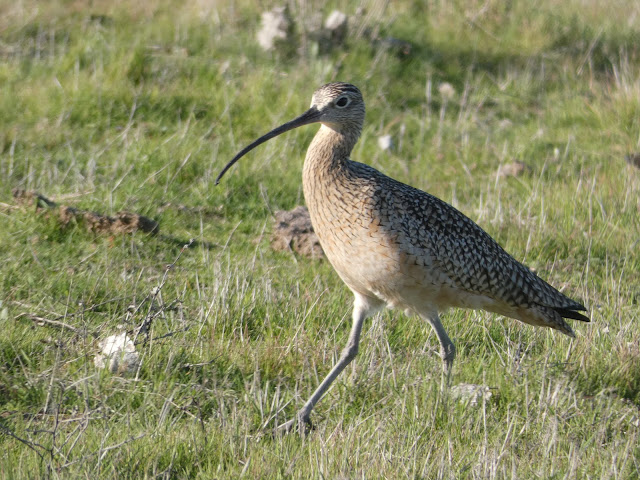
The prize for wildest beak goes to the Long-billed Curlew. I guess they can reach bugs and worms in the mud and soil that other birds can only dream of.
The Greater White-fronted Goose may be one of the more unfamiliar goose species around the valley. I've seen only a few in urban settings. Like the others, they are long-range migrants.
One of the special treats for the last two or three years has been a female Vermilion Flycatcher that decided to spend winters at the Merced NWR. This is the extreme north end of their range, and only a few are ever seen on a yearly basis in Stanislaus or Merced counties. Global warming may be allowing them to expand northward, and it may be only a matter of time before the scattered males and females find each other and start making little flycatchers.
This is an American Avocet, another bird that has a crazy bill that is good for probing deep in the mud.
There are a goodly number of raptor species that live in the refuges. One of the most beautiful is the White-tailed Kite. We thought we were done with photo opportunities when we reached the open grasslands at the end of the auto-tour at Merced, but this kite was perched on the sole tree eyeing the ground squirrels (and they were eyeing it).
The last bird of the day was the biggest surprise of all because it was the first time I had seen it in several years. It's a Black-bellied Plover, and it's not all that rare. It's just that I don't always know to look for it or recognize it when I see it. And it doesn't have a black belly. The males grow it when breeding season comes along.
Sunset at the Merced NWR
We here in the Great Valley sometimes forget that it is indeed a great valley, and that there are treasures that lie just beyond the boundaries of our cities. The auto-tours at Merced and San Luis provide opportunities for all, but those who want to walk will find a number of nice level trails. I especially recommend the Pelican Trail at the San Joaquin River National Wildlife Refuge. It passes through a series of diverse habitats and offers the greatest diversity of birds outside of the Modesto Water Treatment Plant (seriously, sewage ponds attract a lot of birds!). Check it out sometime, or any of the others up and down the valley.
Thursday, March 8, 2018

Ross's Geese at the Merced National Wildlife Refuge: Preparing for a long journey north...


They are still there by the thousands, but not for very much longer. The Ross's Goose (Anser rossii) spends winters at a few select refuges in California's Great Valley, but when spring arrives, they will migrate thousands of miles north to the Arctic. Their favored breeding grounds are on Baffin Island, the shoreline of Hudson Bay, and the shore of the Arctic Sea.

The Ross's Goose is smaller than most goose species but they are very similar in appearance to the Snow Goose. Both are completely white except for the black wing tips, but the beak of the Ross's is pink. The Snow Goose beak is pink on top, but with a black outline around the "lips". It doesn't help that they like to gather together with Snow Geese in huge flocks.

We got these pictures at one of our favorite places in the Great Valley, the Merced National Wildlife Refuge. There were hundreds of them visible from the autotour route, but there may have been several thousand hidden in the interior of the refuge. But not for very much longer. Like the Sandhill Cranes, they are getting restless, and ready to fly to their summer homes.

The

Saturday, January 13, 2018

A River of Ross's Geese at the Merced National Wildlife Refuge

Many years ago (1997) there was a record flood on the Walker River in the eastern Sierra Nevada. I knew folks who lived in the path of the raging waters, so I was there in the aftermath helping to clean up. The river had picked for itself a new channel on the valley floor, and the Army Corps of Engineers considered this to be an affront to their management, so they decided to put the river back. I was there when the big bulldozer made the cut that restored the river and I was mesmerized as the water first trickled and then fully flowed back into its old channel.

I realize that this is a strange opening for a blog post about birds, but I was reminded of that river rebirth the other day when we were at the Merced National Wildlife Refuge. It was the end of the day, the sun already set, and we were at the last part of the auto-tour. We hadn't seen a great many geese except at a great distance. Usually we love to see the dramatic sight of thousands of geese taking flight all at once, but it's not really good for the geese, since the flights use a lot of energy and food sources can be limited in winter.
So the sight that met us in the dusk was much calmer. Thousands of what I think were Ross's Geese (Snow Geese are very similar in appearance and they sometimes comingle) were gathered into a single flock on the pasture. The Ross's Geese (Chen rossii) looked like a lake of geese, and then like a new river, a string of geese broke away and started "flowing". The line of geese even meandered across the plain like an undulating river. I caught a bit of the flow in a short video below.
Ross's Geese are a true North American species.. They breed in a few isolated parts of the Canadian Arctic tundra, including the shores of Hudson Bay, and they winter in the Great Valley and in a strip across Mexico, New Mexico and the Texas coast. Their migration routes allow occasional sightings across the United States.
The Merced National Wildlife Refuge and its five mile auto tour route is one of the best places to see a huge variety of migratory and resident species of birds and other animals. It's on Sandy Mush Road south of the town of Merced, and admission is free. There are three hiking trails and restrooms are available.

Thursday, December 24, 2015

Some Geese and Swans for Christmas Day

I was trying to think which birds are appropriate for Christmas day wishes, and I couldn't get much farther than "The Twelve Days of Christmas", with partridges, turtle doves, french hens, calling birds (colly birds), and of course, the six geese a-laying and seven swans a-swimming. There are some who think that all twelve gifts are birds out of Celtic legends. I'm in no position to analyze the veracity of the claim, though.
Out of the long list I was able to pick out the geese and swans, since they've arrived in our area for their winter sojourn in our local wildlife refuges. The first two pictures are Ross's Geese (Chen rossii), the smaller of the two white geese. All of them were hanging out at the Merced National Wildlife Refuge a week ago.
The larger Snow Goose (Chen caerulescens) has a longer beak with a black lip. The geese often flock together in huge numbers. There is nothing quite like seeing tens of thousands take flight all at once.
We will sometimes see Tundra Swans (Cygnus columbianus) at the local refuges as well.
Merry Christmas and a wonderful holiday season all around. May you find blessings as numerous as the birds who fill the skies! And here's hoping for a wonderful new year as well! Thanks for reading!

Wednesday, March 18, 2015

White-faced Ibis Flock at San Luis National Wildlife Refuge (and some geese too)


I took a short break at work this afternoon to see if anything was up at the Beckwith Road viewpoint for the San Joaquin National Wildlife Refuge. They have been plowing the refuge field where the corn feed was planted last fall, so I wasn't expecting to see many birds, especially since we are getting on into March. The Sandhill Cranes seem to be gone already, and the geese won't be waiting around much longer. Still, there are plenty of year-round resident birds, and I've learned that surprises can happen any time.

For instance, I stopped a few blocks short of the viewpoint because I saw a lot of birds at a different corner of the refuge and some of them were unfamiliar. I found a spot to park and walked to the fence and realized it was a large flock of White-faced Ibises (Plegadis chihi). I've seen ibises before, but mostly as individuals or in small groups. There were perhaps a hundred or more, heads mostly down feeding.
There were also several hundred geese visible in the distance. There were at least three species, the Greater White-fronted, Ross's, and maybe some Cackling Geese. It seems some of them still want to hang around.

I got frustrated trying to catch snapshots of the ibises (they kept their heads down while feeding), so I tried a short video instead. Enjoy!

Sunday, February 8, 2015

Bird of the Day: I Don't Know, But Don't Really Care Anyway

So here are two birds. I couldn't identify them, although I suspect they are geese, based on the way they were flying. They are probably of the Canada sort, although thousands of Snow Geese, Ross's Geese, and Greater White-fronted Geese are wintering in the San Joaquin National Wildlife Refuge, which is only about eight miles away as the goose flies.
 Of course, I was actually taking a picture of the rainbow this afternoon after a real gully-washer roared through town, the first rainstorm of any sort in six weeks. The drought is not over yet.
The setting was hardly idyllic. We were in a Walmart parking lot in town, but we had literally four minutes to do what we could with photography before it faded.  There was no running out to a pasture or bird refuge this time, although I would have loved being out at the Beckwith Road viewing platform at a time like this!
The photo below might be a first for me, a nearly complete rainbow. My new camera has a pretty wide field of view. Enjoy

Monday, February 2, 2015

Bird of the Day: Snow Geese at the Merced National Wildlife Refuge

I have to admit I haven't been following football much this year. I think there was some kind of big game today, seeing as how I detected a sense of despair and sadness emanating from the spirits of my Seattle region relatives. I took advantage of the afternoon by heading out to the Merced National Wildife Refuge to visit the overwintering birds.
There were birds of all kinds (look for lots of them in coming posts!), but the Snow Geese (Chen caerulescens) were just stunning. There are tens of thousands of them spending the winter months at the refuge.
The geese will be leaving to their breeding grounds in the far north in just a few weeks. In the meantime, they are foraging on the refuge wetlands and in surrounding agricultural fields to fatten up for the flight.
They roost in huge flocks, and there is nothing quite like the sound when they all take flight at once. They didn't do it while we were there today (and it's not really good for them if it is a false alarm; it uses unnecessary energy). To get an idea, check out these videos I posted earlier: https://www.youtube.com/watch?v=0fHPoNMnCJw or https://www.youtube.com/watch?v=PTPMSrxHtvU.
It was a beautiful day on the refuge after a month of fog and gloom. We hope to be back soon!


Friday, December 19, 2014

Bird of the Day: Geese. Lots and Lots of Geese at the San Joaquin National Wildlife Refuge


You drive west of town, through the seemingly endless agricultural fields. The road gets more corrupted and full of potholes, and soon there is a sign saying "no outlet". Another mile brings you to a small dirt parking lot with a kiosk and a wooden viewing platform. You climb the short path to the top of the viewing area, and there it is: a field! The field seems empty except for a constant noise in the distance, and you finally realize that the sky is in motion, like white glitter, like a gigantic snow globe.
This is the Beckwith Road access point of the San Joaquin National Wildlife Refuge just west of Modesto, only about eight miles from the Vintage Faire Shopping Mall. The contrast between the parking lots crowded with shoppers and this empty field could hardly be bigger.
The Great Valley of central California was once the destination of millions, maybe billions of migrating geese, ducks, and other birds. Snow rarely falls on the valley floor and the temperature rarely reaches below freezing. Once the rains begin, the grass will grow all through the winter, providing a basic food chain with seeds, bugs, fish, amphibians and other creatures that feed the multitudes of birds when food is scarce elsewhere. The valley was a haven.
The value of the valley was apparent to humans. For thousands of years, people have lived in the valley alongside the birds and other animals, and drew sustenance from them. But in the last century and a half, the humans have changed the landscape, drying up the wetlands, and breaking up the prairie soils in favor of crops. Eventually only about 5% of the original landscape remained, and the birds no longer had many safe places to wait out the winter.

Over the decades, there were those who came to recognize the value of the birds, and eventually a series of wildlife refuges were established that allowed the health of the bird populations to be a priority. A visit to these refuges at the right time of year is a stunning introduction to the way the Great Valley used to be. There are birds here. Tens of thousands of Snow Geese, Ross's Geese, Aleutian Cackling Geese, and many others. In the evening, they start to settle in large groups, but occasionally something will startle them, a predator perhaps, and tens of thousands of birds will take to the air simultaneously. The sound of their wings is almost like a jet engine.
I still am in awe that I lived here for twenty years before I realized the treasure in my backyard. It is a wondrous experience to watch these huge beautiful birds flying so chaotically and yet with perfect timing and direction. Eventually they come drifting back to the ground, but the cackling never seems to stop.
How many birds are in this one picture alone? The flock we were watching was estimated at 30,000 individuals.

YouTube compression does awful things to my videos, but the short example below gives some hint to what it is like to see these birds in motion.