We were out at the Merced National Wildlife Refuge today and Mrs. Geotripper kept saying there was something...out there...
I kept insisting that it was just a couple of ground squirrels out in the grass, but she was sure that something was...watching us. I ended up focusing on what I was sure was an extra fat ground squirrel and found out that indeed something was watching us. It was a Burrowing Owl (Athene cunicularia). The east part of the auto tour at the Merced NWR traverses prairie and grassland. Other birders have often reported seeing Burrowing Owls there, so I've always been watching for them, but without success. This was a nice moment, not unlike the moment a few weeks ago when we were treated to a Burrowing Owl at Turlock Lake.
The Burrowing Owls have had a tough time of it, as their habitat has been seriously co-opted by human beings. The grasslands of California, especially in the Central Valley, have been largely taken over by agriculture. I'm truly ashamed to note that my own county has seen the conversion of around 40,000 acres of former prairie to almond tree orchards in just ten years or so. They will probably be abandoned with a decade or so because of water and irrigation conflicts. The string of national wildlife refuges in the valley provide critical prairie areas where the owls can thrive.
There are few things more eerie than an owl rotating its head to stare at you. Check it out in the video below...
I was on my way to collect some very big rocks today in the Mother Lode foothills when I passed by a familiar bird on a fencepost. It was a beautiful Horned Lark (Eremophila alpestris) and unlike all the other birds today it didn't fly off as I drove by. So I got a couple of shots to share with you!
The big rocks, by the way, were VERY big rocks, several tons each, to be deployed at our Great Valley Outdoor Nature Lab at Modesto Junior College. The lab will be a microcosm of the Great Valley natural environment. Maybe one day some Horned Larks will be lured into visiting our campus...
A few weeks ago I was in Yosemite Valley and saw a Red-breasted Sapsucker, and was properly thrilled to get a couple of half-decent shots. Since I've only seen them in the mountains, I wasn't thinking about them as I walked this afternoon on the campus of CSU Stanislaus. It's an urban campus of course, but there are two "sort-of" natural areas, a pond called Willow Lake that is heavily grown with cattails and tule reeds on one side. The other is the Trans-California Pathway, a kind of reconstruction of the native vegetation from the Sierra foothills to the valley. I was walking through the oak grove at the west end of the pathway thinking how I had not seen any woodpeckers in a long while.
And then I saw one!
I assumed it was the 'usual' Nuttall's Woodpecker or Acorn Woodpecker, but when I focused in I saw the red head and immediately realized it was something unexpected: a Red-breasted Sapsucker (Sphyrapicus ruber). They've certainly been seen in the area (especially by fellow nature-blogger Siera Nystrom), but not all that often. It was a nice little surprise for the day.
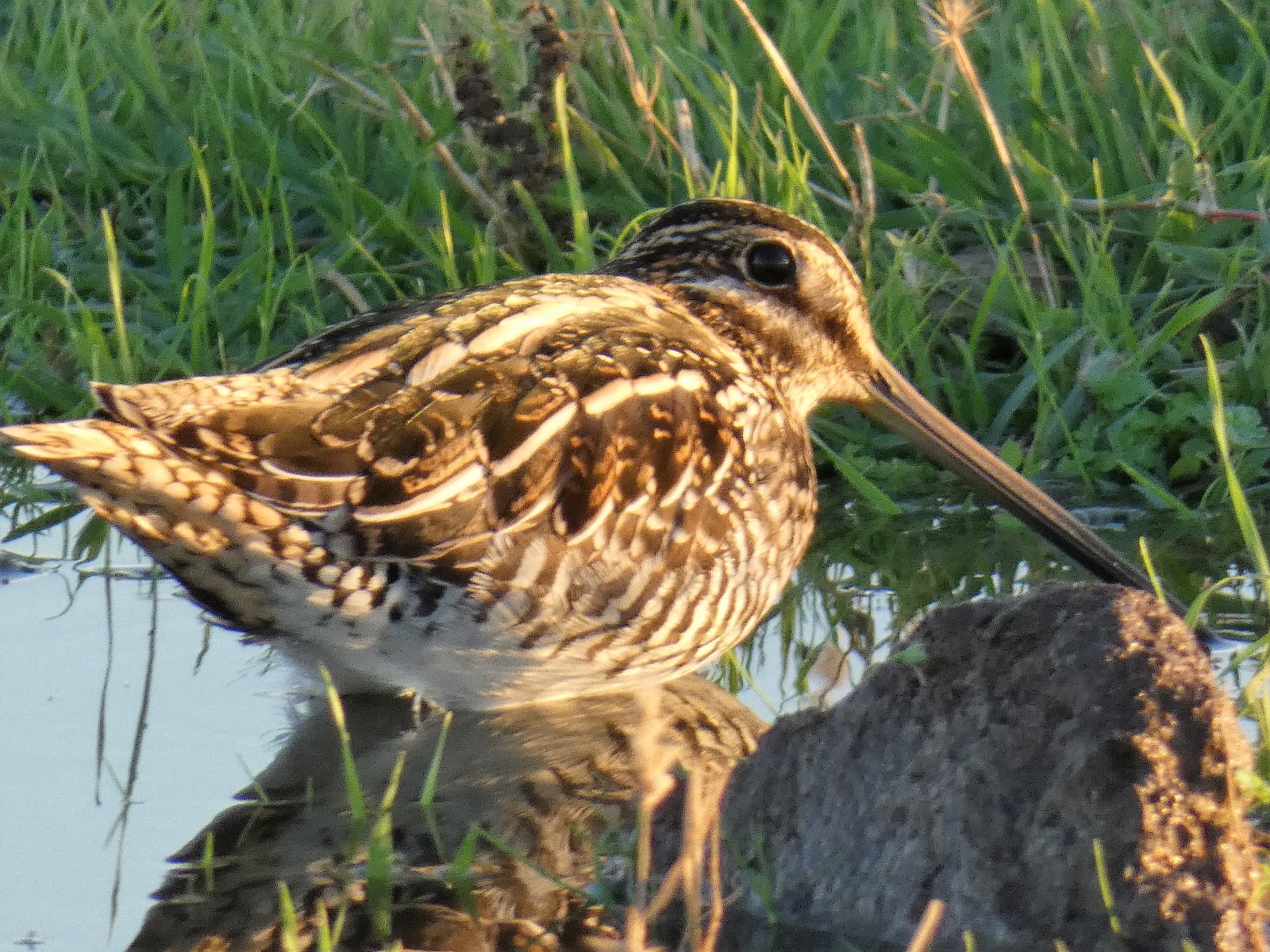
When I was a scout back in another era we often introduced the new guys to our trip by conducting a snipe hunt, chasing imaginary birds with paper sacks in the dark. For some reason we never caught any. I had no idea at the time that snipes actually existed, but they do.
I was out at the San Joaquin River National Wildlife Refuge the other day looking for migrant geese. I certainly found some at the viewing platform on Beckwith Road, several thousand Aleutian Cackling Geese, Sandhill Cranes, and even a handful of Snow Geese.
There is no open water at the Beckwith Viewing Platform except in the great distance, so it isn't the best place to be searching for shorebirds. But on the way east along the access road there are a few seasonal ponds that are good for birdwatching. This time around my search for a Wilson's Snipe (Gallinago delicate) was successful, although to be honest I didn't know I was searching for it. Six of them were feeding in the mud along the shoreline of the pond.
One of the more noticeable features of the snipe is the location of their eyes in the middle of their skull. This arrangement allows them to see behind as well as ahead. They can see a predator coming from far off, which goes a long way towards explaining why our snipe hunts were never successful all those years ago.
Momentous things are happening in the Great Valley this month! Wave after wave of migratory birds are starting to arrive at the string of national wildlife refuges up and down the valley floor. The Sandhill Cranes arrived in large numbers several weeks ago, constituting the "first wave" (this, by the way, is my entirely made-up description; I'm no biologist. I'm just reporting what I've been seeing). We saw hundreds and hundreds of them last week in the Merced National Wildlife Refuge, and I saw a few hundred of them at the San Joaquin River National Wildlife Refuge. There were also a few dozen Greater White-fronted Geese at both refuges, but not in large numbers.
But this week there was a big change at the San Joaquin River National Wildlife Refuge. I stopped by on Tuesday and again on Saturday to find a huge flock of several thousand Aleutian Cackling Geese (Branta hutchinsii). The corn in the section near the viewing platform on Beckwith Road had been cut so the birds were foraging for food.
The Cackling Goose strongly resembles the Canada Goose and was once classed as a subspecies. Subsequent studies showed enough differences that they are considered separate species today. They are noticeably smaller and their necks are short than those of the Canada Goose. They breed on just a few of the Aleutian Islands and most of them migrate to just a small area of the Central Valley, primarily the San Joaquin River National Wildlife Refuge. The birds were actually thought to be extinct for a few decades after 1938, due to over-hunting in the valley and the introduction of foxes in their breeding grounds in Alaska. A few hundred individuals were discovered on an isolated island and the bird was placed on the endangered species list soon after in 1967. The foxes were removed from the breeding islands and hunting was controlled and the birds rebounded. They now number more than 120,000.
There was a harbinger in the crowd of Cackling Geese which you may have noticed in some of the pictures above. It was the presence of seven or eight Snow Geese. They are another Arctic breeder, and they are on their way south too. In another two or three weeks there will be tens of thousands of them at the refuges (my official "third wave").
The viewing platform on Beckwith Road is about eight miles west of the Vintage Faire Mall in Modesto. It's open now and free to visit. If you want the challenge of a hike you can go across the San Joaquin River on Highway 132 and go a few miles south to another section of the refuge. The Pelican Trail is about 4 miles total with a variety of different riparian habitats. It's not unusual to run across three dozen bird species or more.
The Great Valley is often thought of as a dusty, flat and boring place. It often is. But there are treasures hidden here. A visit to the national refuges during the winter migrations is as spectacular as a trip through the African savanna, especially in those moments when tens of thousands of geese take flight all at once. It is well worth your time if you ever happen to be passing through.
You just never know. One of the joys of my new hobby (well, four years now) is the possibility that any day there can be something new and unexpected. I was roaming the west campus on my lunch break and it seemed like the birds had all left to have a siesta somewhere other than where I was at. But then I saw movement in the dead cottonwood tree in the sheep pasture and discovered a Say's Phoebe. It's not an overly rare bird, but it is the first time I've seen one on campus. But that's not what I'm talking about today!
While I was trying to catch a shot of the Phoebe, another bird fluttered into the branches above. I saw yellow and thought "warbler" but I zeroed in and discovered that it was actually a Kingbird. And it wasn't a Western Kingbird that floods into our region in the spring and summer. They're all gone now, having migrated south back into Central America. I could see the white tips on the tail feathers, the white "moustache", and the gray head and realized it was a Cassin's Kingbird (Tyrannus vociferans). This is remarkable because not only are we at the extreme northern edge of its range, but it should have migrated south by now along with the Western Kingbirds.
This may very well be the same bird that I discovered on campus last year. I haven't seen it in almost a year so it is kind of a mystery about why it is here.
"He is the mountain streams’ own darling,
the humming-bird of blooming waters,
loving rocky ripple-slopes and sheets of foam as a bee loves flowers,
as a lark loves sunshine and meadows.
Among all the mountain birds,
none has cheered me so much in my lonely wanderings,
—none so unfailingly.
For both in winter and summer he sings,
sweetly,
cheerily,
independent alike of sunshine and of love,
requiring no other inspiration than the stream on which he dwells.
While water sings,
so must he,
in heat or cold,
calm or storm,
ever attuning his voice in sure accord; low in the drought of summer and the drought of winter,
but never silent." The Mountains of California, 1894
I've seen Water Ouzels, known officially today as American Dippers (Cinclus mexicanus) on a few rare occasions, but not recently, and none that I've been able photograph. Only one has made an appearance in my county (Stanislaus), which caused a stir in the birding community in the winter of 2017-18. I never got a chance to look for that individual, but I finally got to see one this last weekend up in Yosemite Valley. I was walking along the Merced River near the Curry Village tent cabins when I saw some strange movements of a bird. It was, well, dipping.
The dippers are one of the most aquatic of birds, spending most of their time swimming, walking underwater, and dipping in mountain streams of unpolluted water. They don't migrate, staying in the same general area winter and summer, but they range over an immense region, from northern Alaska to Central America. They mostly eat aquatic insects and their larvae. I only got two half-decent pictures, but the video came out a bit better. Enjoy!
The