Monday, November 30, 2015

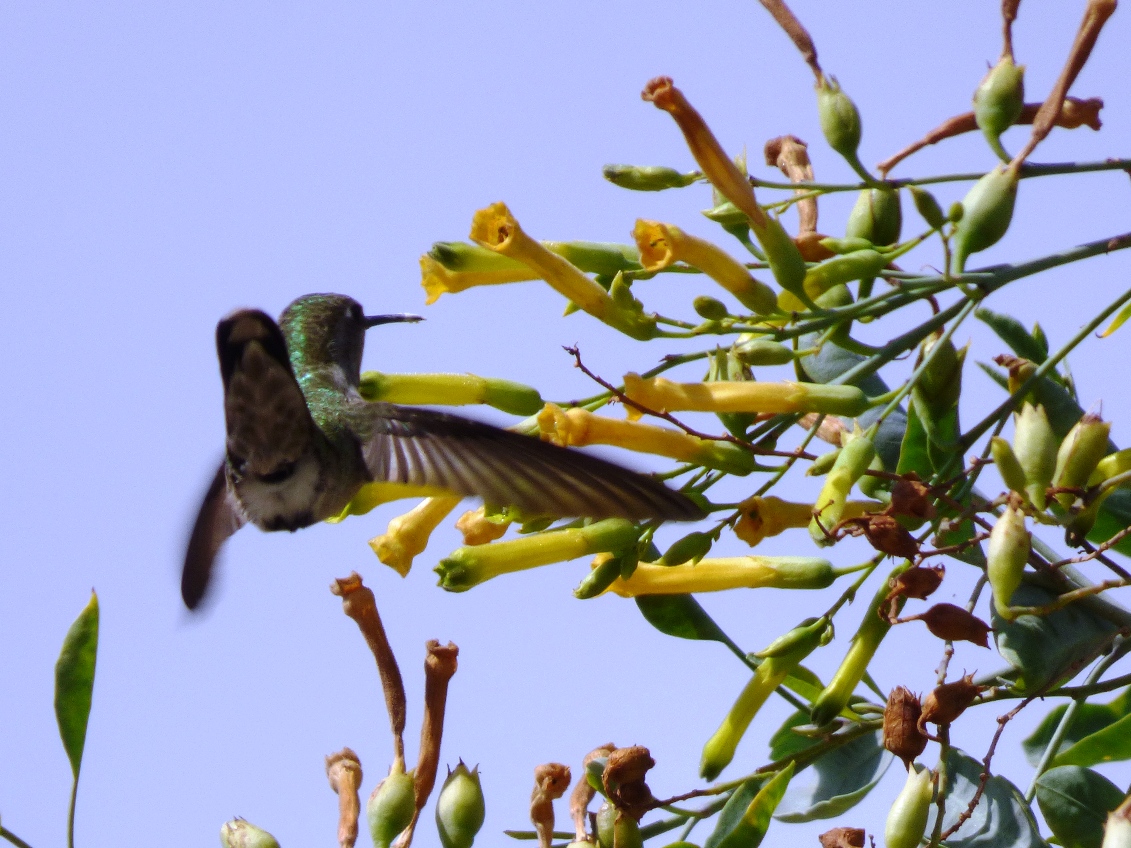
Anna's Hummingbird at the Sacramento National Wildlife Refuge

We've completed our Thanksgiving journeys through Northern California and Oregon, and we made our traditional stop at the Sacramento National Wildlife Refuge in the northern Great Valley. This is a marvelous time of year, with thousands of migratory birds stopping in for the winter (you can expect to see plenty of pictures in future posts), and quite a number of year-round residents as well. My first choice from the pictures of the day was this little Anna's Hummingbird (Calypte anna) taking shelter near the refuge visitor center. It's been a frigid couple of days (parts of California were colder than northern Alaska yesterday), and I would have worried about this little one. The metabolism of these birds is such that they are always within hours of starvation, and must consume a significant percentage of their body weight every day, especially in cold weather (they are tropical birds at heart). The refuge has planted some native shrubs outside the visitor center, so there were some flowers even in this cold weather to provide food for the hummingbirds.
The Anna's Hummingbird is more or less a California endemic with a historic range in Southern California and Baja, but it has expanded its range north to Vancouver with human habitation providing secure food sources for winter.

After seeing tens of thousands of geese, and dozens of raptors, it was such a shock to see this one little bird all by itself. I guess that made it stand out today.

Saturday, November 28, 2015

Bald Eagle on the Umpqua River near Reedsport, Oregon

I guess this was my week for Bald Eagles (Haliaeetus leucocephalus). I hadn't seen any for the better part of a year, and then I see two in the space of four days. This one was a lot closer than the bird I saw flying with the pelicans on Tuesday.
We were on our way to our Thanksgiving gathering in central Oregon, and stopped for a few minutes at the Dean Creek Elk Viewing area on the Umpqua River near Reedsport on the coast. We were there to see the elk, but there are almost always some birds about as well. We were leaving when I noticed very large bird in the tree down the highway. There were some Ravens nearby, but this bird seemed larger. Much larger. Although it was silhouetted in the sun, my zoom lens confirmed the shape of the beak and the white head. 
It's no surprise an eagle would be found here, as the river is a haven for salmon. The eagles are expanding their range in the lower 48 states after nearly being extirpated by DDT and illegal hunting. There are one of just a few conservation success stories.

It would have been a shame to drive our national bird to extinction...

Tuesday, November 24, 2015

Bald Eagle among the Pelicans at the San Joaquin National Wildlife Refuge

I was out at the Beckwith Road Platform this afternoon, seeing how the Cackling Geese and Ross's Geese were faring in today's rainstorm. The rain had actually cleared out and I was treated to the awesome sight of thousands of the geese taking flight for some reason or another. But that's not what I'm writing about today.
I was talking to one of the Fish and Wildlife managers, and he hinted that I should be on the lookout for a Bald Eagle that had been hanging out at the refuge the last few days. As luck would have it, I saw a large bird in the distance, flying along with, or in front of, a flock of American White Pelicans (Pelecanus erythrorhynchos). I thought it was a hawk with flying geese at the great distance, but the camera zoom showed different.
The birds seemed to be following a parallel pathway. Bald Eagles sometimes prey on Pelicans, or least their nestlings. They're also not averse to stealing fish from pelicans.
I wish the pictures were a bit sharper. The eagle was probably a quarter or a third of a mile away, so I really appreciate the zoom on my camera! A few moments later, I caught the eagle perching on a post in the distance. 
I have some closer shots of a Bald Eagle at Turlock Lake, and in a life and death struggle with Great Blue Herons in Victoria, British Columbia. Check them out!

Monday, November 23, 2015

First Sighting of Cedar Waxwings this Fall!

One if my favorite times of the birding year is the arrival of the Cedar Waxwings (Bombycilla cedrorum) in our area. I saw a flock the other day on campus, but they were far away, as was my camera. This afternoon I took a short break at Fox Grove on the Tuolumne River between Modesto and Waterford.
I saw another flock of yellowish birds in the distance, and the telephoto confirmed it was a group of Cedar Waxwings. There were maybe two dozen of them in the dead cottonwood tree.

The birds come through the region while migrating between the tropics of Central America and Canada. They are year-round residents in the northern states. They feed primarily on fruits, which protects them from the nesting antics of cowbirds: the cowbird chicks can't live on the fruit diet and generally don't survive. The waxwings will supplement their diet with the occasional bug, however.
I'm hoping they'll return to the flowering pear in my front yard soon. They always surprise me when they arrive, because they are almost motionless and silent when they bed down for the night, and I therefore don't notice them except by chance. Then I feel a little creeped out as they stare at me...
Fox Grove is a 64 acre county park along the Tuolumne River between Modesto and Waterford. Some of the park is groomed (and ecologically barren) grass, and there is a large colony of feral cats. On the other hand, a lot of the park is recovering riparian habitat, and there are some good birding opportunities. I haven't spent a lot of time there, although I saw a Hooded Oriole there last spring.

Friday, November 20, 2015

Black-chinned Hummingbird on the Tuolumne River Parkway Trail

I've hesitated putting these pictures up, because I'm not fully confident in my identification of these birds as Black-chinned Hummingbirds (Archilochus alexandri). We are only seeing them from the back, and Anna's Hummingbirds or others also have green backs. It's just that the only times I have seen them from the front, they were Black-chinned.
The picture above is one of the most unique angles I've ever caught of a hummingbird! The first two pictures are from one month ago, but I caught the picture below just this morning. I'm glad to see the birds survived through what we hope is the end of the drought. These birds are a true western species, and are not found east of the Rocky Mountains.
As always, please let me know if I've missed the species identification! I'm still new at this.

Western Meadowlark at the Merced National Wildlife Refuge

On our visit to the Merced National Wildlife Refuge a few weeks ago, we were mostly on the lookout for the big arriving migrants like the Sandhill Cranes and Snow Geese. But we also kept an eye out for some of the year-round residents, and along one stretch, we heard a familiar song. It was a Western Meadowlark (Sturnella neglecta) on the opposite side of the levee from the ponds.

The Meadowlarks are not necessarily endangered, but like many native birds, they have suffered population losses since the 1960s, due to habitat loss. The losses continue in our area as rangelands give way to almond orchards.

I didn't get any video this time out, but a few months back I caught a meadowlark singing in the Sierra Nevada foothills. Enjoy!
 

Tuesday, November 17, 2015

Snowy Egrets at the Merced National Wildlife Refuge

Thousands of Sandhill Cranes are already in residence, but tens of thousands of Ross's Geese and Snow Geese have yet to arrive. So the Merced National Wildlife Refuge doesn't feel particularly crowded at the moment. As a result, the year-round denizens still stand out a bit, especially if they are pure white. The Snowy Egret (Egretta thula) is one of them.
The Snowy Egret is one of the most elegant and graceful birds to be seen in our area. Their beautiful delicate feathers were once worth more than their weight in gold, and that almost led to their extinction a century ago. They were one of the first birds to receive protected status back in a time when such things simply weren't done (the wild Turkey was another early benificiary of protection after being hunted to near-extinction).
When the other migratory birds arrive in a few weeks, the egrets will still be seen wandering alone through thunderous flocks of geese and cranes. They seem pretty unflappable, as I've seen tens of thousands of geese panic and take flight all at once, while the few egrets look up for a moment, and then resume feeding in the water.