Monday, November 26, 2018

Why Yes, I am the Center of the Universe: Yellow-billed Magpie on the Tuolumne River


Just a quick single picture tonight. This is a Yellow-billed Magpie (Pica nuttalli), one of California's
very few endemic bird species. Endemics are those species that are found in one place and nowhere else in the world, and this magpie fits the bill very nicely. It is common in California's Great Valley and the Coast Ranges, and is found nowhere else. We almost lost it a decade ago when the West Nile virus decimated the flocks. More than half the population was wiped out. Luckily a few seemed to have had some resistance to the virus and the populations have stabilized somewhat, although not yet to the number that existed prior to 2004 when the virus arrived.

I was thrilled to see a flock of more than a hundred of the Yellow-billed Magpies flying over the campus of CSU Stanislaus a few weeks ago. I've seen as many as two dozen or so at a time on the bluffs above the Tuolumne River in Waterford in recent weeks as well. There are also at least two dozen living on the west campus of Modesto Junior College.

This one that I saw today was obviously saying that it was the center of the Universe by making sure it was framed correctly by the barbed wire.

Tuesday, November 20, 2018

American Kestrels on the Tuolumne Parkway Trail

One of the dependable birds that I see on my walks along the Tuolumne River are the American Kestrels (Falco sparverius). They are certainly not as common as Starlings or Scrub Jays, but there is a pair that consistently shows up in the treetops. I'm not usually close enough for good shots, but once in awhile one of them perches in near the trail keeping an eye on me. That's how I got this shot yesterday.

I caught the Kestrel pair last August in the top of one of the huge oak trees along the river. I have no idea if they had a nest this year or not, but I'll be watching more carefully as spring rolls around.

Monday, November 19, 2018

As Cute as They Get: Bushtit on the Tuolumne River


The Bushtits (Psaltriparus minimus) are busy little birds of the underbrush. They barely ever stop moving in their search for small insects, hopping from branch to branch like little Energizer Bunnies. And they are as cute as a bird can be, with their little beaks and furry looking ping-pong ball bodies.
The females have different-looking eyes and seem a little bit more stern (I featured them two months ago). The black eyes of the males make them simply look like toys. If you live in the American West, you have a pretty good chance of spying these birds, in any place with lots of open shrubs. They forage together in flocks of a few dozen individuals. But good luck getting pictures! They rarely pause in their work.

Sunday, November 18, 2018

Decorating Christmas Trees, Avian-style: Cedar Waxwings on the Tuolumne River

It's getting to be the holiday season, and folks are thinking of trimming and decorating Christmas trees. The avian folks along the Tuolumne Parkway Trail had their own idea of how a tree should be decorated, using around 145 of themselves as ornaments. These beautiful birds are Cedar Waxwings (Bombycilla cedrorum), who tend to show up around here in the fall and winter as they migrate south.

I couldn't get near enough for a close-up, so here's a shot from last January at MJC...

Wednesday, November 14, 2018

Why So Many Turkey Vultures on the Mokelumne River? Oh Yeah...


 Let's face it: Turkey Vultures (Cathartes aura) can be really creepy. Not so much when they're soaring on the thermals; that's when they are actually beautiful. No, it's when they are perched on the branches right over your head staring at you. It's like they're hoping you'll have a heart attack so they can have some lunch.
I was walking along the Mokelumne River this morning near the fish hatchery just below Camanche Reservoir. I had not yet reached the river and was looking for other birds, but I couldn't help but notice that nearly every tree had a Turkey Vulture perching on the top branches. They were all over the place. So yeah, a bit creepy.

As I got closer to the river I heard odd splashing sounds, and suddenly it occurred to me. It was the Chinook Salmon run! The spot where I was walking is the end of the road for the salmon, as Camanche Reservoir blocks their upstream progress. I wondered if there was a fish ladder, and there was, but it led only into the fish hatchery where workers collect the eggs for rearing in the complex. The fish ladder was closed, presumably because their holding tanks were full, so the upper pool of the river was full of Chinook trying to go farther upstream. And the vultures were waiting for a tasty lunch.

Here's a short video of the fish swimming in the Mokelumne River.

Tuesday, November 13, 2018

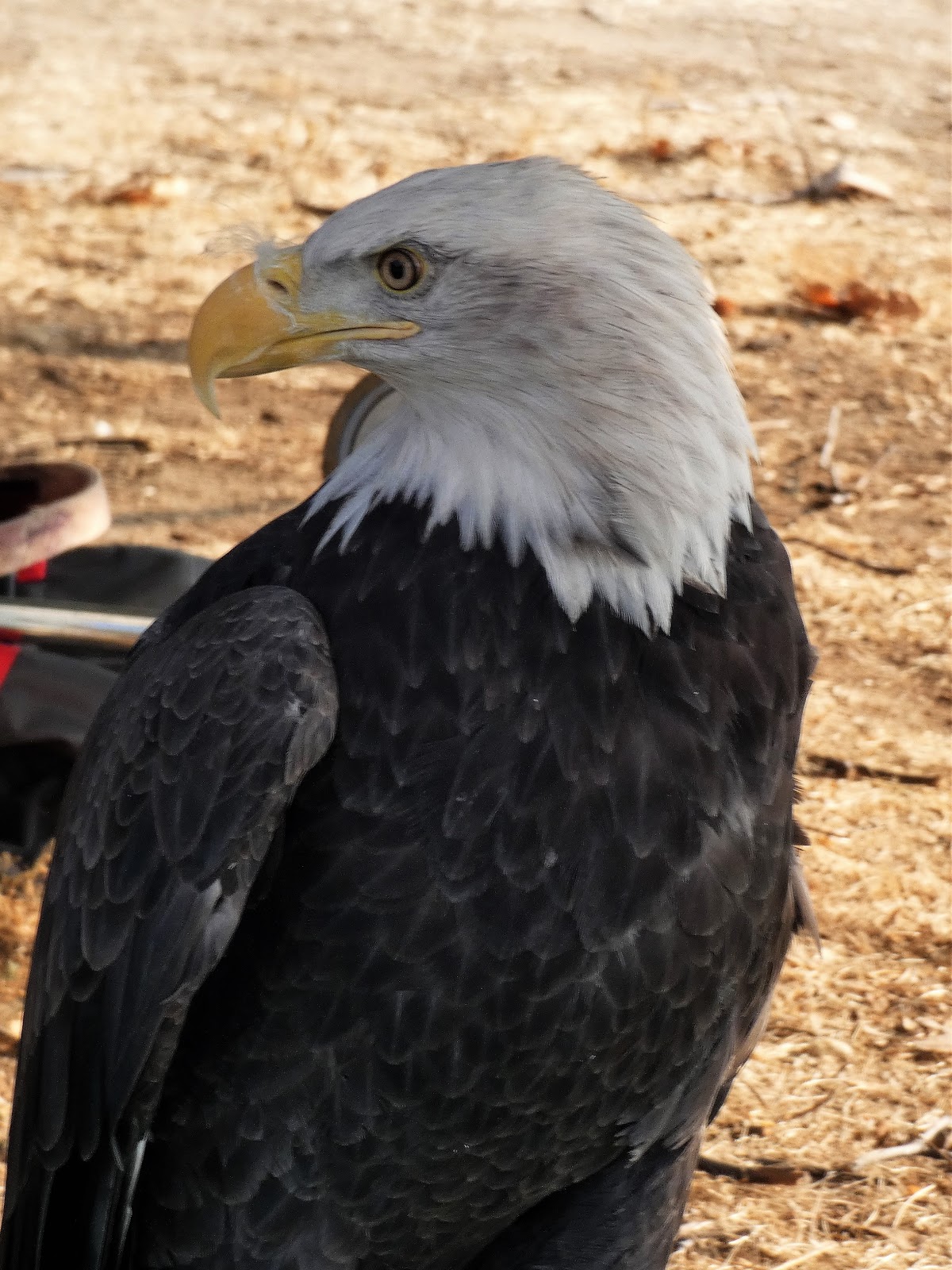
Getting Very Close to our National Bird


This might not be the right distance to meet a Bald Eagle (Haliaeetus leucocephalus). I grant you that. But my camera does have a pretty good zoom, but this is really close.
It's probably clear that we're not looking at a wild bird. Well, it's wild, but not in the wild. Unfortunately someone apparently shot its wing and the bird has been somewhat tamed and serves as a wildlife ambassador. We were at the Salmon Festival on Saturday at Knight's Ferry on the Stanislaus River.
Bald Eagles aren't at all common in our area but a few of them live here. I've seen them at Turlock Lake and near the Beckwith Platform in the San Joaquin River National Wildlife Refuge.
But never this close!
Here's a more normal distance for a shot of an eagle...

Thursday, November 8, 2018

A Surprise Discovery at MJC: A Red-breasted Sapsucker

There's something I've learned with fossil and mineral hunting. If you haven't seen the thing you are looking for, you won't recognize it when you see it. But if you've seen an example of the fossil or mineral, you'll pick it out right away. I'm still a newbie at bird identification, but a few weeks ago I saw a Red-breasted Sapsucker (Sphyrapicus ruber) in Yosemite Valley. I got all excited and got pictures and posted on my discovery that night.

Then, only nine days later, I was wandering the campus of CSU Stanislaus and much to my surprise I saw another Red-breasted Sapsucker! So I posted on the species again. Having seen it once, I guess I was primed to recognize it right away when I saw it again.

So here we are eight days later. I was taking a break between classes and wandered out to the sheep compound, my MJC "mini-wilderness", and saw another woodpecker deep among the branches of a dead tree. I focused in with the camera, and wouldn't you know it, there was another Red-breasted Sapsucker! I've never encountered one here before. So once again, I am posting. It the pattern holds, we should be hearing of the Tuolumne River Parkway Trail Sapsucker discovery any day now...