I've had some marvelous views of Wood Ducks (Aix sponsa) of late on the Tuolumne River Parkway Trail. There are several pairs that have spent time up in the trees, and others that have been creeping about in the underbrush. I've seen as many as six in a day (unless they've been flying up or downstream to fool me). And I was especially pleased to the get the shot above, the clearest and most colorful that I've ever taken.
The one thing I haven't seen is Wood Duck ducklings. I don't know if they haven't bred yet, or if they are keeping their chicks well-hidden from predators, but I haven't seen any young ones. That changed today, but I had to travel all the way to Washington to see them. Lake Washington is a huge glacial lake that borders the east side of Seattle, and it is an urban nightmare. On the other hand, the local cities have put together a really nice nature trail that runs along the lower 17 miles of the Cedar River, on the of the main rivers that feeds into Lake Washington. I was exploring a short portion of that trail today, and the bird sightings were unremarkable, just three species, but one of the species was Wood Duck, and their were a fair number of them, mainly a pair of Wood Ducks, and a Mom with her ducklings making their way through a small swamp adjacent to the river. They were constantly moving, but finally settled for a nap on a floating log that was growing a bit of grass.
Sunday, May 13, 2018
Wednesday, May 9, 2018
Acorn Woodpeckers along the Tuolumne River
If they took up residence in my yard, I would probably not like them as much. But they haven't, and so the Acorn Woodpecker (Melanerpes formicivorus) remains one of my favorite sights when I walk the Tuolumne River Parkway Trail on most mornings. They are capable of doing a lot of damage to the eaves of a house, and they can be loud and raucous, but their clown-like faces and silly antics can be endearing.
The individuals that I've seen most often lately have been at war with European Starlings over nest cavities in an old dead cottonwood tree towards the west end of the Parkway Trail. I can't tell who's winning, but a number of times I've seen the woodpeckers hard at work producing a cavity while the Starlings watch and wait to take it over. There is a lot of flying, yelling and shuffling around. I've not posted pictures because my observation point is kind of distant, so pictures are so-so.
This morning I walked a bit further and took a careful look at some of the huge oak trees just east of the water treatment plant, and I heard the familiar calls of the woodpeckers, and one climbed out on a branch right in front of me and posed for awhile. I was honored to take a couple of portraits. I didn't see so many Starlings in the vicinity.
The shot below is typical of the woodpeckers at the west end war zone. The heavily zoomed photos are sometimes okay, but they don't convey much of the personality of the individual birds.
The individuals that I've seen most often lately have been at war with European Starlings over nest cavities in an old dead cottonwood tree towards the west end of the Parkway Trail. I can't tell who's winning, but a number of times I've seen the woodpeckers hard at work producing a cavity while the Starlings watch and wait to take it over. There is a lot of flying, yelling and shuffling around. I've not posted pictures because my observation point is kind of distant, so pictures are so-so.
This morning I walked a bit further and took a careful look at some of the huge oak trees just east of the water treatment plant, and I heard the familiar calls of the woodpeckers, and one climbed out on a branch right in front of me and posed for awhile. I was honored to take a couple of portraits. I didn't see so many Starlings in the vicinity.
The shot below is typical of the woodpeckers at the west end war zone. The heavily zoomed photos are sometimes okay, but they don't convey much of the personality of the individual birds.
Monday, May 7, 2018
Another New Bird (for me) on the Tuolumne River: A Western Wood-Pewee
I was kind of excited to add two birds to my Tuolumne River Parkway Trail list this week. The first, and most exotic, was the Forster's Terns that I was able to get pictures of (finally). On the same day I saw the first tern, I also saw a bird that acted just like a Black Phoebe, chasing insects from a prominent perch and flying back. But it wasn't black. I realized eventually that I had come across a Western Wood Pewee (Contopus sordidulus). It isn't entirely unusual to see them here in the valley, but they are more common in hilly or mountainous terrain. They are also a summer migrant, and they've been seen at just four localities in our county thus far this year (according to eBird).
I have seen Pewees before, but in a far different and unusual place: Ash Meadows National Wildlife Refuge, an oasis in the barren desert east of Death Valley National Park. They range across all the western states and Alaska as well as Central America and the northernmost part of South America. Their range ends across a north-south line in the Great Plains, a line that coincides with the western edge of the range of the Eastern Wood Pewee. The birds are pretty much identical aside from their songs, but according to eBird there is little evidence that the two species interbreed. This leads to an interesting mystery: they migrate south for the winter, but no one is sure about where they go. The birds don't sing often in winter, and are thus pretty much indistinguishable in their winter habitat. Wherever it may be.
Sunday, May 6, 2018
A Bird Who Didn't Want to be Seen: Red-Breasted Nuthatch on the West Campus
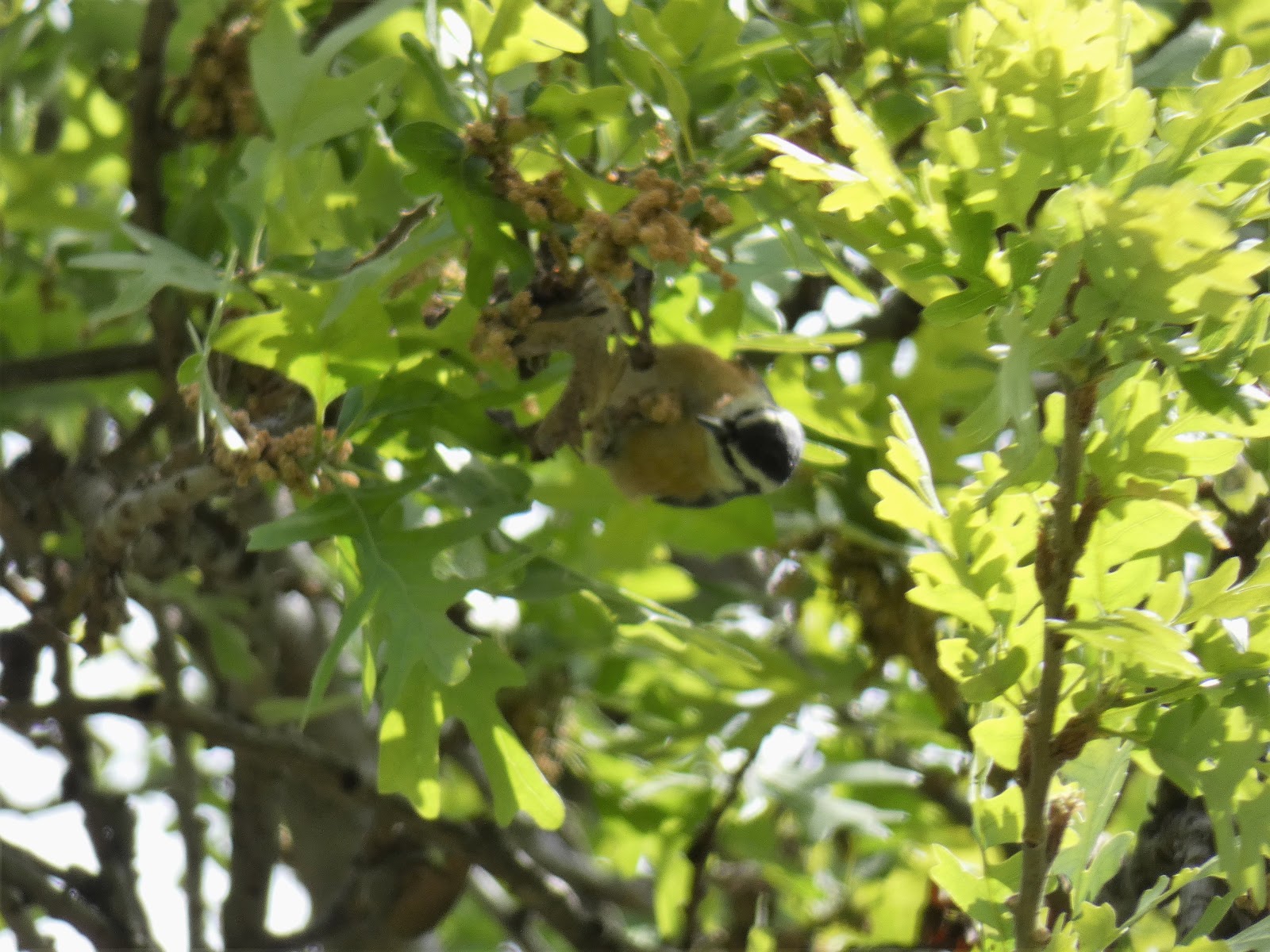
I'm a little behind on bird updates, as these pictures are from April 17. I'm not happy with the them, but then again I was lucky to see this bird at all. It's a Red-breasted Nuthatch (Sitta canadensis), and it was deep in the foliage of a tree on the West Campus of my college. It was the last week of classes, and I was stretching my legs during a break from grading. It's the first time I've seen one so I'm looking forward to getting better shots some day.
The Red-breasted Nuthatchers usually search for insects in the summer and later in the year they may switch to nuts (kind of like their name). They are more of a conifer forest species and are typically found at higher elevations outside the Great Valley. They range across North America from the Mexican border to Alaska.
Saturday, May 5, 2018
A New Bird (for me) on the Tuolumne River: A Forster's Tern
Look! Up in the sky! It's a bird! No, it's a plane! No, it's Superman! Oh, it's actually a bird. But it's a new one, one that I haven't noted before on the Tuolumne River Parkway Trail. It started yesterday when I saw a white bird across the river over the pond at the west end of the trail. White birds on this part of the Tuolumne are almost always egrets, but this one was dipping and soaring like no egret I've ever seen. And it was a lot faster.
I then thought it must be a gull of some sort, but it still didn't seem right. I commenced taking a series of hopeless pictures from a quarter mile away hoping that I might figure out what it was. I struggled with the computer to try and bring out some diagnostic features out of the visual static, and finally settled on Forster's Tern (Sterna forsteri) as an identification. There are several similar-looking terns, but I thought I could see a long forked tail in the fuzzy pictures, and that was it. I figured I wouldn't see anymore since I've been walking the trail for three years and never seen one before.
So I went out this morning and there were five of them! And they weren't just over the distant pond, they were also soaring over the river itself, almost overhead. So I had the challenge of trying to focus the camera on fast-moving birds. I got a few shots, enough to confirm what I thought I saw the previous day.
Forster's Terns are a purely North American species, spending winters in Mexico, and migrating north across the United States to breeding grounds in the Pacific Northwest states and southern Canada. They've been seen all over California in shoreline and delta habitats, but are not particularly common in the Central Valley. They've been seen most often at the local reservoirs like Turlock Lake and Woodward Reservoir.
The Tuolumne Parkway Trail is sort of a new birding environment. A number of county bird experts have kayaked the river, but it wasn't until the city completed work in the trail two years ago that birders could easily access the river habitat. To say I had no idea how diverse our habitat is would be a major understatement. In just two years, they've sighted 102 species! There have been 306 species sighted in Stanislaus County, so there is a lot of potential for future discoveries (the single most productive birding hotspot in the county is at the Modesto Water Treatment plant, with 229 species so far). I've seen 78 of the species on the Tuolumne Parkway Trail, so I've still got some work to do.
The orange and yellow invasion of migrant species is at a lull. I'm still hoping to see a Hooded Oriole or a Varied Thrush on some occasion, but in the meantime I'll keep my eyes open for more surprises.
Wednesday, May 2, 2018
Some More Spring Arrivals, But These Aren't Migrants: The Babies of CSU Stanislaus
The babies are everywhere! I took the occasion to wander the campus of CSU Stanislaus in Turlock this afternoon. The landscape includes some rather large ponds, and an artificial stream that is meant to reflect the vegetation from the Sierra Nevada to the floor of the Great Valley. Reeds have become established in some of the ponds, and as such, the campus has recreated some of the wetland environments that used to exist in valley. The birds have responded, and a number of species are reproducing and raising their young on the campus. And that means for a few weeks of the year, there are adorable young chicks running around everywhere.
First we have the Mallard babies (Anas platyrhynchos). Five of them were huddled just a few inches from the pathway along the artificial stream. Apparently the humans here treat them well because Momma Mallard let me carefully step by without scattering as long as I had my back to them and pretended to be looking at something else.
Then there were the Canada Geese babies (Branta candensis). There are a lot of geese on the campus, and at times they have become a bit of a nuisance. They sometimes get chased off by specially trained dogs, but there were around thirty of them scattered across the campus today. There were two broods of goslings that I ran across, and the parents were on the verge of being aggressive when I walked by, but they kept their distance. The babies of course were cute.
The biggest surprise was one that I didn't recognize right away because it seemed like there were no parents around. I got two clues a short time later, as an American Coot (Fulica Americana) was nearby chasing off some Mallards from the baby. And then there were the feet, visible when it climbed out of the water for a moment. Those giant odd-shaped feet are unmistakeably coot-like.
Black-headed Grosbeaks in Yosemite Valley
The invasion of the brightly colored tropical migrants continues! I had occasion to be in Yosemite Valley yesterday in the midst of some spectacular thunderstorms (the occasion was "I wanted to go spend the afternoon in Yosemite with Mrs. Geotripper"). We stopped for a moment to take pictures of some big rocks (specifically the Three Brothers) and we realized that there were bright orange-colored birds flitting about in the trees overhead. As always I thought "orioles" first, but a look at the stocky beak quickly told me that we were seeing Black-headed Grosbeaks (Pheucticus melanocephalus) instead. I had seen the male of the species only once before (last Thursday to be precise), so this episode provides support for the idea that one sees what one is looking for, and doesn't see what one is not looking for. They haven't been in Yosemite Valley for very long. They've been reported by only six observers on eBird, the first report having come in on April 21st.
We moved up the valley and ended up at Mirror Lake. While enjoying the spectacular view of Mt. Watkins over the reflecting waters of the "lake" (really a wide spot in the stream), I heard an insistent, but pretty bird song in the trees above. After a few moments I located another Black-headed Grosbeak trying to draw the attention of the ladies. The video appears below.
The watch for the spring migrants shall continue!
We moved up the valley and ended up at Mirror Lake. While enjoying the spectacular view of Mt. Watkins over the reflecting waters of the "lake" (really a wide spot in the stream), I heard an insistent, but pretty bird song in the trees above. After a few moments I located another Black-headed Grosbeak trying to draw the attention of the ladies. The video appears below.
The watch for the spring migrants shall continue!
Subscribe to:
Posts (Atom)