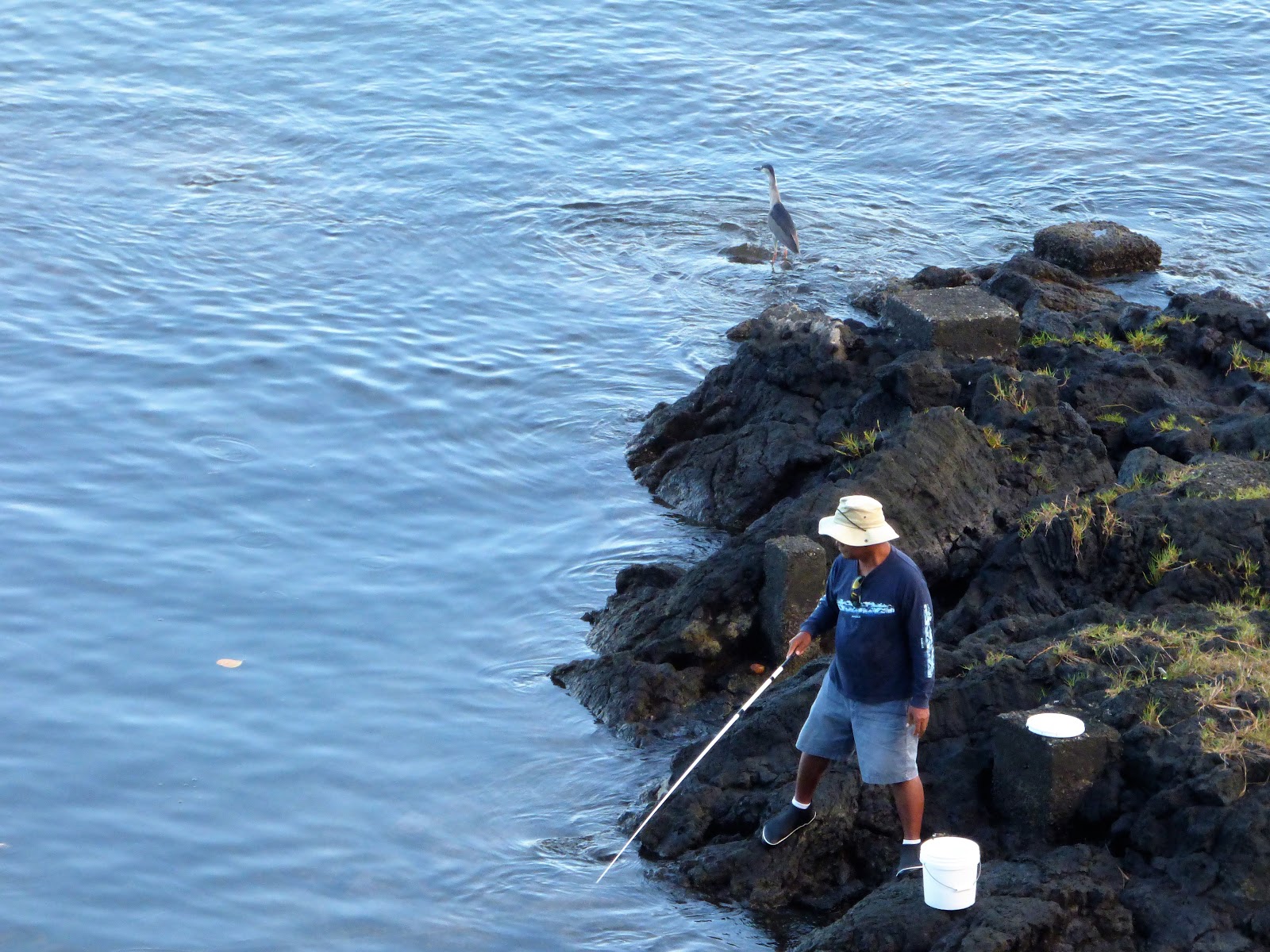
I'm back in the Hawaiian Islands this week! It explains the relative lack of blogging anywhere, and I have precious little time for hunting birds (the topic of the week is geology, and the excuse for being in the islands is a conference and conference-related field trip). But still, I watch for them when I can, and I had a good opportunity early this morning.
I was last here about a year ago, and I had a short post showing the 'Auku'u (Black-crowned Night Heron; Nycticorax nycticorax) at night searching for fish in Hilo Bay in front of the Hilo Hawaiian Hotel. I never got a good luck of the bird in the daytime. That changed this morning. I spied him from my window hanging out with the fishermen along the shore, and went downstairs to see if I could get a closer look. It didn't seem too concerned about humans, given that some were standing just a few yards away.
The 'Auku'u is of a special breed, that of a bird that is native to the Hawaiian Islands. The ancestors of this bird arrived by chance thousands of years, maybe tens of thousands of years ago and established populations here. Unlike other species which have undergone intense evolutionary change, the Heron is more or less indistinguishable from its mainland relatives. If you have good adaptations, you stick with them!
Saturday, May 20, 2017
Tuesday, May 16, 2017
More Migrants on the Tuolumne River: Cedar Waxwings!
I mentioned in the last blog how much I love our migrant bird species. The Orioles have arrived, and so have a number of others. I saw a couple of yellowish birds flitting in the trees at the Tuolumne River Parkway trailhead the other day, and caught a few fuzzy images, but not really good enough to post. It was enough to identify them as Cedar Waxwings (Bombycilla cedrorum).
A day or two later I was out walking again and saw a flock of birds fleeing a hawk and eventually they settled down in a dead cottonwood tree along the river. I got some much sharper shots, though at some greater distance.
The Cedar Waxwings are colorful birds, with yellow breasts and distinctive "raccoon" masks around their eyes. They can make noise, but I rarely hear them vocalize (A year or two ago I had an entire flock in my front yard tree and I didn't notice them for hours).
I live roughly at the northern boundary of the bird's winter range (from here all the way to Central America), and they migrate north for breeding, so I've mostly seen them during the spring and fall migration.
Monday, May 15, 2017
Bullock's Orioles on the Tuolumne River Parkway Trail
One of the pleasures of the coming summer season is the arrival of the tropical species in our region. Many of them are colorful, and as a beginning birder, I was surprised by how many could be seen in our region. I was on my river walk the other day, and I went an extra half mile to the trail that extends along the River Pointe development. There's a nice line of ancient oak trees along the river, but I've not seen a lot of native birds there (mainly lots of sparrows and house finches at the backyard feeders).
This time around, I spotted a yellowish bird in the oaks that I didn't immediately recognize. I immediately thought of female orioles, but wasn't sure. I got a couple of shots and started searching more carefully. I realized there were a number of birds flitting about high in the branches. Some of them were Cedar Waxwings, but then suddenly I saw a bright flash of yellow high over my head, and there it was: a male Bullock's Oriole (Icterus bullockii).
I did something unusual for my walks...I sat down! The birds weren't particularly upset by my presence, and there was a bench anyway, so I enjoyed watching the activity above.
I got a couple of half-decent shots and a short video. Enjoy!
I don't know, maybe he was irritated with me after all...
This time around, I spotted a yellowish bird in the oaks that I didn't immediately recognize. I immediately thought of female orioles, but wasn't sure. I got a couple of shots and started searching more carefully. I realized there were a number of birds flitting about high in the branches. Some of them were Cedar Waxwings, but then suddenly I saw a bright flash of yellow high over my head, and there it was: a male Bullock's Oriole (Icterus bullockii).
I did something unusual for my walks...I sat down! The birds weren't particularly upset by my presence, and there was a bench anyway, so I enjoyed watching the activity above.
I got a couple of half-decent shots and a short video. Enjoy!
I don't know, maybe he was irritated with me after all...
Tuesday, May 9, 2017
Western Meadowlark at the San Luis National WIldlife Refuge
I don't know what it is about springtime (well, maybe I do), but the Western Meadowlarks (Sturnella neglecta) are very visible these days. We were touring the San Luis National Wildlife Refuge to see who would still be hanging about after the Sandhill Cranes and Snow Geese left for their Arctic breeding grounds, and found that the meadowlarks were guarding their breeding territory.
This one was camped in a bush right next to the road, and didn't really care that I rolled down the window and picked up a camera. As long as I didn't invade his territory, he seemed fine with my presence. Being only 20 or so feet away, it's about as close as I ever get to a bird.
Monday, May 8, 2017
Pied-billed Grebe (and trailing flock) at the San Luis National Wildlife Refuge
During the winter, bird watching at our Great Valley refuges is relatively straightforward. There are thousands, even tens of thousands of migratory geese and cranes, and one can look practically any direction and see all manner of large charismatic bird species. At other times of the year it can be a bit of a challenge. A great many summer residents have arrived and they are having babies, and it makes sense that they would want to be inconspicuous until the chicks are grown enough to fend for themselves.
We were at the San Luis National Wildlife Refuge last week and made a stop at the nature trail near the visitor center. At first glance not much was moving. At that point the value of binoculars or a powerful zoom lens became apparent. I saw something moving in the brown vegetation in the center of the picture above. I could barely make it out.
It looked like some strange aquatic beast periscoping out of the water. Then there were more of them, and then momma appeared. She was a Pied-billed Grebe (Podilymbus podiceps) with a flock of four chicks!
The Pied-billed Grebes are described as half-bird, half-submarine, given their penchant for constantly diving. They can be very frustrating to photograph for that reason. Invariably, the moment I have one in focus it disappears and reappears somewhere far away.
It's moments like this that I really appreciate a 60x zoom. I was able to see these cute little chicks from probably 150 yards away, get some almost-focused pictures, and I didn't have to disturb them.
We were at the San Luis National Wildlife Refuge last week and made a stop at the nature trail near the visitor center. At first glance not much was moving. At that point the value of binoculars or a powerful zoom lens became apparent. I saw something moving in the brown vegetation in the center of the picture above. I could barely make it out.
It looked like some strange aquatic beast periscoping out of the water. Then there were more of them, and then momma appeared. She was a Pied-billed Grebe (Podilymbus podiceps) with a flock of four chicks!
The Pied-billed Grebes are described as half-bird, half-submarine, given their penchant for constantly diving. They can be very frustrating to photograph for that reason. Invariably, the moment I have one in focus it disappears and reappears somewhere far away.
It's moments like this that I really appreciate a 60x zoom. I was able to see these cute little chicks from probably 150 yards away, get some almost-focused pictures, and I didn't have to disturb them.
Sunday, May 7, 2017
My First American Bittern! At the San Luis National Wildlife Refuge
There are lots of birds out there that are reasonably common, but for one reason or another I haven't seen a fair number of them yet. The American Bittern (Botaurus lentiginosus) is an example. They are reasonably abundant in the wetlands of the Great Valley, but they are also solitary and secretive in their habits.
We've been exploring our local refuges for a few years now, and on Thursday we were following the Waterfowl Auto Tour at the San Luis National Wildlife Refuge. I spotted a large bird who was too busy concentrating on dinner to run and hide as we drove by. I almost missed it entirely, as its colors blended in so well with the vegetation. I got the camera in position quickly enough to see the evening's dinner menu: crawdad. It swallowed the thing whole.
It shook off any remainders, and we moved on. I thought I had been watching a juvenile Black-crowned Night Heron. It wasn't until I was working with the pictures later on that I realized I had spied a new bird for my list. Next time I'll make sure the pictures are sharper!
We've been exploring our local refuges for a few years now, and on Thursday we were following the Waterfowl Auto Tour at the San Luis National Wildlife Refuge. I spotted a large bird who was too busy concentrating on dinner to run and hide as we drove by. I almost missed it entirely, as its colors blended in so well with the vegetation. I got the camera in position quickly enough to see the evening's dinner menu: crawdad. It swallowed the thing whole.
It shook off any remainders, and we moved on. I thought I had been watching a juvenile Black-crowned Night Heron. It wasn't until I was working with the pictures later on that I realized I had spied a new bird for my list. Next time I'll make sure the pictures are sharper!
Thursday, May 4, 2017
California Towhee in Battle on the Tuolumne River
I got a single good shot of a California Towhee (Melozone crissalis) on my walk along the Tuolumne River the other day and it reminded me of a picture I got sometime back. The Towhees don't like competition, but they also misunderstand mirrors. I caught one last year in a vicious fight with himself at the water treatment plant. The picture looks like it's a mutual admiration society, but it kept striking at the image. I guess the nice thing is it can't lose, but it can't exactly win either.
The California Towhee is aptly named. Except for some populations in southern Oregon, it is a California endemic, with a range throughout California and Baja, but nowhere else (The Canyon Towhee is very similar and closely related, but inhabits the Four Corners states and Texas).
Subscribe to:
Posts (Atom)