Spring is springing on the Tuolumne River! I saw quite a few birds on my recent stroll down the Parkway Trail where the Tuolumne flows into the Great Valley. There was a blooming fruit tree along the trail, and I thought I could see something up in the top, and the zoom lens caught the small hummingbird sitting in the luxurious growth of flower petals. It must be a relief to have flowers blooming after the hard times of winter.
I think it's an Anna's Hummingbird (Calypte anna), based on the shape of the dark feathers across the breast, but I couldn't make out any other identifying marks. I'm open to correction if I am wrong!
Wednesday, February 24, 2016
Monday, February 22, 2016
Away from the River Too Long: Nuttall's Woodpecker on the Tuolumne
A combination of extensive travels and orthopedic problems have kept me away from my own backyard wilderness along the Tuolumne River. It's been a month or more, so I headed down today to see how the spring bloom was progressing.
I saw more than the normal number of birds, including a first time sighting of this one, a Nuttall's Woodpecker (Picoides nuttallii). I've seen them in the area, but not on the river before. Nuttall's Woodpeckers are very nearly one of the few California endemic species, with a range that extends just over the Mexican border (1% of their population lives there), and maybe just a little bit into Oregon. They prefer the oak woodlands that are so prevalent in the state, although they don't eat acorns. They're usually chasing down insects, and occasionally some fruits.
The River Parkway Trail is "nearing completion" as they have been saying for months now, but it is walkable, and spring is beginning. Some of the nut trees are reawakening, and the grass is knee-high. A few flowers are starting to appear here and there. It was a delightful return to strolling along the Tuolumne River.
I saw more than the normal number of birds, including a first time sighting of this one, a Nuttall's Woodpecker (Picoides nuttallii). I've seen them in the area, but not on the river before. Nuttall's Woodpeckers are very nearly one of the few California endemic species, with a range that extends just over the Mexican border (1% of their population lives there), and maybe just a little bit into Oregon. They prefer the oak woodlands that are so prevalent in the state, although they don't eat acorns. They're usually chasing down insects, and occasionally some fruits.
The River Parkway Trail is "nearing completion" as they have been saying for months now, but it is walkable, and spring is beginning. Some of the nut trees are reawakening, and the grass is knee-high. A few flowers are starting to appear here and there. It was a delightful return to strolling along the Tuolumne River.
Friday, February 19, 2016
Great Blue Heron at the San Luis National Wildlife Refuge
Some birds are just plain majestic. We were at the San Luis National Wildlife Refuge a couple of weeks ago, and while we watched for beavers in the Salt Slough a Great Blue Heron (Ardea herodias) landed a few yards away.
The herons are a familiar sight in wetlands all across North America, but I never fail to be impressed by their grace and beauty. Except when they are chasing my goldfish in the backyard pond (which thankfully has only happened once).
The San Luis National Wildlife Refuge is part of a nationwide network of wetlands and other habitats that protect hundreds of species of birds and other animals. Their very existence is a recognition that we are stewards of the planet, and all creatures that live on it. That philosophy is under attack in some quarters, and the armed takeover of the Malheur Refuge in Oregon was a horrible and repugnant example of the mindset of a small minority. I wrote about this a short time ago at Geotripper: http://geotripper.blogspot.com/2016/02/these-lands-belong-to-all-of-us.html.
The herons are a familiar sight in wetlands all across North America, but I never fail to be impressed by their grace and beauty. Except when they are chasing my goldfish in the backyard pond (which thankfully has only happened once).
The San Luis National Wildlife Refuge is part of a nationwide network of wetlands and other habitats that protect hundreds of species of birds and other animals. Their very existence is a recognition that we are stewards of the planet, and all creatures that live on it. That philosophy is under attack in some quarters, and the armed takeover of the Malheur Refuge in Oregon was a horrible and repugnant example of the mindset of a small minority. I wrote about this a short time ago at Geotripper: http://geotripper.blogspot.com/2016/02/these-lands-belong-to-all-of-us.html.
Tuesday, February 9, 2016
Cedar Waxwings on the Modesto Junior College West Campus
I was just too busy to take my usual Tuesday quick drive out to the San Joaquin Refuge this afternoon, so I settled for a walk around the campus. I haven't done it in a while, and I realized that spring was well underway. I saw something like 15 bird species in the space of 20 minutes or so. One of my favorite discoveries today was a pair of Cedar Waxwings (Bombycilla cedrorum). They pass through our region on their migrations, so it is a treat when they stop for a bit.
The name "waxwing" derives from the orange spot on the wings. It's a waxy secretion that may have something to do with attracting mates, but who actually knows? (not Cornell anyway).
Double-crested Cormorants at San Luis National Wildlife Refuge. Would Hitchcock be Proud?
It was a beautiful evening at the San Luis National Wildlife Refuge between Turlock and Los Banos. We were along Salt Slough, a tributary to the San Joaquin River, watching beavers or muskrats and various small birds flitting thorough the trees. But we couldn't shake the feeling that we were being watched...
I looked harder into the trees to find that we were being watched. I had a momentary thought of scenes from a Hitchcock movie concerning avians instead of aliens, but it was clear the birds were simply settling in for the night.
They were a flock of Double-crested Cormorants (Phalacrocorax auritus). They are the most common Cormorant in the United States, with a range that includes the entire lower 48 states and Alaska.
These birds probably could be forgiven if they harbor anti-human impulses a la "The Birds". They were hunted and shot in large numbers a century or more ago, and in the sixties they were nearly done in by the use of DDT. They've rebounded and are generally doing well in most places.
I looked harder into the trees to find that we were being watched. I had a momentary thought of scenes from a Hitchcock movie concerning avians instead of aliens, but it was clear the birds were simply settling in for the night.
They were a flock of Double-crested Cormorants (Phalacrocorax auritus). They are the most common Cormorant in the United States, with a range that includes the entire lower 48 states and Alaska.
These birds probably could be forgiven if they harbor anti-human impulses a la "The Birds". They were hunted and shot in large numbers a century or more ago, and in the sixties they were nearly done in by the use of DDT. They've rebounded and are generally doing well in most places.
Sunday, February 7, 2016
Western Meadowlark at the San Luis National Wildlife Refuge - Their Land and Ours
These Western Meadowlarks (Sturnella neglecta) were out and about yesterday at the Tule Elk enclosure at the San Luis National Wildlife Refuge. Spring is just around the corner; the grass is already green and growing, and the trees can't be far behind.
We were out on a 'lark', and ended up at the refuge. As we drove along the autotour, I was reflecting on the horrible events at the Malheur National Wildlife Refuge, where armed thugs took over the park headquarters and threatened to kill anyone who tried to root them out. It angered me beyond words, but I wrote words anyway over at Geotripper (link here). But as the bird songs continued I relaxed and ended up thoroughly enjoying the afternoon sojourn.
The Western Meadowlarks were singing for mates, and it seemed that practically all the other birds were as well. After four years of drought and dryness, it was so nice to see an explosion of life.
We were out on a 'lark', and ended up at the refuge. As we drove along the autotour, I was reflecting on the horrible events at the Malheur National Wildlife Refuge, where armed thugs took over the park headquarters and threatened to kill anyone who tried to root them out. It angered me beyond words, but I wrote words anyway over at Geotripper (link here). But as the bird songs continued I relaxed and ended up thoroughly enjoying the afternoon sojourn.
The Western Meadowlarks were singing for mates, and it seemed that practically all the other birds were as well. After four years of drought and dryness, it was so nice to see an explosion of life.
Thursday, February 4, 2016
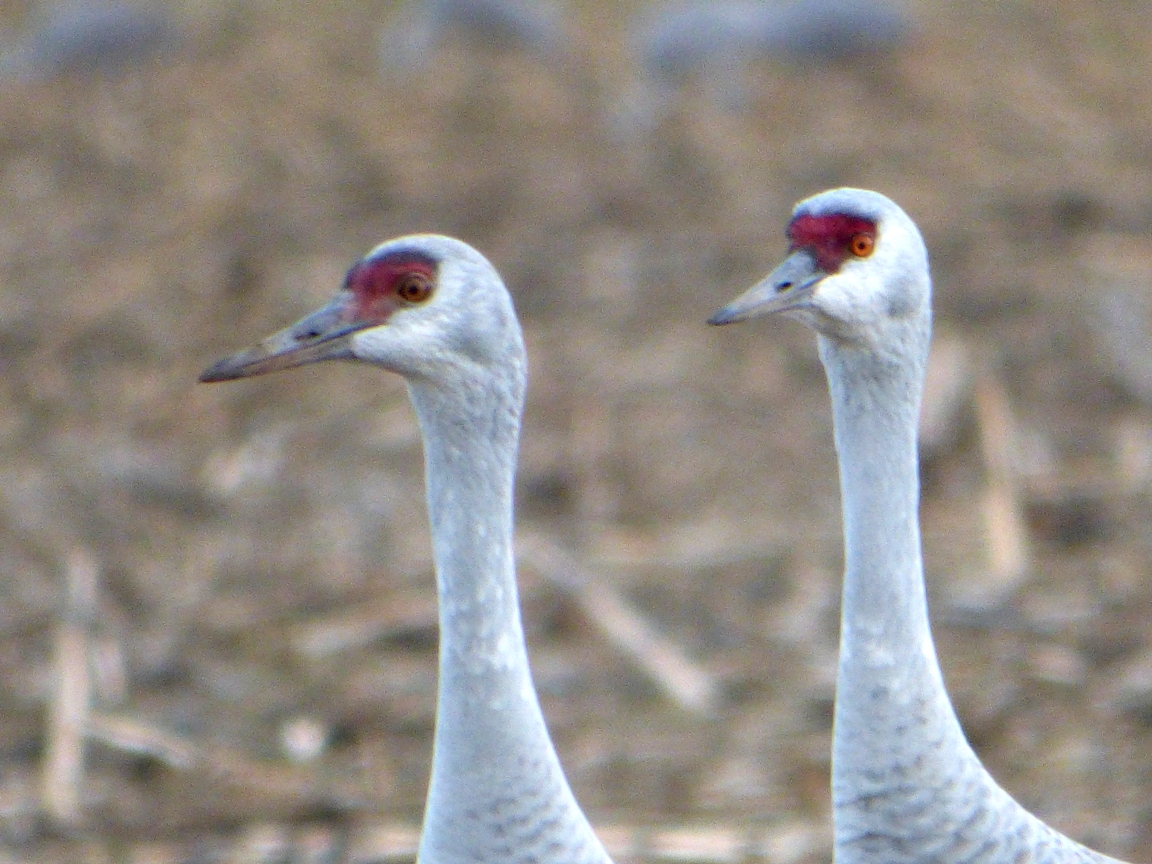
Sandhill Crane Heads at the San Joaquin National Wildlife Refuge
Does it seem like there have been a lot of Sandhill Cranes (Grus canadensis) in my blogs of late? There's a reason for that. They're going to be gone pretty soon.
Oh, not from extinction so far as I know. But gone from this area. It's February and spring is coming soon. They will be moving north back to their breeding grounds in Canada and Alaska. I'm going to miss them.
I'm still getting cloudy afternoons on Tuesdays when I can get out to the Beckwith Road platform overlooking the San Joaquin National Wildlife Refuge so the zoomed shots are still a bit unfocused. But the birds have been roaming closer and closer to the road. The reason is, of course, food.
The cornfields have long since been mowed down, and the voracious cranes and geese have eaten a lot of the food in the refuge. They've avoided the cobs remaining near the road, but now that area is one of the "good" spots for foraging, so they have been close enough for some detailed shots of their faces and heads. And thus today's post.
Since taking up birding, the cranes have been one of my favorite local "discoveries". I had no idea that they spent winters here in the Central Vally, just a short drive from my workplace. By the tens of thousands!
I wish them well on their arduous journey. In the meantime, I'll keep shooting and posting until they're gone!
Oh, not from extinction so far as I know. But gone from this area. It's February and spring is coming soon. They will be moving north back to their breeding grounds in Canada and Alaska. I'm going to miss them.
I'm still getting cloudy afternoons on Tuesdays when I can get out to the Beckwith Road platform overlooking the San Joaquin National Wildlife Refuge so the zoomed shots are still a bit unfocused. But the birds have been roaming closer and closer to the road. The reason is, of course, food.
The cornfields have long since been mowed down, and the voracious cranes and geese have eaten a lot of the food in the refuge. They've avoided the cobs remaining near the road, but now that area is one of the "good" spots for foraging, so they have been close enough for some detailed shots of their faces and heads. And thus today's post.
I wish them well on their arduous journey. In the meantime, I'll keep shooting and posting until they're gone!
| Arduous journey? Say what? |
Subscribe to:
Posts (Atom)