As usual life gets hectic in fits and starts, and blogging is always somewhere way down the list, so these pictures aren't exactly current. I was on a field studies class to Death Valley National Park in the middle of February, and while we didn't see all that many birds, there were certainly a few, and one of the species was just spectacular. It was a pair of Wood Ducks (Aix sponsa) in our camp on the Kern River at the south end of the Sierra Nevada.
Wood Ducks are one of the few duck species with sharp enough claws that they can perch in trees, and that's where I've seen a fair number of them in my travels along the Tuolumne. They nest in cavities in trees (or bird boxes), and when the ducklings are ready, they'll jump out of the nest, falling as much as 50 feet to the ground without injury.
The Kern River drains a huge region of the southern Sierra Nevada, flowing into the Central Valley near Bakersfield. Historically the river ended in a huge lake (Buena Vista Lake) and the waters never reached the sea, evaporating in the desert environment instead. Diversions of river water for agriculture caused the lake to dry up as well. The lake had provided habitat for vast numbers of migratory birds, who have few alternatives today for winter shelter aside from a few wildlife refuges. The Kern River (and nearby Ming Lake) provides a little bit more.
Saturday, March 9, 2019
Wednesday, March 6, 2019
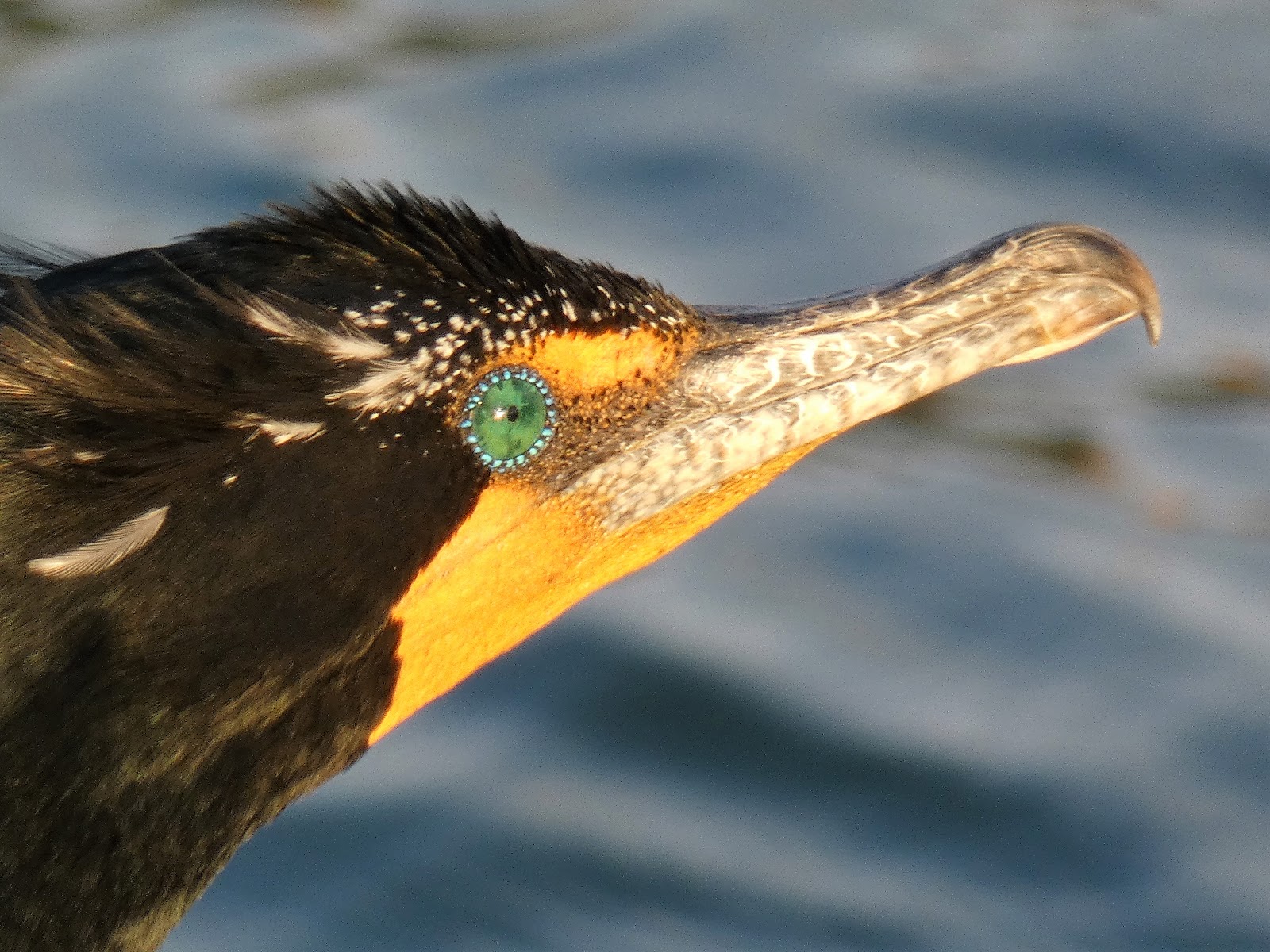
That Freaky Weird Eye...Double-crested Cormorant at CSU Stanislaus
It is one of the most alien-like eyes in nature, in my view. I mean, sure, there's reptilian eyes with their cold emotionless stare, and goat's eyes with their horizontal slits, but nothing can quite compare to turquoise stare of a Double-crested Cormorant. I rarely get near enough to them in the wild to get closeup pictures, but there is one that lives in Warrior Lake at the campus of CSU Stanislaus, where I teach part-time. It is much more acclimated to people and so doesn't retreat as I walk by.
The Double-crested Cormorants, like all their cousins, are consummate fish hunters. Unlike most fishing birds, they dive into the water and chase their prey under the surface. To do so, they can't be overly buoyant and thus they have fewer oils in their feathers. They can get sort of waterlogged, in other words. As a consequence, they will spend a portion of their day drying off, like this one was doing when I happened by.
Mountain Bluebirds on the California Prairie
I've had some pleasant finds of late on our birding journeys of late. We ventured out on Monday to the prairies that lie east of our town in the Great Valley. We ended up on Willm's Road near Knight's Ferry on the Stanislaus. There were quite a few birds out, but have I ever mentioned that blue is my favorite color? I saw a flash of blue on the fenceposts in the distance and realized I was seeing a Mountain Bluebird (Sialia currucoides) for the first time in my county. I've seen them only twice before, once in Tuolumne Meadows in Yosemite National Park, and last summer in Mesa Verde National Park.
These are some of the most beautiful birds there are, but their habitat is locally under siege. They prefer woodlands at the edge of the prairie, the trees providing nesting sites, and the prairie providing the insects that they eat. But the prairies out here are being converted to almond orchards at a furious rate. There are lots of difficult issues involved here, but it seems a shame to be losing so much of one of California's unique and rare environments and the animals that live there.
| Mrs. Geotripper caught this shot of the Mountain Bluebird giving us "the look". |
Sunday, March 3, 2019
The Problem of Scale and Zoom: What is That Up There?
I went out to Robert's Ferry Bridge on the Tuolumne River today to see if the Ospreys had returned to their platform on the south side of the river. It felt like time was passing without any Osprey sightings and I was worried whether they would be back at all. I was also curious if there were any birds nesting in the bridge structure, since I knew of several stick pile nests, but I couldn't tell if any birds were present.
It was really difficult to see the nests because they were in the eaves and framed by very bright skies. I had to depend on the camera to lighten up the darkness up in the eaves and I snapped a couple of shots. On the small screen of my camera the pictures seemed to show a bit of bird tail, and there was some kind of yellow thing, but I couldn't make out what it was, maybe part of the bridge superstructure, or a piece of plastic in the nest perhaps. It wasn't until I saw the pictures on my computer that I realized that my sense of scale was way off. It wasn't a bird tail at all! But at least I know who's on the nest ("who"...do you see what I did there? Do you get it?).
So, add a Great Horned Owl to the list of nesting birds in my area. Oh, and the Ospreys? They were there, both of them. They didn't seem too concerned about the herb garden growing in their nest. Now we watch and wait for all the babies to hatch!
It was really difficult to see the nests because they were in the eaves and framed by very bright skies. I had to depend on the camera to lighten up the darkness up in the eaves and I snapped a couple of shots. On the small screen of my camera the pictures seemed to show a bit of bird tail, and there was some kind of yellow thing, but I couldn't make out what it was, maybe part of the bridge superstructure, or a piece of plastic in the nest perhaps. It wasn't until I saw the pictures on my computer that I realized that my sense of scale was way off. It wasn't a bird tail at all! But at least I know who's on the nest ("who"...do you see what I did there? Do you get it?).
So, add a Great Horned Owl to the list of nesting birds in my area. Oh, and the Ospreys? They were there, both of them. They didn't seem too concerned about the herb garden growing in their nest. Now we watch and wait for all the babies to hatch!
Saturday, March 2, 2019
Spotted Towhee on the Tuolumne River Parkway and a Few Thoughts on Diversity
Spotted Towhees (Pipilo maculatus) are a colorful sight, although they tend to be a little shy when I see them on the Tuolumne River Parkway Trail. Many times I've been able to only see a mysterious red eye staring out of the shrubs. So it was a bit of a treat this week to have two of them just sitting out there just a few feet off the trail. Given that they were singing their heart out, I'm guessing it's springtime, and love is in the air.
The Spotted Towhee is one of those birds I had no idea existed in the world, and much less that it lived in the river environments close to my own home. I can still remember those days fifty years ago when I thought there were just a few kinds of rocks and minerals, and then I discovered the incredible world of geology that changed the trajectory of my life. In the same way, I found out only five years ago that there were more than just pigeons and sparrows that lived in my immediate neighborhood. I could not have conceived that with the completion of the Tuolumne River Parkway Trail that after two or three years, myself and another couple of birders would discover more than 120 species living along the walkway, with more being sighted every month. I was amazed by the diversity of species I could see.
And the really neat part? This is pretty much true no matter where you live. Would you believe that the most diverse county in California for bird species is Los Angeles, with 544? Followed closely by San Diego with 542? It's true that there are more eyes looking in the skies in those urban landscapes, but the sightings are real. If that seems unlikely, get out and have a look in any open spaces where you live: parks, rivers, refuges, even school yards. You might be amazed.
The Spotted Towhee is one of those birds I had no idea existed in the world, and much less that it lived in the river environments close to my own home. I can still remember those days fifty years ago when I thought there were just a few kinds of rocks and minerals, and then I discovered the incredible world of geology that changed the trajectory of my life. In the same way, I found out only five years ago that there were more than just pigeons and sparrows that lived in my immediate neighborhood. I could not have conceived that with the completion of the Tuolumne River Parkway Trail that after two or three years, myself and another couple of birders would discover more than 120 species living along the walkway, with more being sighted every month. I was amazed by the diversity of species I could see.
Tuesday, February 26, 2019
What To Do With a Dinner Invitation When You're All Tied Up
First off, it really sucks to be the snake in this little narrative. It was on the losing end of the battles that occur in the "circle of life". One eventually has to accept that everything in nature is ultimately trying to eat everything else in nature. Even the top predators are going to be consumed by scavengers eventually. We'll just hope that the reincarnation of the little snake has a better ending the next time around.
We were driving the Bear Creek Unit auto tour at the San Luis National Wildlife Refuge last weekend when we spotted a Great Blue Heron with something hanging from its beak. After a few moments we realized it was a small snake. As a last defensive measure it seems to have tied itself into a knot, but it didn't work. As we watched, the Heron gulped down the entire snake, knot and all.
Great Blue Herons are large birds and are thus one of the top predators in the freshwater marsh environment. They eat fish, amphibians, reptiles, and small mammals. They have their own problems with predators, however. We witnessed a dramatic confrontation between Bald Eagles and Great Blue Herons in Victoria, B.C. a few years ago. They can presumably be attacked by wolves or coyotes as well.
And thus, the "tail end" of the drama, but actually the head went last. It was a somewhat stunning act to witness.
We were driving the Bear Creek Unit auto tour at the San Luis National Wildlife Refuge last weekend when we spotted a Great Blue Heron with something hanging from its beak. After a few moments we realized it was a small snake. As a last defensive measure it seems to have tied itself into a knot, but it didn't work. As we watched, the Heron gulped down the entire snake, knot and all.
Great Blue Herons are large birds and are thus one of the top predators in the freshwater marsh environment. They eat fish, amphibians, reptiles, and small mammals. They have their own problems with predators, however. We witnessed a dramatic confrontation between Bald Eagles and Great Blue Herons in Victoria, B.C. a few years ago. They can presumably be attacked by wolves or coyotes as well.
And thus, the "tail end" of the drama, but actually the head went last. It was a somewhat stunning act to witness.
Friday, February 22, 2019
What's Everyone Yelling About? Cedar Waxwings at the MJC West Campus
Cedar Waxwings (Bombycilla cedrorum) always strike me as quiet unassuming birds. I've had flocks of dozens in my flowering pear tree that were so quiet that I almost missed them entirely (it doesn't help that their call is so high-pitched that I can't hear them).
I was wandering around the northwest corner of the west campus of Modesto Junior College yesterday, near the "mini-wilderness" of the sheep pasture. There's a watering tank that birds often utilize, and yesterday was no exception. There were several dozen Cedar Waxwings flitting about in the trees, and eight or nine at a time were getting water. I snapped a few pictures from a distance and didn't notice until later that they looked as if they were yelling at each other.
What was that all about?
Subscribe to:
Posts (Atom)