Sunday, April 28, 2019

The Latest Arriving Tropical Migrant on the Tuolumne Parkway Trail: A Western Tanager

The colors remind me of tinted calendar pictures and postcards from the 1930s that I recalled seeing at my grandmother's house long ago. Back then, it was the very difficult problem of producing color photos of any kind. Today, it's what happens when you use a photo app to try and eliminate dark shadows from a digital photograph. But in any case today's photos show the latest arrival on the Tuolumne River Parkway Trail from its winter home in the tropics: a Western Tanager (Piranga ludoviciana).

I admit I was feeling a tiny bit discouraged at the lack of any new migrants, since it had been a good two weeks since I had sighted some of the other "first of season" arrivals like the Bullock's and Hooded Orioles and the Ash-throated Flycatcher. I'm still watching out for Black-headed and Blue Grosbeaks, Lazuli Buntings, and a variety of flycatchers that should also be in the region by now. But today all those discouraging feeling were swept away. I had been walking for nearly two hours, and had seen a nice collection of different species, but I saw a flash of yellow in the upper parts of the last big oak tree along the trail. It took me several moments to locate it again, and I got a dozen really poor shots that would have served no purpose other than confirming my identification. Then I got a pair of half-decent shots aside from the dark shadows. After a moment it flew off, followed by another tanager! At that point I lost them.

If you are wondering about the original shots, here they are. You are welcome to judge which is actually better...


The Unsung Beauties of the West Campus: California Scrub Jay

I admit it. Sometimes when I'm out there looking for birds, I'm watching for the rare and unusual species. I have a tendency to ignore the birds that are always there, and yet are real beauties. I am, for instance, on the lookout for the first Blue Grosbeak and the first Lazuli Bunting of the spring, primarily because blue is pretty much my favorite color, especially with birds.
And so it is with the California Scrub Jay (Aphelocoma californica). I see them commonly on walks throughout the region, and I rarely lift the camera for a picture, and I dutifully count them on the bird list and walk on. But once in a great while, I stop and think about living in a place where one could never see one of these birds (and that actually includes everywhere except the Pacific Coast states). I'm then reminded how extraordinary this bird actually is. You would be missing out, never being able to see these birds.
They can certainly be obnoxious at times, carrying on continuous fights with the local Mockingbirds, and arguing among themselves. But they are extremely intelligent birds as well, and worthy of being enjoyed. And photographed too, when I finally think of it.

Tuesday, April 23, 2019

More Tropical Spring Migrants: Western Kingbird on the Tuolumne River

I've been enjoying the arrivals of the tropical migrants in our region after the long winter. The Hooded Orioles, the Bullock's Orioles, the Yellow-headed Blackbirds, and the Rufous Hummingbirds have all shown up in recent weeks in our region. I've also seen Ash-throated Flycatchers, but don't have good photographs yet. But one of the first was the Western Kingbird, a tyrant flycatcher (Tyrannus verticalis). I actually saw the first one a month ago on March 23rd, but there were so many distractions as one tropical yellow bird after another kept showing up.
It's a thrill to see one the first time, but as the spring carries on, more arrive, and they become one of the more abundant species on the California prairie. They winter in Mexico and Central America, and migrate widely across western North America.

Saturday, April 20, 2019

Well, I Never....Really? In my own Backyard? Hooded Orioles

It's been a week now since I reported seeing a Hooded Oriole in my backyard. It was an astounding moment, being that Hooded Orioles (Icterus cucullatus) have been one of my most challenging species to observe. In the three weeks since the first sighting in our county, only about five birders have reported seeing any at all.
It turns out, though, that as rare as they seem to be around the region, they're a common sight in my backyard. Our hummingbird feeder is not in an easily visible spot from inside our house. There's no place to sit and watch it. We have to notice feeding birds as we walk from one room to another, and despite this, I've seen an oriole at the feeder at least a dozen times now. And yesterday, the oriole visitors included at least one female!

Like many bird species, the female Hooded Orioles are not quite as showy and colorful as the males, but they are quite beautiful just the same. They are almost entirely yellow with black and white wings. The fact that there is at least one pair in the immediate vicinity leads me to wonder if there is a nest nearby. The orioles weave hanging nests constructed in part from palm leaf fibers, so our neighborhood palm trees are getting increased scrutiny these days...

Thursday, April 18, 2019

More Bird Babies to Report: Mute Swans on the Tuolumne River

I've been secretly a tiny bit worried for the past few days. There has been a pair of Mute Swans (Cygnus olor) living in the pond across from the west end of the Tuolumne River Trail for at least three years now. It's probable that they are domestic (Mute Swans are not native to North America; many are escaped "ornamental" birds), but this pair has been reproducing each spring, with four cygnets last year, three of whom survived to adulthood. For several weeks, the only swan visible was the male, who was doing a lot of territorial defense with the local Canada Geese, while the female presumably was nesting. But then even the male seemed to disappear.

This week my surveillance contact on the bluffs reported that the swans were back in action and they were trailing a little one! Mrs. Geotripper and I had to go down and check it out, zoom lenses in hand. At first we could only see the one cygnet staying really close to mama, but then then she turned and we saw the second little one.

We'll look in every so often to see how they are doing...

Tuesday, April 16, 2019

The Red-Tailed Hawk Babies are Born! The Newest Raptors at MJC...

The Red-tailed Hawk babies have hatched! I've been watching the activity around the nest since late February when I first noticed the parent hawks building the nest. I feared the eggs might have been lost at one point during a particularly violent windstorm a few weeks ago. I was comforted when the parents were cursing at me in hawk language when I walked by a few days later. Today I thought I saw something move that wasn't "hawk" colored. It was downy white instead. Out came the camera, and there is at least one chick. There may be more...I'll be watching and reporting as I see anything. The hawk baby  (or babies) will be in the nest for around six weeks before they start flying and getting trained in hunting skills.

ADDENDUM: There are TWO chicks (so far)

Saturday, April 13, 2019

Second Sighting of a Hooded Oriole, on the Tuolumne River!

But the second sighting begs the question: "What happened to the first one?" And that's the story of the day.

Hooded Orioles (Icterus cucullatus) are one of the most attractive birds I never knew existed in our region. Once I started looking for new species around five years ago, I concentrated on the one place in the county that the local birding guide said they might be found: Fox Grove on the Tuolumne River east of Modesto. As it turned out, I finally saw and photographed them there (link here). I found them again at Fox Grove the following year (link here). By then I was wondering whether couldn't be found a few miles upstream on my favorite local trail, the Tuolumne Parkway Trail in Waterford. I started watching more carefully and got a single picture of Hooded Oriole in August of 2016. Ironically, I thought it was Bullock's Oriole at the time, but seeing the photograph later on set me straight (link here).

In 2017, I finally saw Hooded Orioles on the trail and got a selection of pictures. But I finally hit 'gold' in 2018. I found a family of the birds nesting in some palms on the bluff above the river.

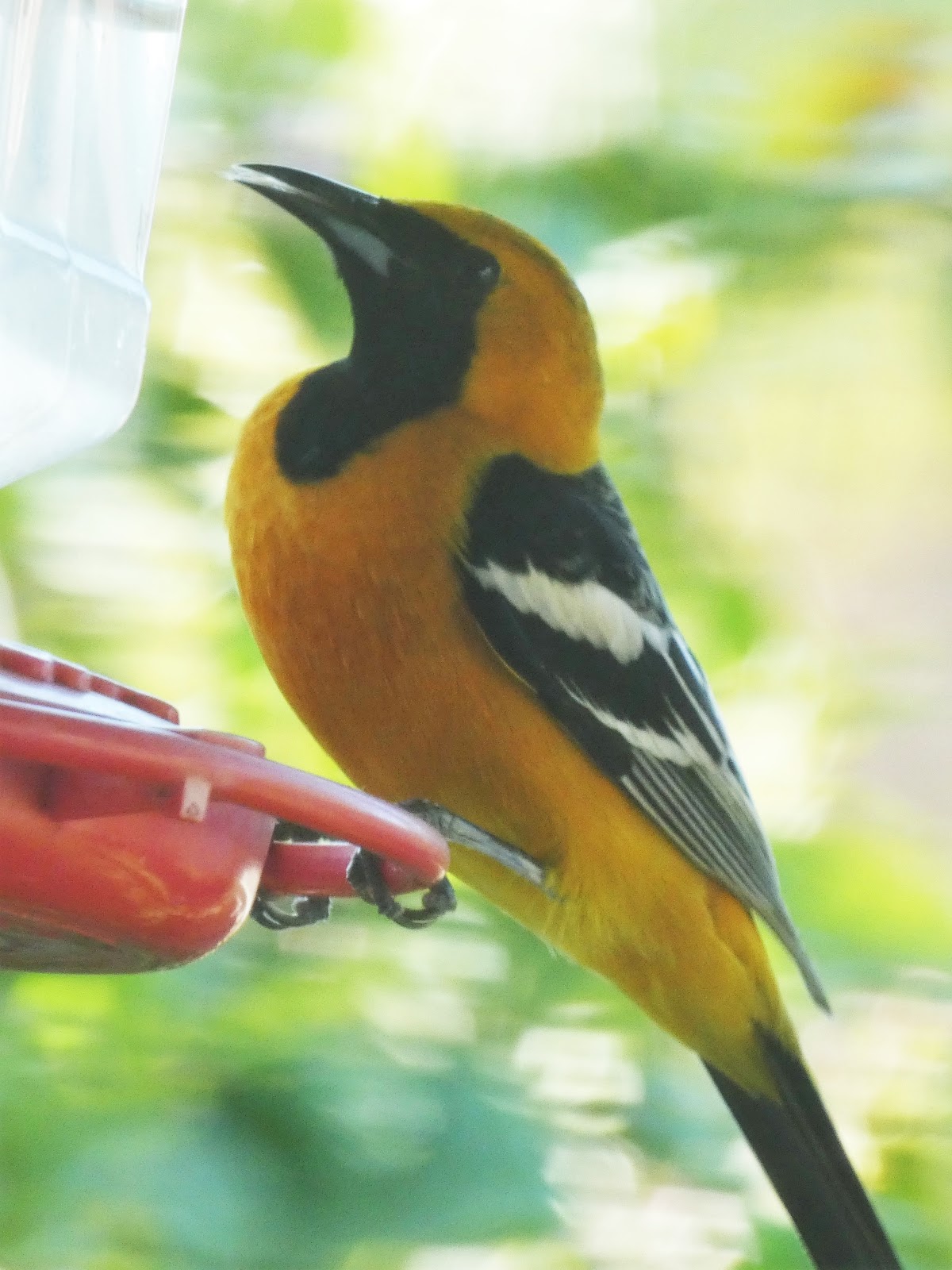
So this year I've been watching the palms along my walking route (sometimes to the consternation of the homeowners), hoping to see the nest-building process and following the progress of any of the young. I have been watching carefully. With patience. With unceasing vigilance. And nothing. But then earlier this week I happened to glance at the hummingbird feeder in our backyard, and right there, 10 feet away, was a male Hooded Oriole posing for a picture. I called Mrs. Geotripper, and struggled to unpack my camera, but in the end the picture below is all I got to document the sighting, only the third or fourth in the county so far this spring.
And that is why the second sighting this morning down on the river trail was a bit more satisfying than the first one. I only got the one fairly sharp shot, but it was enough. The bird seems to have some nesting material in its mouth, and I saw it fly up towards the palm trees on the bluff where they nested the previous year. I can bet that I'll be watching more carefully in coming weeks!

ADDENDUM: Not two hours after posting this I was pulling weeds in the yard and sat to rest for a few moments. In perhaps 20 minutes I saw the Hooded Oriole twice. I got a fuzzy shot, but I have hopes now for better. Apparently this Oriole is in our yard more often than I thought.